-
-
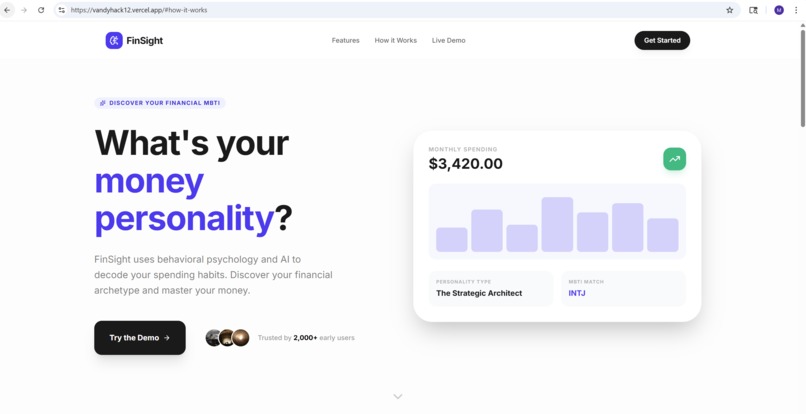
Smarter insights. Better habits. Stronger finances.
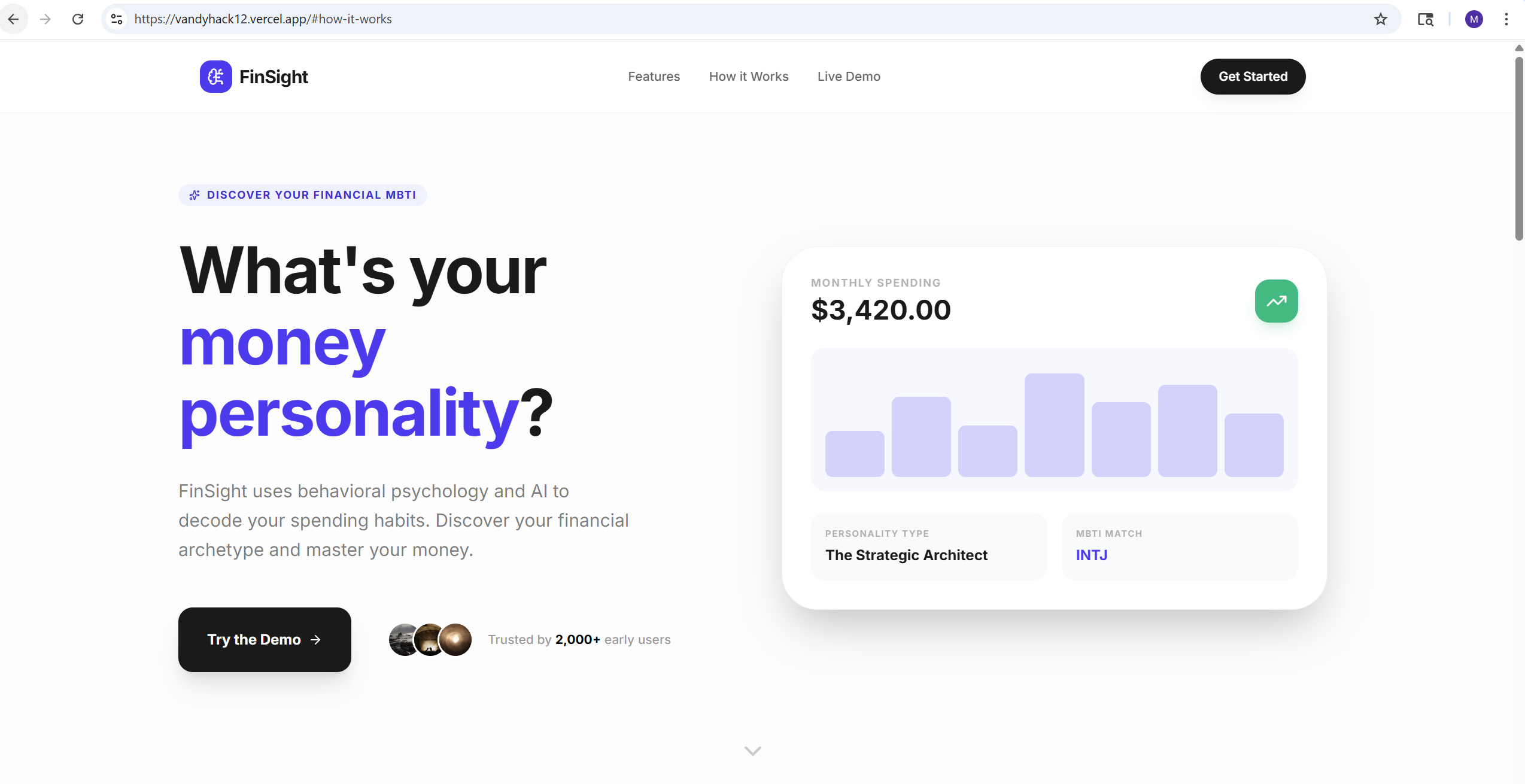
FinSight
Inspiration
When meeting new people, we often use frameworks like MBTI to quickly understand how they think and behave. This idea inspired us to ask: what if we could understand financial behavior the same way?
Today, most people don’t struggle with accessing financial data — they struggle with interpreting it. Bank statements are cluttered, overwhelming, and lack meaningful guidance. As a result, many users overspend without fully understanding why.
We wanted to bridge that gap by transforming raw transaction data into something intuitive, behavioral, and actionable.
What We Built
FinSight Assistant is an AI-powered fintech application that analyzes transaction data to uncover spending patterns, identify behavioral tendencies, and provide actionable recommendations.
Instead of simply tracking expenses, FinSight:
- Classifies a user’s financial personality
- Explains the why behind spending habits
- Suggests targeted interventions to improve financial behavior
For example, if a user frequently makes small purchases, FinSight may identify a high-frequency spending pattern and recommend introducing a delay before purchases or setting a weekly cap.
How We Built It
We built FinSight using a modern full-stack architecture:
- Frontend: React + Vite for a fast, responsive interface
- Backend: Vercel serverless functions to securely handle API requests
- AI Engine: Google Gemini API for natural language insights
- Styling: TailwindCSS for clean, minimal UI design
We designed a pipeline where:
- Users input transaction data
- The backend processes and formats the data
- Gemini generates insights based on behavioral patterns
- The frontend presents results in a clear, user-friendly format
Mathematically, we think of spending patterns as a function:
$$ Behavior = f(Transaction\ Frequency,\ Category\ Distribution,\ Spending\ Variance) $$
This allows us to map raw financial data to interpretable behavioral outputs.
What We Learned
Through this project, we learned:
- How to integrate AI models into real-world applications
- The importance of secure API handling (moving from frontend to backend)
- How to design systems that prioritize user understanding over raw data
- The value of combining behavioral psychology with technology
We also gained experience working with serverless architectures and deploying scalable applications using Vercel.
Challenges We Faced
One of the biggest challenges was ensuring that sensitive API keys were not exposed. Initially, our AI calls were handled on the frontend, which posed a security risk. We resolved this by moving all AI interactions to a backend serverless function.
Another challenge was structuring AI outputs in a way that felt useful and actionable rather than generic. This required careful prompt design and iteration to ensure the responses were meaningful.
We also had to align branding and user experience across the app to ensure consistency and clarity, especially for a live demo environment.
Impact & Future Vision
FinSight is more than a financial tracker — it’s a behavioral guide.
Our goal is to help users:
- Understand their spending habits
- Make better financial decisions
- Build long-term financial discipline
In the future, we plan to:
- Integrate with real-time banking APIs
- Add budgeting and forecasting tools
- Provide proactive alerts before overspending occurs
- Develop a more personalized financial coaching system
Conclusion
FinSight transforms financial data into meaningful decisions.
By combining AI with behavioral insights, we aim to empower users not just to see their money — but to truly understand it.

Log in or sign up for Devpost to join the conversation.