-
-
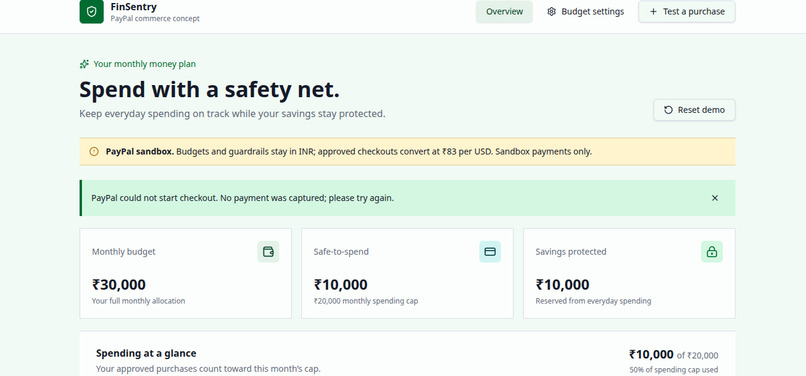
Dashboard
-
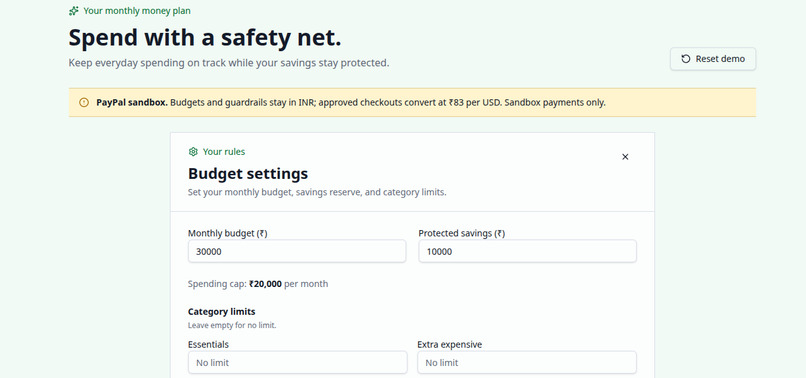
Limit Setting
-
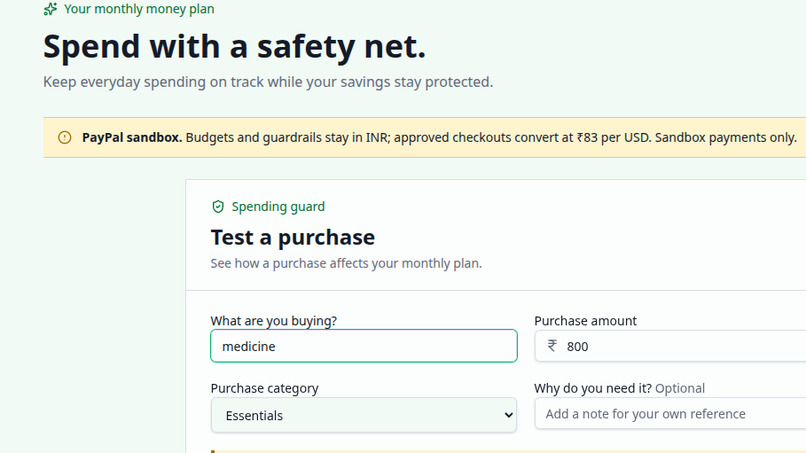
Payment Window
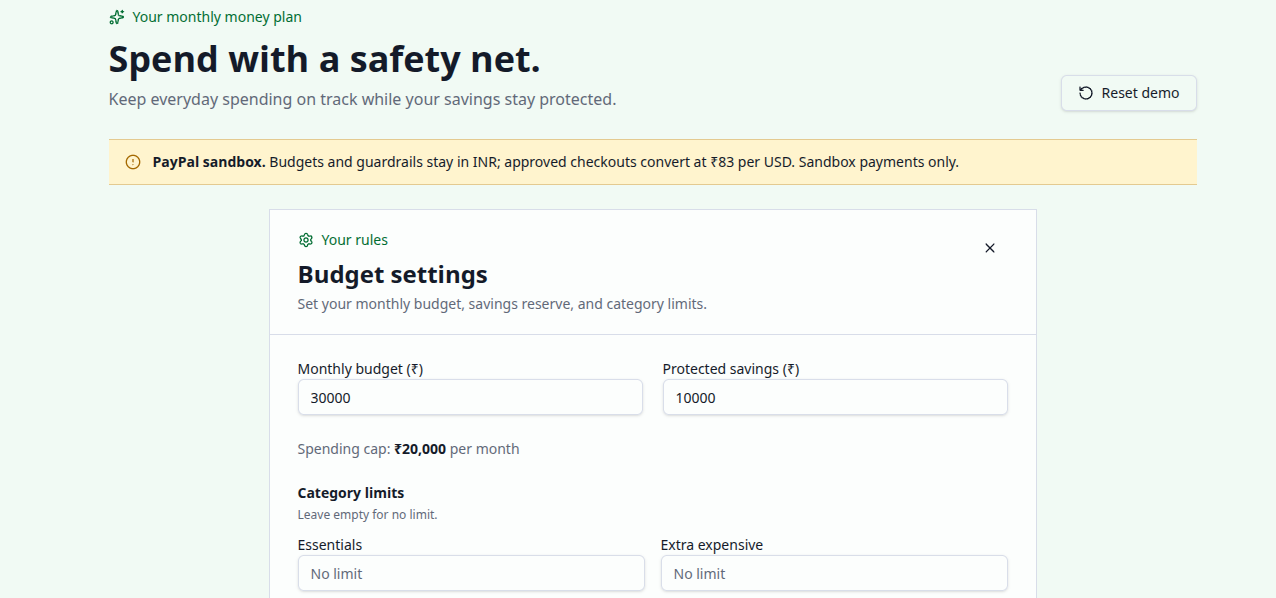
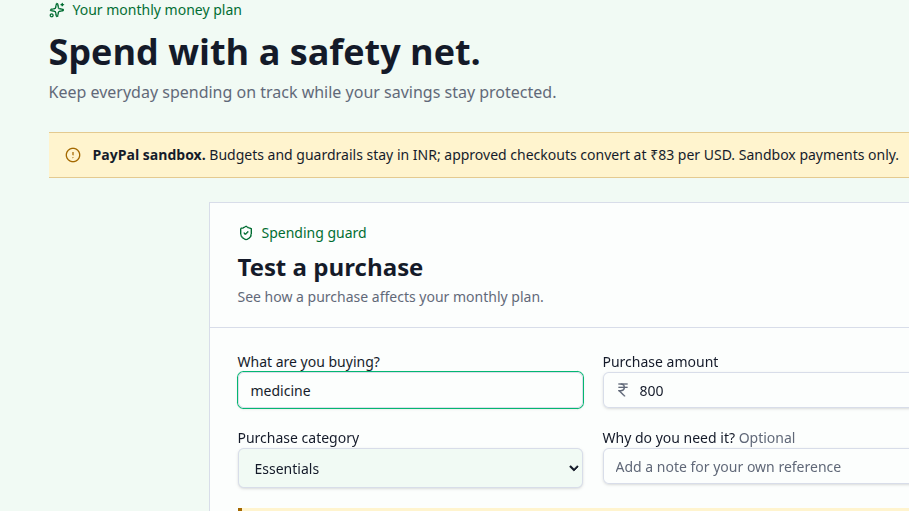
Inspiration As a college student, I manage a monthly budget of ₹30,000. On paper, it seems like plenty to cover my expenses and still build up a decent savings buffer.
In reality, money slips away in small, frictionless payments. A coffee here, a food delivery order there, grocery runs, printer fees, and stationery costs. Because every digital transaction is quick and painless, I'd go through the month feeling like I had plenty in my pocket—only to look at my bank account on day 30 and realize I hadn't saved a single rupee.
Traditional budget apps didn't fix this. They only sent me an alert after I had already overspent, showing me a colorful pie chart of my bad financial decisions when it was already too late to undo them.
I didn't need another passive tracker; I needed an active gatekeeper.
That experience inspired me to build FinSentry—an AI-powered financial sentry designed around the concept of Agentic Commerce.
Instead of watching me spend, FinSentry intercepts payments at the exact moment of checkout. It establishes a hard ₹20,000 spending cap for the month, automatically locking and safeguarding a ₹10,000 savings goal. When I try to buy something through PayPal, FinSentry’s AI agent evaluates the request in real time:
Impulse or non-essential buys that threaten to breach the ₹20,000 cap are instantly blocked before a single rupee leaves my account.
Essential emergency needs (like pharmacy runs or critical supplies) trigger a smart AI Emergency Override, allowing the checkout to proceed.
FinSentry changes the dynamic from post-spending regret to pre-checkout intervention, ensuring that no matter how hectic student life gets, my savings stay locked, protected, and untouched.
What it does
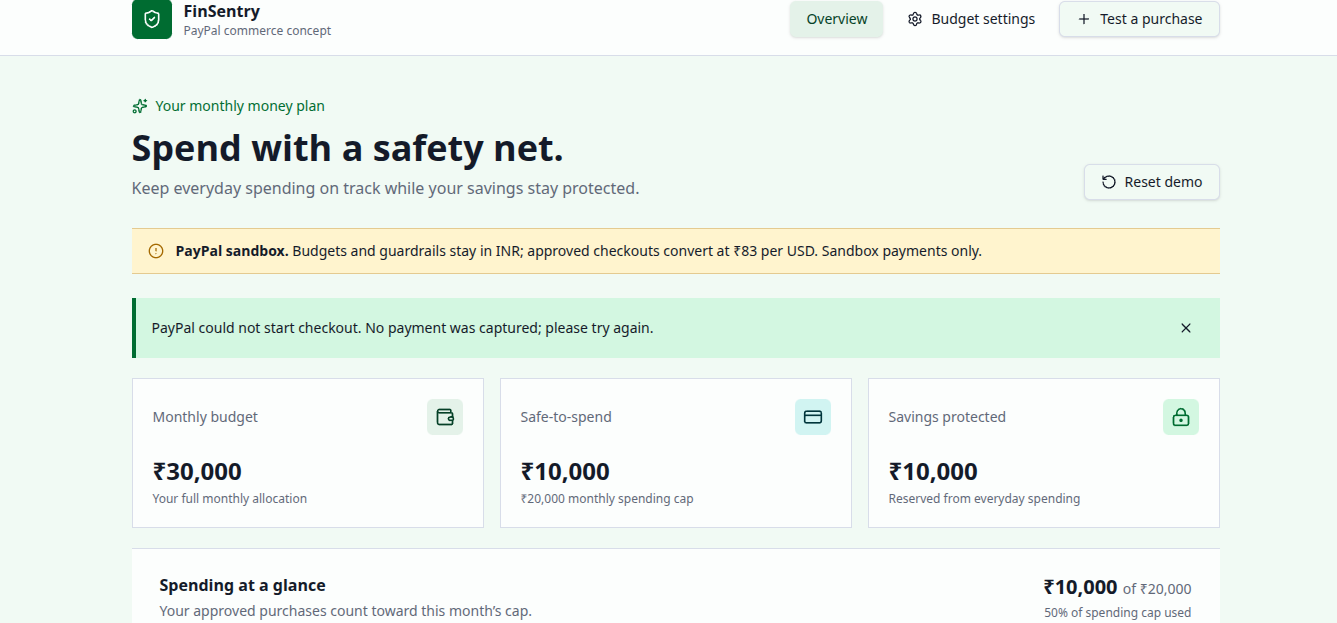
FinSentry is an AI-powered pre-transaction gatekeeper designed around the concept of Agentic Commerce. Operating on a monthly student budget of ₹30,000, FinSentry automatically enforces a hard ₹20,000 spending cap to isolate and safeguard a ₹10,000 locked savings goal.
Unlike passive budget tracking apps that issue delayed alerts after money has been spent, FinSentry actively intercepts checkout requests before payment processing occurs. When a transaction is initiated via PayPal: Impulse Purchases: Non-essential transactions that threaten to breach the ₹20,000 ceiling are blocked instantly, keeping the savings pool untouched. Emergency Overrides: Context-aware AI logic identifies critical categories (such as pharmacy or medical emergencies) and grants instant overrides even if spending thresholds are met.
How we built it
We built FinSentry as an end-to-end serverless web application using modern full-stack tools:
Frontend UI:Built and designed in Lovable using React, TypeScript, and Tailwind CSS to create a high-contrast, dark-mode financial dashboard featuring real-time budget utilization meters.
Backend & API Integration:Serverless Supabase Edge Functions handle API requests and secret management.
Payment Engine:Integrated with the PayPal Sandbox API (/v2/checkout/orders). When the AI gatekeeper approves a transaction, the Edge Function generates a secure PayPal checkout link (approval_url) for execution.
Rule & State Engine:Built-in TypeScript ledger logic tracks real-time expenditure against the ₹20,000 threshold and dynamically updates budget states.
Challenges we ran into
- Pre-Transaction Interception:Designing an agentic workflow that cleanly intercepts user intent before creating a PayPal checkout order, rather than relying on post-payment webhooks.
- Sandbox API Authentication: Managing OAuth 2.0 token generation safely within serverless Edge Functions while protecting API Client IDs and Secrets.
- Context-Aware Override Logic:Balancing strict spending boundaries with safety mechanisms so that essential purchases (e.g., medical supplies) aren't incorrectly blocked.
Accomplishments that we're proud of
End-to-End Execution:Successfully integrating real-time AI approval logic directly with live PayPal Sandbox checkout flows. Zero-Friction UX:Creating an intuitive visual dashboard that clearly communicates spending limits, locked savings, and rejection reasons without confusing the user. True Agentic Commerce:Shifting the personal finance paradigm from post-spending regret to pre-checkout protection.
What we learned
Agentic Financial Flows:How to effectively design AI agents that act as active decision-makers within financial transactions rather than static data displays. PayPal API Architecture:Gained hands-on experience structuring PayPal Sandbox Order creation and handling OAuth 2.0 authentication flows within serverless environments. State Management in Edge Environments: Securing API credentials in cloud environments while keeping client-side state responsive.
What's next for FinSentry
LLM-Driven Context Parsing: Integrating natural language processing to evaluate complex user justifications (e.g., "Replacing broken laptop charger for exams") during override requests. Multi-Currency & Bank API Support:Expanding beyond Sandbox environments to support live regional payment gateways and open banking APIs. Automated Wealth Allocation:Automatically transferring the locked ₹10,000 savings pool into yield-bearing high-interest savings accounts or index funds at the end of every month.
Built With
- css
- react
- tailwind
- typescript
