-
-

FinSearch — because what you do should matter more than where you come from.
-
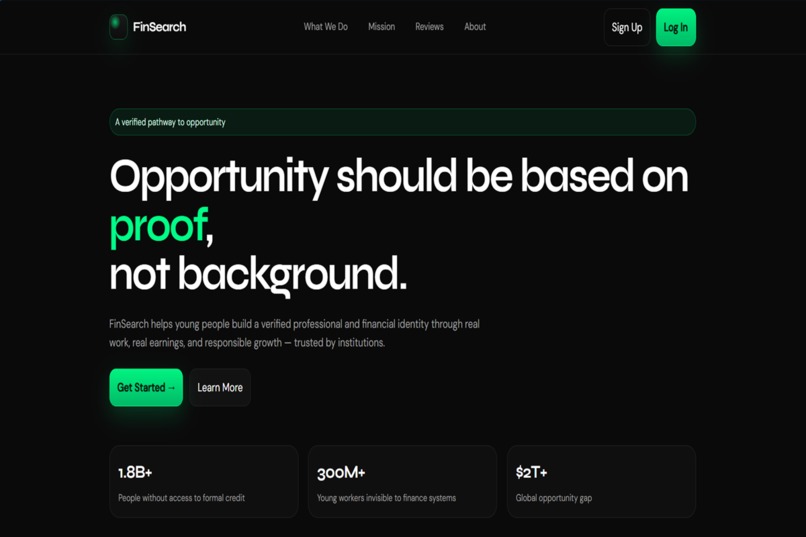
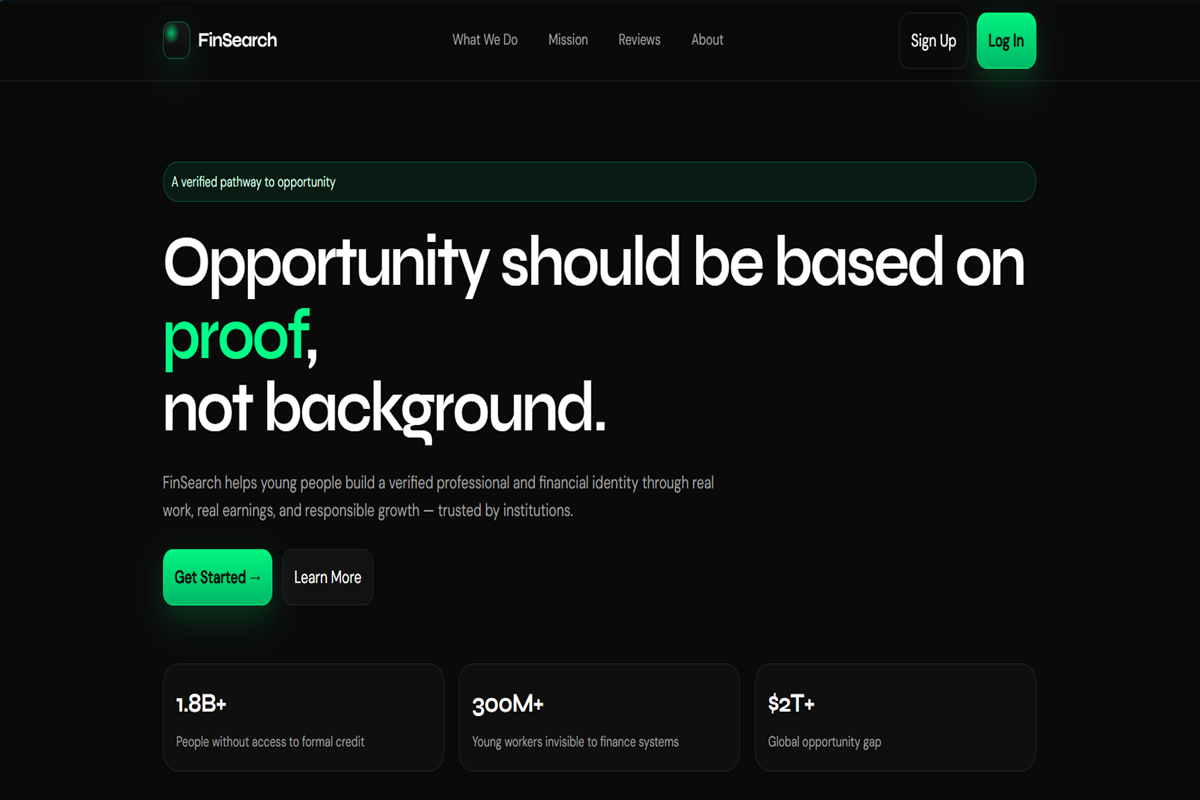
FinSearch home interface showing how opportunity is reframed around verified proof rather than background.
-
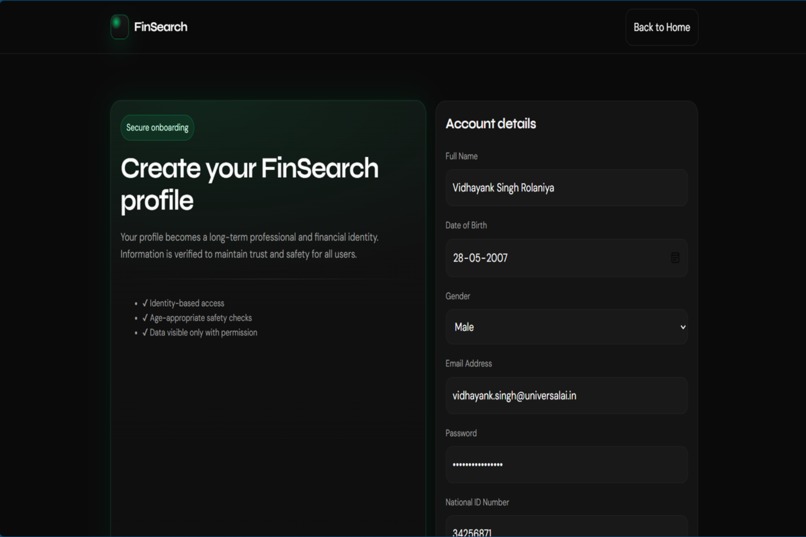
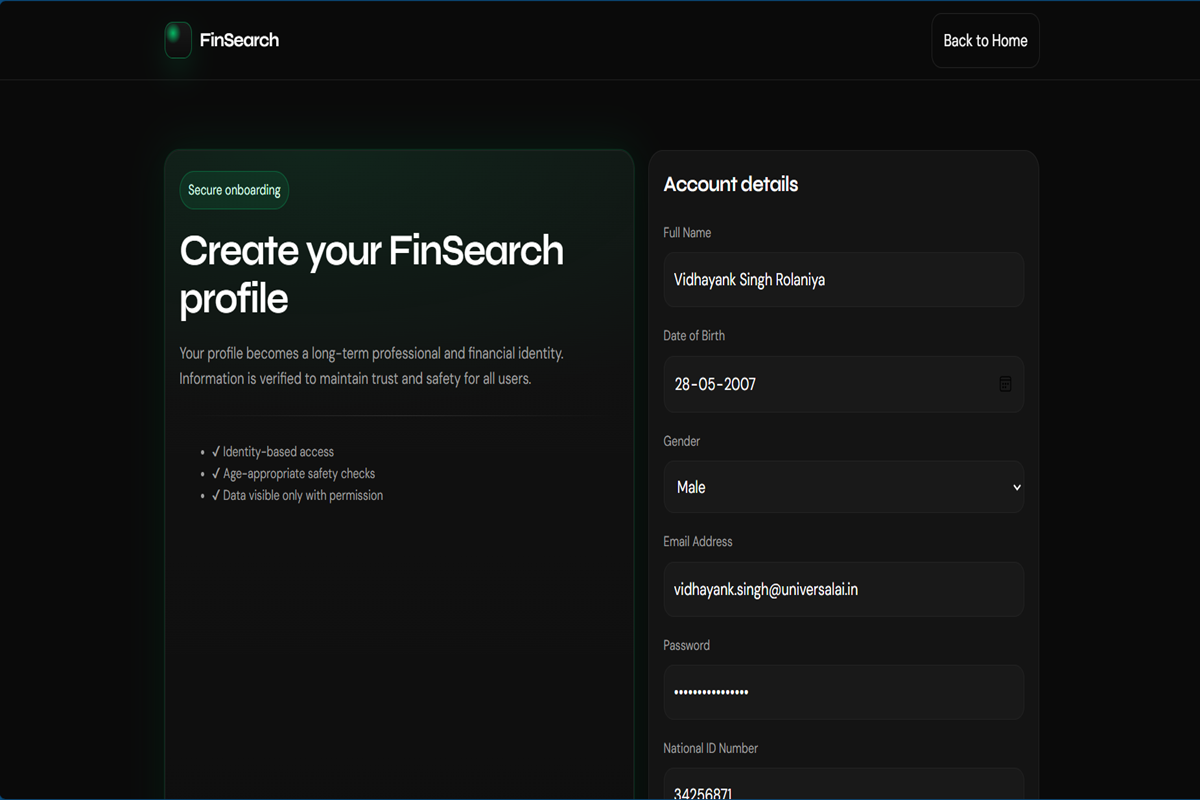
Secure onboarding flow showing how FinSearch verifies identity and creates a long-term professional and financial profile.
-
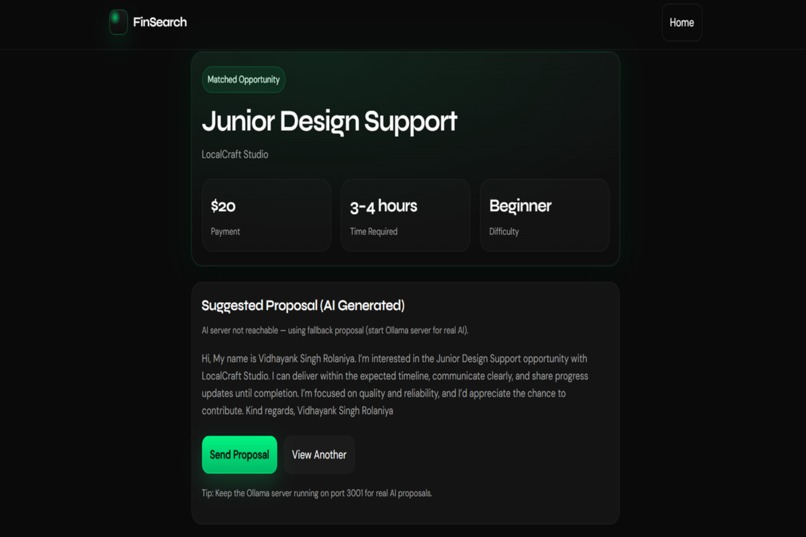
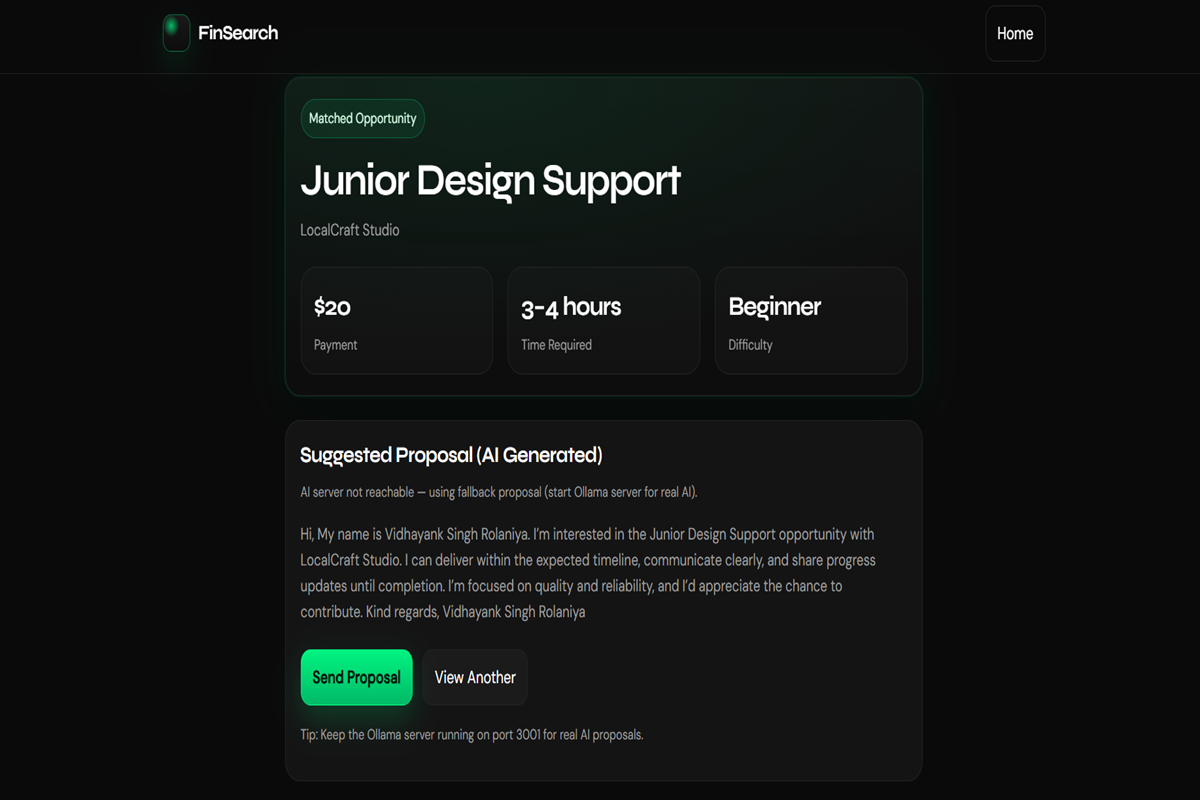
FinSearch matching engine recommending a beginner-friendly task and generating a professional proposal using an LLM.
-
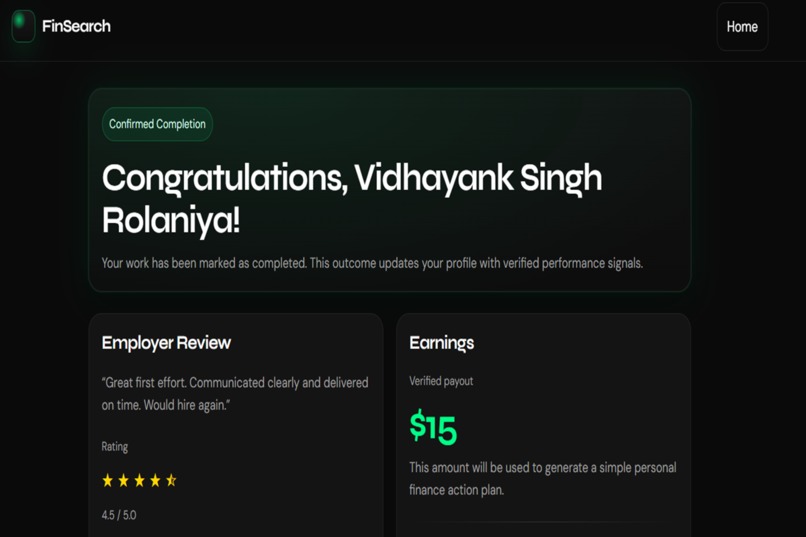
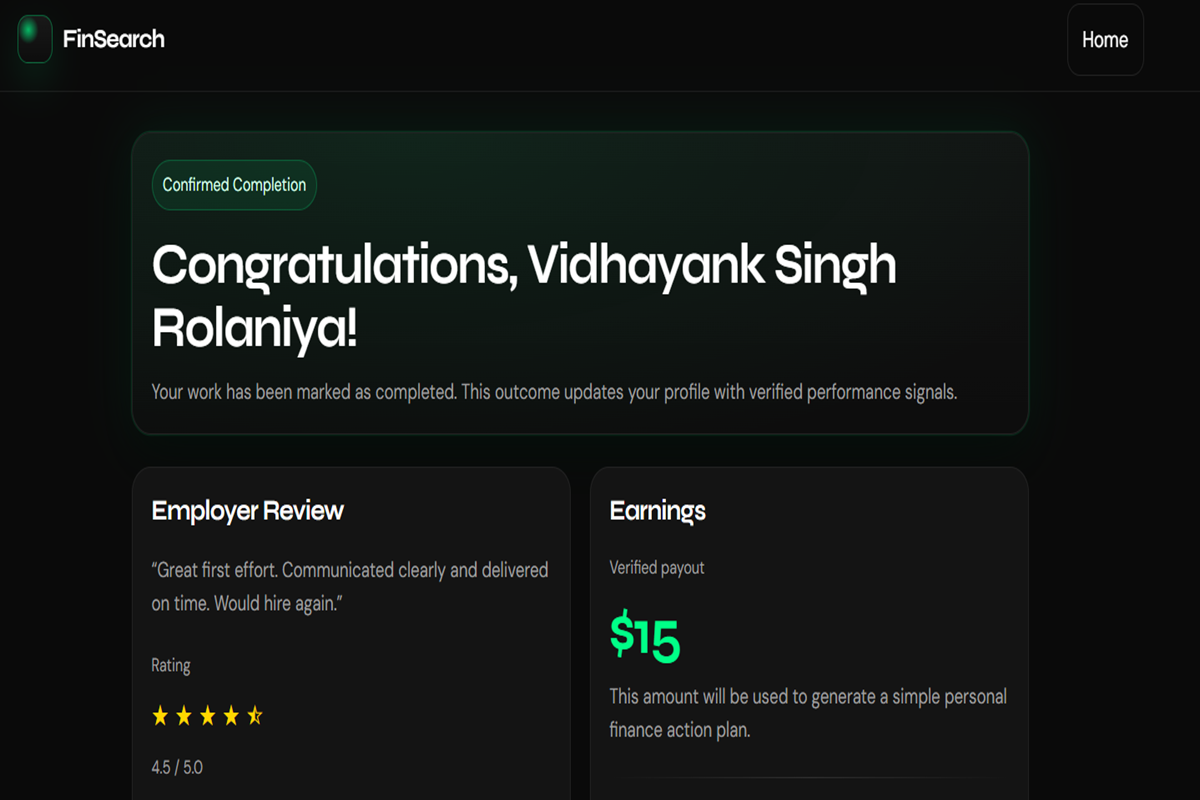
Verified job completion with employer review and confirmed earnings, converting real work into trusted performance data.
-
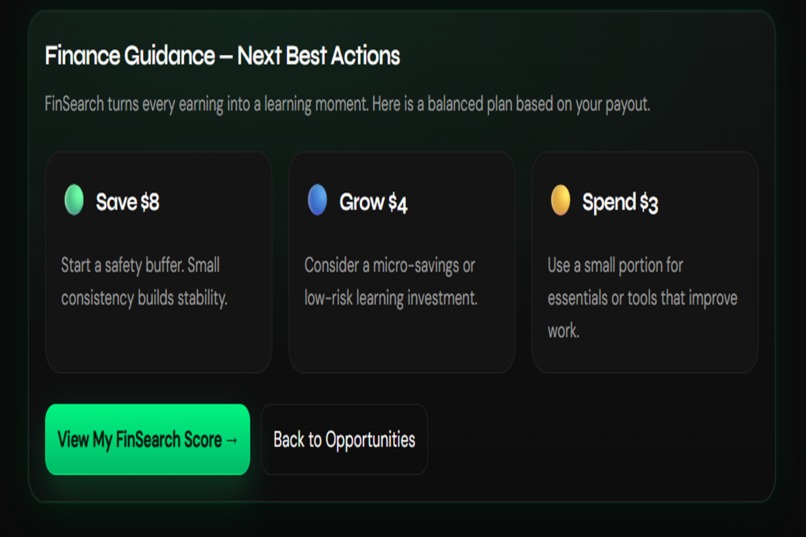
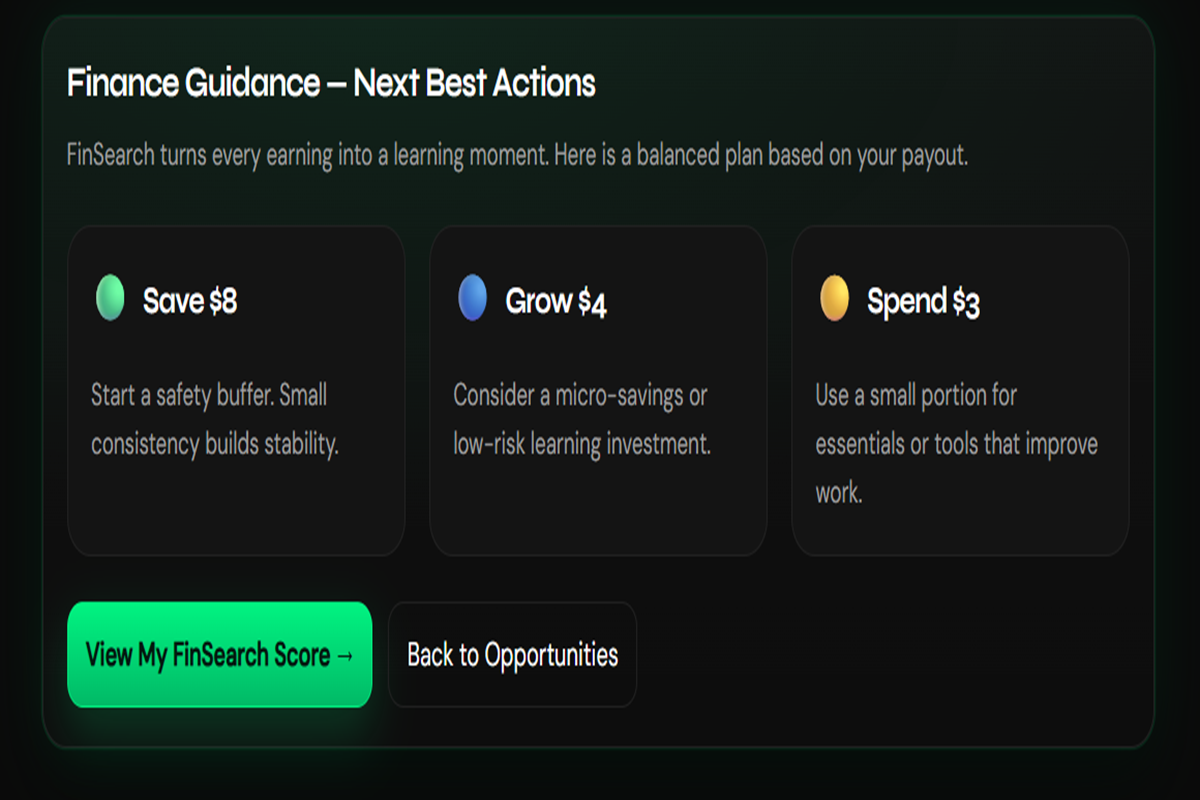
AI-driven financial guidance delivered immediately after earnings, helping users build responsible money habits from real income.
-
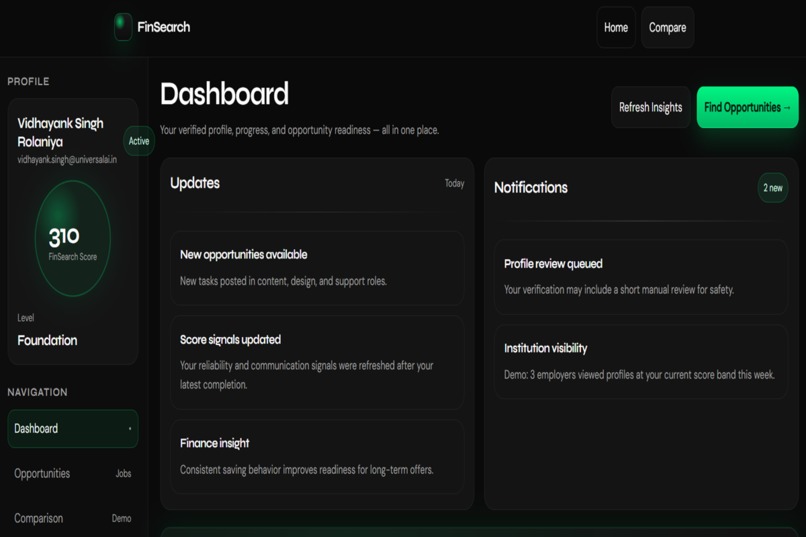
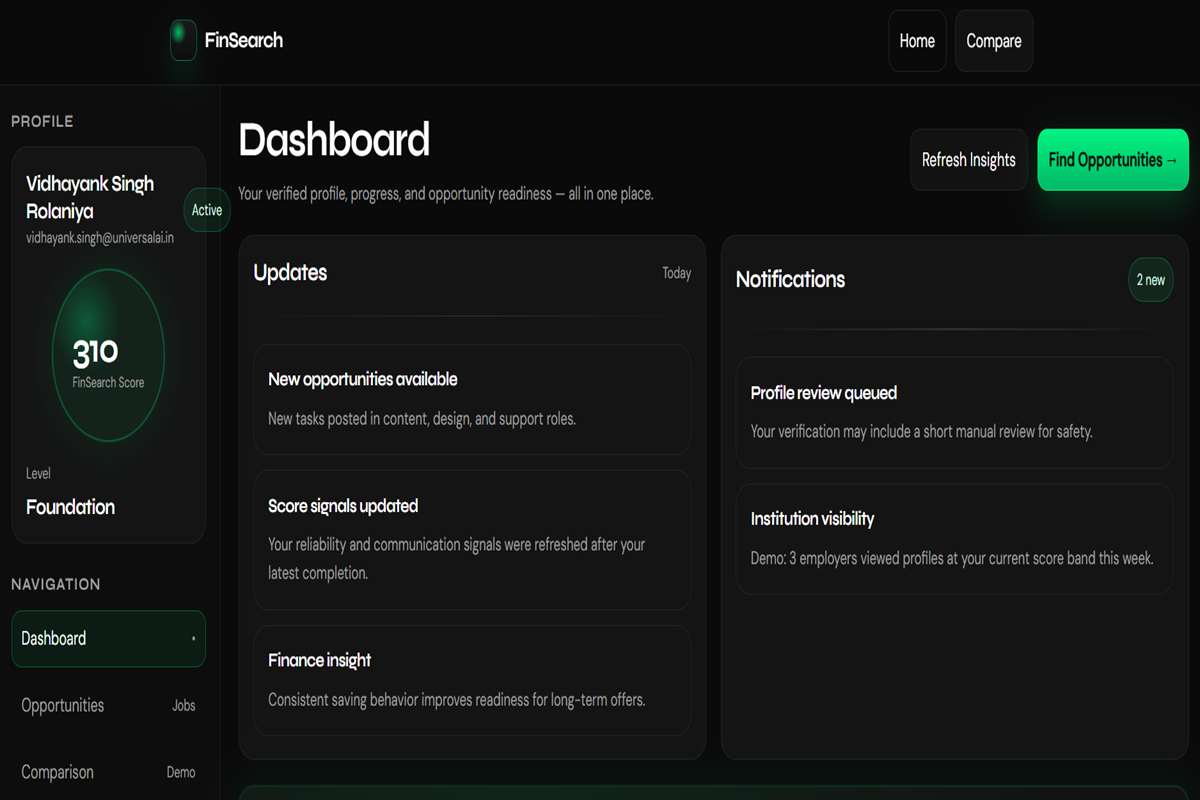
Unified dashboard translating verified work, financial behavior, and growth signals into opportunity readiness for institutions.
-
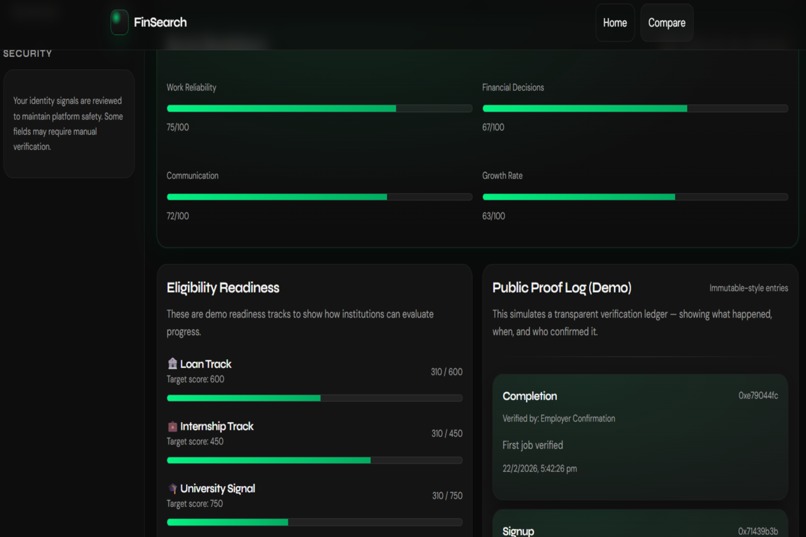
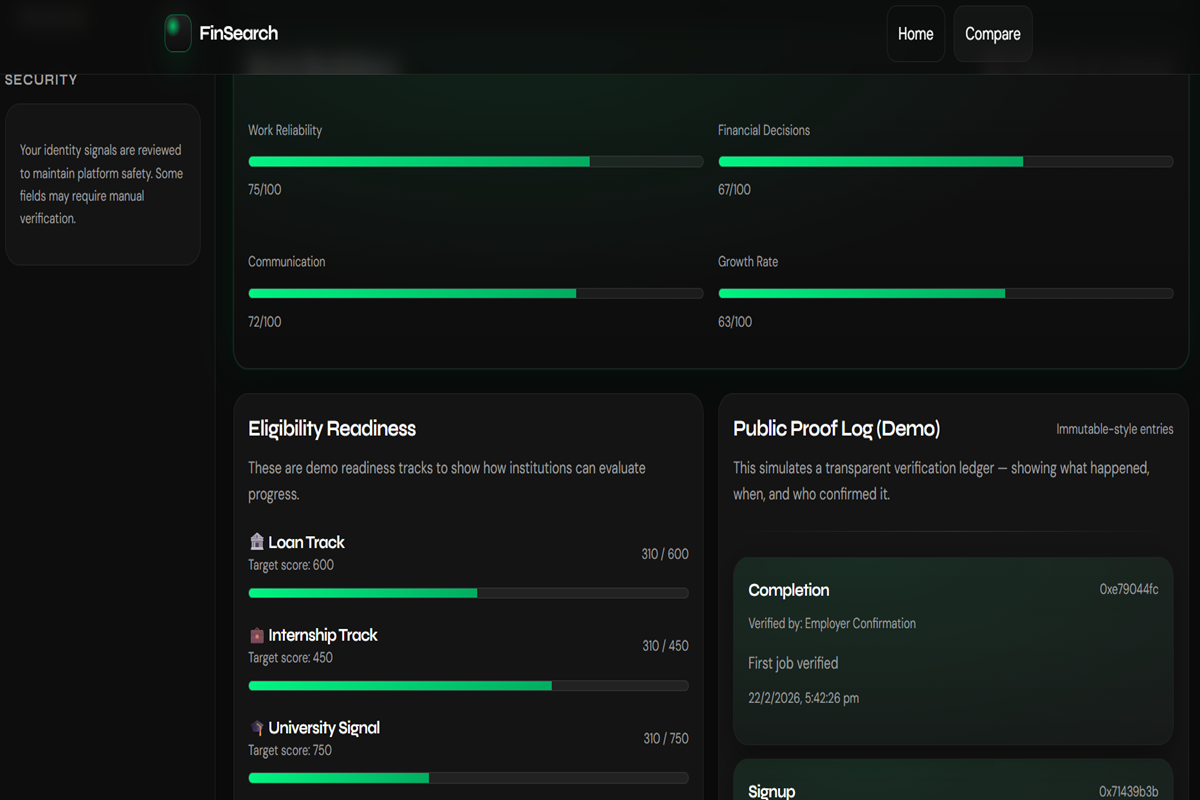
Multi-dimensional scoring system combining work reliability, financial behavior, and growth rate with a transparent verification log.
-
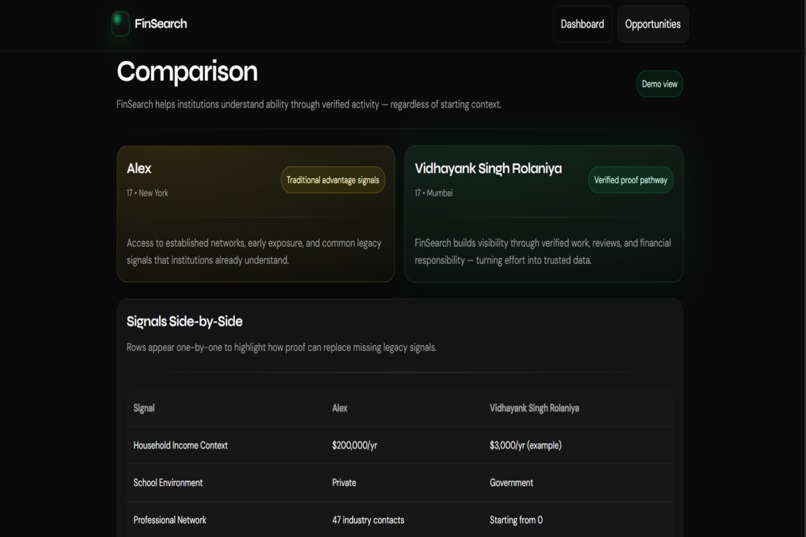
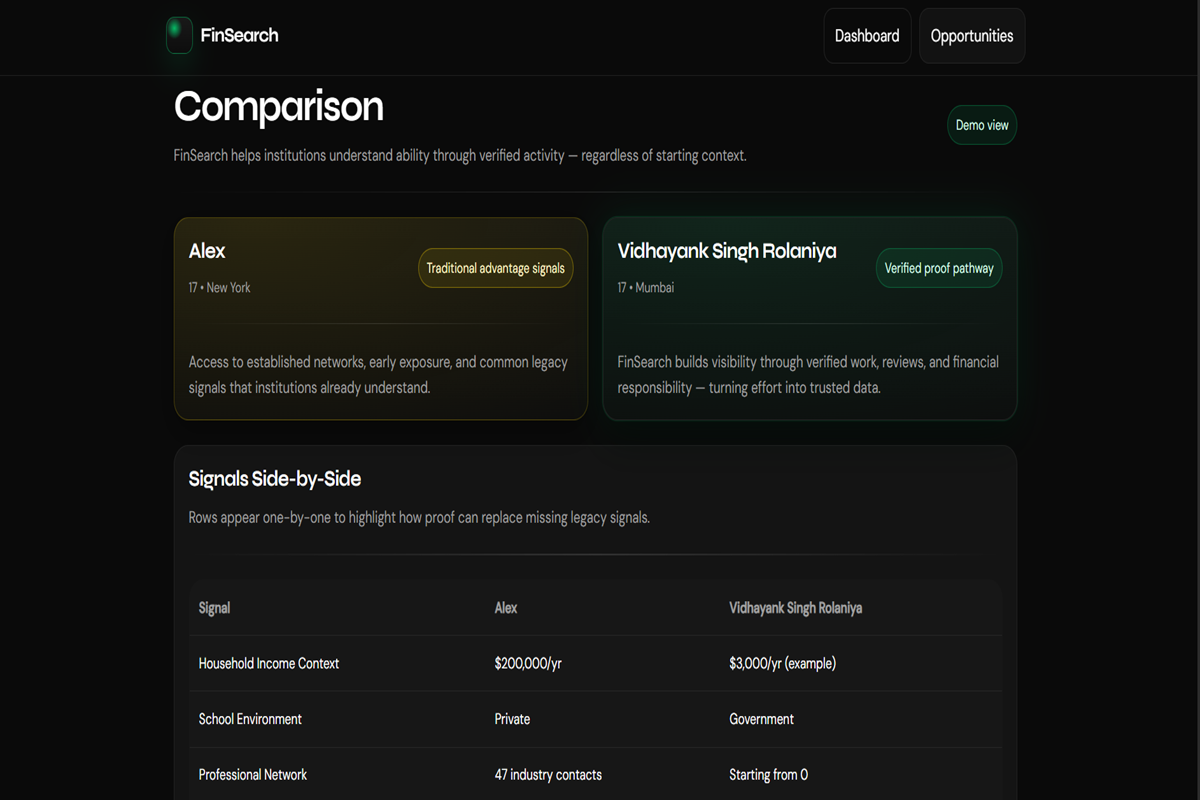
Comparison view showing how FinSearch allows different starting contexts to be evaluated through the same proof-based signals.
-
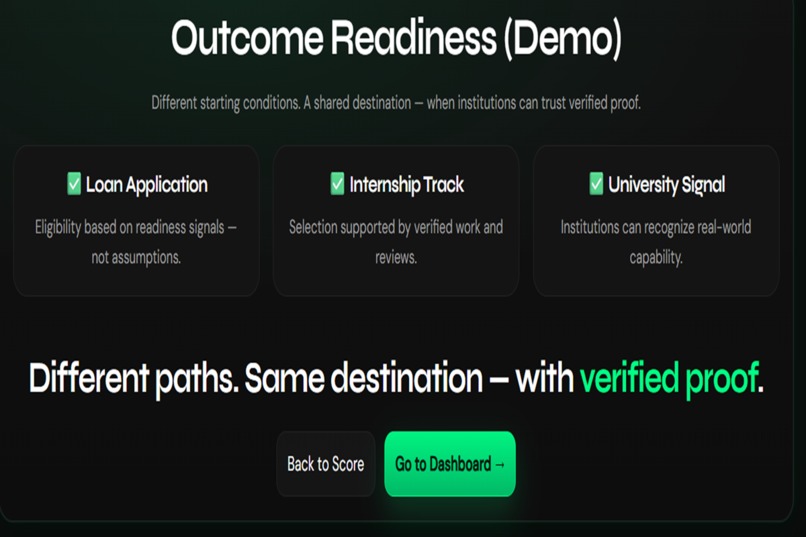
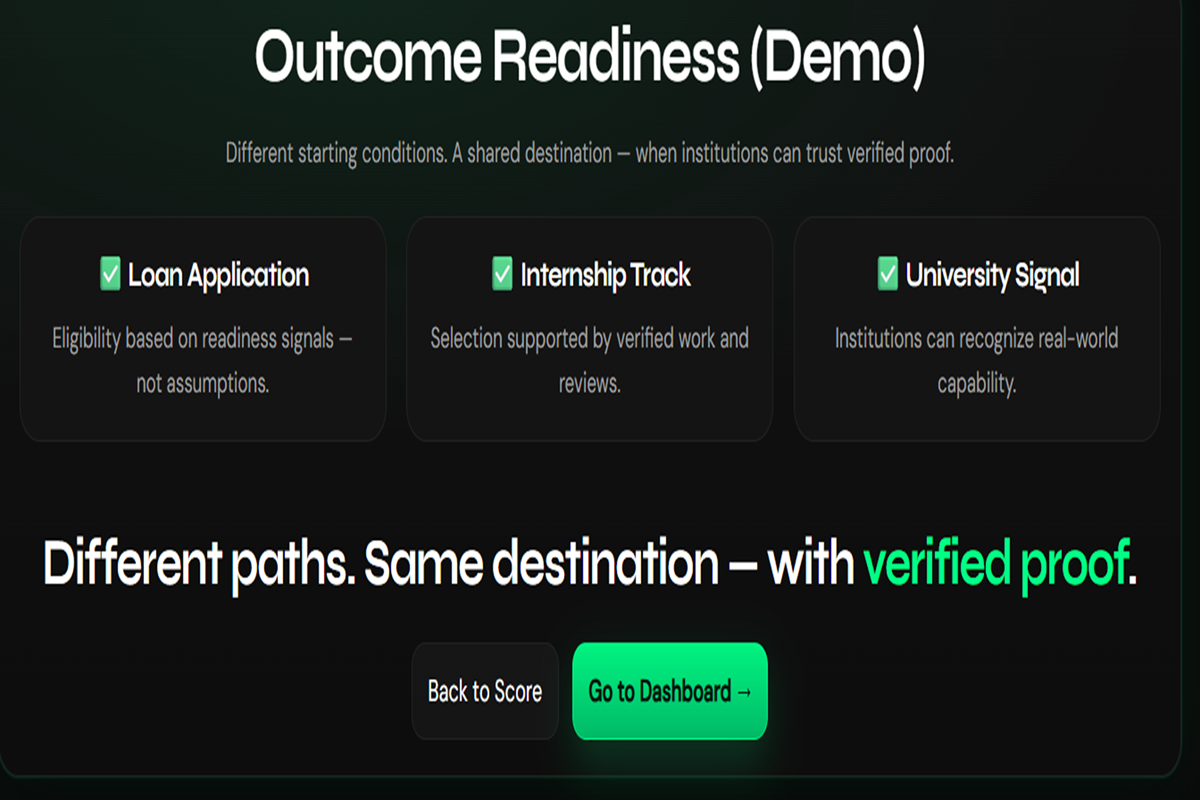
Final readiness screen demonstrating how different paths can lead to the same opportunities when proof is trusted.

Inspiration
We were inspired by a personal and uncomfortable realization: many systems that decide a person’s future are built around where someone comes from, not what they have actually done.
As teenagers, most people are never taught how real work happens or how money actually works. Some grow up with access and exposure, others grow up without it—but in both cases, effort and responsibility are rarely recorded in a way institutions can trust.
For capable young people without early access, opportunity becomes invisible—not because of a lack of talent, but because there is no accepted way to create proof. We wanted to explore a different approach: what if real work, real effort, and real responsibility could become the foundation of trust?
That question led to FinSearch.
What it does
FinSearch is a platform that helps underage teens and young adults build a verified professional and financial identity through real work.
Users are matched to real, skill-based opportunities, assisted by AI in writing professional proposals, and guided through completing tasks and earning income. Each verified action contributes to a long-term score that reflects reliability, growth, communication, and financial behavior.
Instead of replacing existing systems, FinSearch creates a new trust layer that institutions—such as employers, banks, and universities—can understand and build on using real-world data.
How we built it
This project was built as a full front-end prototype to demonstrate the complete user journey from first task to first trusted signal.
- Frontend: HTML, CSS, and vanilla JavaScript for a clean, business-grade user experience
- State handling: Local storage to simulate identity, scores, and progression
- AI integration: A local LLM using Ollama, connected through a lightweight Node.js server, to generate professional job proposals in real time
- Architecture: Modular pages representing onboarding, opportunity matching, job completion, score reveal, dashboards, and comparison views
The focus was not on feature quantity, but on clearly demonstrating the core loop end-to-end.
Challenges we faced
One of the biggest challenges was designing a system that felt serious and credible, not gamified or exaggerated.
We also had to balance emotional impact with a professional tone, especially when addressing topics like youth access, trust, and long-term financial identity. Integrating AI in a way that was real and demonstrable—without adding unnecessary complexity—was another key challenge.
Finally, we spent significant time refining the narrative so that the product, demo, and pitch all communicated the same underlying idea.
What we learned
We learned that many large-scale problems in finance and education are not caused by a lack of talent, but by a lack of visibility.
We also learned that good technology alone is not enough—how you frame a problem, how responsibly you design systems, and how clearly you explain them matters just as much as the code itself.
Most importantly, we learned that even a focused demo can communicate a much larger vision when the core idea is clear and grounded in reality.
What’s next
This demo represents only the first step.
In the future, FinSearch could expand into:
- Deeper skill mapping and progression tracking across multiple domains
- FinSearch for employers to discover proven, reliable talent
- Direct integrations with banks, universities, and internship programs
- Stronger identity verification and age-appropriate safety mechanisms
- A long-term, portable trust score that evolves over decades
Our goal is not to predict potential, but to record it—and make opportunity more accessible through proof.


Log in or sign up for Devpost to join the conversation.