
Inspiration
College students are surrounded by financial jargon and generic advice. Most budgeting apps only show where your money went. They rarely tell you what to do next.
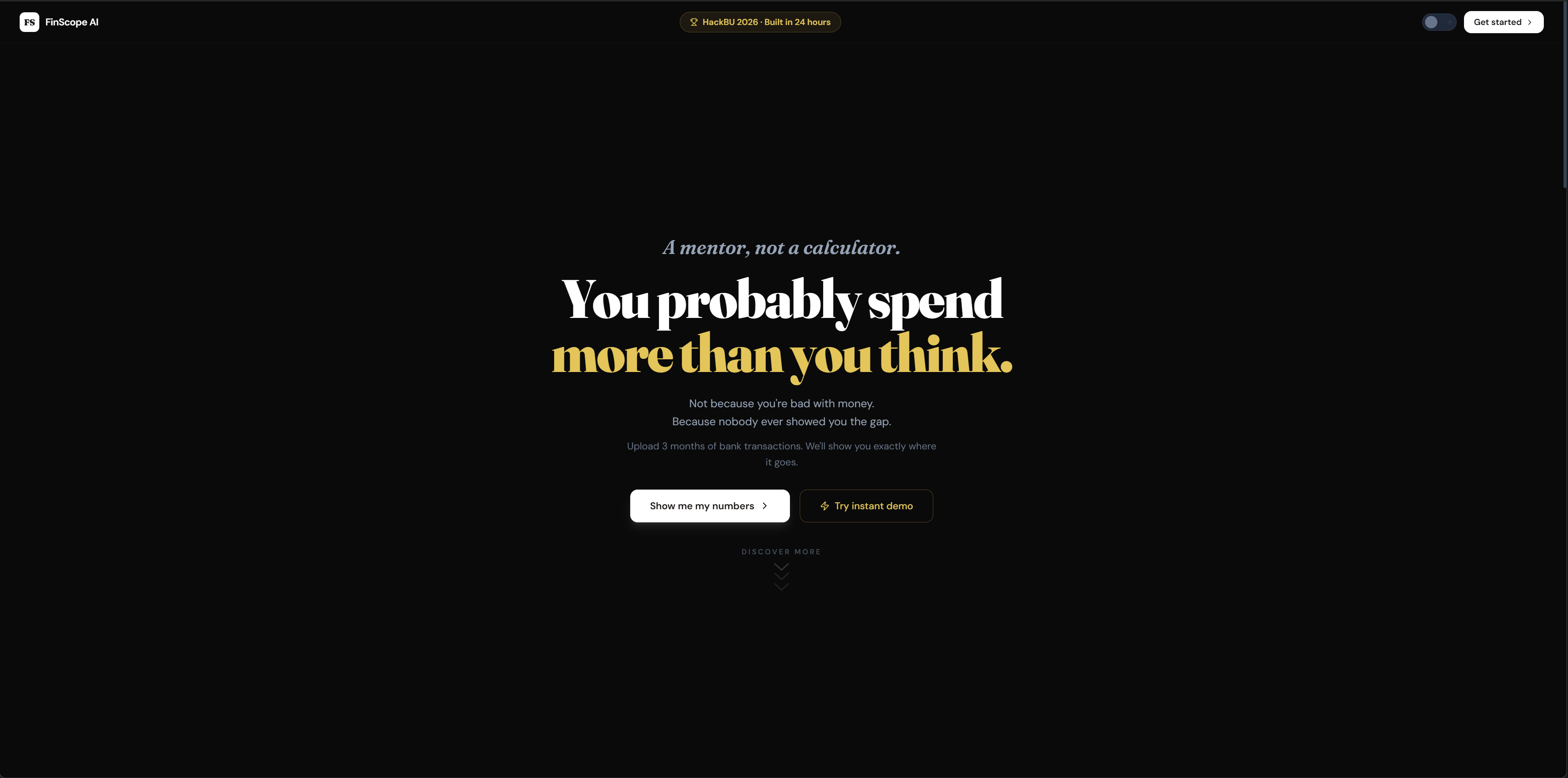
For many students, there is a big gap between what we think we spend and what we actually spend. You might believe you spend about $200 a month on food, but your bank statement tells a very different story. And when that realization hits, there is usually no one there to help you figure out what to do next.
We are three graduate students at Binghamton University who have lived this reality ourselves. We have navigated stipends, student loans, credit cards, and the constant question of whether we should even be thinking about investing yet. When we looked for tools to guide us, most of them felt like calculators instead of mentors.
So we built FinScope AI.
Our core belief is simple. The most valuable thing a financial mentor does is help you see the gap between what you think you do and what you actually do. Once that gap becomes clear, you can finally make a realistic plan and start moving forward with confidence.
What it does
FinScope AI is a personal finance mentoring web app designed specifically for college students.
Instead of just showing numbers, it helps students understand their financial habits and figure out what to do next.
Simple onboarding You start by answering a short questionnaire about your income, monthly expenses, loans, credit card balance, savings goals, risk tolerance, and time horizon. This helps the system understand how you currently think about your finances.
Upload your transactions Next, you upload a CSV or Excel export of your bank transactions, or try the app using sample data. FinScope AI automatically parses and categorizes every transaction so you can see where your money is really going.
Reveal the gap The platform compares what you believe you spend with what your bank statement actually shows. Categories are highlighted in red, amber, or green so you can instantly see where your expectations and reality differ.
Your financial dashboard You receive two readiness scores, Saving Readiness and Investment Readiness, each rated from 0 to 10. The dashboard also gives you a personalized explanation of your financial behavior, insights such as subscription creep or high credit utilization, and a clear 90-day action plan with realistic monthly targets.
Live investment watchlist You can follow beginner-friendly ETFs such as VTI, VOO, and SPY with real-time price updates so you can keep track of the investments we recommend.
Ask questions anytime If you have questions, just ask in plain English. The AI chat assistant pulls information from trusted sources such as CFPB, investor.gov, and OpenStax, and can also search the web when needed. Every answer includes clear citations so you know where the information comes from.
How we built it
FinScope AI is built around three core components that work together to deliver the experience. The backend handles all of the financial logic. It manages session state, processes uploaded bank transactions, categorizes spending, calculates financial readiness scores, and streams live ETF prices so the dashboard stays updated in real time. Alongside it, the AI service powers the intelligence of the platform. It retrieves trusted financial information, generates personalized explanations, and supports the chat assistant so students can ask questions about budgeting, debt, or investing in plain English. The frontend is a fast, modern web interface that connects these services and presents everything through a clean dashboard designed for simplicity and clarity.
A key design principle behind FinScope AI is that the financial guidance itself is not generated by AI. All scores and recommendations come from transparent, deterministic formulas. For example, the Saving Readiness Score combines signals such as emergency fund coverage, savings consistency, debt-to-income ratio, and income stability to produce a score from 0 to 10 that reflects how prepared someone is to build savings. The Investment Readiness Score builds on this foundation by incorporating factors like investable surplus, time horizon, and risk tolerance, while applying penalties when credit card debt is high. Because these calculations are rule-based, the system always produces consistent results.
The AI model is used only to translate those numbers into a human explanation. Once the scores and action plan are computed, the system asks the AI to convert them into a readable narrative, highlight behavioral insights, and explain the 90-day action plan. If the AI service fails for any reason, the system simply serves a fallback explanation generated directly from the same numbers. This ensures that the financial advice is always stable, transparent, and never hallucinated. To keep the system efficient, strategy results are cached using a secure hash of the user’s profile, so refreshing the dashboard instantly returns the same analysis without unnecessary recomputation or API usage.
Challenges we ran into
Getting the gap analysis right. Mapping free-text bank transaction descriptions into meaningful spending categories (food, rent, subscriptions, etc.) required careful regex + keyword heuristics. Edge cases — Venmo, Cash App, payroll credits — took significant iteration.
LLM provider churn. We started with Binghamton's on-campus OpenWebUI/Llama 3.2 instance, moved to Anthropic Claude for quality, then settled on Google Gemini for the best cost/latency/output balance. The codebase still contains all three client modules as a result.
Real-time WebSocket reliability. Finnhub's free-tier WebSocket drops connections under low traffic. We built an HTTP polling fallback with exponential backoff on the frontend so the watchlist gracefully degrades rather than showing stale or missing prices.
In-memory session state. With no database, every server restart wipes sessions. This was an intentional scope decision for a hackathon, but it forced us to design the onboarding flow so a user can always re-enter their data quickly (and the "use sample data" path lets judges demo the full app without uploading real bank statements).
Keeping financial advice responsible. We scope every output to educational information only, with clear disclaimers that FinSight AI is not a licensed financial advisor. The RAG knowledge base sources are exclusively government (CFPB, investor.gov) and academic (OpenStax) materials — no random blog posts.
Accomplishments that we're proud of
Deterministic-first, LLM-second is the right pattern for anything involving numbers and trust. Users (and judges) need to know where the numbers come from. Hybrid RAG (local vector store + live web search) dramatically improves answer quality for concept questions without requiring a constantly updated knowledge base. Multi-service architectures on free-tier cloud require careful CORS, cold-start, and timeout management. Financial literacy gaps among our peers are real and significant — every beta tester was surprised by their Gap Reveal results.
What we learned
Building FinScope AI taught us that personal finance problems are rarely about math. They are about behavior and awareness. Many students believe they understand their spending habits, but when we compared their expectations with real transaction data, the gap was often significant. Designing a system that reveals this gap in a clear and constructive way turned out to be far more impactful than simply visualizing expenses.
We also learned that trust is essential when AI is involved in financial guidance. That is why we designed the system so that all financial scores and recommendations come from transparent, deterministic formulas, while the AI model is only responsible for explaining the results in a human-readable way. This architecture helped us avoid hallucinations and keep advice consistent.
From an engineering perspective, we learned the importance of separating concerns across services. Keeping the financial computation, AI intelligence, and frontend interface independent allowed us to move faster, debug more easily, and maintain a reliable system even when external APIs fail. It also reinforced how powerful modern web stacks can be when combining real-time data, AI retrieval, and clean user interfaces in a short development cycle.
Most importantly, we learned that tools for students need to feel like mentors rather than calculators. The best feedback we received was not about the technology, but about how the app helped users understand their financial habits for the first time.
What's next for FinScope AI
Our immediate goal is to improve the accuracy and usability of the system. We plan to expand transaction categorization, support direct bank integrations, and improve the behavioral insights so users receive more precise recommendations about spending patterns, subscriptions, and debt management.
We also want to deepen the mentoring aspect of the platform. Future versions will include adaptive financial coaching, smarter action plans that adjust as spending behavior changes, and scenario simulations so students can explore questions like “What happens if I pay down my credit card faster?” or “How much can I safely invest each month?”
On the technical side, we plan to expand the knowledge base behind the AI assistant by incorporating additional trusted financial education sources and improving retrieval quality. This will allow the chat system to provide clearer explanations and more contextual answers while still grounding every response in verifiable sources.
In the longer term, we see FinScope AI evolving into a financial guidance platform specifically built for early-career individuals. The goal is to help students transition from managing expenses to building long-term financial confidence, starting with their very first paycheck and continuing as their financial lives become more complex.
Built With
- apis
- beautiful-soup
- fastapi
- finnhub
- pandas
- python
- react
- tailwindcss
- typescript
- vite


Log in or sign up for Devpost to join the conversation.