Inspiration
Responding to the HackPSU Fall 2026 FNB Challenge—focused on helping people turn information into understanding, understanding into confidence, and confidence into action—we set out to fix a common flaw in personal finance tools: overwhelming users with raw numbers without providing context for future decisions. Most budgeting apps present static retrospectives, leaving users unsure if they can safely make a large purchase or take on a new bill. We built a streamlined platform that bridges raw bank data with dynamic decision-making.
What it does
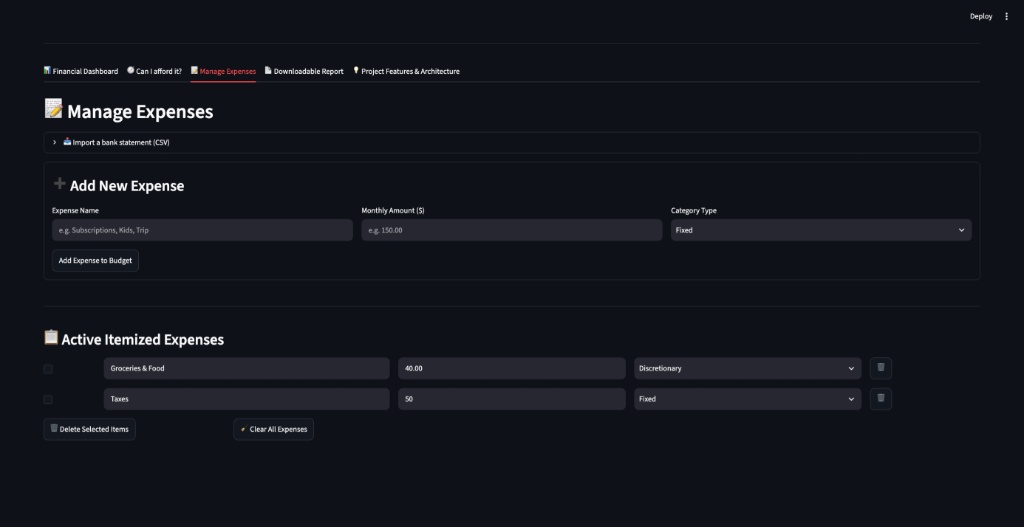
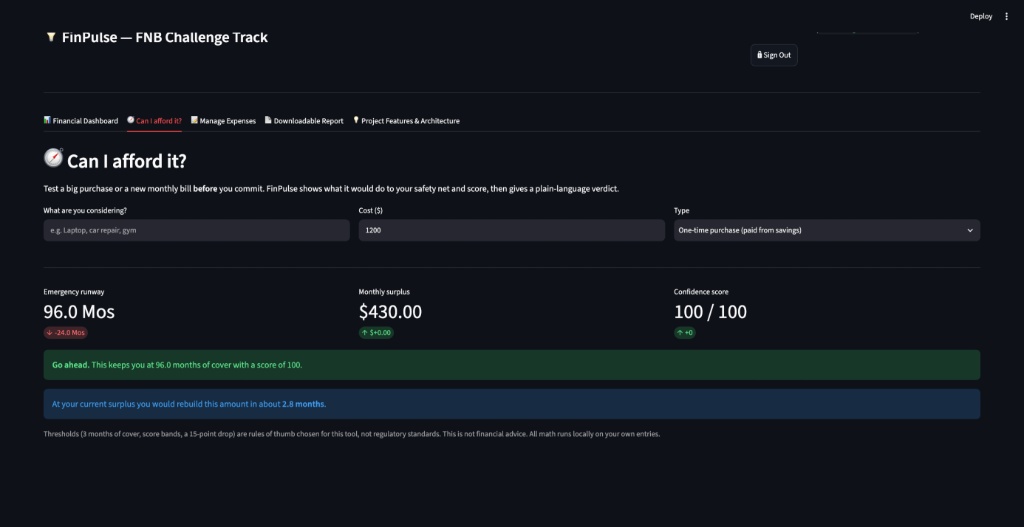
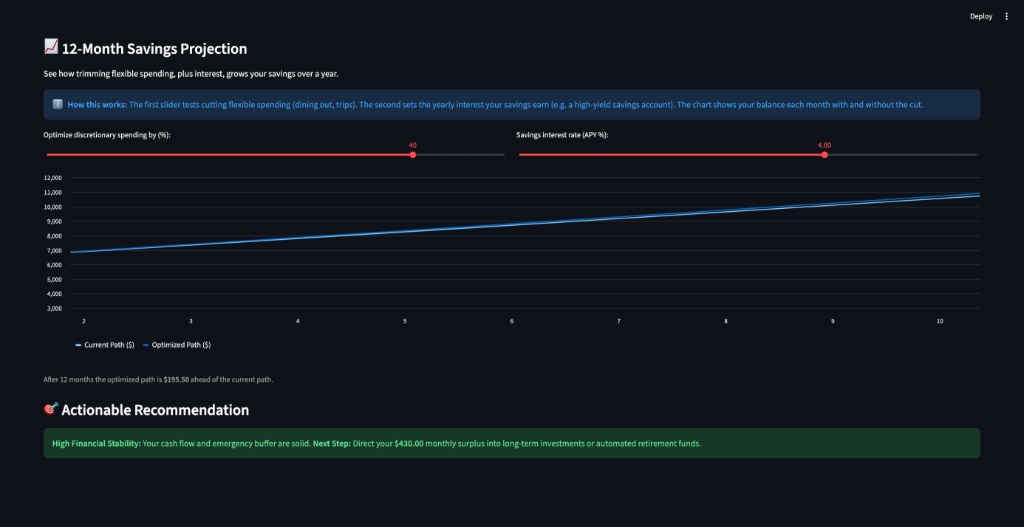
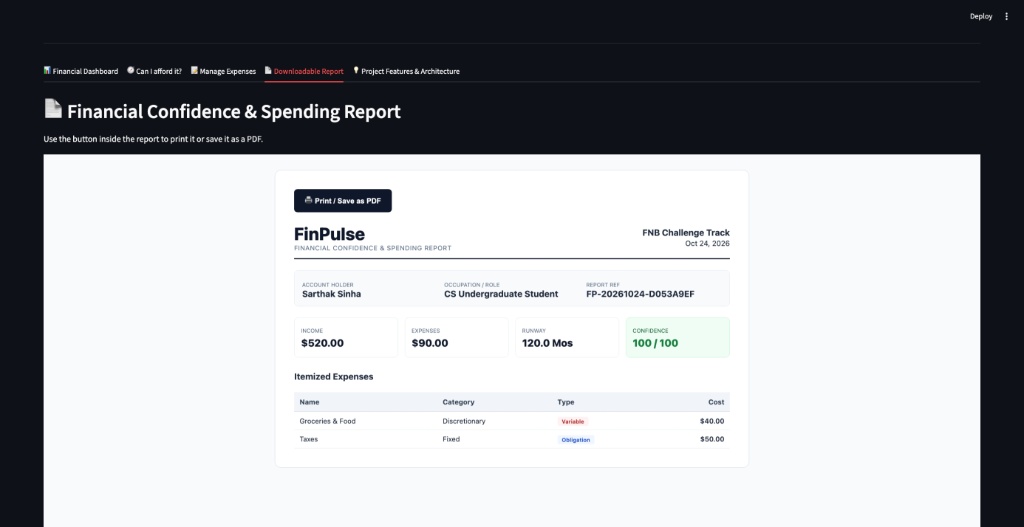
Built with Streamlit, SQLite, and pandas, our application features user authentication via salted PBKDF2 password hashing, a core financial health score, and a new "Can I afford it?" decision engine. The health score assigns 40 points for emergency runway and 60 points for savings rate—a deliberate design choice to encourage safety buffers. The "Can I afford it?" tab evaluates one-time purchases or new monthly recurring expenses against runway, monthly surplus, and overall score, rendering an instant verdict: "Go ahead," "Tighten up," or "Hold off." Users can also import bank statements using a deterministic CSV keyword parser and run 12-month compound growth projections via an APY slider.
How we built it
We developed the application using Python, leveraging Streamlit for the front end, SQLite for persistent storage, and pandas for transaction processing and math evaluation. During development, we used Gemini and Claude as coding assistants to accelerate development, while ensuring the production application operates entirely locally without embedded generative-AI APIs.
Challenges
Designing deterministic rule thresholds for the "Can I afford it?" engine required balancing multiple variables (such as checking for 3 months of runway cover, score drops, and net surplus changes) so that the feedback feels intuitive across different purchase tiers. Structuring the pandas CSV parser to handle varied statement layouts without AI dependencies also required rigorous boundary testing.
Accomplishments
We delivered a fully functional web application featuring local database authentication, CSV statement processing, compound savings modeling, and an interactive purchase-feasibility simulator that directly turns financial data into clear actions.
What we learned
We deepened our expertise in managing state across multi-tab Streamlit applications, building transparent rule-based financial evaluation algorithms, and structuring relational database queries efficiently.
What's next
Future plans include multi-account aggregation, customizable spending category thresholds, and automated recurring bill detection.
Impact
Financial uncertainty prevents many individuals from making major life purchases with confidence. According to Bankrate's 2026 Emergency Savings Report, only 46% of Americans have enough savings to cover three months of living expenses. Furthermore, the FINRA Foundation’s National Financial Capability Study highlights that 63% of adults feel anxious when thinking about their personal finances. By evaluating purchases against specific rule-of-thumb thresholds—like preserving 3 months of runway—our application turns static data into actionable confidence.


Log in or sign up for Devpost to join the conversation.