-
-
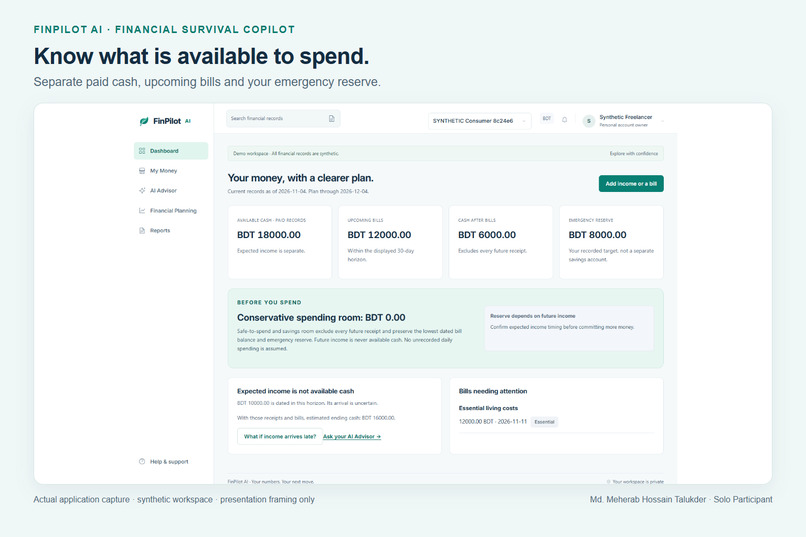
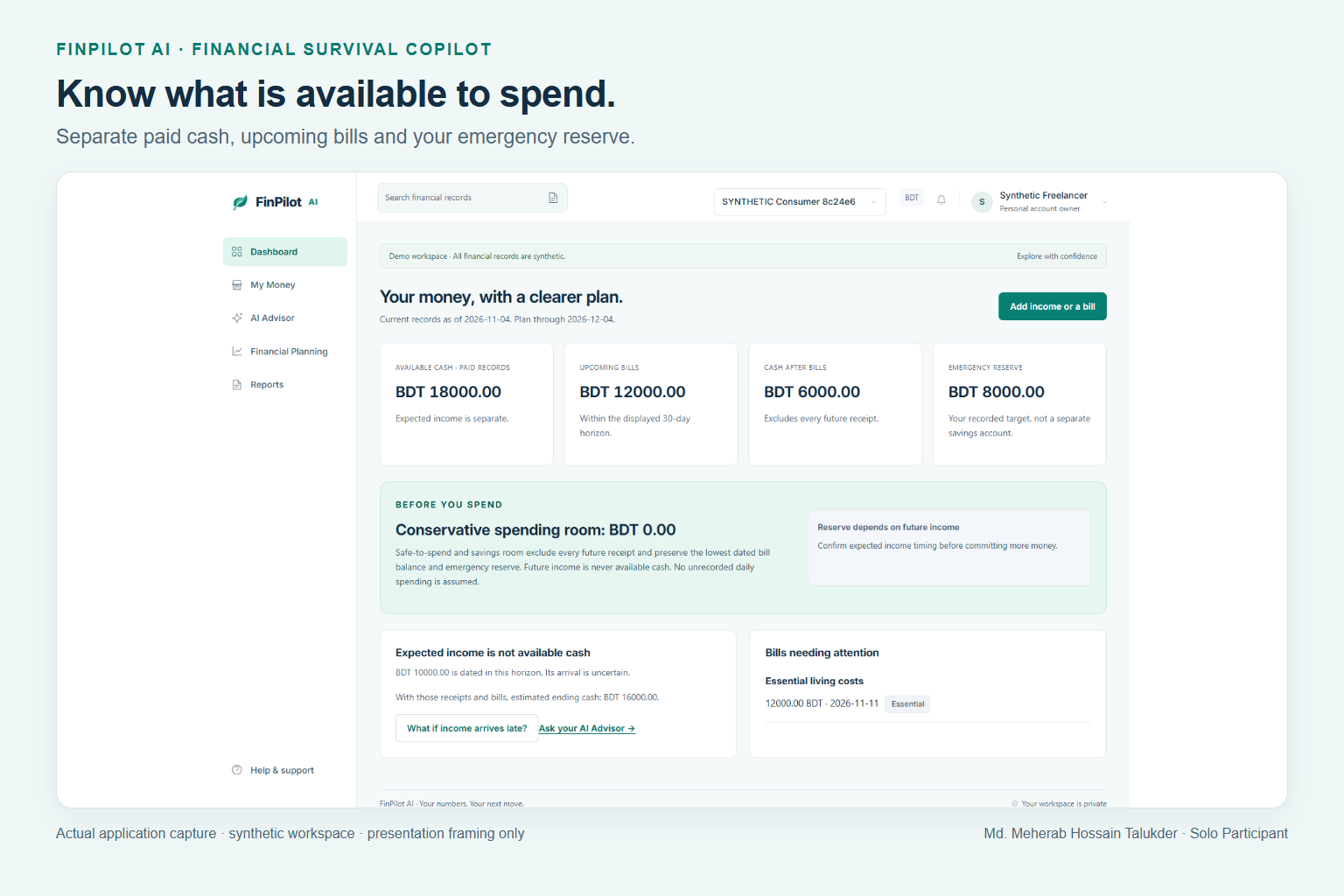
Personal Dashboard — Cash, Bills & Emergency Reserve
-
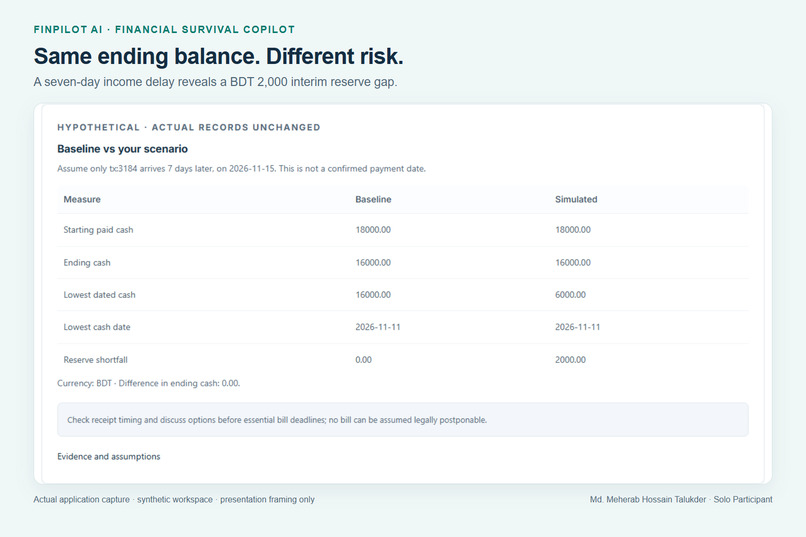
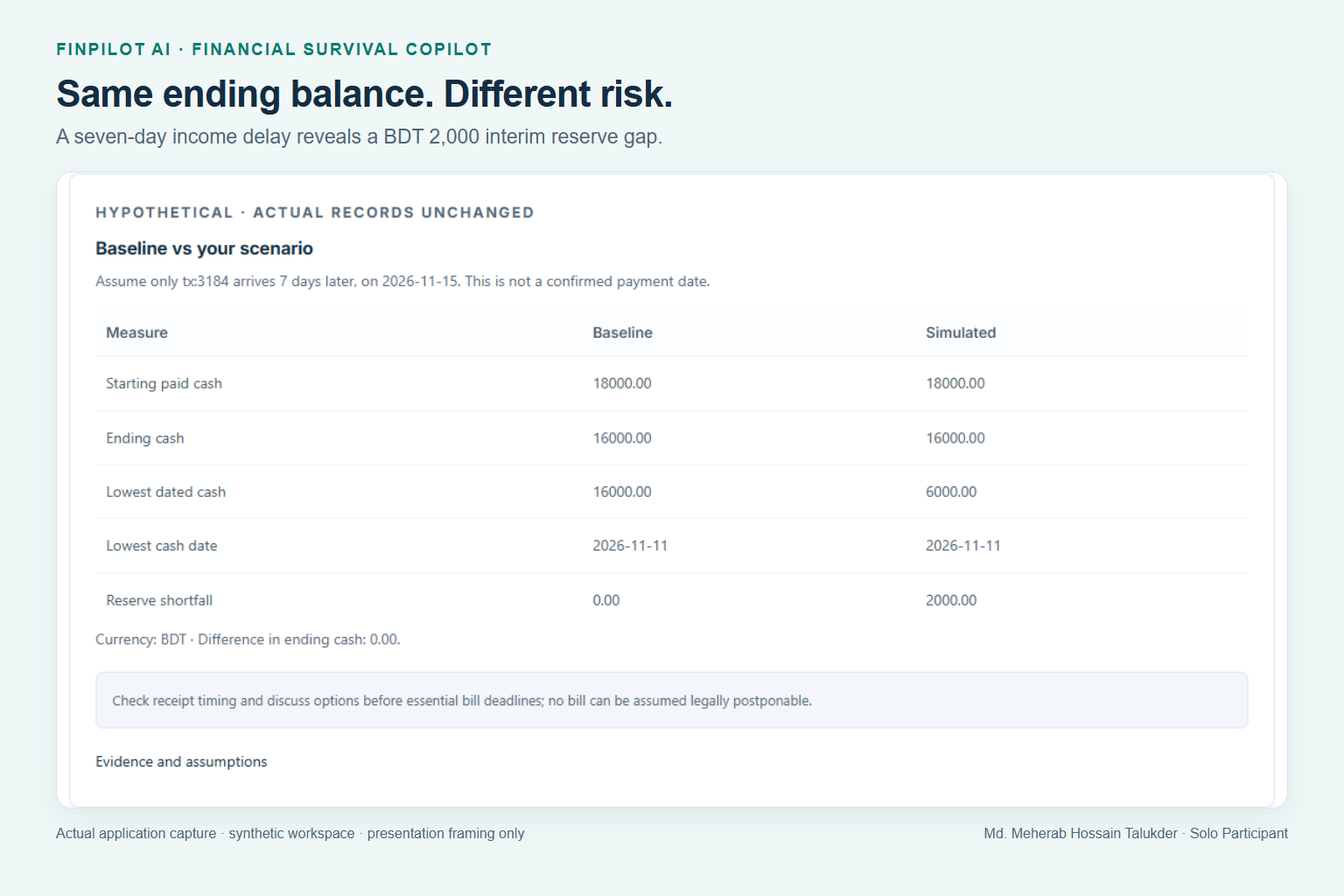
Scenario Planning — Impact of a 7-Day Income Delay
-
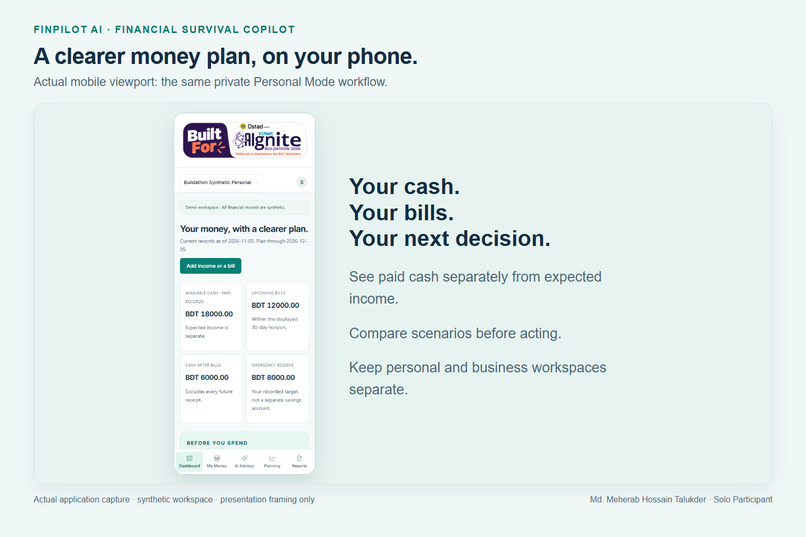
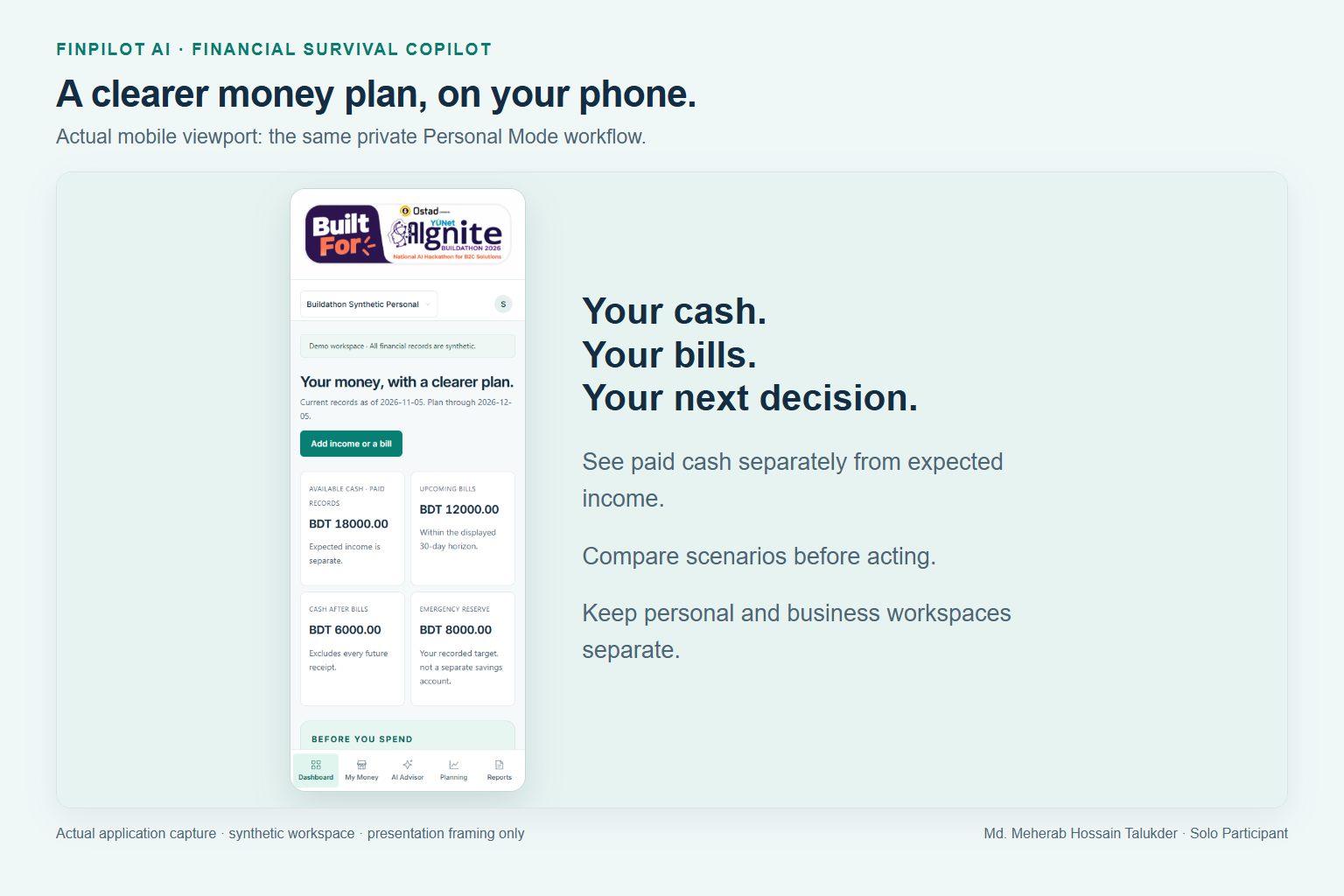
Mobile View — Personal Finance on the Go
-
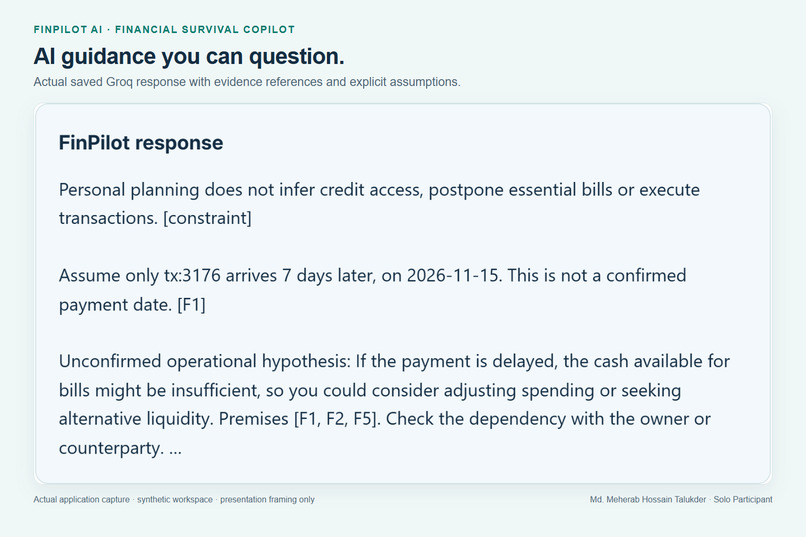
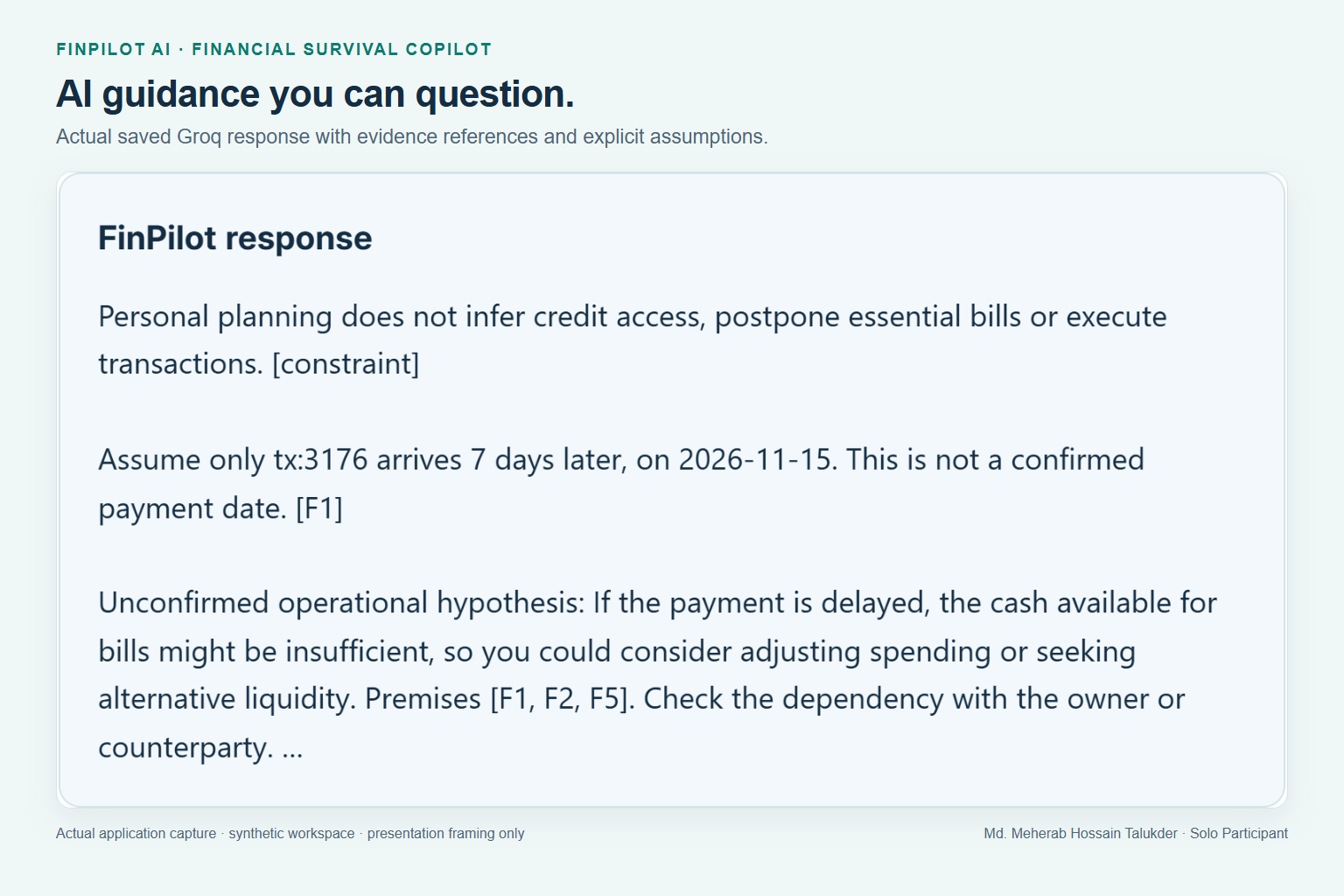
AI Advisor — Explainable, Evidence-Based Guidance
-
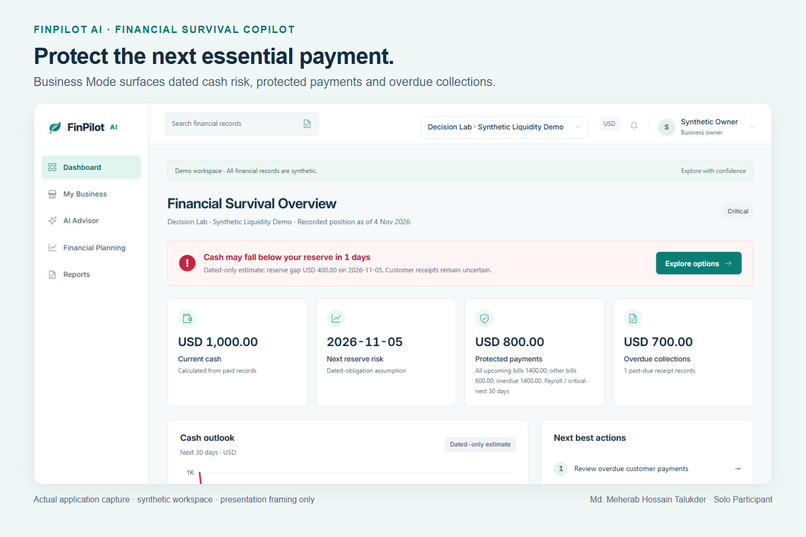
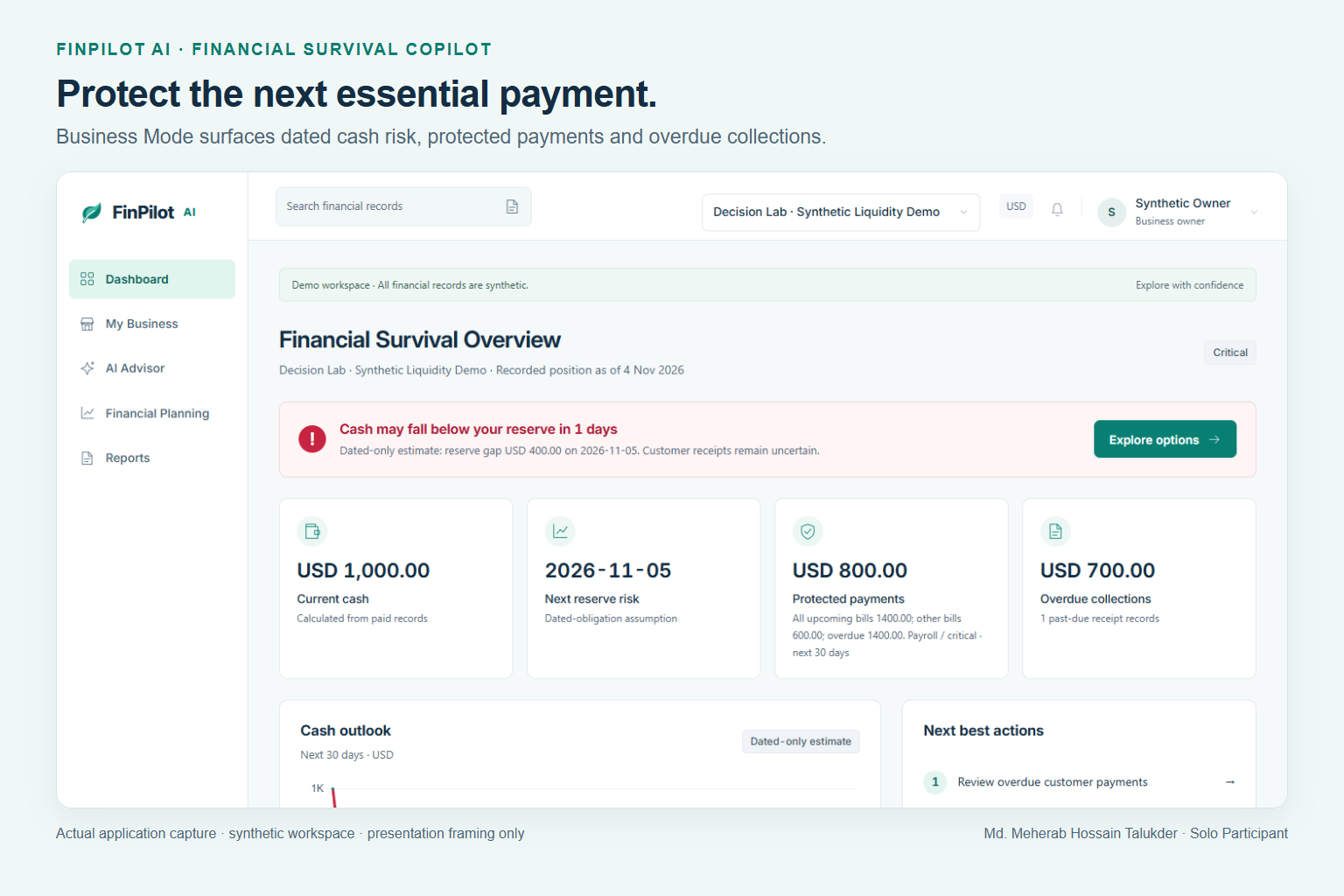
Business Dashboard — Cash Risks & Payment Priorities
-

FinPilot AI — Financial Survival Copilot
Inspiration
A freelancer can have a payment on the way and still struggle to cover a bill due tomorrow. A small business can show a healthy monthly total while running short of cash before an essential payment. The problem is not only how much money is expected, but when it becomes available.
I built FinPilot AI around a practical question: “Can I make this decision now without putting my next essential payment or emergency reserve at risk?”
For this buildathon, I extended my existing small-business financial application with a dedicated consumer experience for freelancers, students and individual sellers. Personal finances deserve their own workflow, rather than a business dashboard with a different label.
What it does
FinPilot AI helps users understand their cash position, explore possible shortages and compare decisions before acting.
- Personal Mode separates paid cash, expected income, upcoming essential bills and an emergency reserve. Its conservative spending buffer excludes future receipts until they actually arrive.
- Scenario planning compares a baseline with delayed income, an unexpected expense, a proposed savings transfer or lower future income. Simulations remain hypothetical and do not change actual financial records.
- The private AI Advisor explains authorized financial evidence, identifies assumptions and offers conditional guidance. Financial amounts are calculated deterministically; the AI cannot execute transactions or move money.
- Business Mode preserves the existing tools for cash planning, payment priorities, overdue collections and financial reports.
- Reports and separate workspaces help users review their records while keeping personal and business contexts apart.
An account-free demo lets judges explore the consumer workflow using clearly labeled synthetic data. Its explanations are deterministic; private workspaces use the configured Groq integration.
How we built it
I developed FinPilot AI as a solo participant using Python, Django and PostgreSQL, with Django templates, Tailwind CSS, JavaScript and Chart.js for the interface. Python's Decimal arithmetic supports financial calculations, and structured Pydantic schemas help validate AI output.
The core flow is records → dated cash calculations → scenario comparison → evidence-based explanation → user decision. Groq adds explanations around authorized evidence rather than acting as the source of financial figures. If provider output is invalid or unavailable, the application falls back to a truthfully labeled calculated explanation.
The buildathon work adds consumer onboarding, Personal Mode, conservative spending and savings calculations, four personal scenario types, consumer-specific AI context and a stateless public demo. I reused the existing ledger, authentication, workspace controls and export safeguards instead of rebuilding them.
The application is deployed on Render and Vercel with its backend and database connection. Screenshots and public demo examples use synthetic records.
Challenges we ran into
The hardest design challenge was separating expected money from available cash. Counting an unpaid invoice as spendable would make the interface reassuring while making its advice less useful.
Another challenge was extending a mature business workflow without bringing supplier, payroll or lending assumptions into personal planning. I added mode-specific forms, views and explanations while preserving existing business behavior.
AI reliability also required clear boundaries: workspace isolation, validated evidence references, explicit uncertainty and a fallback that does not pretend a model answered when it did not. Finally, financial tables and explanations needed to remain usable on phones as well as desktop screens.
Accomplishments that we're proud of
One synthetic example demonstrates the project's central idea: delaying a BDT 10,000 receipt by seven days leaves ending cash at BDT 16,000, yet creates an interim BDT 2,000 emergency-reserve shortfall. The monthly ending balance alone misses that risk.
I completed the personal setup, dashboard, scenario, private Advisor and reporting workflow, verified an actual Groq response using isolated synthetic records, and retained existing business regression coverage. The PostgreSQL suite passed 368 tests, with additional browser checks across seven screen widths.
What we learned
Financial guidance becomes more useful when it explains timing and assumptions, not just a final number. Clear separation between received cash, uncertain income and hypothetical decisions matters as much as the model itself.
I also learned to evaluate the complete workflow: calculations, authorization, fallback behavior, exports and responsive presentation. A fluent explanation is only one part of a trustworthy financial tool.
What's next for FinPilot AI – Financial Survival Copilot
Next steps include consent-based bank imports, richer personal budgeting, independently evaluated forecast calibration and opt-in monitoring with verified notification delivery. These are future improvements, not features claimed in the current release.
FinPilot AI provides decision support based on recorded data and assumptions. Its projections are conditional estimates, not guarantees.
Created by Md. Meherab Hossain Talukder — Solo Participant.
Built With
- chart.js
- css3
- django
- github
- groq
- html5
- javascript
- openpyxl
- playwright
- postgresql
- pydantic
- python
- render
- reportlab
- tailwind-css
- vercel
