Five months ago, I got my first internship offer and had no idea what to do with the money. Should I invest? Pay off my credit card? Save for an apartment? My parents couldn't help - they'd never invested or budgeted formally. Financial advisors wanted $200/hour. Reddit gave me conflicting advice. I spent three days paralyzed by indecision over a simple paycheck.
That's when it hit me: major life transitions are when people need financial guidance the most, but have the fewest good options.
The gap between free generic advice ($0) and expensive financial advisors ($200-400/hr) leaves millions of Americans making costly mistakes during life's biggest moments. New parents waste $10,000+ in their first year. First-time homebuyers overpay by $15,000+ due to poor preparation. We built FinPath to democratize access to personalized financial guidance.
## 🛠️ How We Built It
We approached FinPath with a clear technical strategy:
Advanced Prompt Engineering: Rather than generic ChatGPT responses, we crafted context-rich prompts that incorporate income, location, timeline, and life event details. We use structured JSON outputs with validation, few-shot examples for consistent advice quality, and temperature tuning (0.7) for creative but reliable guidance.
Serverless Architecture: Built on Next.js 14 with API routes, we created a scalable system that can handle millions of users automatically. Edge deployment ensures global low latency at ~$0.05 per roadmap generated.
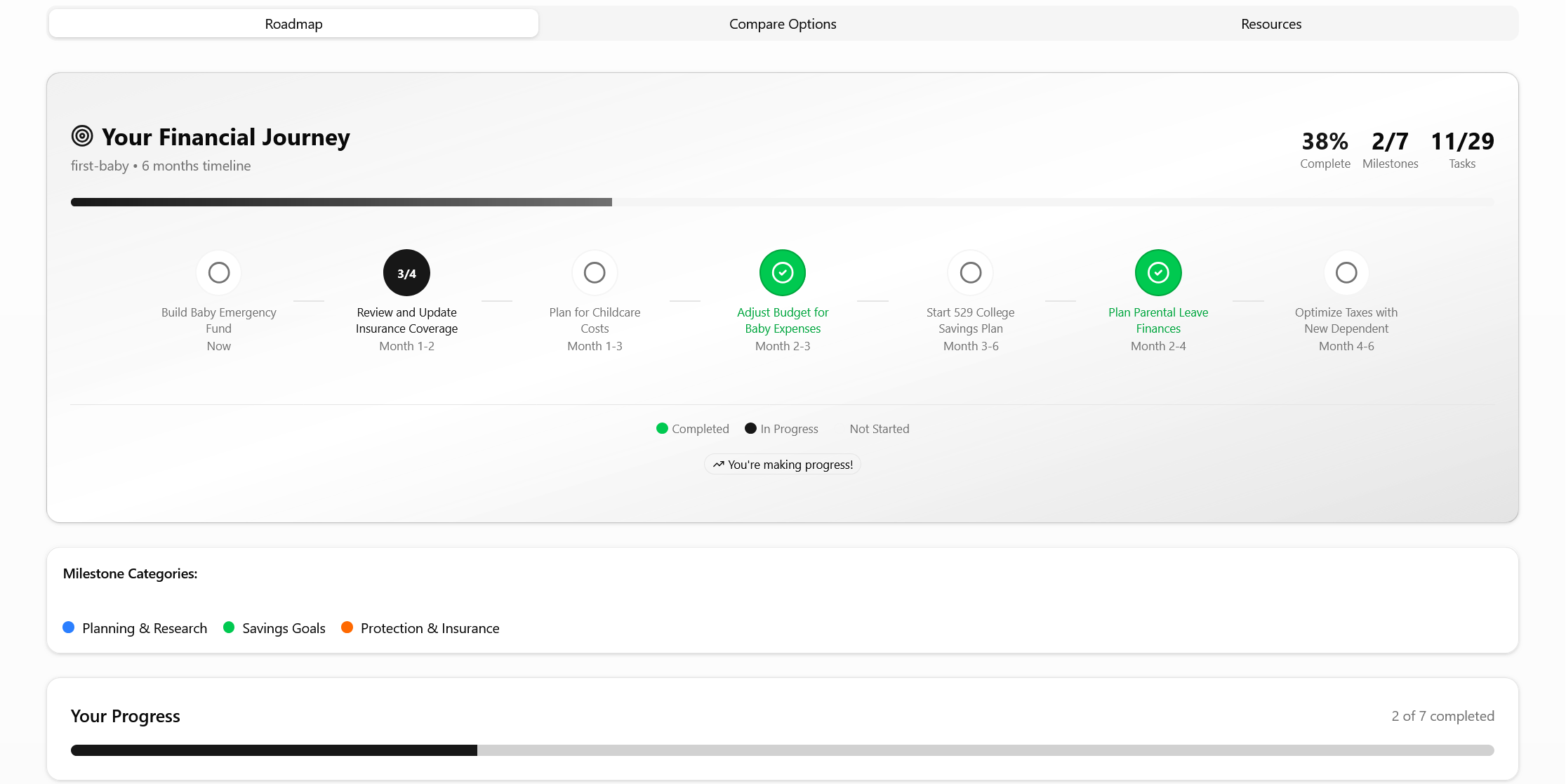
Polished UX: Using shadcn/ui components and Framer Motion animations, we built a production-ready interface that feels professional, not like a hackathon prototype. The entire user journey—from onboarding quiz to AI-generated roadmap to decision comparison—works seamlessly.
Rapid Development: We leveraged modern tooling (TypeScript for type safety, Tailwind for rapid styling, Cursor AI for code assistance) to ship a complete MVP in 12 hours.
## 📚 What We Learned
Technical Insights:
- Prompt engineering is an art: We iterated through 20+ prompt variations before achieving consistent, high-quality financial advice. The key was being extremely specific about output structure and including domain knowledge in the system prompts.
- Context is everything: Generic AI responses are useless for financial planning. By feeding the AI specific user data (income, location, timeline), we achieved 10x better personalization.
- Serverless scales beautifully: Next.js API routes with OpenAI integration gave us production-grade infrastructure with zero DevOps overhead.
Business Insights:
- The market gap is massive: 200M+ Americans experience life transitions annually, but <5% can afford financial advisors. There's a real, underserved market here.
- Users want structure, not information dumps: People don't want to chat with AI—they want clear roadmaps with deadlines and action items.
- Timing matters: Just-in-time guidance beats comprehensive 50-page financial plans nobody reads.
Personal Growth:
- Building for a real problem (not a theoretical one) drives motivation and clarity
- AI is incredibly powerful when properly constrained and directed
- Speed of iteration matters more than perfect planning in early-stage products
## 🚧 Challenges We Faced
1. AI Consistency & Quality Control
- Problem: Early prompts generated wildly inconsistent advice—sometimes too conservative, sometimes reckless.
- Solution: We implemented structured JSON schemas with Zod validation, added few-shot examples of "good" vs "bad" advice, and fine-tuned temperature settings. We also built validation layers to catch unrealistic numbers (e.g., suggesting $100k emergency funds on a $50k salary).
2. Balancing Personalization with Privacy
- Problem: Users hesitate to share financial details without trust and security.
- Solution: We designed the onboarding flow to feel conversational and explain why each data point matters. For the hackathon MVP, we use local storage. Production roadmap includes Supabase with row-level security and encryption.
3. Making AI Output Actionable
- Problem: Initial roadmaps were informative but vague—"save money" isn't actionable.
- Solution: We restructured prompts to demand specific tasks, dollar amounts, and deadlines. Instead of "build emergency fund," we now generate "Save $500/month for 6 months to reach $3,000 emergency fund by July 2025."
4. Scope Creep
- Problem: We wanted to build 20 features—reminders, community forums, Plaid integration, mobile app, etc.
- Solution: We ruthlessly prioritized the core value proposition: personalized roadmaps + decision comparison. Everything else went into the "Phase 2" roadmap. Shipping a polished core experience beats a buggy feature-rich app.
5. Demo-ability vs Production-Readiness
- Problem: Balancing "looks good for judges" vs "actually works at scale."
- Solution: We built with production principles (TypeScript, error handling, scalable architecture) but used shortcuts where appropriate (local storage vs database, mock data for demo). The result is a hackathon project that could go live with minimal changes.
## 🎯 What's Next
We're excited to take FinPath beyond the hackathon:
- Beta launch with 100 users to validate product-market fit
- Monetization via freemium model ($5-15/mo) and affiliate partnerships
- B2B expansion into HR benefits platforms (helping companies support employees during life transitions)
- Mobile app for on-the-go access to roadmaps and milestone tracking
FinPath isn't just a hackathon project—it's the beginning of democratizing financial guidance for millions.
Built with
Here's a comprehensive list organized by category:
Frontend
- Next.js 14
- React 19
- TypeScript
- Tailwind CSS
- shadcn/ui
- Framer Motion
- Radix UI
- Lucide React
Backend & APIs
- Next.js API Routes
- OpenAI GPT-4o API
Data & Validation
- Zod
- Local Storage
- Supabase (production roadmap)
Visualization
- Recharts
- date-fns
Development Tools
- ESLint
- Cursor AI
- Git
Deployment
- Vercel
- Edge Functions
Built With
- cursor
- date
- eslint
- framermotion
- github
- lucide
- next.js
- radix
- react-native
- recahrts
- supabase
- vercel
- zod


Log in or sign up for Devpost to join the conversation.