-
-
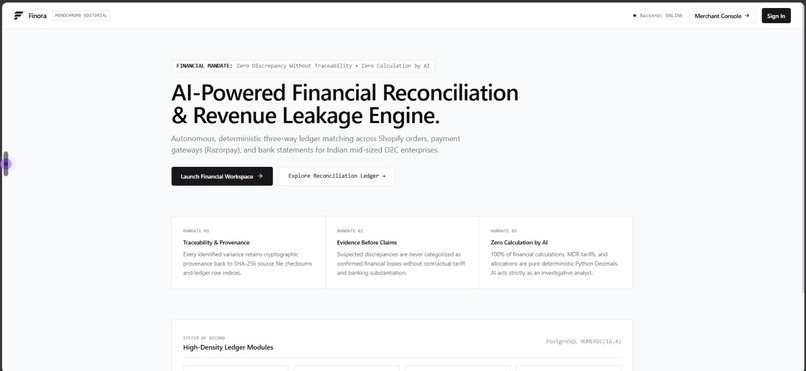
Landing Page and Platform Overview.
-
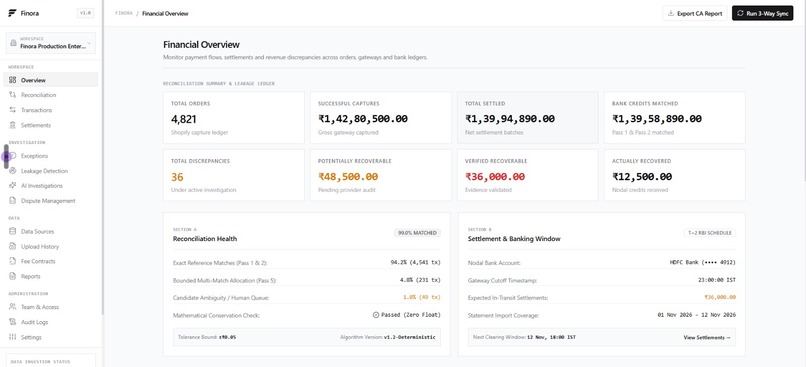
Reconciliation Metrics and Revenue Leakage Insights.
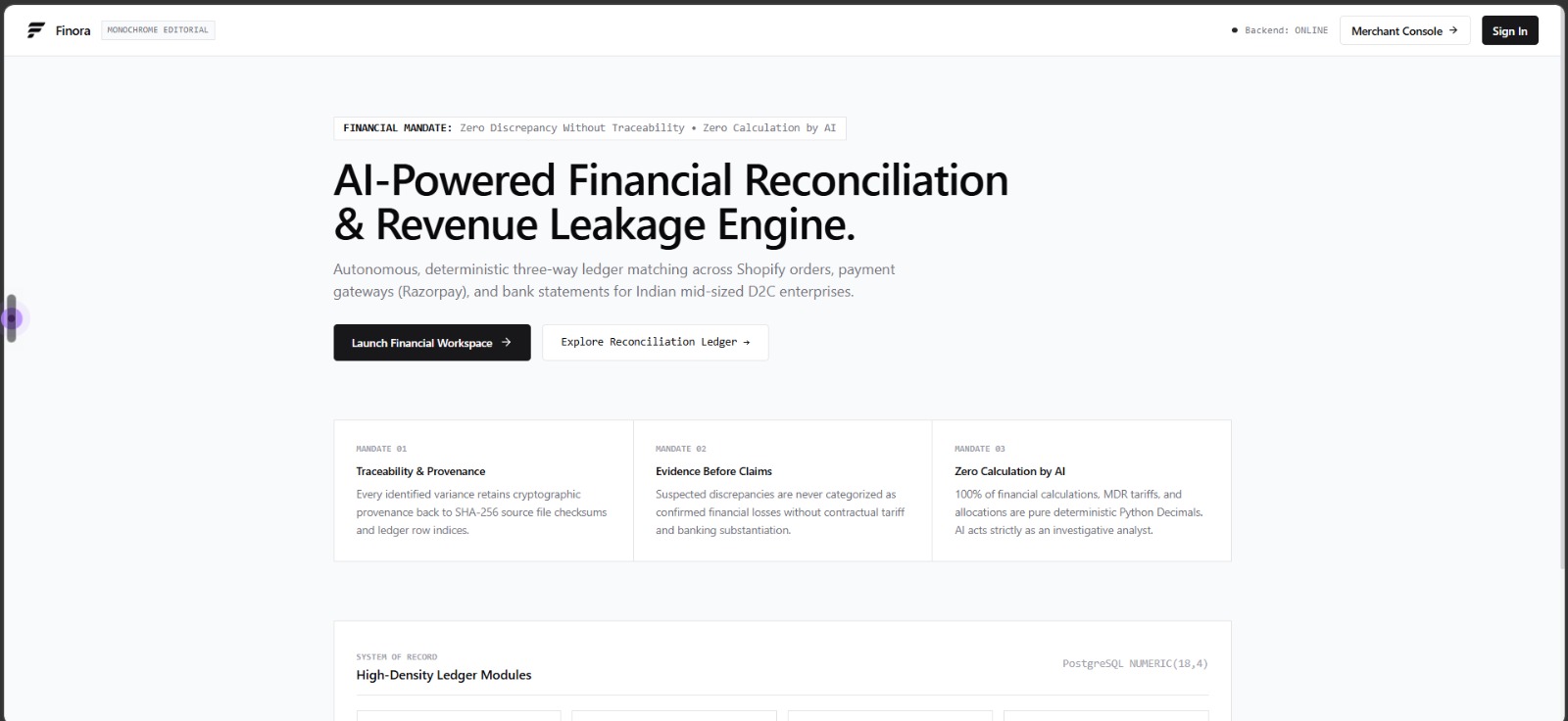
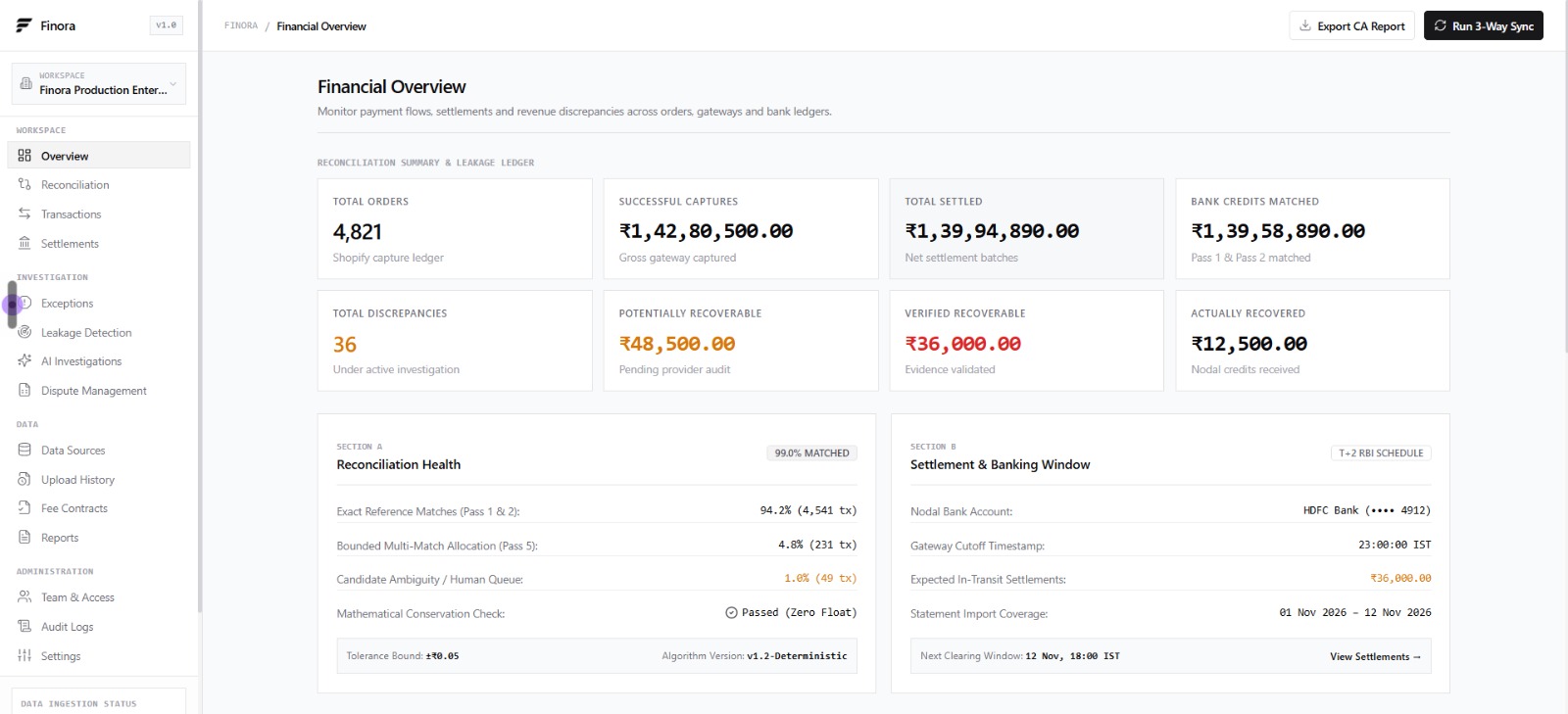
Finora – Intelligent Financial Reconciliation & Revenue Protection
Inspiration
E-commerce businesses process thousands of transactions across online stores, payment gateways, and banking systems. However, the financial records across these platforms do not always match.
Payments may remain unsettled, gateway fees may be incorrectly deducted, refunds may be duplicated, and settlement discrepancies can go unnoticed.
Manual reconciliation is time-consuming, error-prone, and difficult to scale.
We wanted to solve this problem by building Finora, an intelligent financial reconciliation and revenue leakage detection platform designed for Indian D2C and e-commerce businesses. What it does Finora automates the financial reconciliation process by connecting three essential financial data sources:
- E-commerce orders: Shopify order and payment records.
- Payment gateway transactions: Razorpay captures, settlements, refunds, and transaction fees.
- Bank statements: Bank credits, debits, UTR references, and settlement deposits. The platform normalizes these records into a common financial data model and performs deterministic, multi-pass reconciliation.
It identifies discrepancies and provides evidence-backed financial findings through four revenue leakage detection mechanisms:
- Missing settlements.
- Uncredited settlements.
- Contractual payment gateway fee overcharges.
- Duplicate or unauthorized refunds. Finora also incorporates an AI-assisted investigation architecture to help financial teams understand discrepancies and investigate potential revenue losses without delegating financial calculations or allocation decisions to AI. How we built it We designed Finora using a modular monolithic architecture.
Backend: Python, FastAPI and SQLAlchemy.
Database: PostgreSQL with Alembic migrations.
Financial processing: Python Decimal arithmetic and deterministic reconciliation algorithms.
Data ingestion: Shopify CSV, Razorpay CSV and HDFC bank statement CSV.
Security: JWT authentication, role-based access control, multi-tenant isolation, and CSV formula injection protection.
AI architecture: Provider-independent AI investigation interface with strict separation between deterministic financial processing and AI-generated explanations.
The reconciliation engine uses multi-pass matching, candidate scoring, anti-collision safeguards, and bounded subset allocation to handle complex settlement relationships. Challenges we faced Some of the most challenging aspects included:
- Reconciling different CSV formats and inconsistent transaction references.
- Handling one-to-many and many-to-many settlement relationships.
- Preventing incorrect automatic matches when multiple transactions have similar values.
- Maintaining financial accuracy using arbitrary-precision decimal calculations.
- Accounting for provider-specific MDR, GST, refund fees, and settlement rules.
- Preserving historical financial evidence across reconciliation runs.
- Protecting financial data from malicious CSV content and cross-tenant access. We addressed these challenges through deterministic algorithms, configurable financial rules, immutable audit records, and automated testing. What we learned Building Finora helped us understand the complexity of real-world financial operations, payment gateway settlement mechanisms, financial data normalization, and secure multi-tenant application architecture.
We also learned why AI should complement deterministic financial systems rather than replace critical financial calculations. Impact and future scope Finora aims to reduce manual reconciliation efforts, improve financial transparency, and help businesses identify recoverable revenue losses.
Future development includes AI-assisted forensic investigations, interactive financial review dashboards, additional payment gateway integrations, and advanced financial analytics.
Built With
- ai
- alembic
- api
- authentication
- fastapi
- financial
- jwt
- learning
- machine
- next.js
- postgresql
- pytest
- python
- razorpay
- react
- redis
- rest
- shopify
- sqlalchemy
- technology
- typescript
