-
-
login
-
chat
-
api
-
profile
-
response
-
cashflow
-
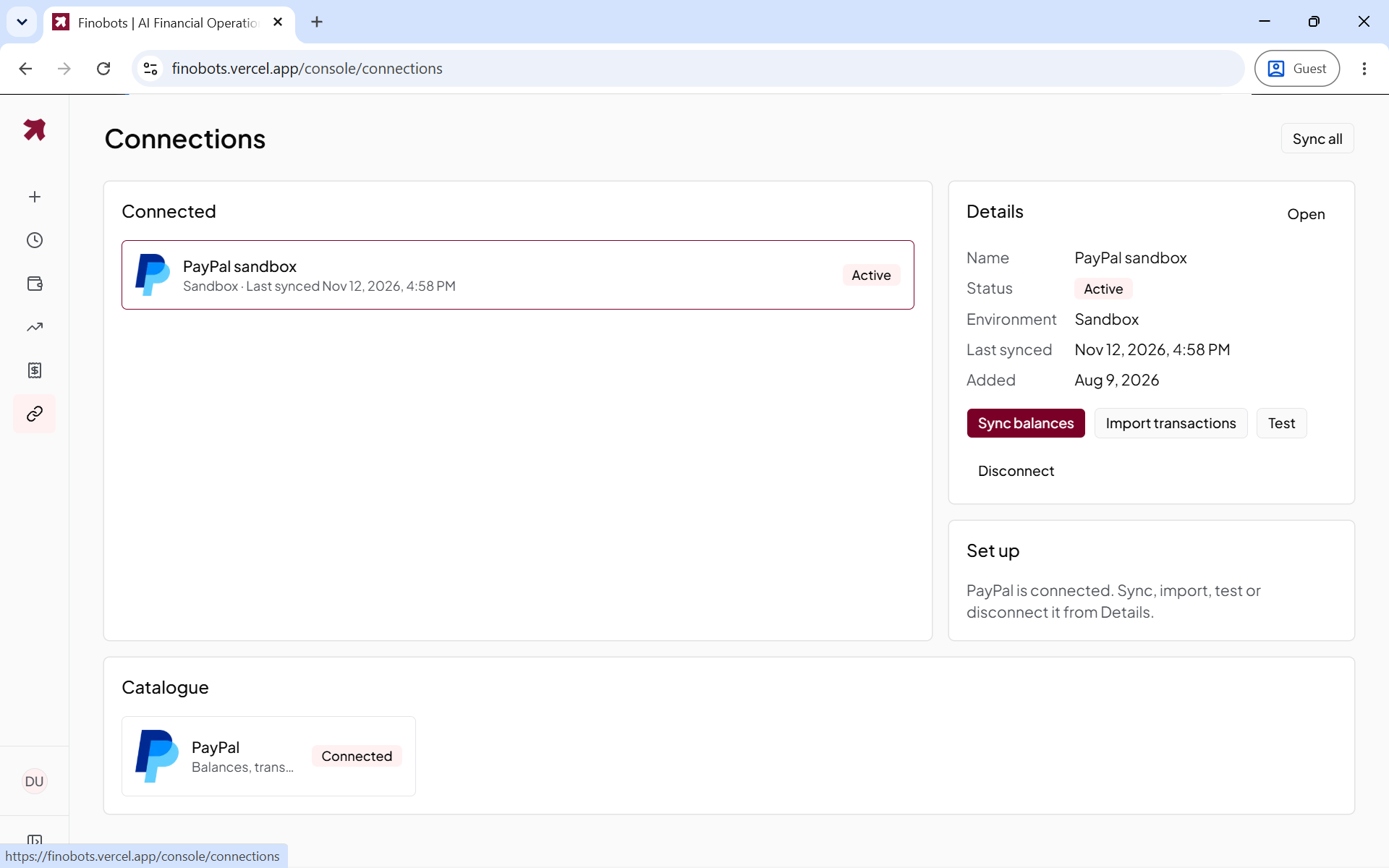
connections
-
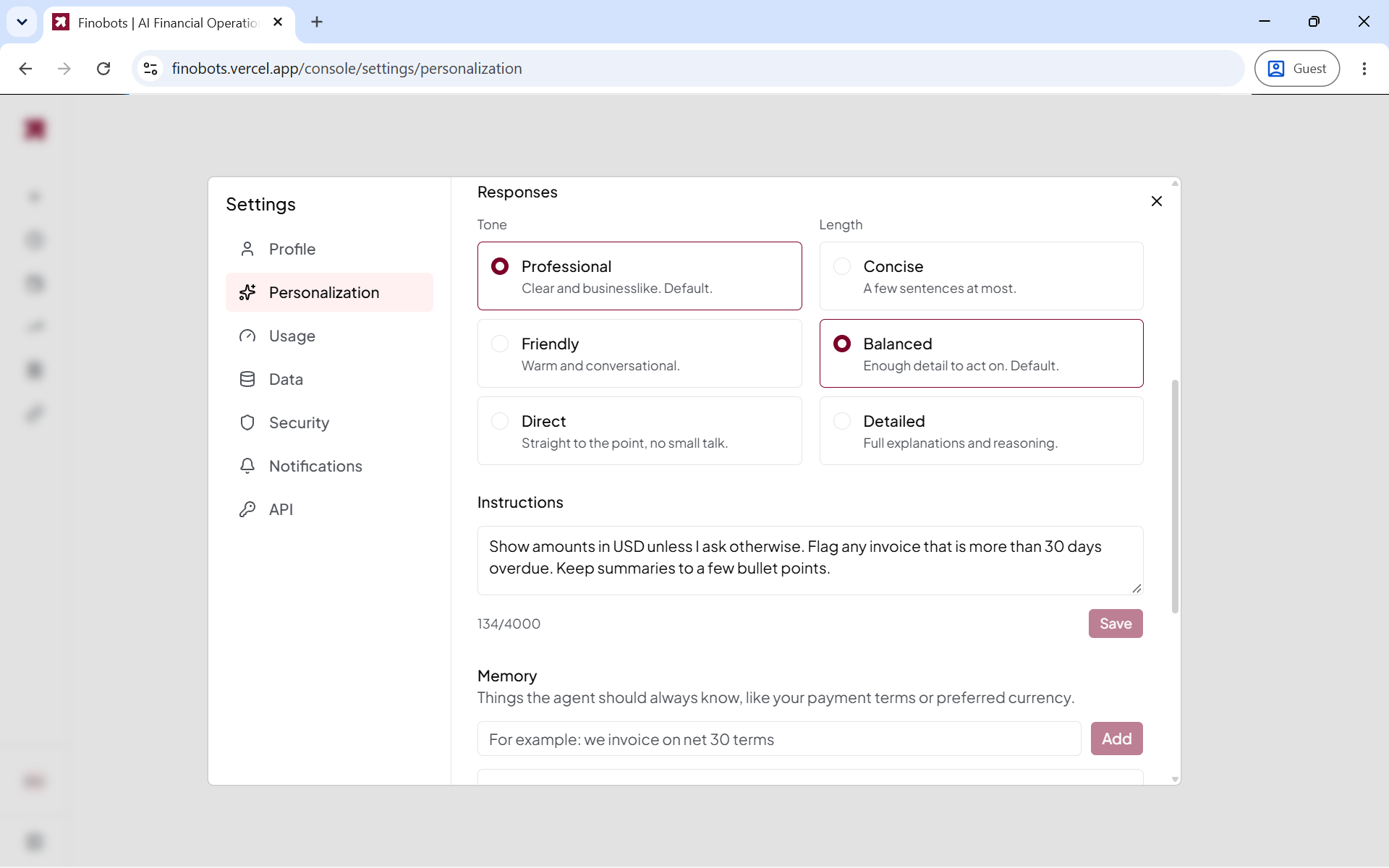
personalization
-
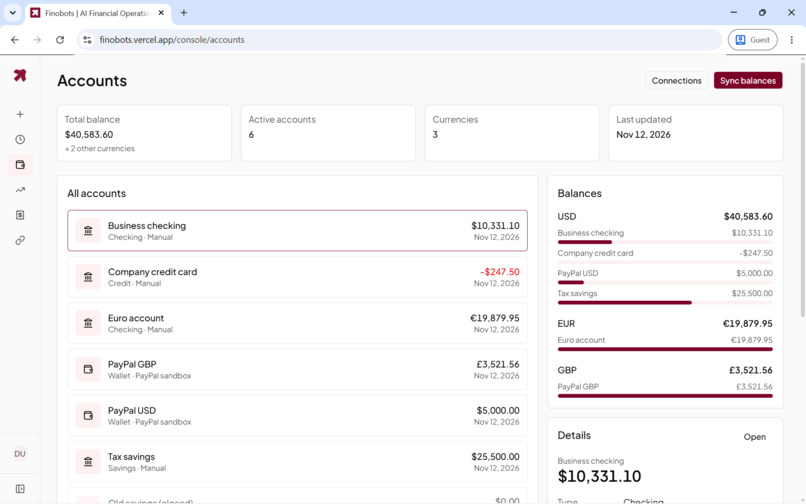
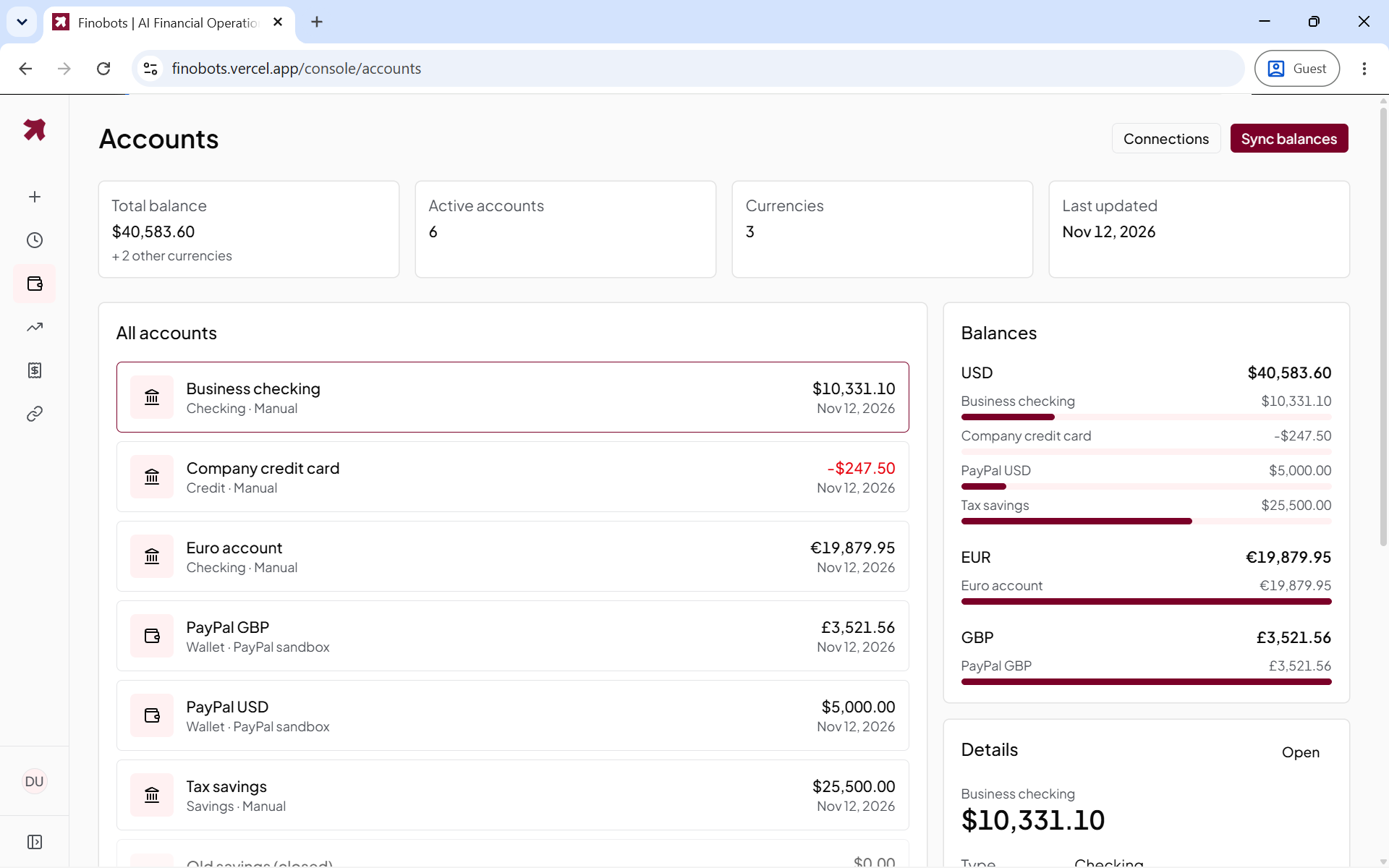
accounts
-
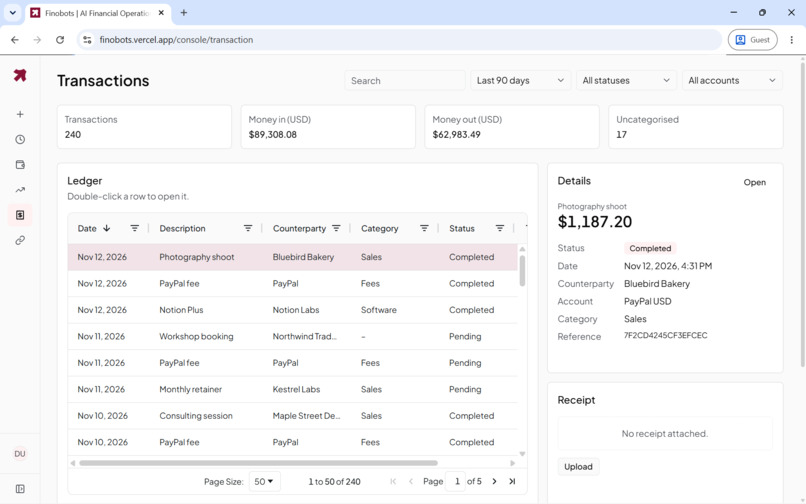
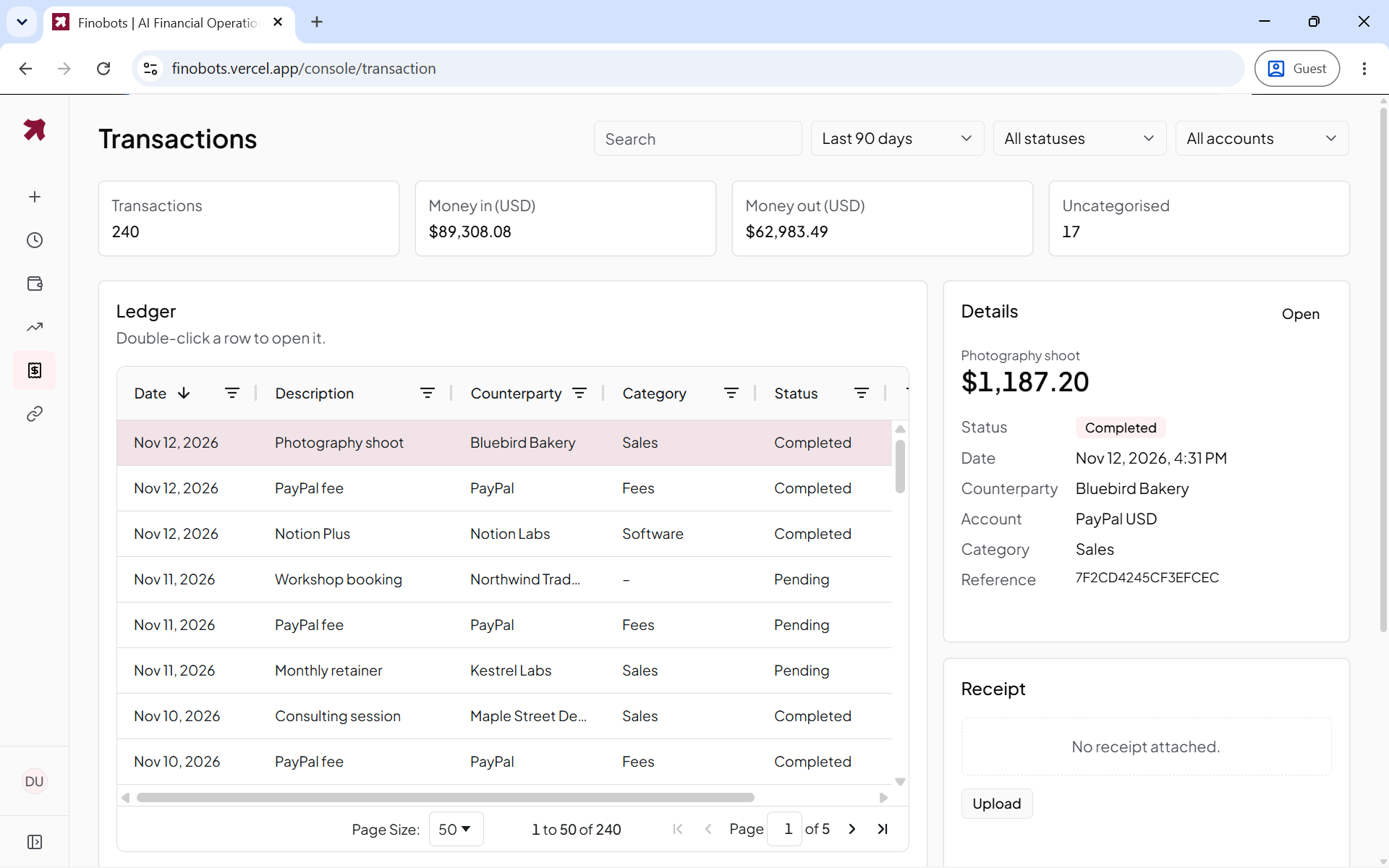
transaction
Inspiration
Small businesses manage their finances across payment dashboards, spreadsheets and inboxes. Balances live in one place, transactions in another, and following up on unpaid invoices takes time.
We built Finobots to bring that work into one conversational workspace: ask questions about your financial records, understand the results, and review proposed actions before they run.
Our guiding principle is simple: the assistant proposes, and a person approves.
What it does
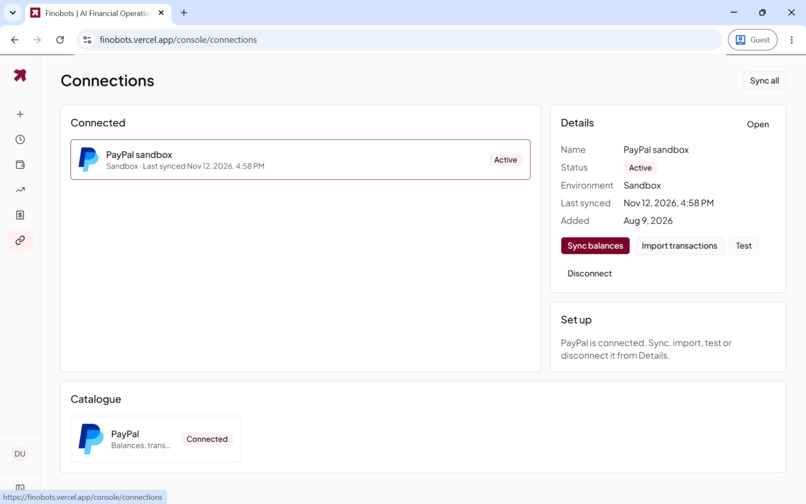
- Connects PayPal. Synchronises balances by currency, imports transactions with separate fee records, and processes verified payment events.
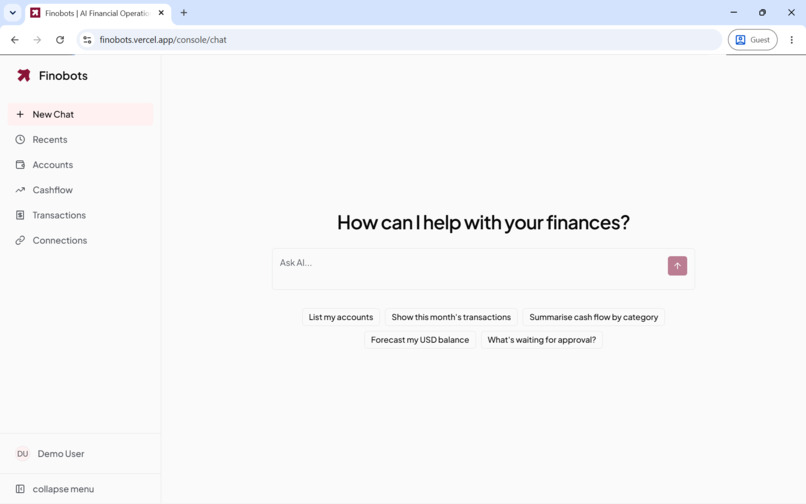
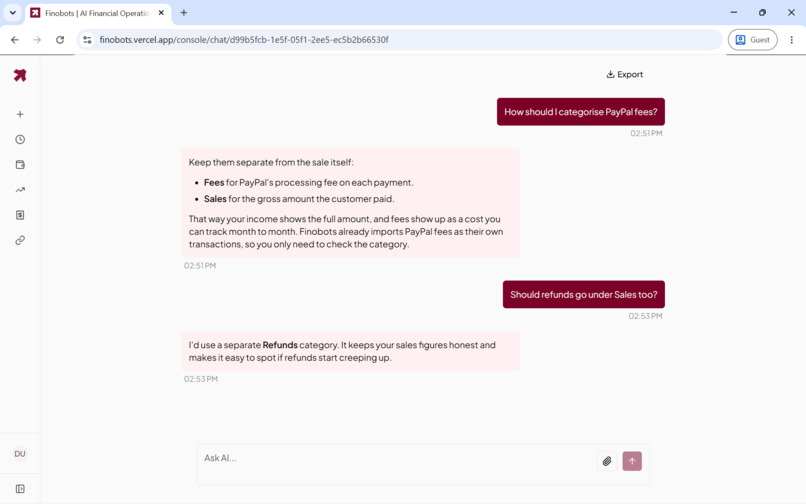
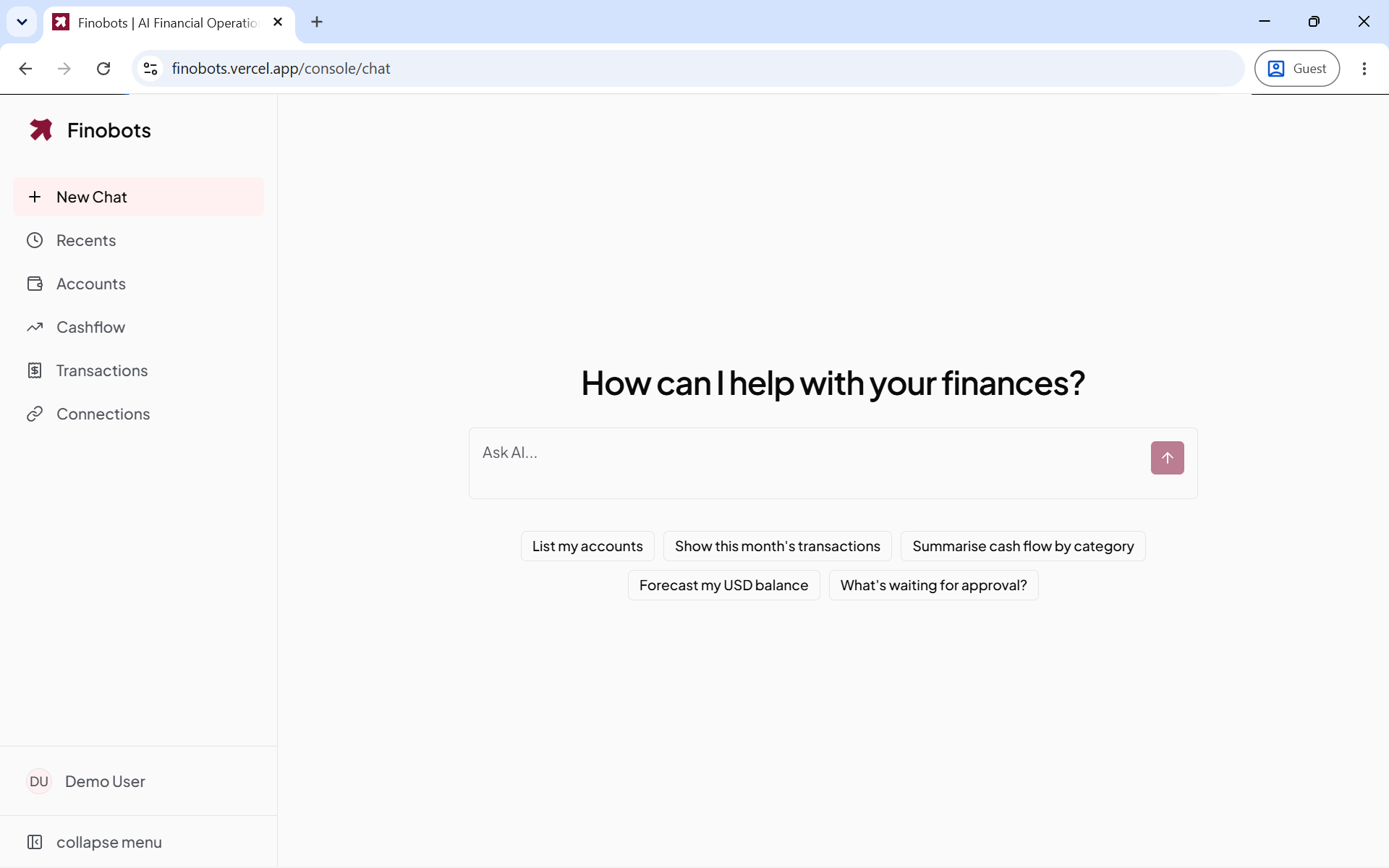
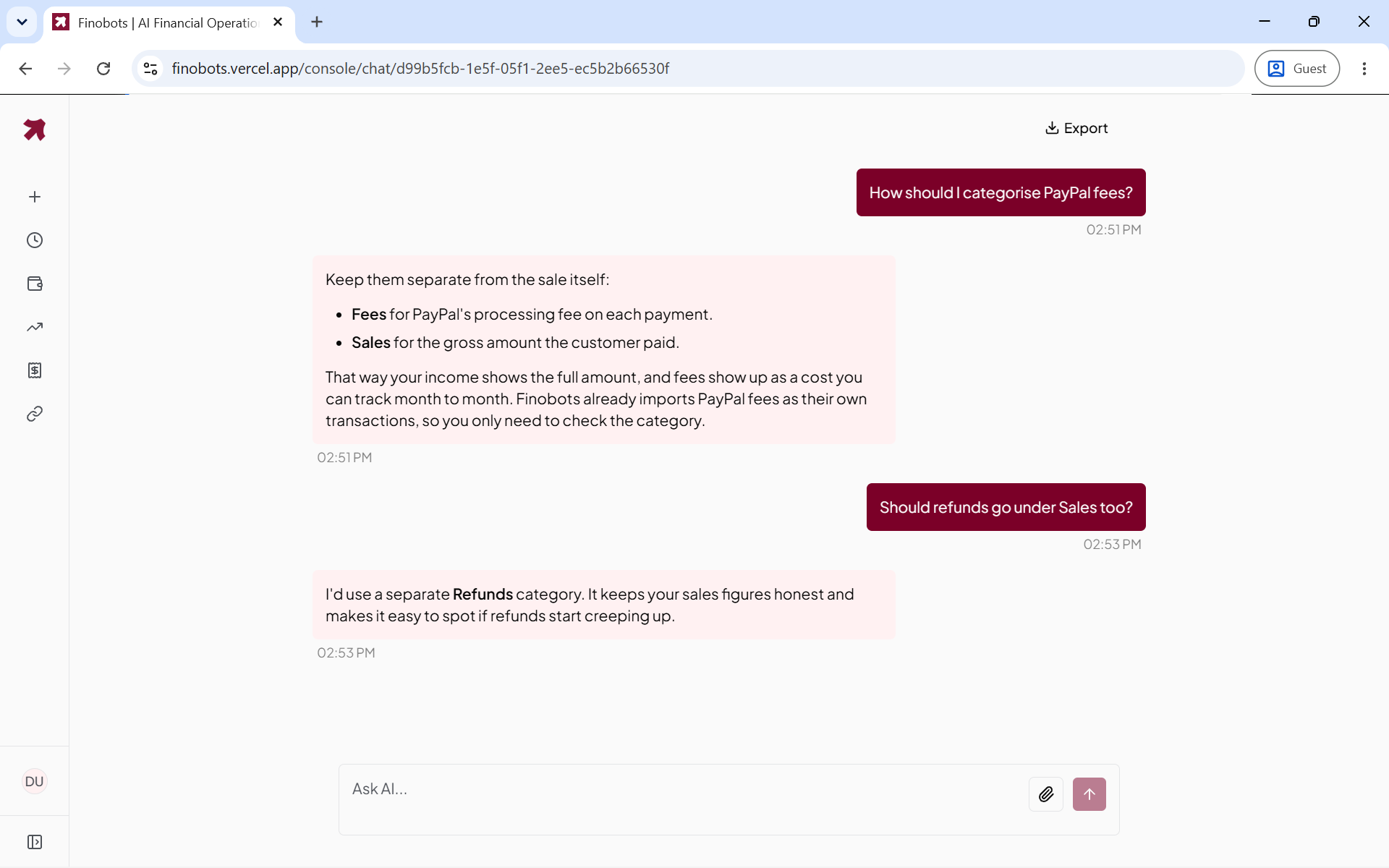
- Answers questions using workspace data. Retrieves accounts, transactions, cashflow summaries, forecasts, connections and approvals through permission-checked tools.
- Requires human approval. Presents invoice sending and payment reminders for review before execution.
- Makes financial data interactive. Uses AG Grid Community for sorting, filtering, searching and exploring records across the console.
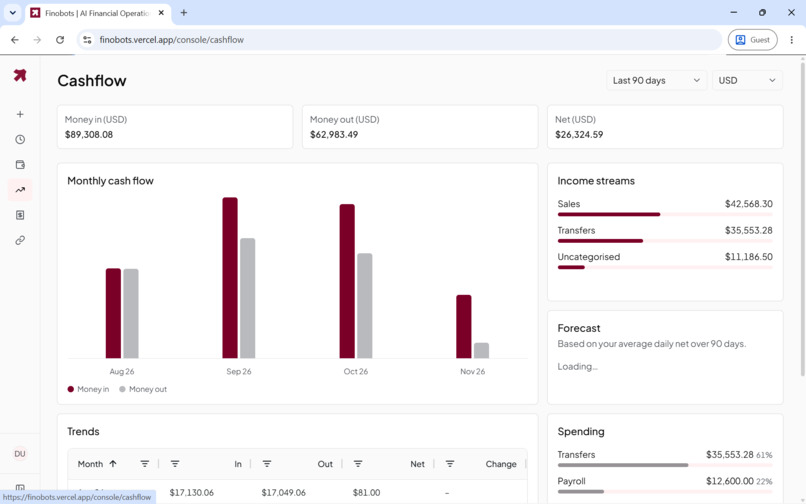
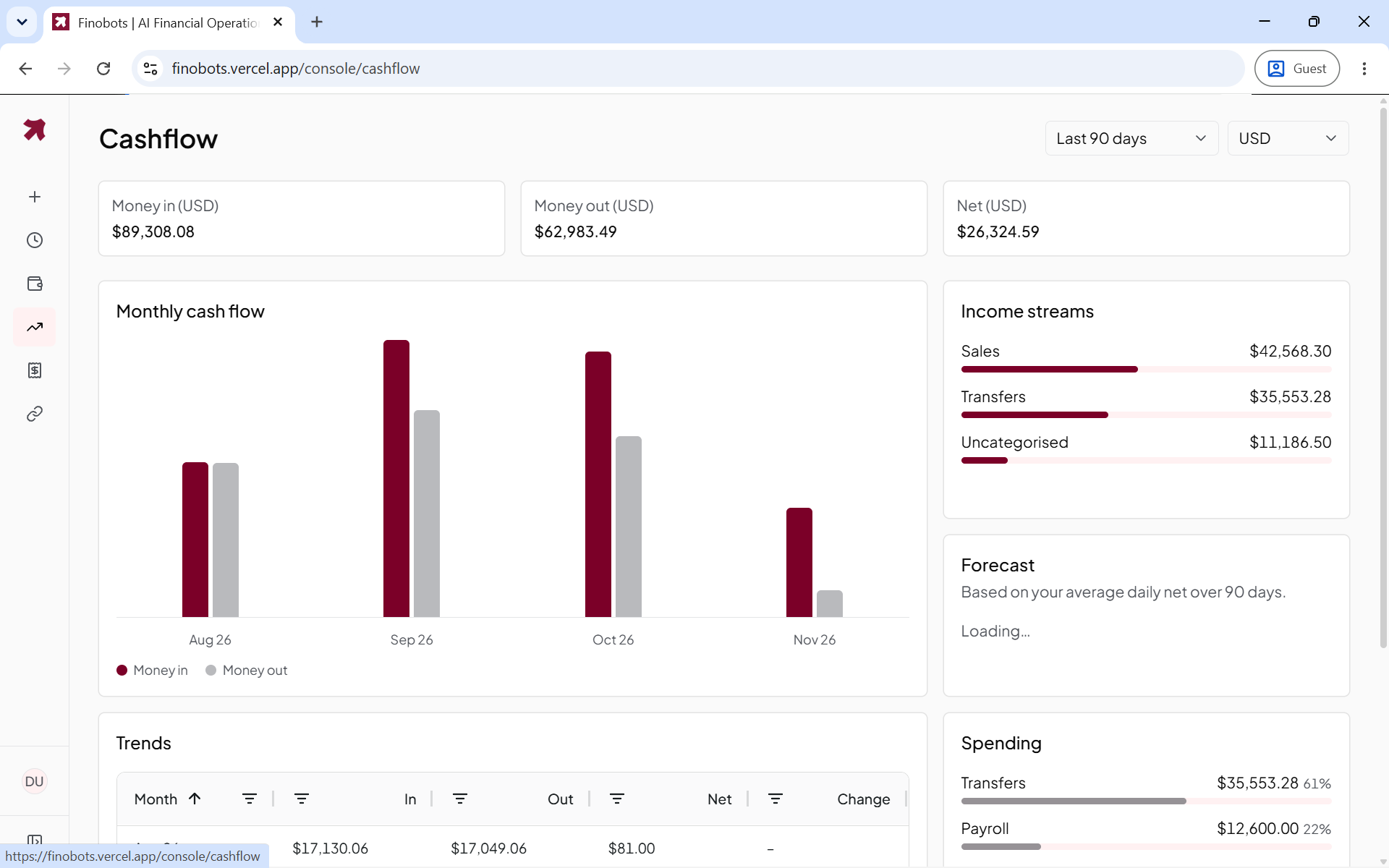
- Visualises cashflow. Shows inflows, outflows, net movement, spending categories and a simple 30-day projection.
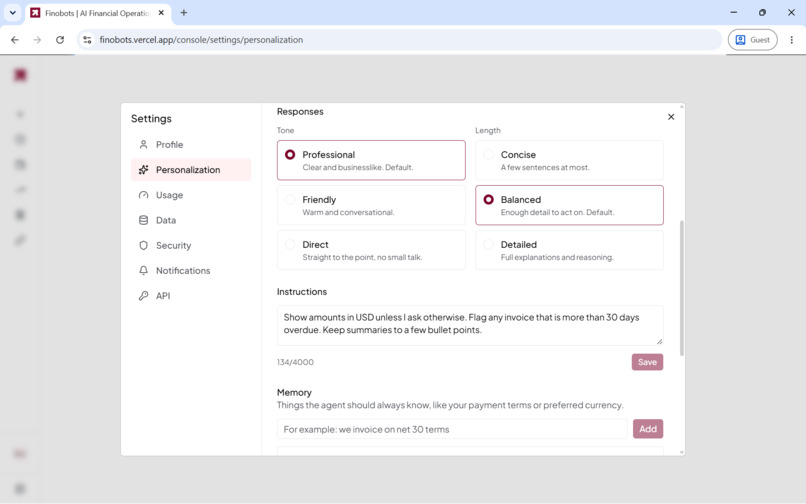
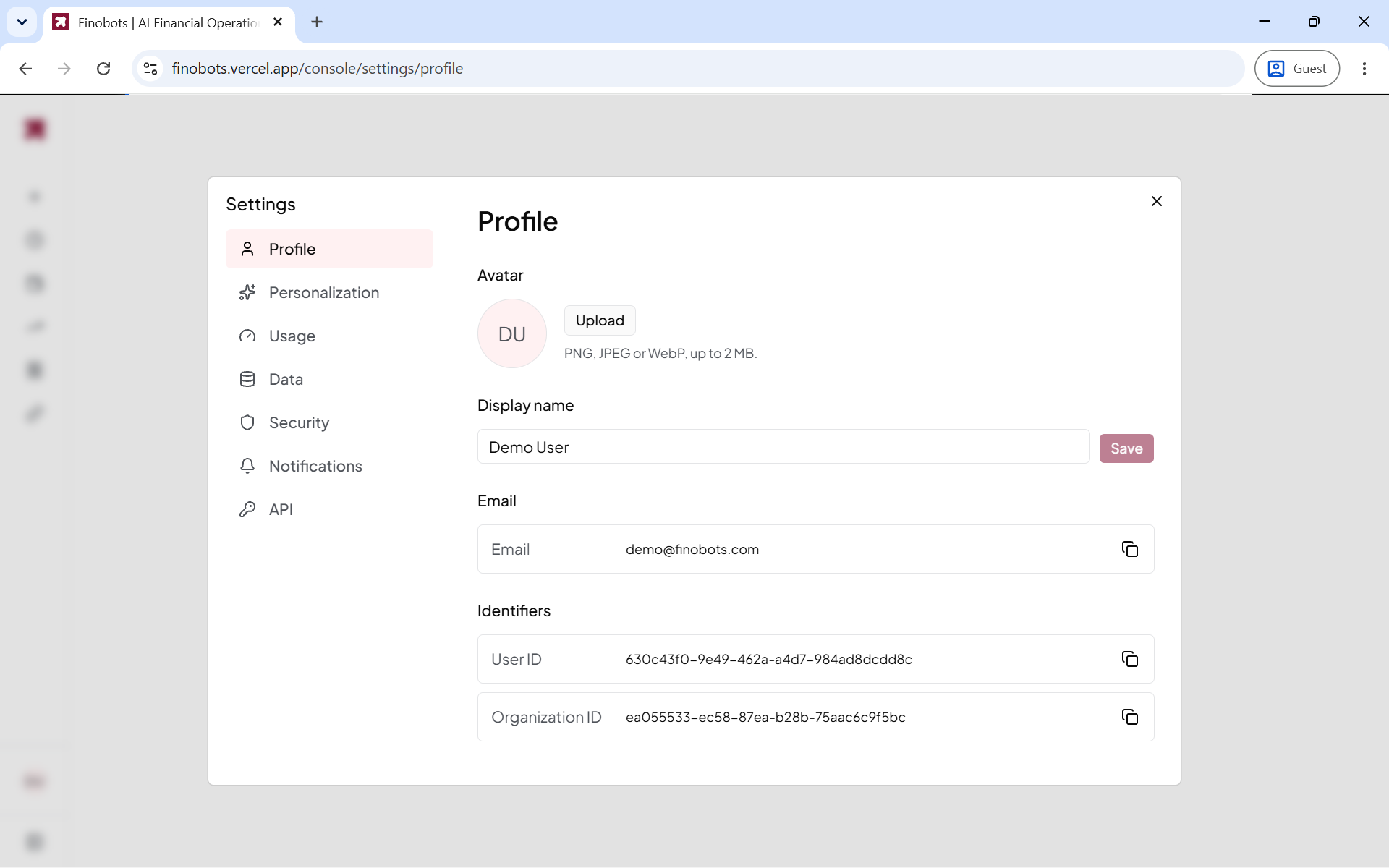
- Personalises responses. Supports preferred tone, response length, custom instructions and saved business context.
- Tracks AI usage. Provides credits, estimated costs, spending limits and usage history.
- Supports model choice. Includes Claude, with optional user-provided Claude, OpenAI or Gemini credentials.
How we built it
| Layer | Technology |
|---|---|
| Application | Next.js 16, React 19, TypeScript |
| Interface | Tailwind CSS v4, shadcn/ui, Base UI, Lucide |
| Financial tables | AG Grid Community |
| Backend | Supabase Auth, PostgreSQL, Storage and Edge Functions |
| Payments | PayPal Reporting and Invoicing APIs, plus webhooks |
| AI | Claude Haiku, with optional OpenAI and Gemini integrations |
| Hosting | Vercel |
Workspace isolation. Organisation-scoped records use row-level security to restrict access. Edge Functions handle operations requiring provider credentials or external API calls.
Conversational retrieval. The chat function streams responses through Server-Sent Events. The assistant can retrieve relevant financial records through read-only tools for up to five rounds before answering. Tool arguments are validated, and financial totals are calculated in application code rather than by the model.
Approval workflow. Proposed actions follow a defined lifecycle:
- Proposed → Approved → Executed or Failed
- Proposed → Rejected
The execution function checks permissions and claims approved actions before contacting PayPal, helping prevent duplicate processing.
Usage accounting. Estimated model costs are calculated from input and output token usage. The built-in model uses credits, with 100 credits representing an internal budget of USD 5. Users receive a daily top-up of 5 credits, capped at 100.
Explainable forecasting. The cashflow projection extends the historical average daily net movement from the current balance. It is a simple projection based on recorded activity, rather than a prediction of guaranteed future receipts.
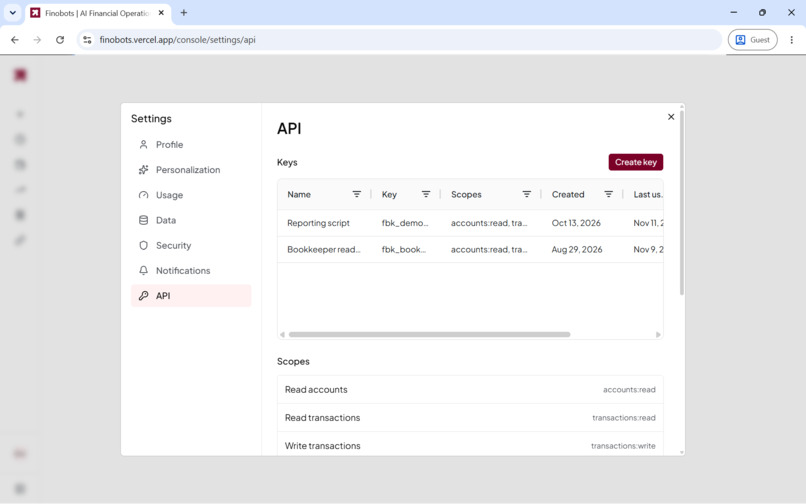
Credential protection. Provider credentials are encrypted using AES-256-GCM and stored for server-side access. API keys are stored as SHA-256 hashes. PayPal webhook signatures are verified before events update financial records.
Challenges we ran into
- Connecting data and actions. A conversation can involve several lookups, a proposed action and a saved response. Keeping these steps understandable required several iterations.
- Handling streamed tool calls. Tool names and arguments arrive in fragments, which must be assembled before validation and execution.
- Keeping calculations reliable. Early responses showed why transaction status matters. We moved financial calculations into code and used AI to explain the results.
- Balancing cost and response quality. Tight output limits sometimes truncated answers, so we adjusted limits and encouraged shorter, focused responses.
- Protecting workspace data. Each new data flow required suitable access policies and separation between browser-accessible records and provider secrets.
- Handling multiple currencies. Balances and summaries remain separate by currency instead of combining incompatible amounts.
- Measuring AI usage. Streaming providers do not always return token counts, requiring estimates when exact usage is unavailable.
- Working with dynamic routes. Request-time data and Suspense boundaries required careful handling in Next.js.
Accomplishments that we're proud of
- Built an open-source workflow connecting PayPal synchronisation, financial records, conversational queries and approvals.
- Grounded assistant responses in permission-checked workspace data.
- Added human review and duplicate-processing checks for proposed actions.
- Integrated PayPal sandbox reporting, transaction imports and verified payment events.
- Used AG Grid throughout the console to make financial records easier to inspect.
- Added model personalisation, bring-your-own-key support and AI usage visibility.
What we learned
- Approval needs backend enforcement. A confirmation button is only useful when permissions and execution rules are checked server-side.
- Financial calculations belong in code. Models can explain results while deterministic logic handles amounts and totals.
- Targeted retrieval improves context. Fetching relevant records keeps conversations focused and reduces unnecessary prompt content.
- Chat and tables work together. Conversation helps users ask questions, while interactive grids help them inspect the evidence.
- Payment events are asynchronous. Duplicate, delayed and out-of-order events require deliberate handling.
- Complete workflows matter. A clear path from connection to an approved action is more useful than a large collection of disconnected features.
What's next for Finobots
- Interactive tables and charts inside chat responses.
- Invoice creation with line items and improved collection workflows.
- Scheduled payment reminders.
- Automatic transaction matching for reconciliation.
- Email and in-app notifications.
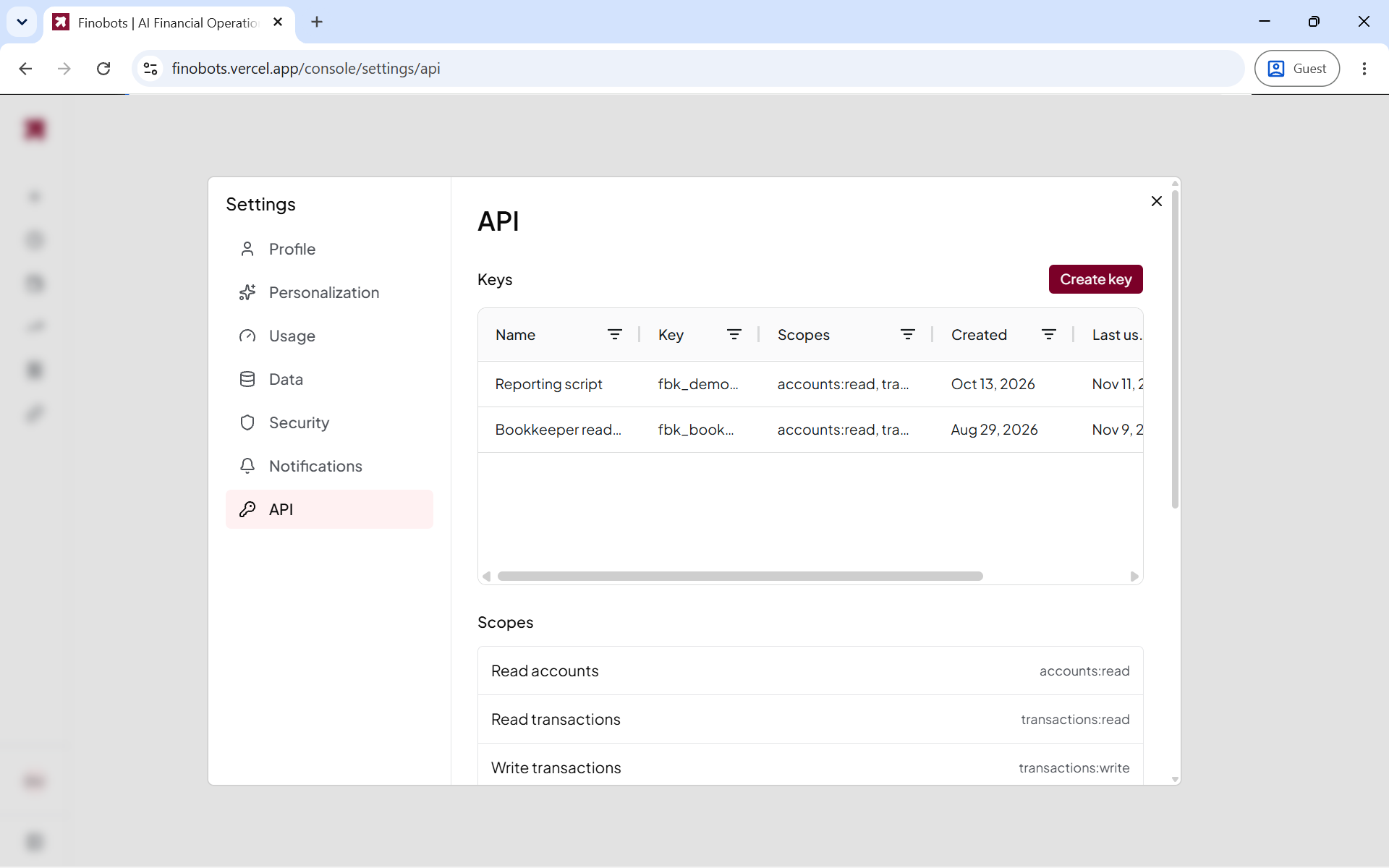
- API endpoints using scoped API keys.
- Team workspaces with role-based access.
- Stronger automated testing, event handling and execution recovery.
- Additional payment and accounting integrations.
Built With
- aggrid
- baseui
- claude
- deno
- eslint
- gemini
- git
- github
- lucide
- next.js
- node.js
- npm
- openai
- paypal
- postgresql
- react
- rest
- shadcn
- sql
- supabase
- tailwind
- typescript
- vercel
- webhooks

