-
-
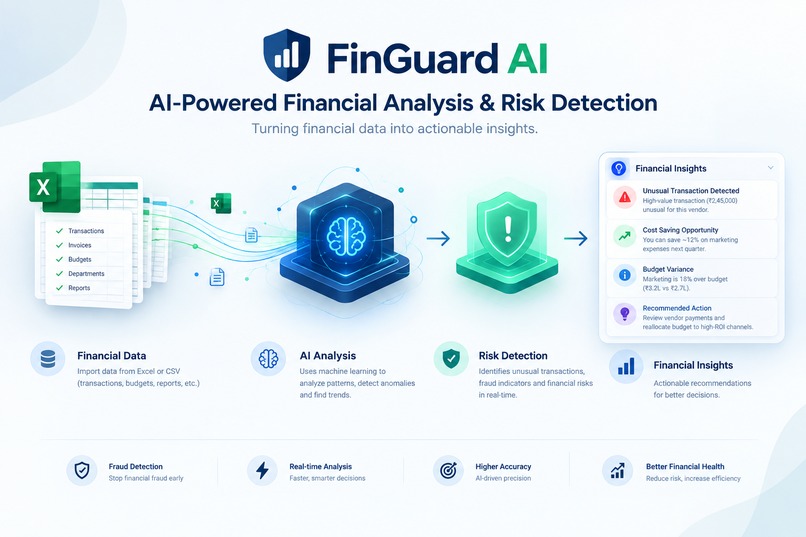
FinGuard Ai Agent
-
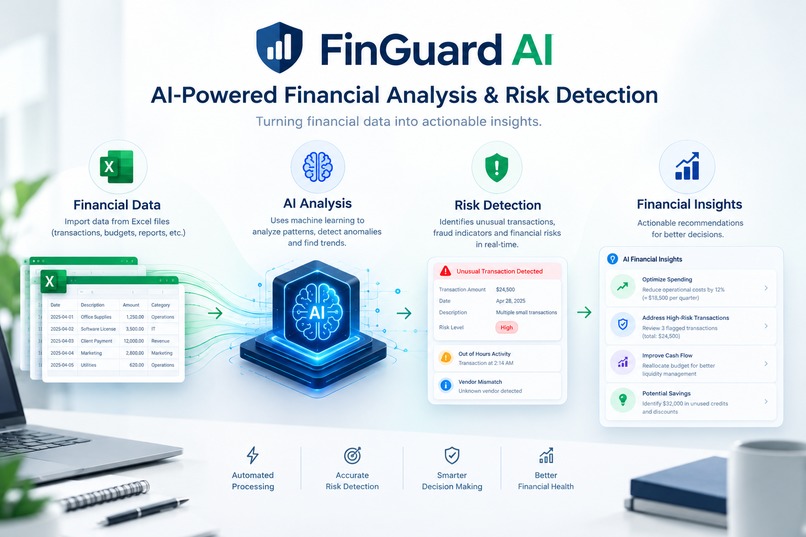
FinGuard AI ka architecture-style visual
Inspiration
The idea for FinGuard AI came from a problem I personally experienced while working with financial data.
When working with budgets and financial reports, I noticed that the difficult part was not calculating the numbers. Excel can easily calculate totals, percentages, and variances. The real challenge was finding the important information hidden inside a large amount of financial data.
I would look at spreadsheets containing transactions from different departments and manually compare budgets with actual spending, identify departments that were overspending, and look for transactions that seemed unusually high.
This made me think:
Why should a finance professional spend so much time searching through rows of data just to find the few things that actually need attention?
That question became the starting point for FinGuard AI.
What it does
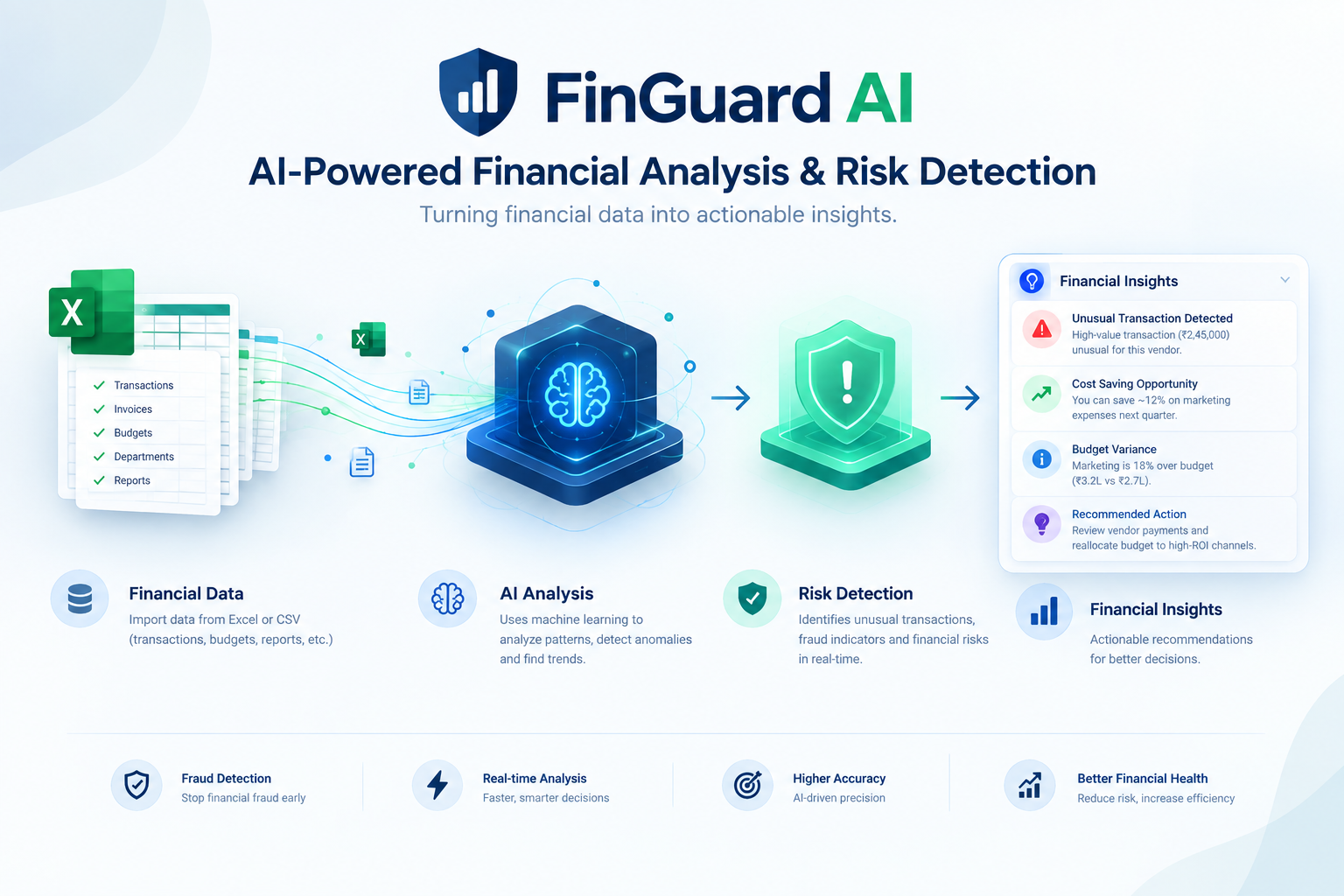
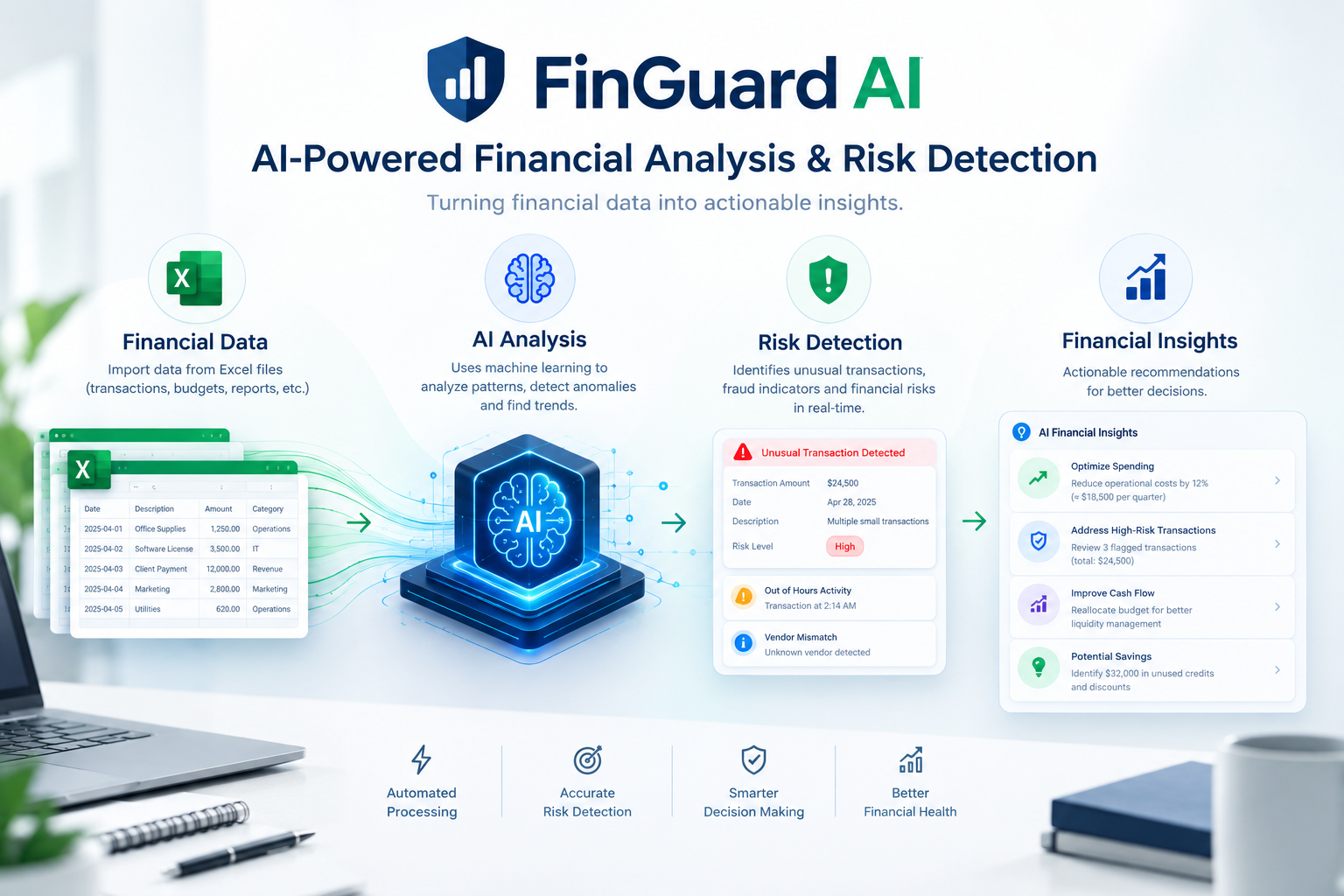
FinGuard AI is a finance-focused intelligent agent that analyzes financial data and highlights the areas that need attention.
It currently:
Calculates total budget and actual spending Calculates budget variance and variance percentage Detects budget overruns Identifies unusually high transactions Provides department-wise financial analysis Generates automated financial recommendations
For example, when actual spending is significantly higher than the approved budget, FinGuard AI flags the situation and recommends a finance manager review.
The goal is not to replace finance professionals. It is to reduce the time they spend searching through spreadsheets and help them focus on financial decisions.
How we built it
I built the current prototype using Python and Pandas, with Excel financial data as the input.
The system reads the financial data, cleans the required values, and performs different financial checks.
The main workflow is:
Excel Data → Data Processing → Financial Analysis → Risk Detection → Recommendation I implemented calculations for budget variance, spending levels, budget overruns, unusual transactions, and department-level performance.
I also structured the project so that it can be extended with AI capabilities, Power BI dashboards, automated alerts, and cloud services in the future.
Challenges we ran into
One of the biggest challenges was making the analysis reliable when working with financial data.
Financial spreadsheets can contain missing values, zero budgets, different spending levels, and other situations that can cause incorrect calculations.
I had to make sure that variance percentages were calculated safely and that unusual transactions were identified in a meaningful way.
Another challenge was deciding what information should actually be highlighted.
I realized that showing more numbers does not necessarily make a finance tool better. The system needs to help the user understand what requires attention and why.
Accomplishments that we're proud of
I am proud that I was able to turn a real financial reporting problem into a working prototype.
FinGuard AI can now take an Excel financial dataset and automatically produce a structured financial analysis instead of requiring every calculation to be done manually.
I am especially proud of the automated recommendation feature because it moves the project beyond simple calculations and toward decision support.
I also successfully structured the project as a GitHub repository with a working Python analysis system and documentation.
What we learned
This project helped me combine my background in finance and data analytics with Python and AI concepts.
One of the biggest things I learned is that building a useful agent starts with understanding a real problem. Technology is only valuable when it actually makes someone's work easier.
I also learned more about financial data processing, anomaly detection, budget variance analysis, handling real-world data issues, and designing outputs that are useful for decision-making.
Most importantly, I learned that a finance tool should not just answer "What are the numbers?"
It should also help answer:
"What needs my attention?"
What's next for FinGuard AI
The current version is a functional prototype, but I want to take FinGuard AI much further.
My next goals are to add:
AI-generated explanations of financial risks Predictive budget forecasting Automated email/notification alerts Interactive Power BI dashboards Natural-language questions about financial data Automated PDF financial reports AWS/cloud deployment More advanced anomaly detection
The long-term vision is to make FinGuard AI a practical financial assistant that can continuously monitor financial data and help finance professionals identify risks earlier.
I started this project because I experienced the frustration of manually searching through financial spreadsheets.
FinGuard AI is my attempt to turn that manual process into a smarter, faster, and more useful financial workflow.
Built With
- ai-agent
- amazon-web-services
- anomaly-detection
- artificial-intelligence
- automation
- budget-analysis
- budget-monitoring
- business-intelligence
- data-analytics
- data-visualization
- excel
- expense-management
- finance
- financial-analysis
- financial-reporting
- financial-technology
- intelligent-automation
- machine-learning
- pandas
- predictive-analytics
- python
- risk
- strands-agents-sdk


Log in or sign up for Devpost to join the conversation.