-
-
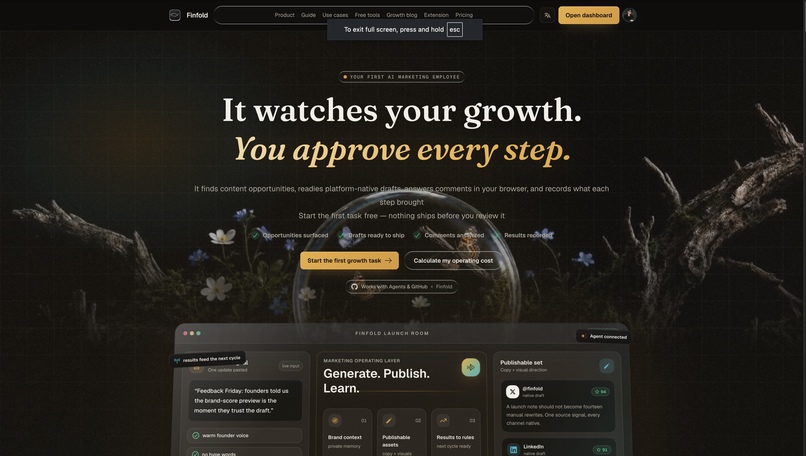
Landing page
-
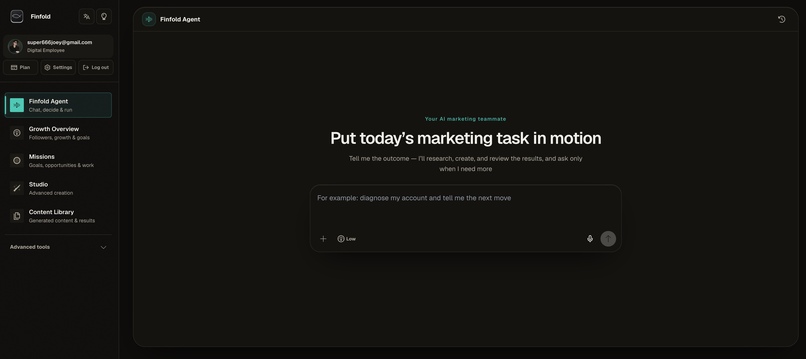
Finfold Agent
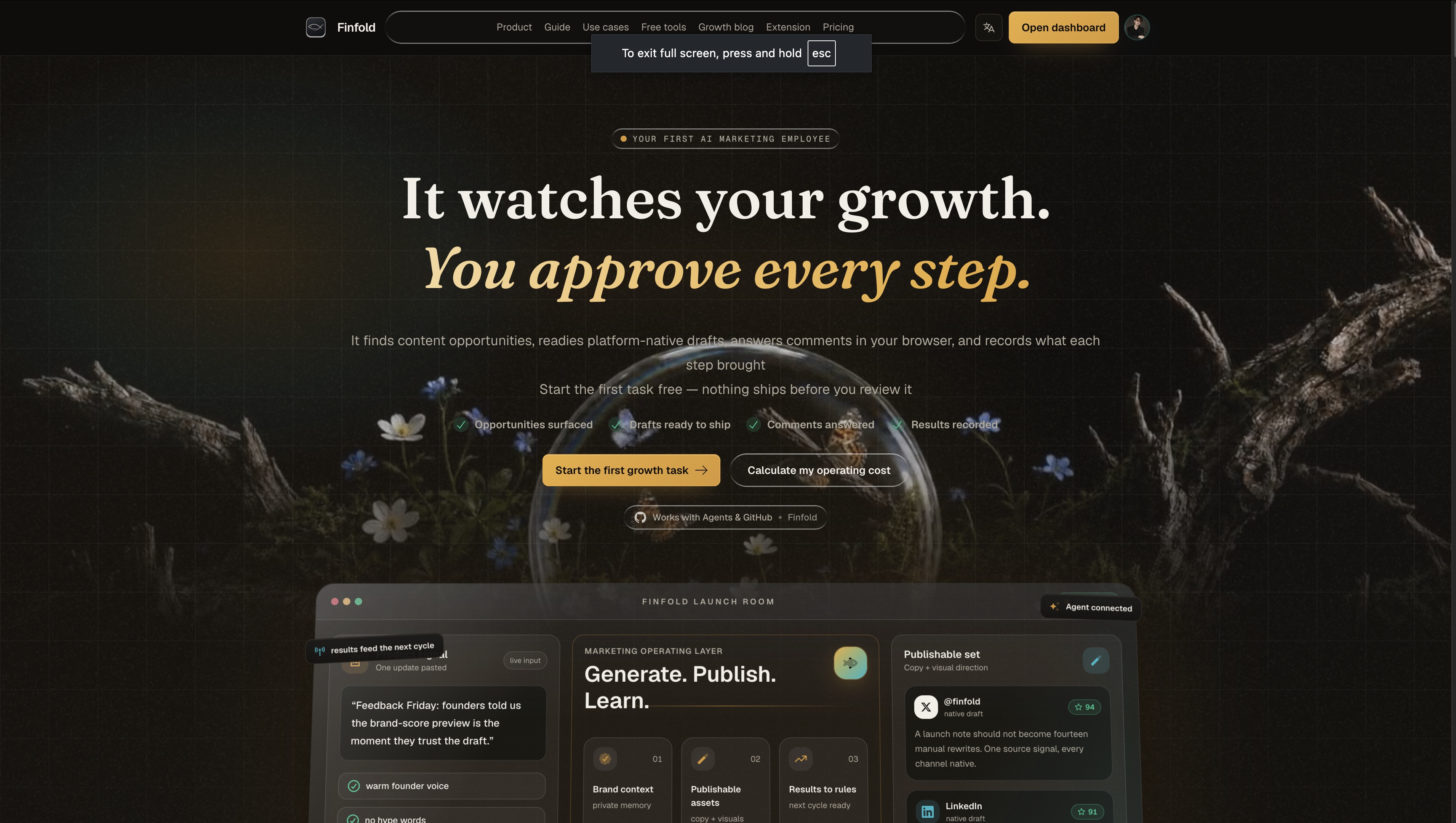
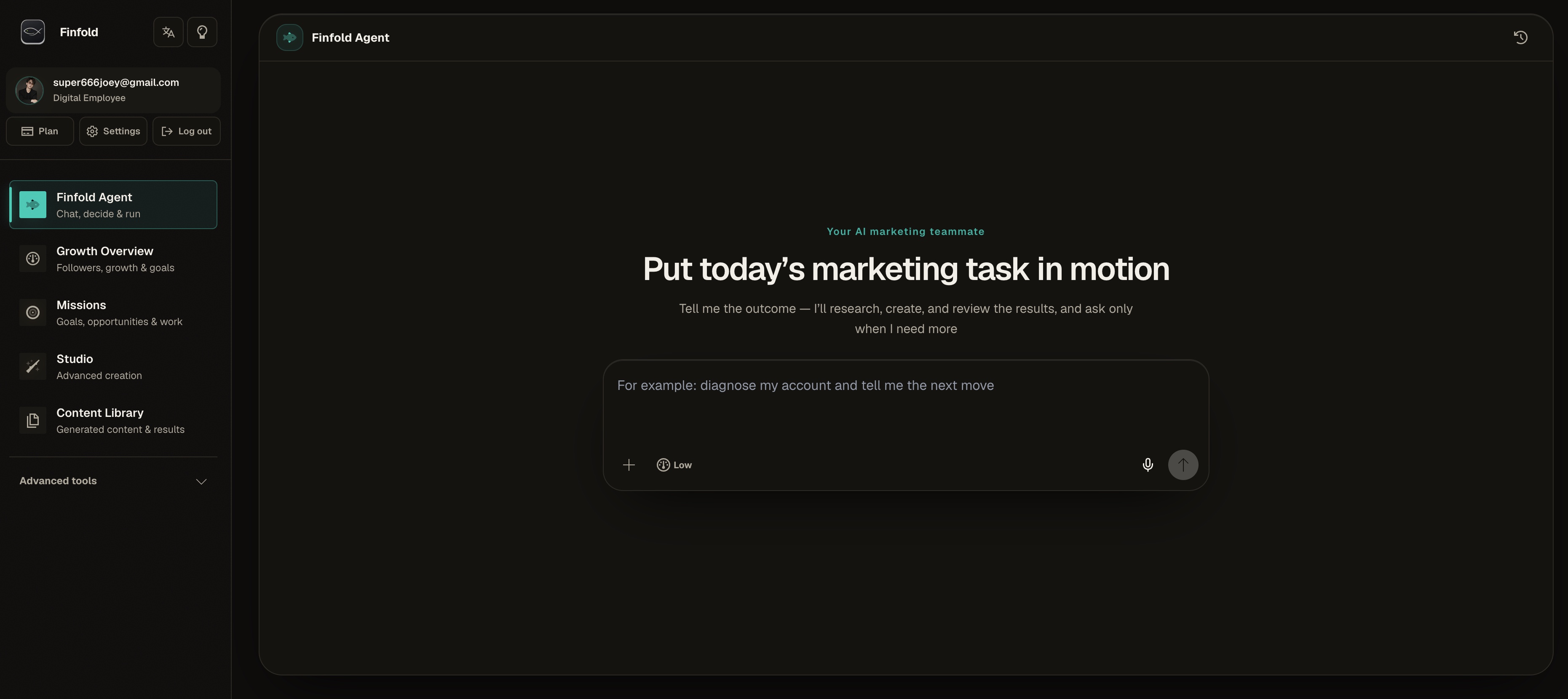
Inspiration
Small teams rarely have a shortage of things to say. The real problem is turning one useful update into content that actually belongs on every channel.
A product launch, customer insight, or founder note often gets rewritten manually for LinkedIn, X, newsletters, RED, and other platforms. The work is repetitive, brand context gets lost, and performance data rarely improves the next round.
Finfold started from a simple question:
What if one source signal could become an entire growth workflow — without turning every channel into the same generic AI rewrite?
What it does
Finfold is an AI growth operations agent for founders, small teams, and lean marketing teams.
A user can provide a product update, idea, customer insight, or existing piece of content. Finfold then helps turn it into a complete cross-channel workflow:
- Understand the source content and business context
- Remember brand voice, audience, preferred examples, and banned language
- Plan what should be published and where
- Create platform-native copy and visual directions
- Adapt content for different channel conventions and formats
- Organize publishing work in one place
- Capture results and turn them into guidance for the next cycle
The goal is not “generate more text.”
The goal is to help a small team operate a repeatable growth loop:
Signal → Plan → Create → Publish → Learn
Why this is different
Most general-purpose AI tools start every conversation from scratch.
Finfold treats growth as an ongoing operational system.
It keeps persistent brand context, understands that every platform has different unwritten rules, and connects creation with what happens after publishing.
A LinkedIn post should not read like a RED post translated into English. A founder update should not become thirteen copies of the same paragraph.
Finfold is designed around that difference.
Hackathon direction
For the Nebius × NVIDIA Global AI Hackathon, we are extending Finfold into a more autonomous growth operations agent.
The hackathon version focuses on using NVIDIA Nemotron through Nebius Token Factory as the reasoning layer behind a multi-step workflow.
Instead of asking a model to simply “write a post,” the agent will reason across multiple stages:
- Understand the source signal and brand context
- Decide which channels and content angles make sense
- Build a structured campaign plan
- Call specialized content-generation tools
- Critique outputs against platform-specific rules
- Produce a coordinated publishing workflow
- Use results and user feedback to improve the next cycle
This lets us use the model where reasoning matters most, while keeping platform rules, brand memory, and execution tools explicit and controllable.
How we built it
Finfold is a working web product built around several layers:
- Persistent brand and audience context
- Platform-specific content rules
- Structured generation workflows
- Visual and copy asset creation
- Publishing-oriented workflows
- Performance feedback and iteration
For the hackathon edition, the architecture is being extended with Nebius Token Factory and NVIDIA Nemotron so that campaign planning and agent reasoning can happen as part of a real multi-step workflow rather than a single prompt-response interaction.
The production product and the hackathon agent are intentionally separated so we can experiment with open infrastructure while keeping the workflow easy to understand, test, and reproduce.
Challenges
Making AI output truly platform-native
The hardest part is not generating text. It is deciding what should change between platforms while preserving the same underlying facts and brand identity.
Giving an agent autonomy without losing control
A useful growth agent needs to make decisions, but users still need predictable behavior. We therefore separate reasoning, brand context, platform rules, and execution tools rather than putting everything into one giant prompt.
Turning feedback into useful memory
Performance data is noisy. The challenge is deciding which signals should become reusable guidance and which should remain temporary observations.
What we learned
AI becomes much more useful when it operates inside a clear workflow.
The model should not replace every part of the system. It should reason about the ambiguous parts — what matters, what to prioritize, how to adapt — while deterministic tools handle rules, formats, and execution.
That combination is what we are exploring with Finfold.
What's next
We are continuing to improve the autonomous workflow, model routing, evaluation, and feedback loop.
Our longer-term goal is simple:
Give a small team the growth operations capability that previously required several specialized people and disconnected tools.
Generate. Publish. Learn.
Built With
- apis
- cloudflare
- figma
- github
- javascript
- llm
- typescript
- workers

Log in or sign up for Devpost to join the conversation.