-
-
Overview
-
What next
-
WebMCP integration
Inspiration
Most of us have developed a habit of blindly clicking “I Agree”. Terms and conditions are often long, complicated, and easy to skip — so we accept them without really knowing what we're agreeing to.
We've already seen tools and Chrome extensions try to solve this problem by automatically analyzing terms and highlighting or summarizing important clauses for us. But the interaction is still fundamentally designed around a human browsing the web.
As AI agents start browsing and acting for us, we asked: what happens when an agent accepts those terms for us — or accepts cookies without understanding what they track?
The problem isn't just whether an agent can find the right button. It's whether the person behind the agent understands what that decision actually means.
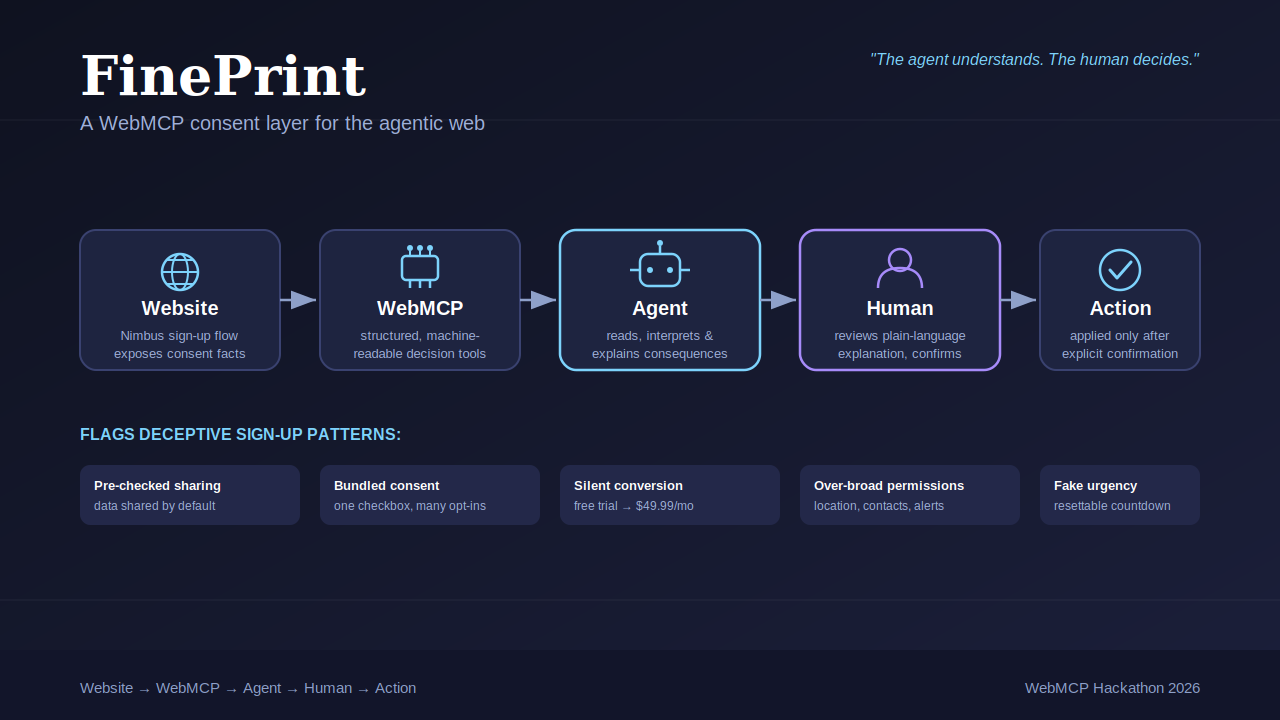
FinePrint explores a simple idea: let the agent read and explain the fine print, while enabling humans to make the final decision.
What it does
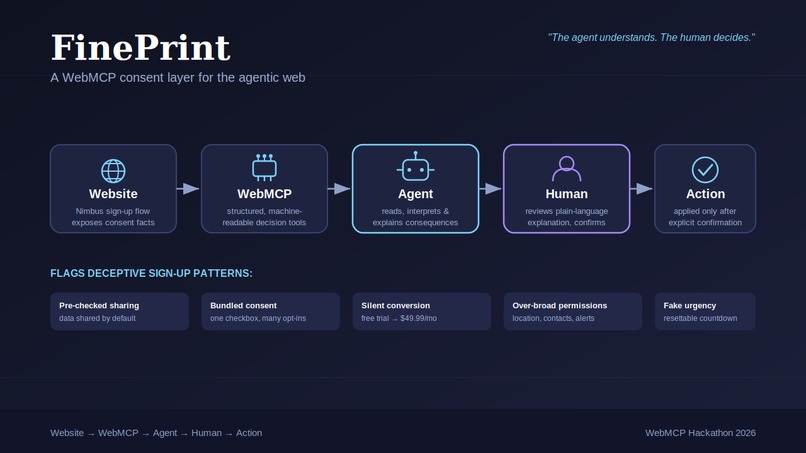
FinePrint is a WebMCP-enabled consent layer that helps people understand and make informed choices before they agree.
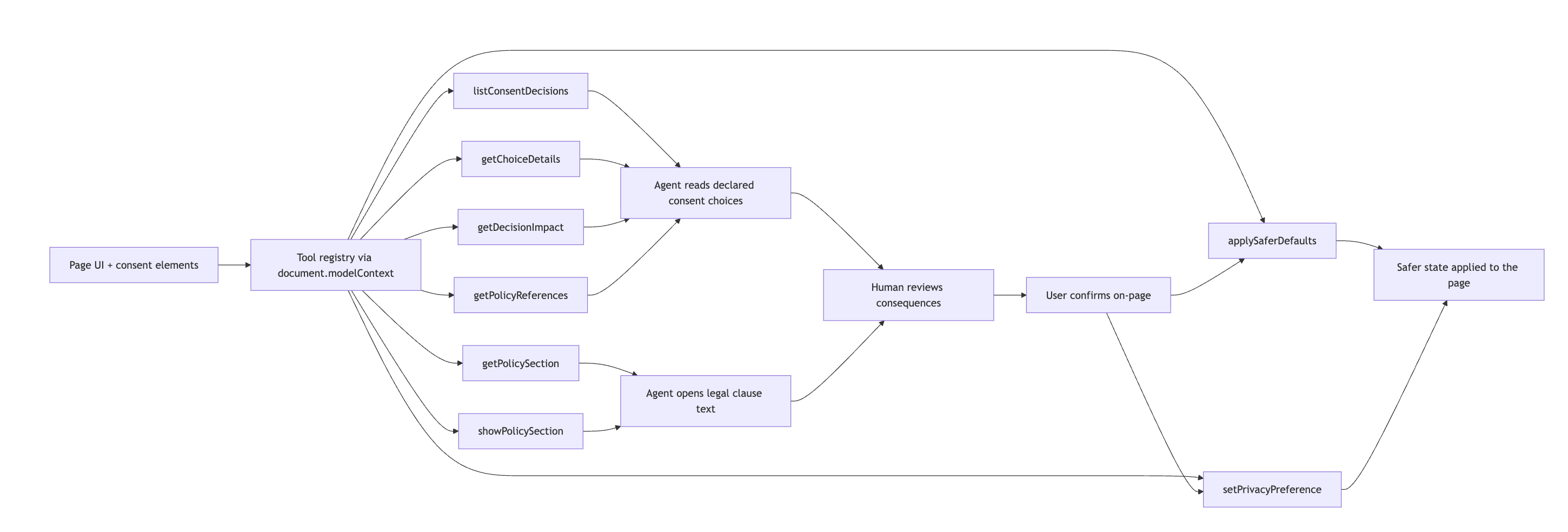
It allows an agent to inspect consent decisions on a website, understand their consequences, find the relevant policy clauses, and explain them to the user in plain language.
Instead of asking a user to read through a cookie notice or hidden legal text, FinePrint can explain what data will be shared, whether the choice can be reversed, and what the relevant policy says.
The agent then pauses and asks the human for confirmation before taking action.
The agent understands. The human decides.
How we built it
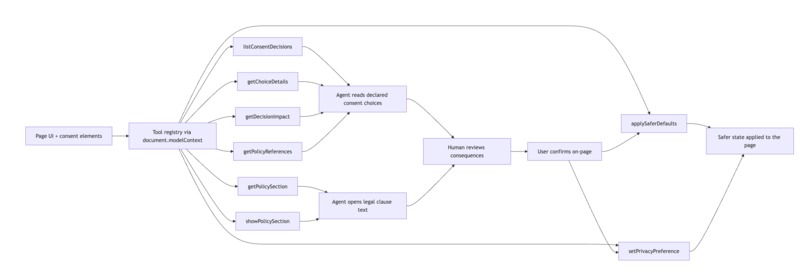
We built a simulated streaming service called Nimbus with a realistic sign-up flow containing multiple consent and decision points. Nimbus exposes structured consent information through WebMCP tools.
An agent can use these tools instead of relying only on visual scraping or guessing from the UI.
For read-only operations, the agent can inspect and explain automatically. For actions that change state, FinePrint introduces an explicit human confirmation before allowing the agent to proceed.
Challenges we ran into
One challenge was moving beyond simply exposing text. The agent needs structured information about what a choice actually means, not just the words displayed on a button.
We also wanted users to see what the agent is doing and track its progress. Designing a visual experience that clearly shows the agent inspecting, understanding, and waiting for confirmation — without overwhelming the user — was another challenge.
Finally, we had to make sure confirmation provides meaningful human control without adding unnecessary friction.
Accomplishments that we're proud of
We’re proud that FinePrint demonstrates a complete interaction loop:
Website → WebMCP → Agent → Human → Action
The agent can discover consent decisions, understand their impact, connect them to the underlying policy, explain them in plain language, and then wait for the human to decide.
We’re especially proud of making human confirmation a fundamental part of the architecture rather than an afterthought.
The result is an experience where agents can handle the tedious work while people retain control over consequential decisions.
What we learned
One of the biggest things we learned was how WebMCP could introduce a new way for websites to integrate AI directly into their experiences.
There’s an interesting parallel with SEO. SEO helped websites structure their content so search engines could discover and understand them. In a similar way, WebMCP gives websites a way to expose structured capabilities and context for AI agents.
Instead of an agent having to infer everything from buttons, text, and UI elements, the website can directly communicate what its actions mean and how they should be used.
With FinePrint, this meant the website could tell the agent what a consent decision means, its impact, and the relevant policy information.
It made us think of a future where websites aren't just search-engine optimized, but agent-ready — designed to communicate with AI as well as humans.
What's next for FinePrint
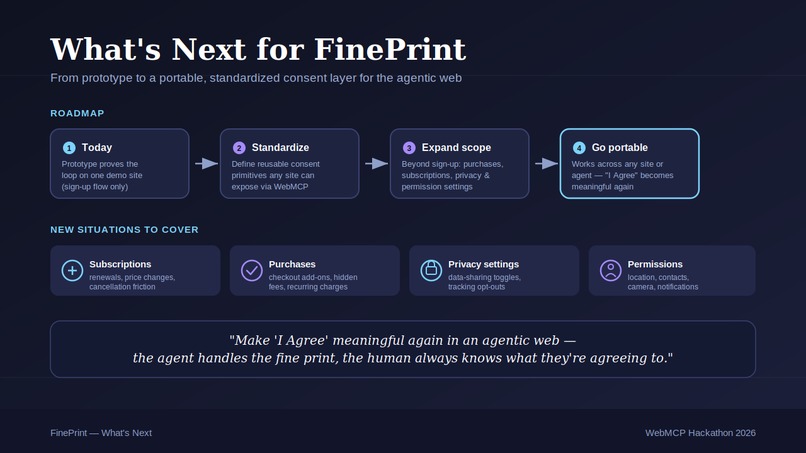
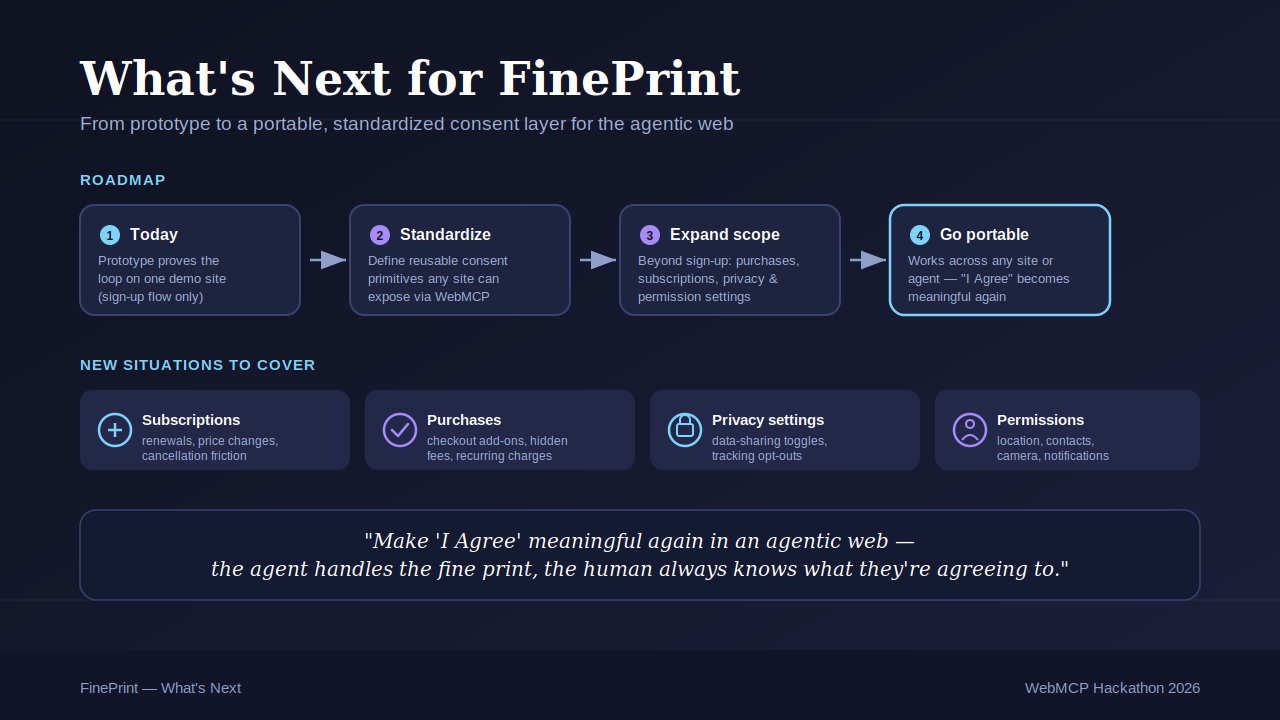
FinePrint is currently a prototype, but we see several directions for taking it further.
We want to explore a standardized set of consent primitives that websites can expose through WebMCP, making the experience portable across different sites and agents.
We also want to expand beyond sign-up flows into other areas such as subscriptions, purchases, privacy settings, permissions, and other situations where an agent may be asked to make a consequential decision on a user’s behalf.
Ultimately, our goal is to make “I Agree” meaningful again in an agentic web — where the agent can handle the fine print, but the human always knows what they are agreeing to.
Built With
- css
- html
- javascript
- vercel
- webmcp

Log in or sign up for Devpost to join the conversation.