Formatting In PDF due to cannot save the full paragraph, issued reported...
Inspiration
Learn contains ear. True listening involves three stages: understanding words, testing assumptions, and learning through daily engagement: all requiring a positive mindset. This made me realize "research" also holds "ear." Seven years ago, witnessing others conduct research felt distant. Four years ago, I formed a YHSA competition team, yet even now, I haven't truly begun research. During undergrad, I actively sought knowledge, watching peers publish their first papers while I struggled to find my own entry point. I’d forgotten the "ear" in "research." Starting demands clarity: What is the focus? What methodology guides it? Why does sharing or reviewing it matter, and what impact might it have? And... financial needs!
My initial drive led me toward research, like my recent delve into arbitration. There, listening to questions helped me grasp contexts, spot overlooked gaps, and perceive hidden angles. Then, I applied my knowledge and skills to address those gaps. Yet, mastering fields like science or business takes time, they’re monuments built over centuries. I once feared my ignorance might tarnish them, much like my stalled research attempt four years ago.
Now I see "years" also carries "ears." Time etches its lessons. Though academia is daunting, I still hope to collaborate with passionate peers in research someday with well prepared tools.
What it does
Use FINEDU to instantly analyze and optimize your project's finances. Simply input basic details about your research or education initiative, and the tool automatically calculates essential metrics like Net Present Value (NPV), Return on Investment (ROI), and break-even points – no finance expertise required. FINEDU empowers you to understand funding needs, explore dynamic visualizations of your data, and run "what-if" scenarios to test different budget options. This enables you to make smarter, data-driven decisions, optimize resource allocation, potentially boost your project's ROI by 15-20%, and prevent millions in wasted funds, ultimately unlocking greater innovation through better financial planning.
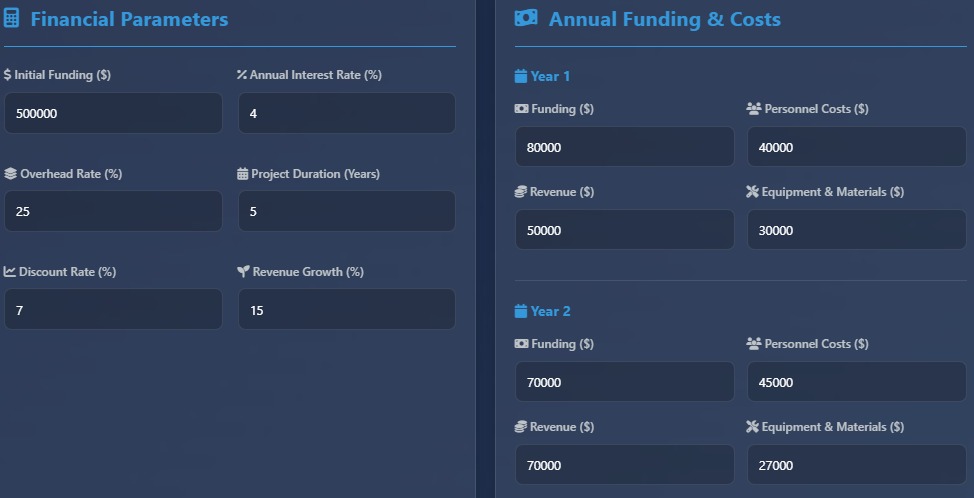
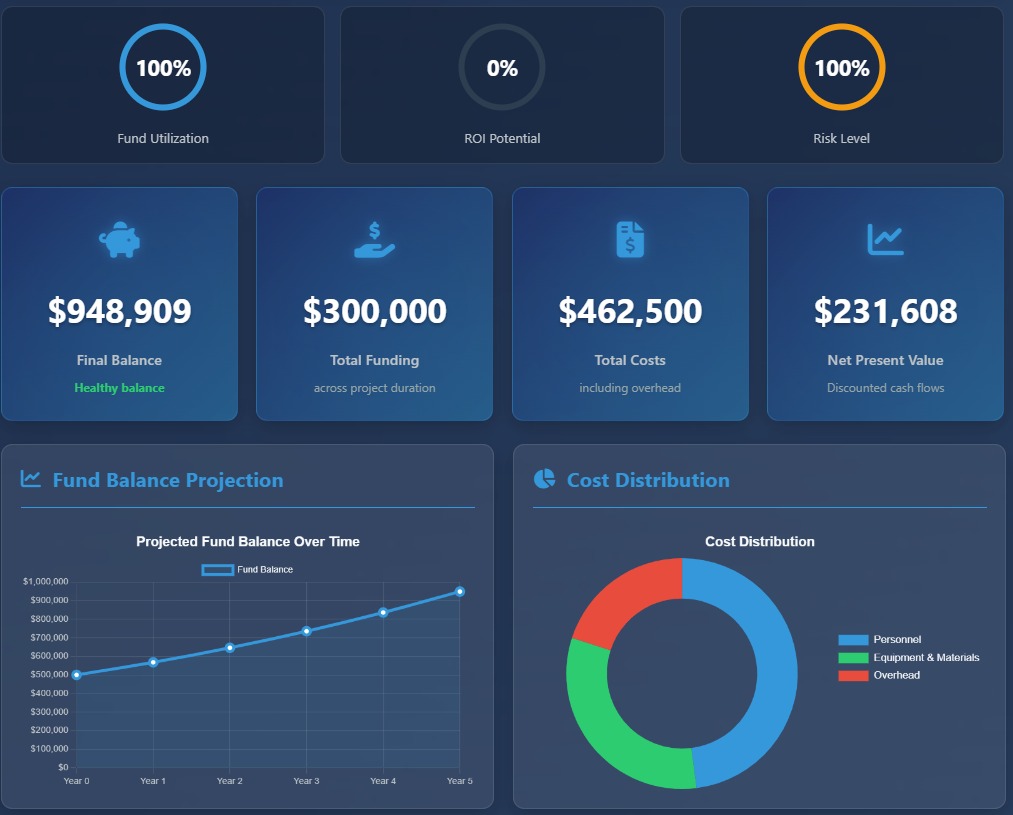
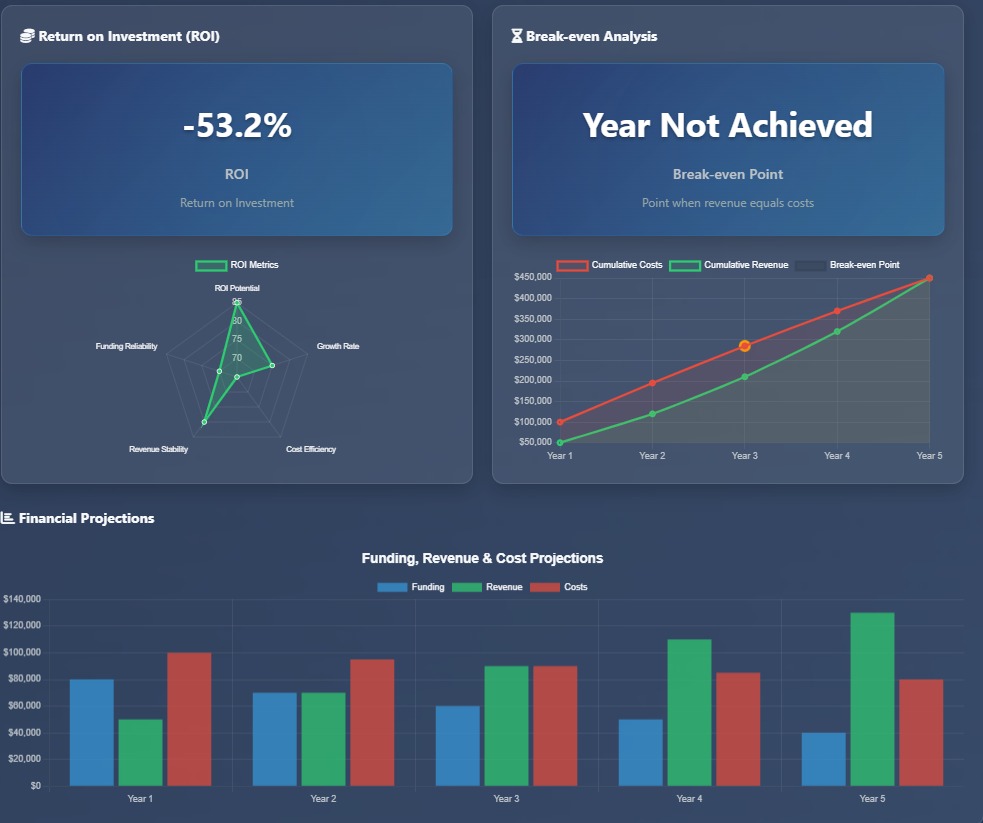
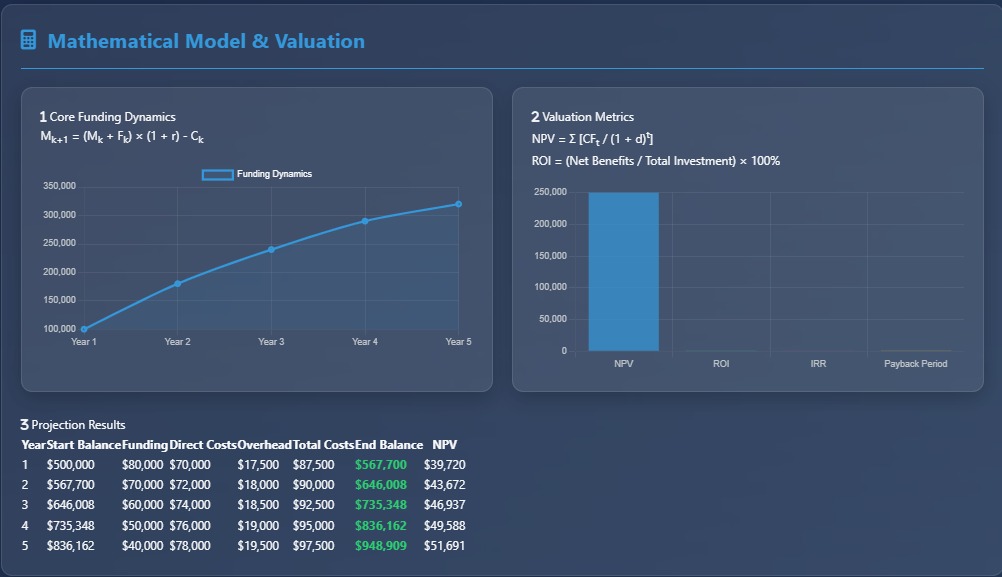
The Research Financial Valuation Model (FINEDU) is a web-based application that integrates education and finance to evaluate research projects by calculating metrics like NPV, ROI, break-even points, fund balances, and cost distributions. It empowers users in underfunded academic settings to optimize budgets and forecast outcomes through user inputs, real-time computations, and visualizations. Built with HTML5 for structure, CSS for intuitive styling, and JavaScript for dynamic calculations (including Chart.js for graphs), the app operates client-side without installations. The input collection function gathers essential parameters: initial funding, annual interest rate, overhead rate, project duration, discount rate, and revenue growth via form fields, storing them for use in core equations like $ M_{k+1} = (M_k + F_k) \times (1 + r) - C_k $. Upon clicking "Calculate Financial Projections," the core computation function processes these inputs iteratively to derive annual funding/costs, NPV ($ \sum [CF_t / (1 + d)^t] $), ROI ((Net Benefits / Total Investment) × 100%), break-even years, and totals, updating displays for final balance, total funding/costs, and NPV.
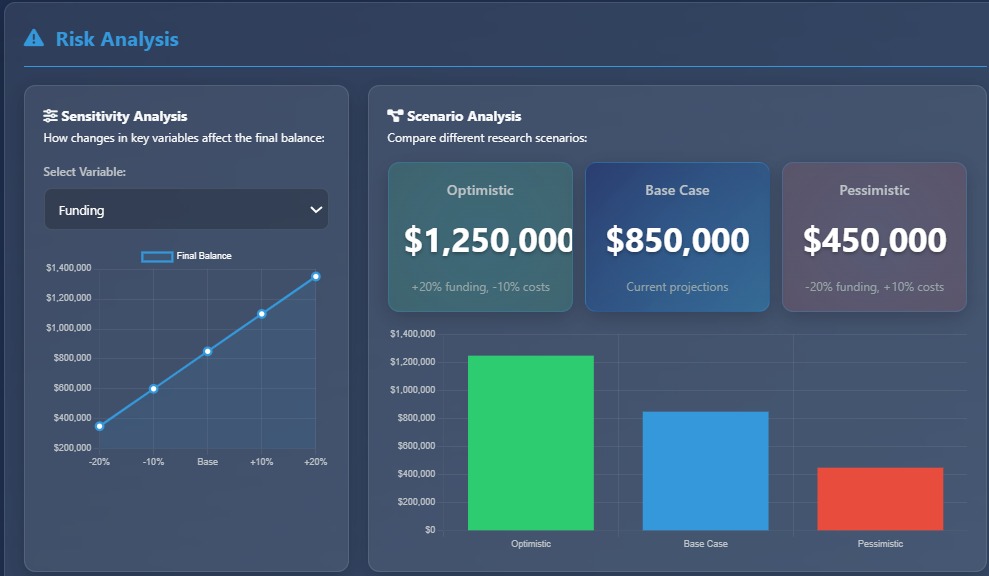
Visualization renders interactive charts for fund balance projections and cost distributions, alongside progress indicators for fund utilization, ROI potential, and risk levels, using canvas elements and JavaScript libraries. Valuation metrics display ROI percentages and break-even points with explanations, while risk analysis handles sensitivity (adjusting variables like ±20% funding) and scenarios (optimistic/base/pessimistic) via dropdowns and buttons, recalculating outcomes dynamically.
Model details present equations and a yearly projections table populated with start balances, funding, costs, and per-year NPV. Additional features include AI-assisted development for formula optimization, PDF export for sharing, and scalability potential via cloud integration, with edge-case validation ensuring reliability.
How we built it
Leveraging our foundational knowledge of secondary school Business, Accounting, and Financial Studies (BAFS), financial lecturer and AI, our science-oriented team first transformed a mathematical model for research and finance. We make use of human creativity and AI prediction tools to adapt financial sector equations to a research context. While these calculations could theoretically be performed in Excel, our goal was to create an interactive HTML/app interface enabling real-time iterative calculations through user-triggered actions like button clicks.
Inspired by teammates' experience in trading competitions, we approached the concept of stock investments holistically into the research and development sector, recognizing that financial components, like stock portfolios, are interdependent and cannot be evaluated in isolation. We subsequently incorporated stock valuation methodology, including bull/bear/normal market scenarios, to address education-sector emergencies. This aligns with Stakeholder Theory by accommodating diverse risk conditions. The final output generates annual Projection Results featuring: Year, Starting Balance, Funding, Direct Costs, Overhead, Total Costs, Ending Balance, Net Present Value (NPV), etc.
Challenges we ran into
First, while we previously implemented a function to export results, its layout varies significantly across devices. This inconsistency means it doesn't currently align with our core tool objectives. Therefore, we've deprioritized this feature for now, leaving the export as raw data. We plan to revisit it as a potential future enhancement. Second, as high school and college students, our direct experience with large-scale research projects is understandably limited. We recognize that real-world research planning involves far greater complexity. However, we've observed that Western universities often provide sophisticated, proprietary funding and financial planning tools. Our goal is to bridge this gap by adapting these powerful concepts for Eastern contexts, fostering faster global evolution through the widespread sharing of innovative ideas.
Accomplishments that we're proud of
Active thinking revealed critical gaps and hidden perspectives in our project. By applying my expertise to these insights, I transformed abstract connections between finance and education into a tangible tool: empowering users to calculate research costs and financial needs, turning obscured concepts into actionable starting points. For example: stock valuation to research valuation
What we learned
At the 2025 Alpha Hackathon hosted by Community Shaper, we teamed up as finEdu (aka fine education in finance and education), comprising a CityU BSc freshman, a MU BSc freshman, a mysterious high school student bound for the UK, and a senior studying finance. As we engaged with other teams, our challenge transcended mere competition; it involved bridging the stark gap between the well-prepared and the disadvantaged. While some teams effortlessly navigated conversations in English, Mandarin, and Cantonese, we often found ourselves struggling to keep up. Amidst these adept competitors, students deeply immersed in science, finance, and the competitive landscape, I glimpsed a world I aspired to join. One summer prior, I encountered a similarly gifted and hardworking student who likened herself to "a fish in an ocean teeming with fish." Like her, these peers moved through networks of mentors, contests, and opportunities that seemed out of reach for us, knowing the intense competitiveness in reality. While they soared, some of us felt trapped, yearning for skies beyond our grasp. Initially driven to emulate their prowess while maintaining a distinctive approach, a pivotal moment shifted my perspective. A teammate in distress sought assistance—his confidence somehow is weakened by the system that pigeonholes 'weaker' students into ill-suited pathways. These individuals are not slow; they are simply stranded, coerced by well-intentioned adults towards finish lines, a possible future that can pass but not well usage of knowledge, instead of fostering solid foundations. This poignant encounter unveiled the true essence of the hackathon: not merely about coding or pitches, but about modifying an equitable education system that fails to offer equal opportunities to all.
What's next for finEdu~for R&D Valuation
Phase 1 strengthens finEdu’s core with Monte Carlo simulations for realistic "bull/bear/emergency" scenario modeling, drag-and-drop NPV interfaces for non-finance users, and Excel/API integrations to automate data workflows. A drag-and-drop NPV interface empowers users to build financial models visually, eliminating complex formulas. Users start by dragging key elements like Funding, Direct Costs, Overhead, and Discount Rates from a toolbox onto a digital canvas. They then connect these components intuitively linking Funding to Cash Inflows or Direct Costs to Cash Outflows, to map financial relationships. Values can be adjusted in real-time using sliders, input fields, or interactive timelines (e.g. dragging a curve to simulate funding growth rates). Finally, a single "Calculate" click generates instant NPV results alongside dynamic visualizations like cash flow charts and scenario comparisons, transforming abstract numbers into actionable insights.
Phase 2 embeds equity through Pathfinder AI, adapting complexity for under-resourced students while stakeholder policy simulators and trilingual (EN/CN/Cantonese) support dismantle language and systemic barriers. finEdu hardwires equity into its framework through three core innovations: The Pathfinder AI dynamically adapts financial modeling complexity, simplifying advanced NPV concepts for under-resourced students while offering deeper customization for experienced users, ensuring no learner is left behind or misdirected onto unsustainable paths. Stakeholder policy simulators expose hidden systemic biases by quantifying how institutional decisions (e.g., funding cuts, overhead rules) disproportionately impact marginalized researchers. Finally, native trilingual support (English, Mandarin, Cantonese) eliminates language as a barrier to access, with financial literacy tooltips, video tutorials, and interface labels localized for Hong Kong’s linguistic diversity. Stochastic modeling extends our valuation approach to education crises, partnerships convert resources into open-source templates, and prioritizing accessibility over elitist speed ensures no student is pushed onto misaligned paths. Ultimately, finEdu transformed from excluded researcher to involved in R&D starting from finance planning.
Built With
- ai
- break-even-analysis
- canvas-api
- chart.js
- chatgpt
- client-side-mvc
- css3
- deepseek
- dom-manipulation
- financial-modeling
- firebase-firestore
- font-awesome
- google-cloud
- grok-ai
- html2pdf.js
- html5
- javascript
- math.js
- net-present-value-(npv)
- node.js-+-express
- oauth-2.0
- responsive-design
- return-on-investment-(roi)
- scenario-modeling

Log in or sign up for Devpost to join the conversation.