-
-
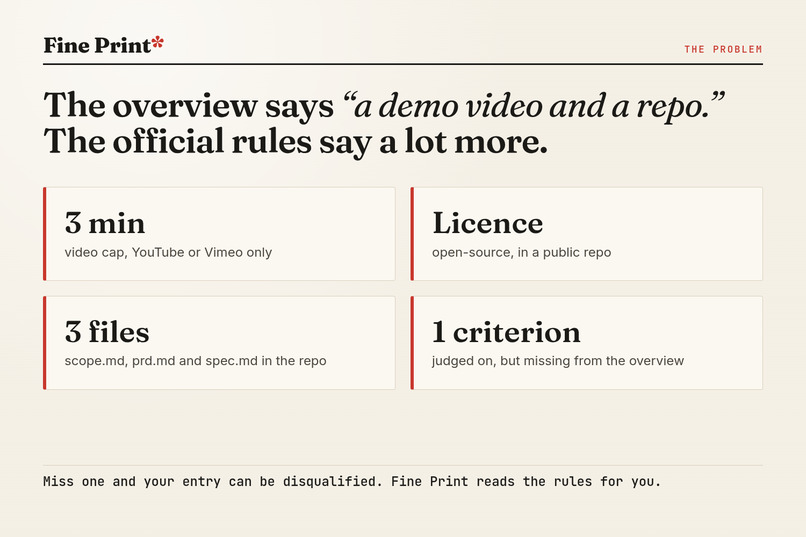
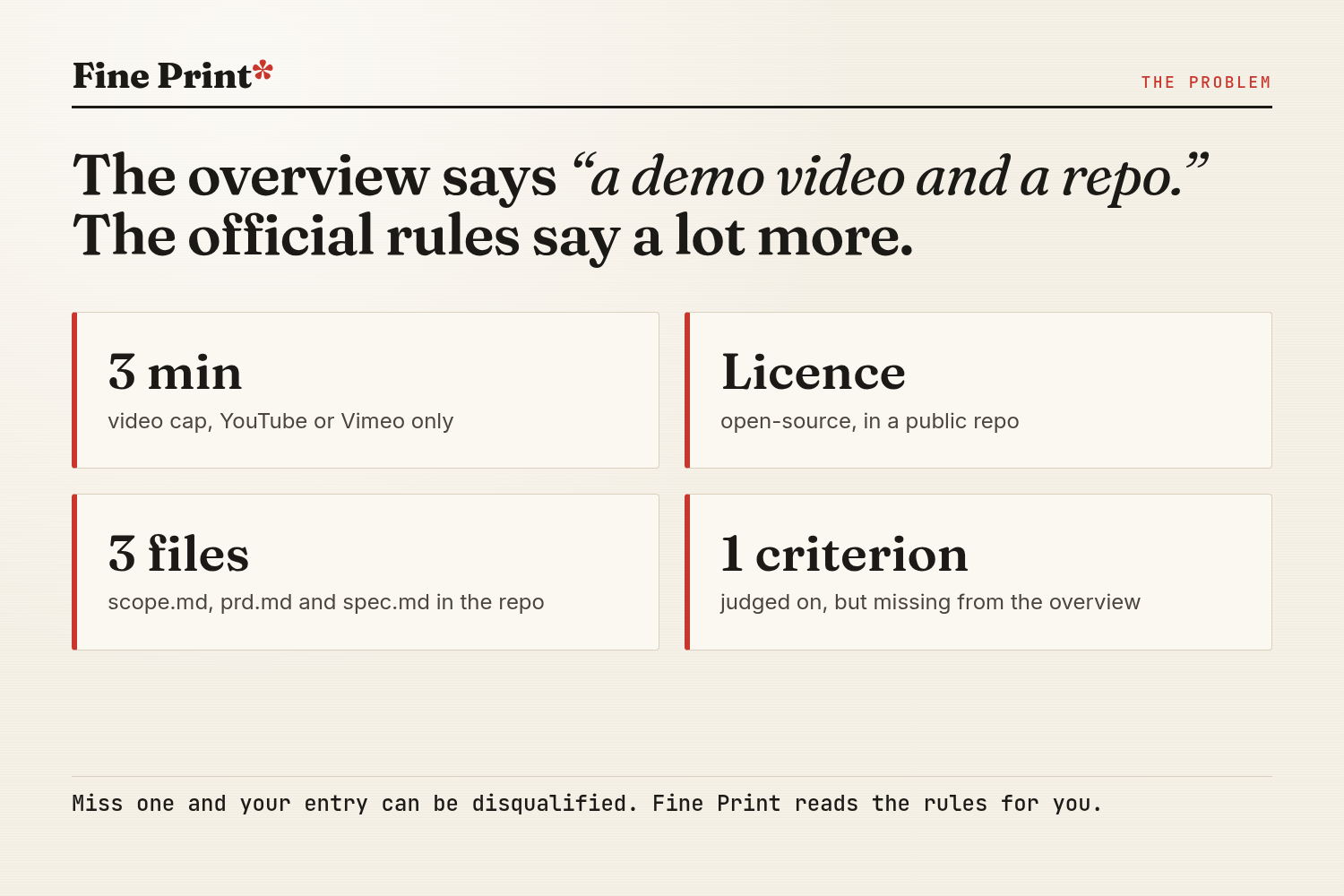
The overview vs the official rules
-
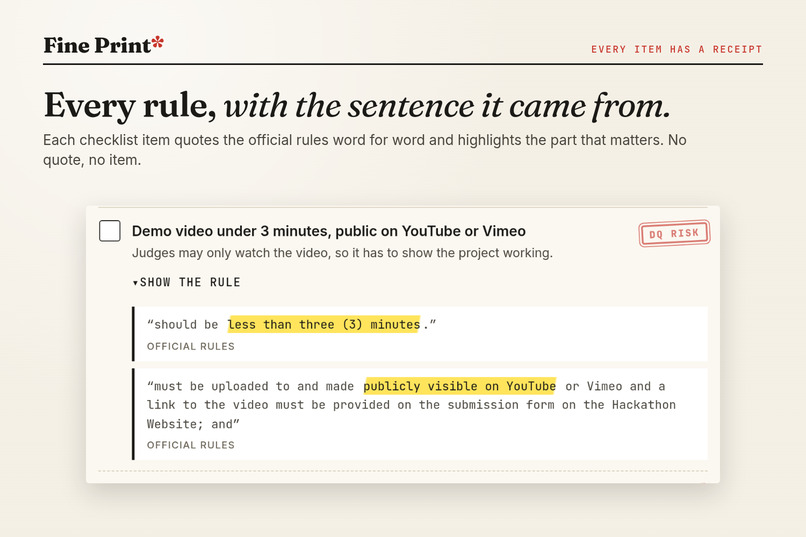
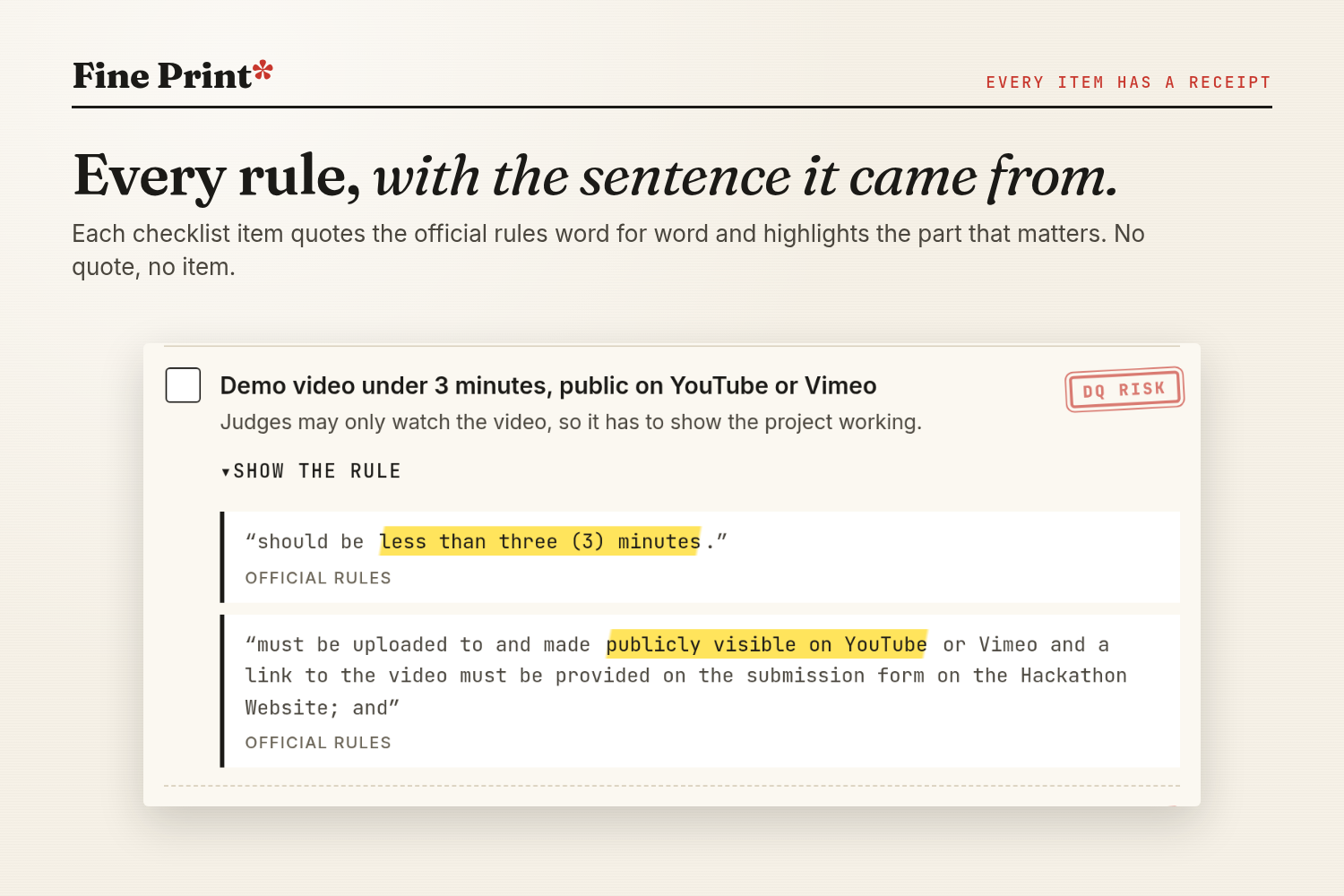
Every item comes with the exact rule
-
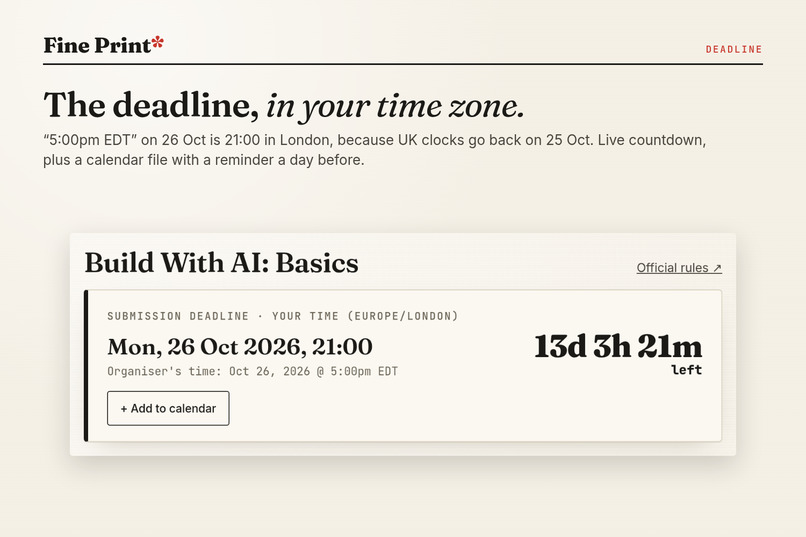
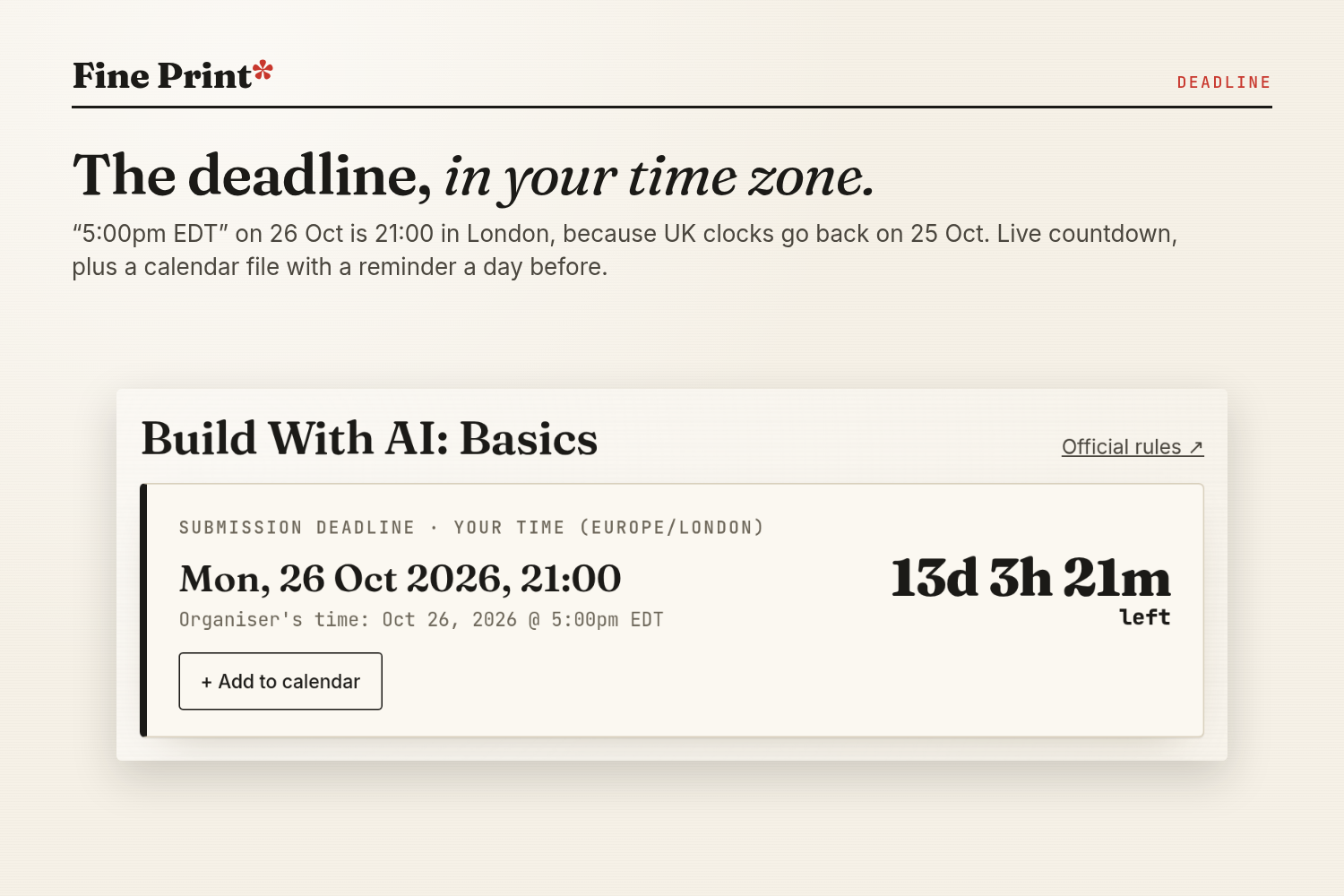
Deadline in your own time zone
-
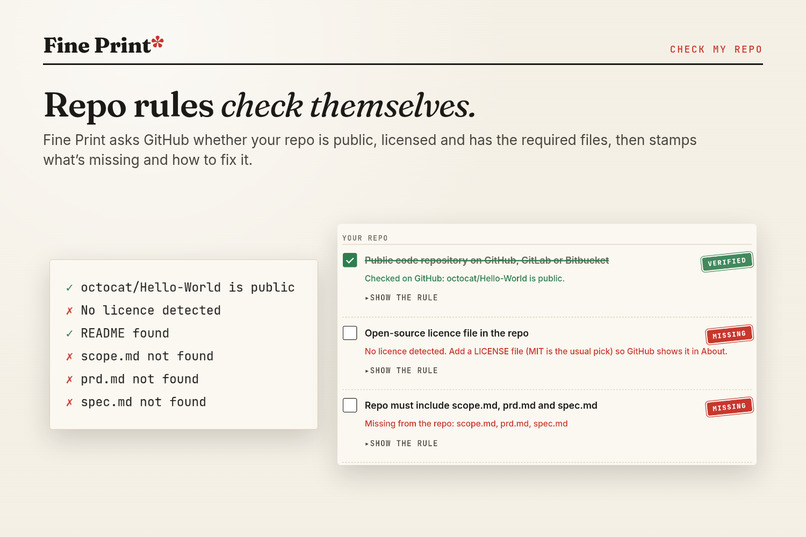
Repo check against the rules
-
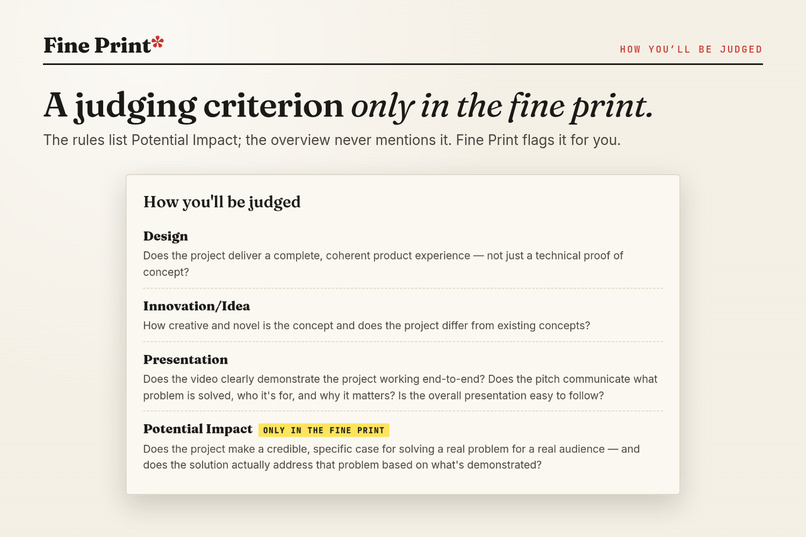
Criteria that only appear in the fine print
Inspiration
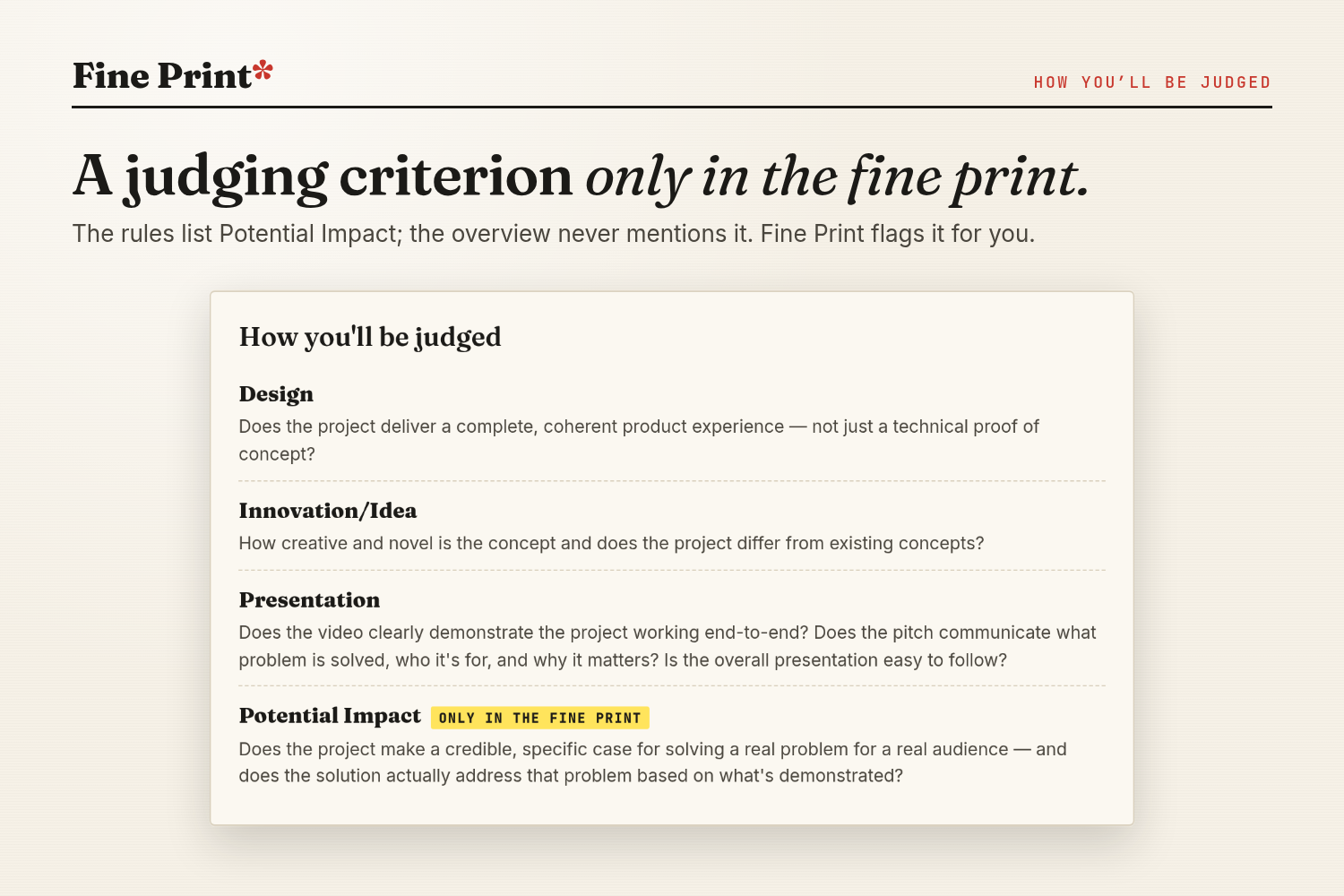
I've signed up for a lot of hackathons, and the overview page never tells the whole story. The things that can get you disqualified are buried in the official rules: a video cap, which hosts the video can go on, a licence file, specific files your repo has to include. Even this hackathon's overview gives three requirements, while the rules add a 3-minute video limit, YouTube or Vimeo only, an open-source licence, and a fourth judging criterion the overview never mentions. I wanted a tool that reads the fine print for me and shows its working.
What it does
Paste a Devpost hackathon link and Fine Print reads the overview and the full official rules. It gives you:
- Every rule that can disqualify you, as a checklist in plain English. Each item has a receipt: the exact sentence from the rules, with the important part highlighted. If there's no quote, there's no item, so nothing is made up.
- The deadline converted to your own time zone, with a countdown and a one-click calendar file that reminds you a day before.
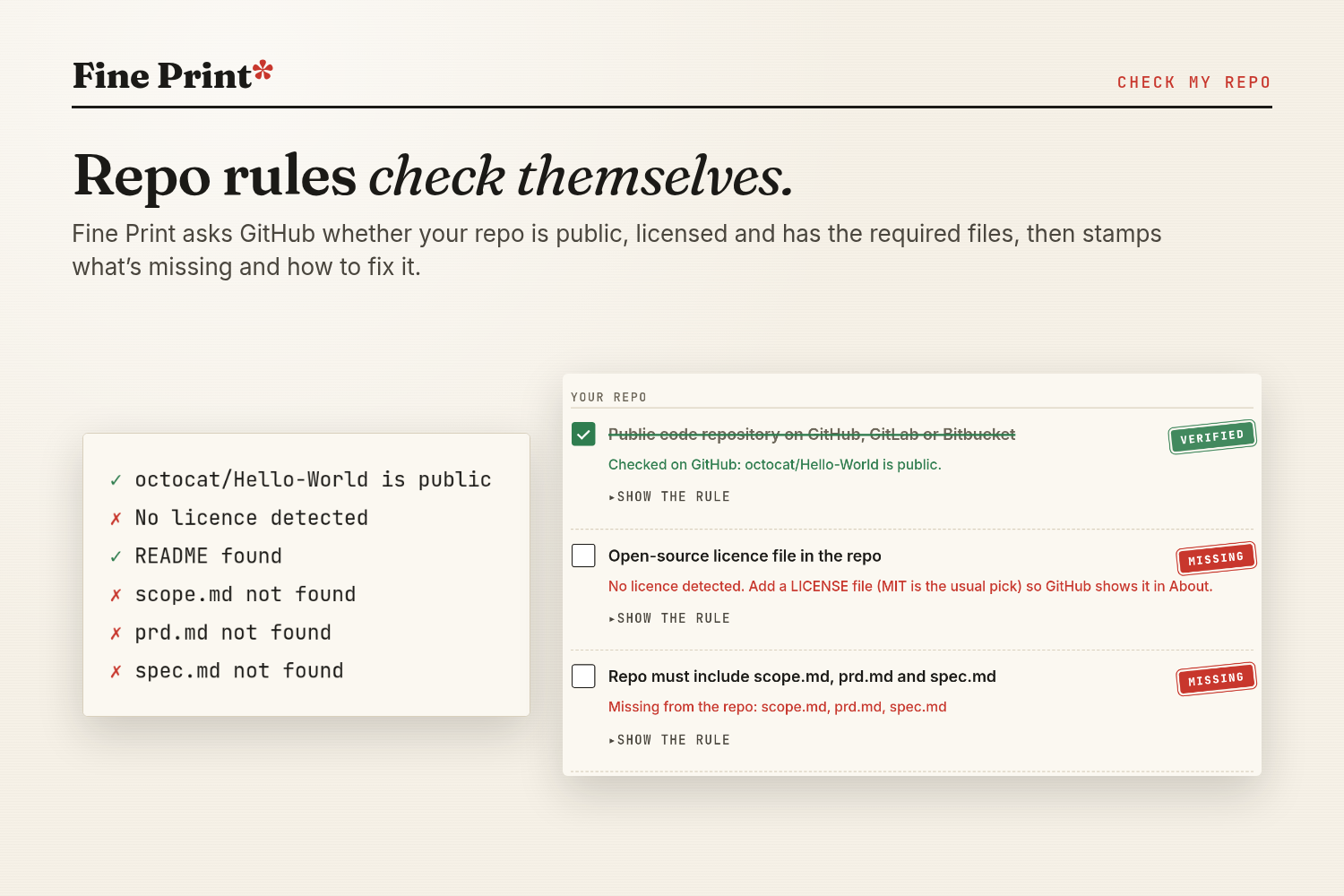
- A repo check: paste your GitHub repo and Fine Print checks whether it's public, whether it has a licence, and whether the files the rules require are there. Repo items turn green on their own or tell you exactly what's missing.
- The judging criteria, with a flag on any criterion that only appears in the official rules.
Your ticks are saved in your browser, so you can come back to it while you build.
Who it's for
First-time and solo hackathon entrants who skim the overview, build for a week, and only find the disqualifying rule when they go to submit.
How I built it
I used the Devpost Learn Skill Pack with an AI coding agent. Before any code was written, I worked through scope, a PRD and a spec, all in the repo under devpost/. Then I built it in three slices: rules to receipts checklist, saved progress and calendar export, then the GitHub check. It's plain HTML, CSS and JavaScript on the front end, with two small Node serverless functions on Vercel: one reads the Devpost pages, and one asks GitHub's public API about the repo. There's no database and no AI model at runtime. The requirement detectors are deterministic, so every result can be traced back to a sentence.
Challenges
Rules pages are long legal documents, and the same idea is worded differently from one hackathon to the next. Early detectors grabbed the wrong sentences, like treating "must be authorized to use" a third-party tool as a required technology, or reading a sentence about complying with open-source licences as a licence requirement. Testing against saved rules from several real Devpost hackathons caught these, and each fix got a test.
What I learned
Planning first paid off. Writing the scope made me cut things I would otherwise have half-built (accounts, other platforms, AI analysis) and focus on the one thing that matters: a checklist you can trust. I also learned that a checklist you can't verify isn't worth much. The receipts are the whole point, and they're why I chose simple pattern matching over an LLM.
What's next
Support for other hackathon platforms, GitLab and Bitbucket repo checks, and a reminder before the deadline.
How it was checked
The agent I built it with was Hark. Before submitting, I had three AI judges review it for design, impact and presentation, then fixed what they found: mobile bugs, false "ready" signals, and a demo caption that got the UK clock change wrong. A sweep of all 40 open Devpost hackathons now finds the deadline on 40 of 40 and rules on 29.
Built With
- css
- devpost-learn-skill-pack
- github-api
- hark
- html
- javascript
- node.js
- vercel

Log in or sign up for Devpost to join the conversation.