-
-
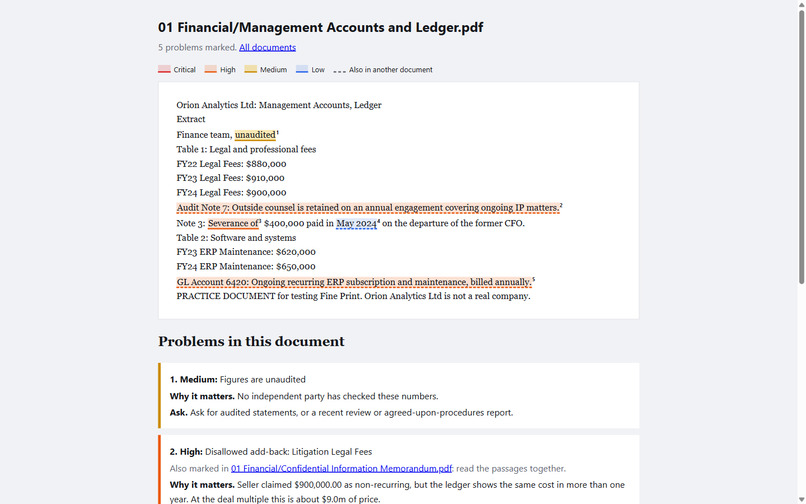
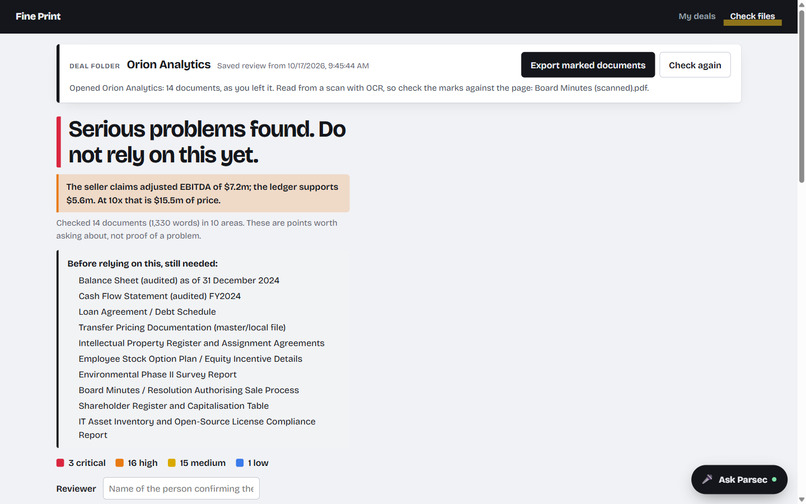
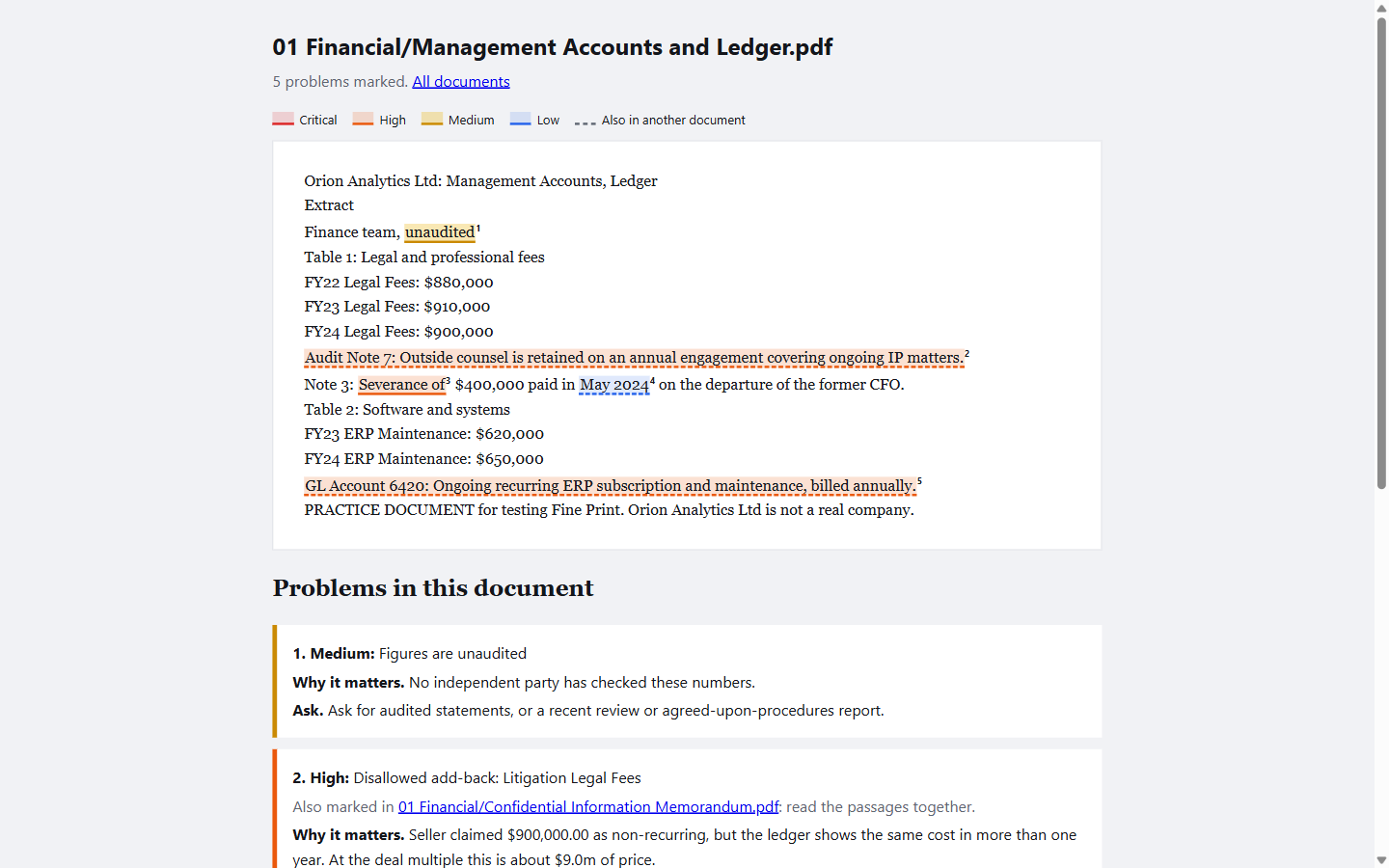
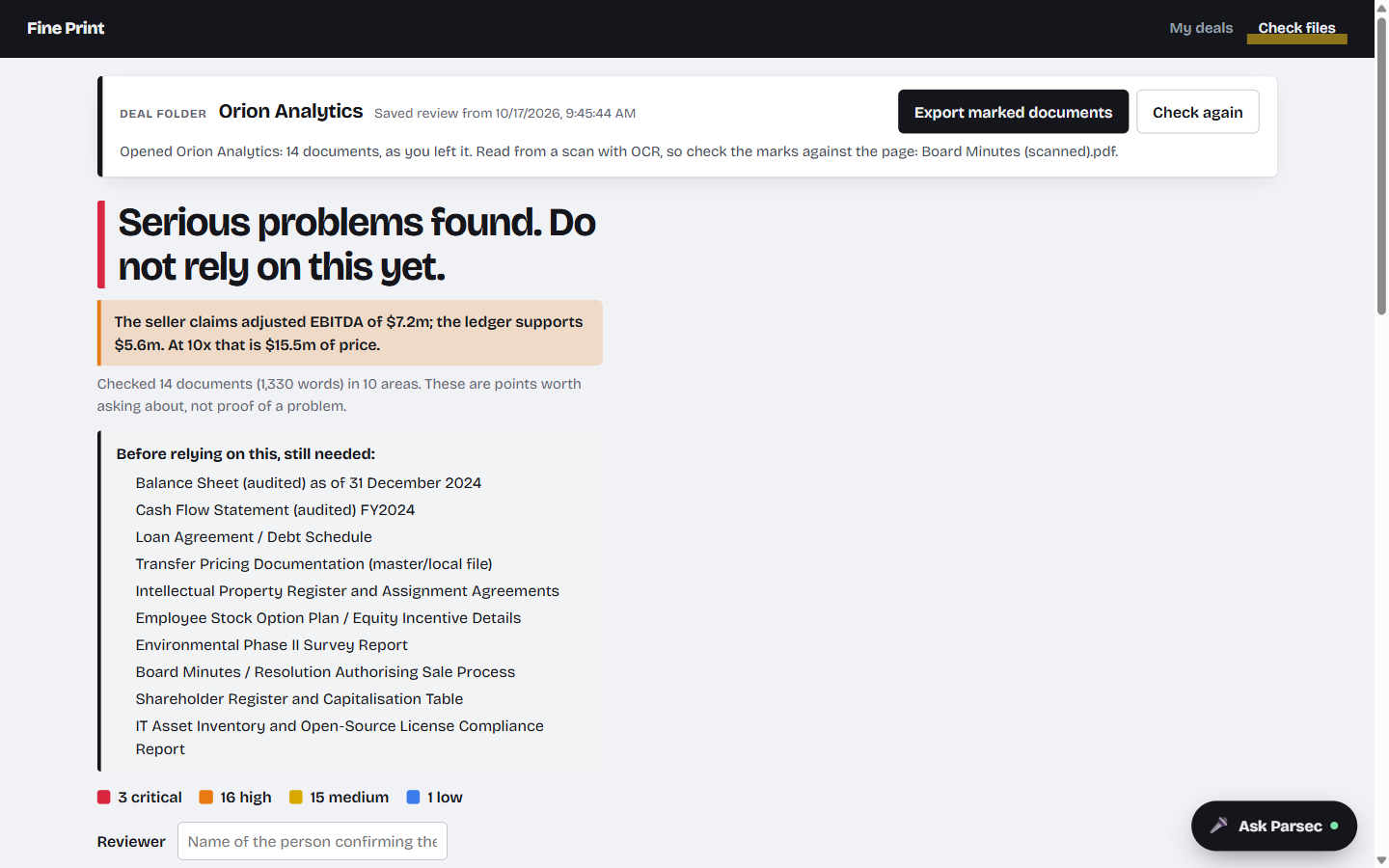
The verdict at a glance: $7.2m EBITDA claimed, $5.6m supported by the ledger, $15.5m of price. Plus what's still missing.
-
Export: a highlighted, numbered copy of every document and a summary, ready to send.
-
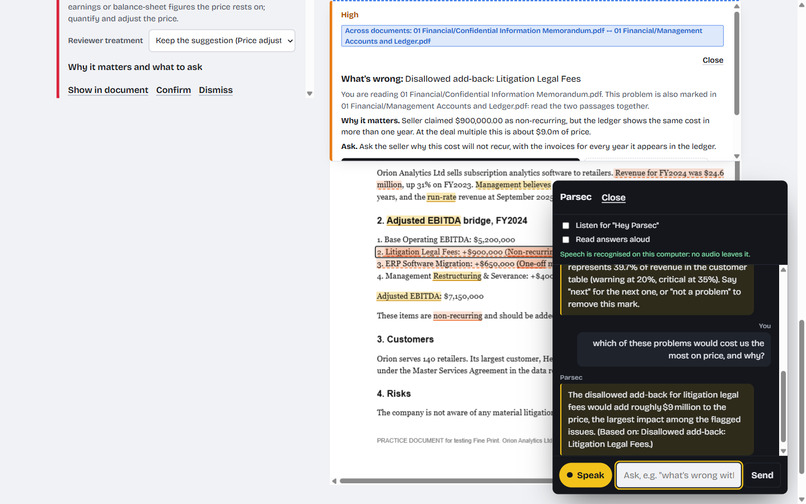
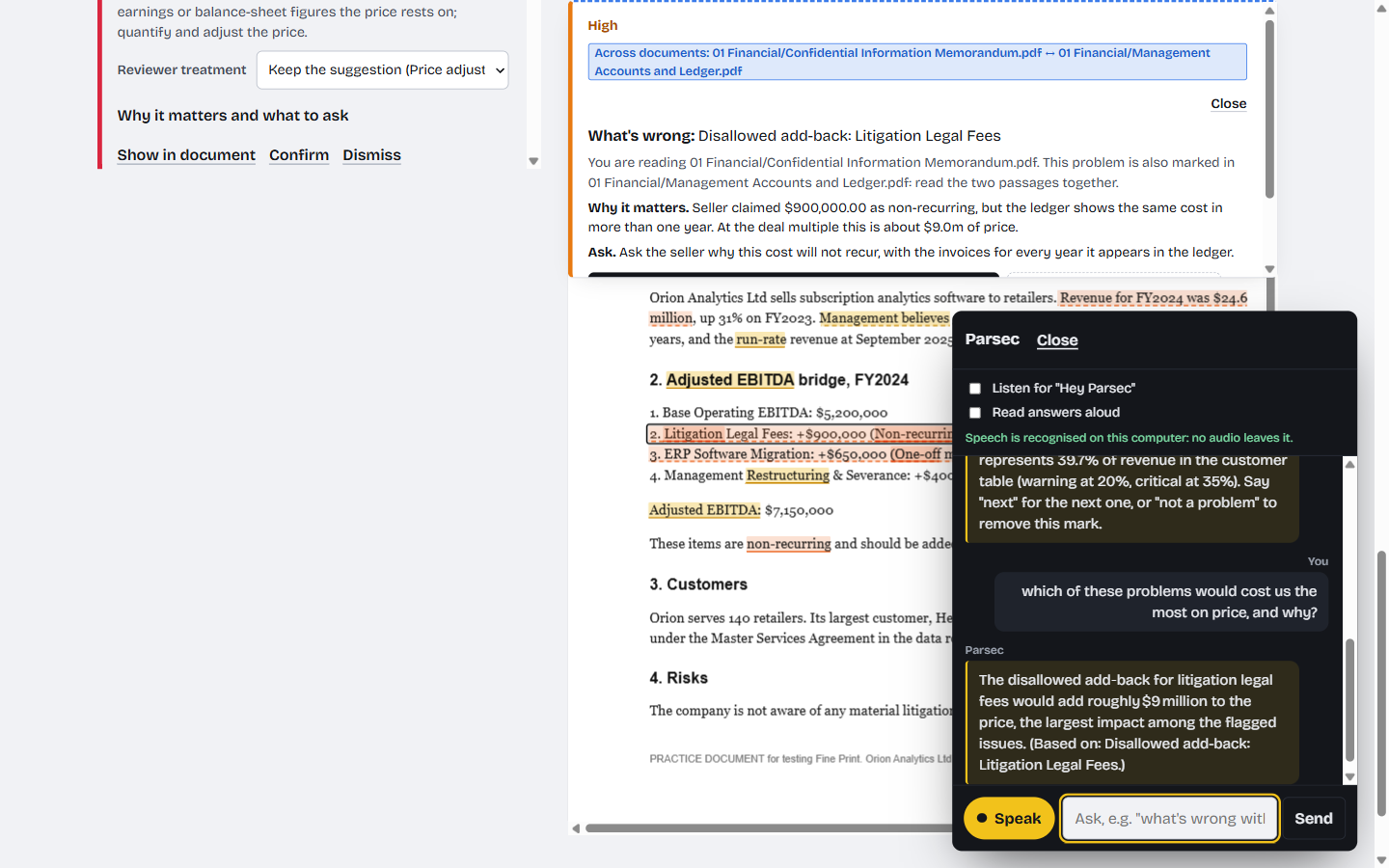
Ask Parsec which problem costs most on price. Nemotron Super answers only from verified findings and cites them.
-
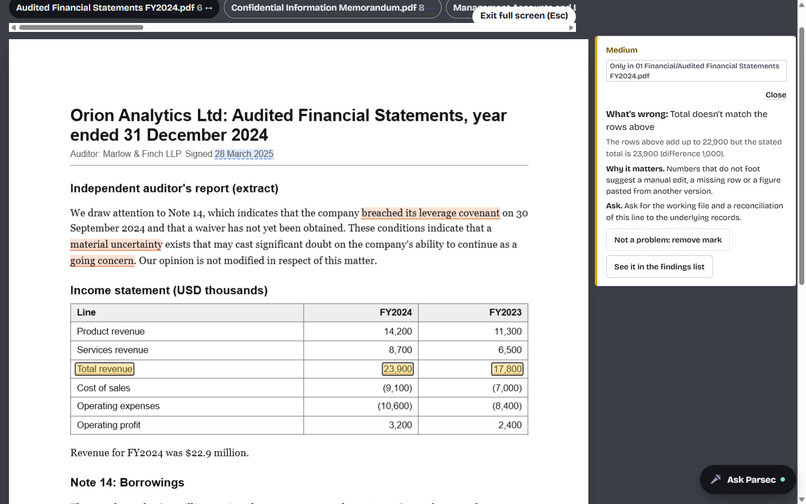
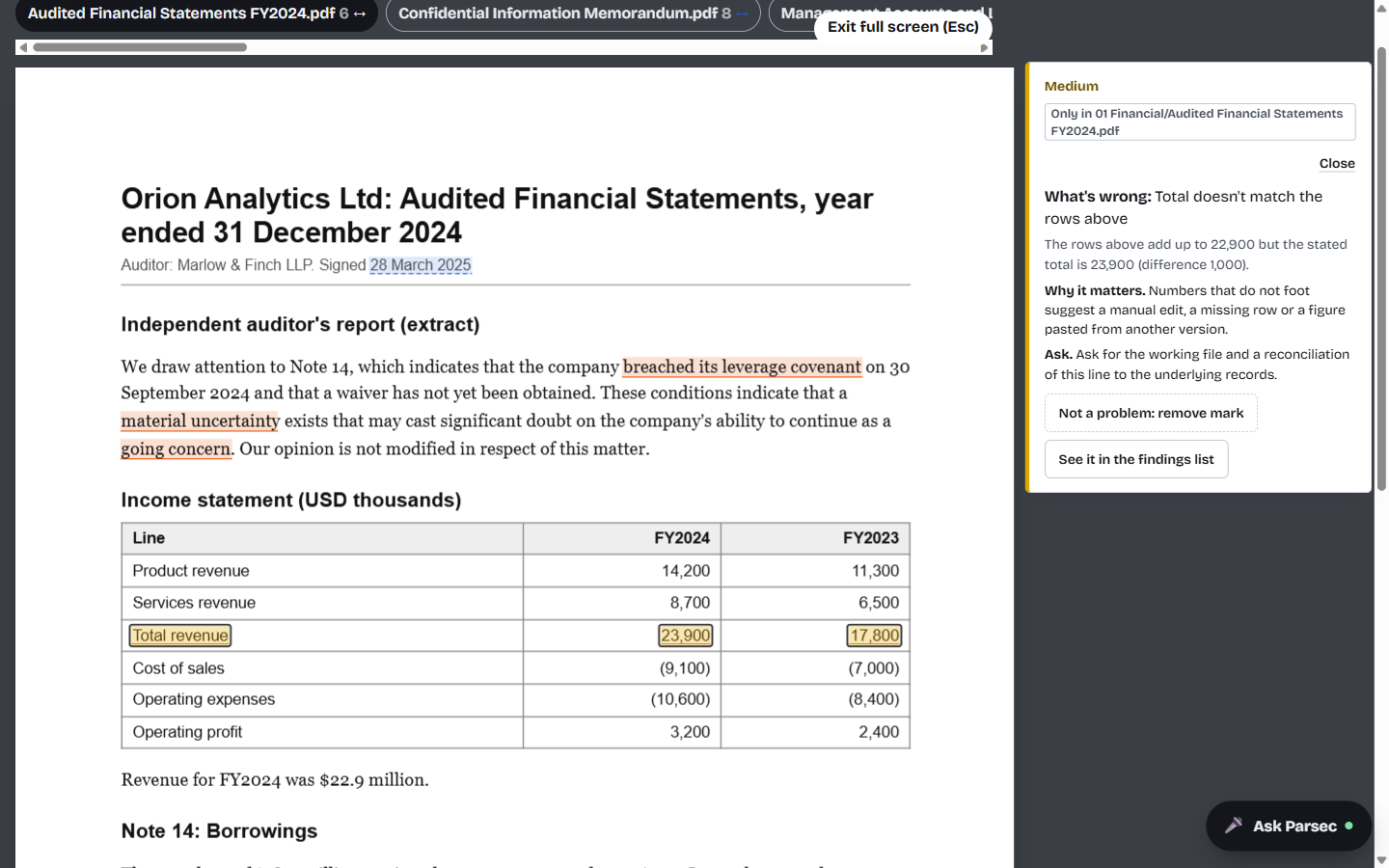
The original PDF page, marked: Total revenue says 23,900, but the rows add up to 22,900. Code did that sum, not the model.
-
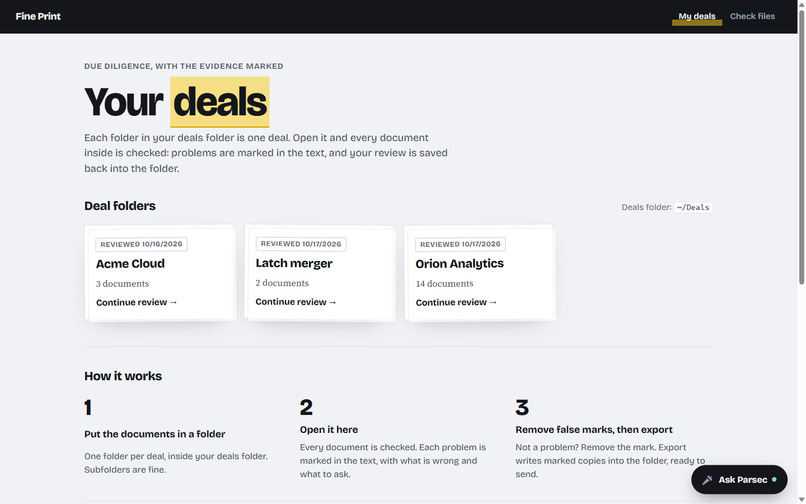
My deals: one folder per deal. Open one and every document is checked across ten due diligence areas.
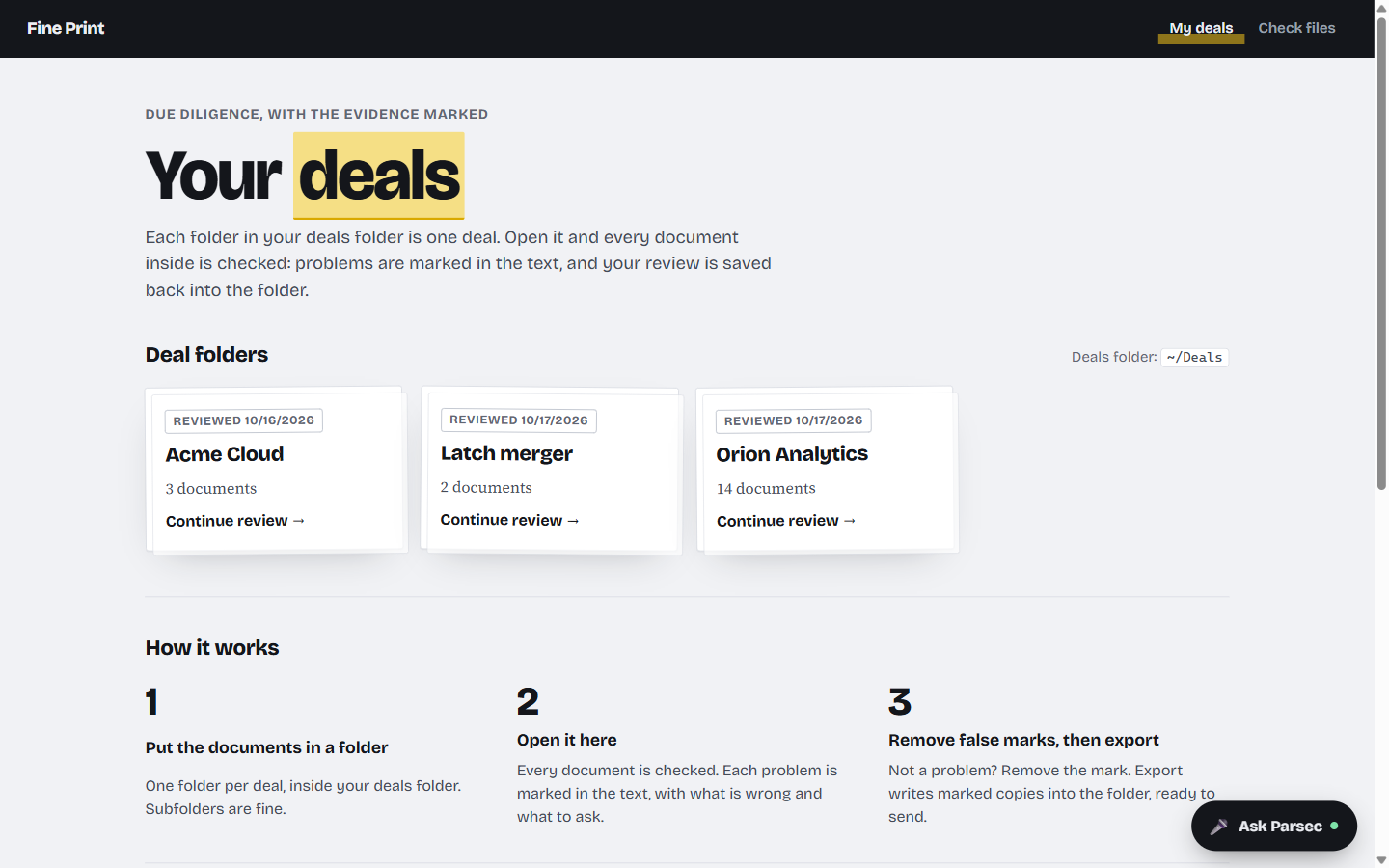
Trying the live demo? The deal list starts empty. Click Download the practice deal, unzip it, then press Choose a folder and pick it: you get Orion Analytics, the deal shown in the video.
What makes it different
- The model proposes, code decides. Every Nemotron answer is checked by code before it is shown: quotes against the text, sums against the totals, citations against the findings. What fails is dropped and counted.
- Evidence on the original page, across documents, scanned PDFs included.
- AI deep read and online check on any documents. The deep read adds points the rules missed, each quoted word for word; Tavily checks public sources on the companies named.
- Smallest Nemotron per task (Nano, Super, Ultra, each with a fallback). Nothing is simulated: if no model answers, the page says so.
- Measured on real, held-out data: 80% clause recall on CUAD contracts; 16 of 20 fresh earnings releases read completely, 0 misread.
Inspiration
Before a company is bought, the buyer gets 30 to 90 days to check it. The seller fills a data room with contracts, accounts, customer lists, tax letters and leases (a mid-sized deal holds 5,000 to 12,000 documents), and lawyers and accountants read their part against the clock.
AI review tools exist, but reviewers keep reporting the same two problems with them: answers that are not tied to the source, and false flags they cannot easily remove. In due diligence an untraceable answer is worse than no answer, because someone signs off on it. So we built around the opposite rule:
The model proposes. Code decides what is kept.
What it does
Fine Print opens a deal folder and checks every document (PDF, Word, text, HTML, CSV) across ten due diligence areas: financial, legal, compliance, technology, people, property, tax, customers, suppliers and document integrity.
- Marks on the real page. PDFs are shown as their original pages, with each problem marked on its words and coloured by severity. Select a mark to see what is wrong, why it matters and what to ask the seller.
- Across documents. When documents disagree (revenue of $24.6m in the CIM, $22.9m in the audited accounts, $21.8m in scanned board minutes), the problem is marked in each, and one click opens the other document at the matching figure.
- Earnings quality. NVIDIA Nemotron reads the Adjusted EBITDA bridge, and code checks every add-back against the ledger. "One-off" costs that recur every year are disallowed, and the price impact at the deal multiple is shown: $7.2m claimed, $5.6m supported, $15.5m of price.
- What is missing. Nemotron Super lists, in analysts' terms, what to request before relying on the file.
- AI deep read. On any documents, Nemotron Super finds clauses and risks the rules missed. Every point must quote the document word for word, or it is thrown away.
- Online check. Tavily searches public sources about the companies named in the documents, with questions for each area (lawsuits for legal, tax disputes for tax, breaches for technology).
- Findings memo. Nemotron Ultra drafts the memo; every point must cite a verified finding, and any number must appear in the evidence it cites.
- Questions and deal tracker. Every finding becomes a question to send the seller, plus a request list and Q&A log by workstream, downloadable as CSV.
- Not a problem. Remove a false mark in one click (or by voice), and it stays removed when the documents are checked again.
- Scanned PDFs. Image-only pages are read with OCR on the server, so scans never leave it, and are marked like any other page.
- Parsec, the assistant. Typed or spoken: "open Orion", "full screen", "which problem costs us most on price?", "not a problem", "export". It can never remove, confirm or export anything by itself.
- Export. A highlighted, numbered copy of every document and a summary, written into the deal folder and downloaded as a zip.
How we built it
A FastAPI server and a plain JavaScript front end. The same rules engine runs in the browser and on the server (Node), so documents can be checked without being uploaded. pdf.js draws the pages, mammoth reads Word files, tesseract.js reads scans, and Tavily powers the online check.
Every model call goes through one gateway to NVIDIA Nemotron 3 on Nebius Token Factory, which retries, falls back, meters tokens and prices each call against a daily budget. Each task is routed to the smallest model that does it well:
| Task | Model (fallback) | What code checks before it is shown |
|---|---|---|
| Clause pass, AI deep read | Nemotron 3 Super 120B (Nano) | The quote must be in the passage, verbatim, or it is dropped |
| EBITDA bridge | Super (Nano) | Every line is found in the document, and the lines add up to the stated total |
| Findings memo, committee questions | Nemotron 3 Ultra 550B (Super) | Every point cites a verified finding, and every number appears in that evidence |
| Parsec, the assistant | Super (Nano) | Only listed actions, only real documents, answers cite real findings |
Nebius Token Factory made this practical. One OpenAI-compatible endpoint serves three model sizes with one key, so moving a task to another model is one line of YAML, and usage on every reply let us price every call. It was also cheap enough to measure honestly: $0.49 for the Nemotron clause pass over 30 held-out contracts, and about half a cent per earnings release.
Measured on real data
Every figure comes from a script in the repository. We tuned on one half of each dataset and tested once on the held-out half.
| What | Data | Result |
|---|---|---|
| Rules + Nemotron Super clause pass | 30 held-out CUAD contracts, 136 lawyer-labelled clauses | 80% recall (rules alone 54%), 0 failed calls |
| Nemotron Super reading EBITDA reconciliations | 20 fresh SEC 8-K earnings releases | 16 read completely and add up, 0 misread |
| Rules, 15 clause categories | 255 held-out CUAD contracts | recall 27% → 58% after tuning |
Challenges we ran into
- Throwing away our own numbers. Our first benchmarks scored the system on synthetic data rooms we had written ourselves, and they looked great. We realised they only proved the rules matched our own answer keys, so we removed all of it and re-measured on real, lawyer-labelled CUAD contracts and real SEC filings. The numbers went down, but they mean something.
- Reasoning models running out of answer. Super sometimes spent its whole token budget reasoning on long batches, and Ultra sometimes returned its reasoning instead of the answer. We raised the budgets, added
/no_thinkand explicit instructions, and made the gateway report an empty answer and retry on the fallback, never simulate one. - Quotes that almost match. Models return curly quotes and non-breaking hyphens, so verbatim checking needed normalisation; without it, correct findings were being dropped.
- Marks on real PDF pages. Placing a highlight on the exact words of an original page, including scanned ones read by OCR, took text-layer geometry, letter widths and OCR word boxes.
- Tiers that did not pay. We built Nano triage and an Ultra second opinion, measured them, and switched both off: triage skipped nothing on long documents, and Ultra rulings cost about 3.7× for no measured gain.
What we learned
- Verification is the product. A model answer becomes useful in due diligence only when code can tie it back to the page.
- Measure on data you did not write, and keep a held-out half you touch only once.
- Route by task, not by habit. Super was the best value for reading; Ultra earned its cost only for the final memo.
- Nano answered "which problem hurts the price most?" by repeating the question, so the assistant runs on Super.
What's next
- More languages: the rules are English-only patterns today.
- Larger data rooms: the AI deep read covers about the first 96,000 characters of a request; the clause pass and the rules already read everything.
- Integrations with virtual data room providers, so a deal opens straight from where the seller shares it.
Built With
- css3
- docker
- fastapi
- html5
- javascript
- mammoth.js
- nebius-token-factory
- nemotron-3-nano
- nemotron-3-super
- nemotron-3-ultra
- node.js
- nvidia-nemotron
- pdf.js
- postgresql
- python
- render
- tavily
- tesseract.js
