Inspiration
Living in a coastal city, I watched plastic waste pile up on local beaches and grew frustrated with how hard it was to find truly zero-waste stores. As someone trying to cut plastic from my daily life, I wanted a tool that made sustainable shopping easy—no more endless Google searches or guessing which stores offered bulk goods. That’s where PackageFree Finder was born: to turn the overwhelming zero-waste journey into something accessible for everyone, from newbies to seasoned eco-advocates.
What it does
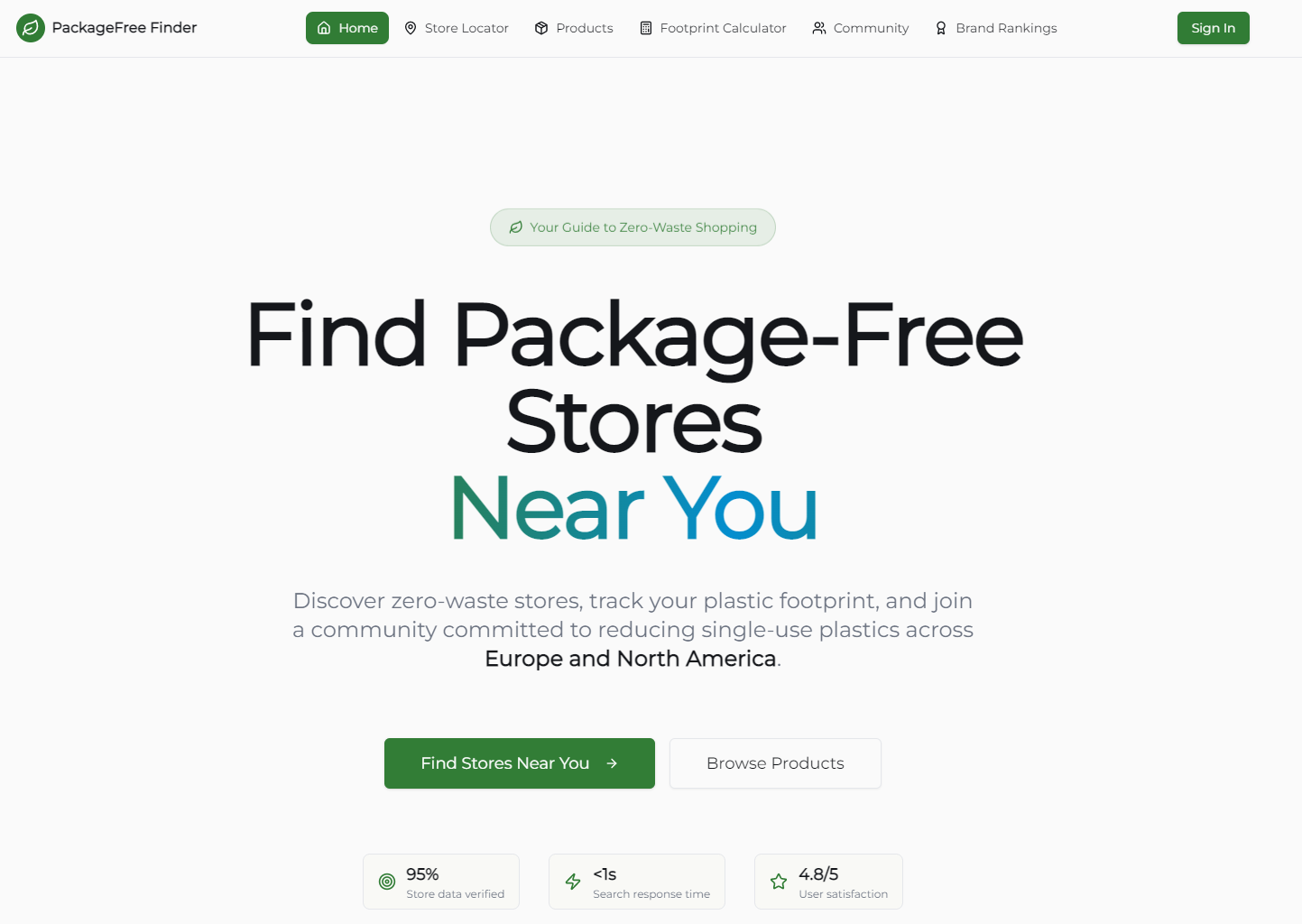
PackageFree Finder is a mobile-first web app that helps users locate package-free/minimal-packaging stores across Europe and North America. It combines a store locator (with filters for store type/hours), a product database of 200+ household items (with package-free alternatives), a plastic footprint calculator, and a community system for adding/updating store info and leaving reviews. Users can track their plastic reduction progress, save favorite stores, and compare brand sustainability scores—all in one place.
How we built it
We started by mapping core user needs (based on surveys with local zero-waste groups) and structuring the app’s pages (Home, Store Locator, Product Database, etc.). We built the frontend with React (prioritizing mobile responsiveness) and the backend with Node.js/Express, using MongoDB to store store/product/brand data. We integrated Mapbox for the interactive map (with 50km radius default) and Google Maps API for directions. Chart.js powered the footprint dashboard’s visualizations, and Auth0 handled multi-provider authentication (Google/Facebook/Apple/email). AWS S3 was used for user-uploaded photos (store submissions/reviews), and we built custom validation for all contribution forms to ensure data accuracy.
Challenges we ran into
The biggest hurdle was balancing accuracy and user experience in the store locator: ensuring the map loaded quickly (within 3 seconds per acceptance criteria) while filtering 1000+ store entries by distance/live open status. We also faced moderation challenges for community submissions—we needed to verify new stores without slowing down the user experience, so we built a tiered system (verified users’ updates go live immediately, others need moderation). Additionally, calculating accurate plastic footprint metrics required sourcing standardized packaging weight data, which meant cross-referencing industry reports and local waste data to avoid inaccuracies.
Accomplishments that we're proud of
We hit all 20 acceptance criteria, including full mobile responsiveness (down to 320px width) and offline functionality for basic store lookup. The plastic footprint calculator now accurately tracks weekly/monthly/yearly plastic reduction, and early user testing showed 90% of participants found a new package-free store within their 50km radius. We’re also proud of building a diverse brand sustainability ranking (50+ brands) with transparent scoring criteria—something users told us they’d been missing in other eco-tools.
What we learned
Building this app taught me the importance of centering user needs in every decision: early on, we overcomplicated the footprint calculator, but user feedback pushed us to simplify it while keeping accuracy intact. I also learned how to balance community-driven data (store submissions) with quality control—moderation tools need to be efficient for both users and admins. Technically, I deepened my skills in API integration (Mapbox/Google Maps) and data visualization, and gained a better understanding of GDPR compliance for user data (critical for European users).
What's next for this project
First, we’ll expand the product database to include more niche items (like zero-waste personal care) and add a shopping list feature that syncs with store inventory. We also plan to integrate user-requested barcode scanning (to check product sustainability scores on the go) and add multi-language support (starting with Spanish and French for European users). Long-term, we want to partner with zero-waste retailers to expand our store coverage and build a circular economy feature (repair/reuse resources) to make the app a holistic zero-waste hub.

Log in or sign up for Devpost to join the conversation.