-
-

FindMyPiece
-
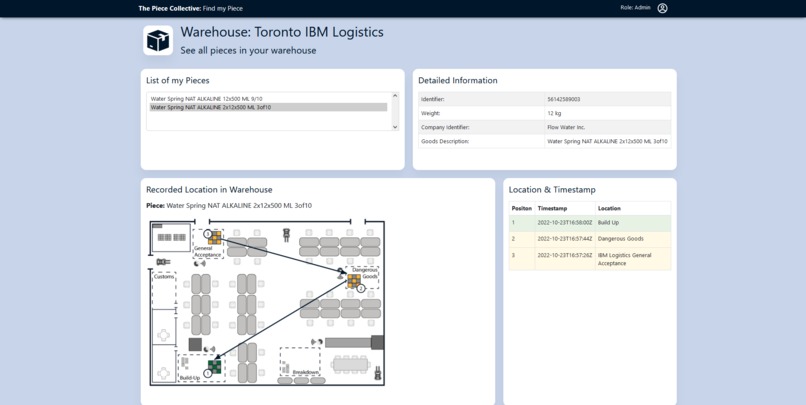
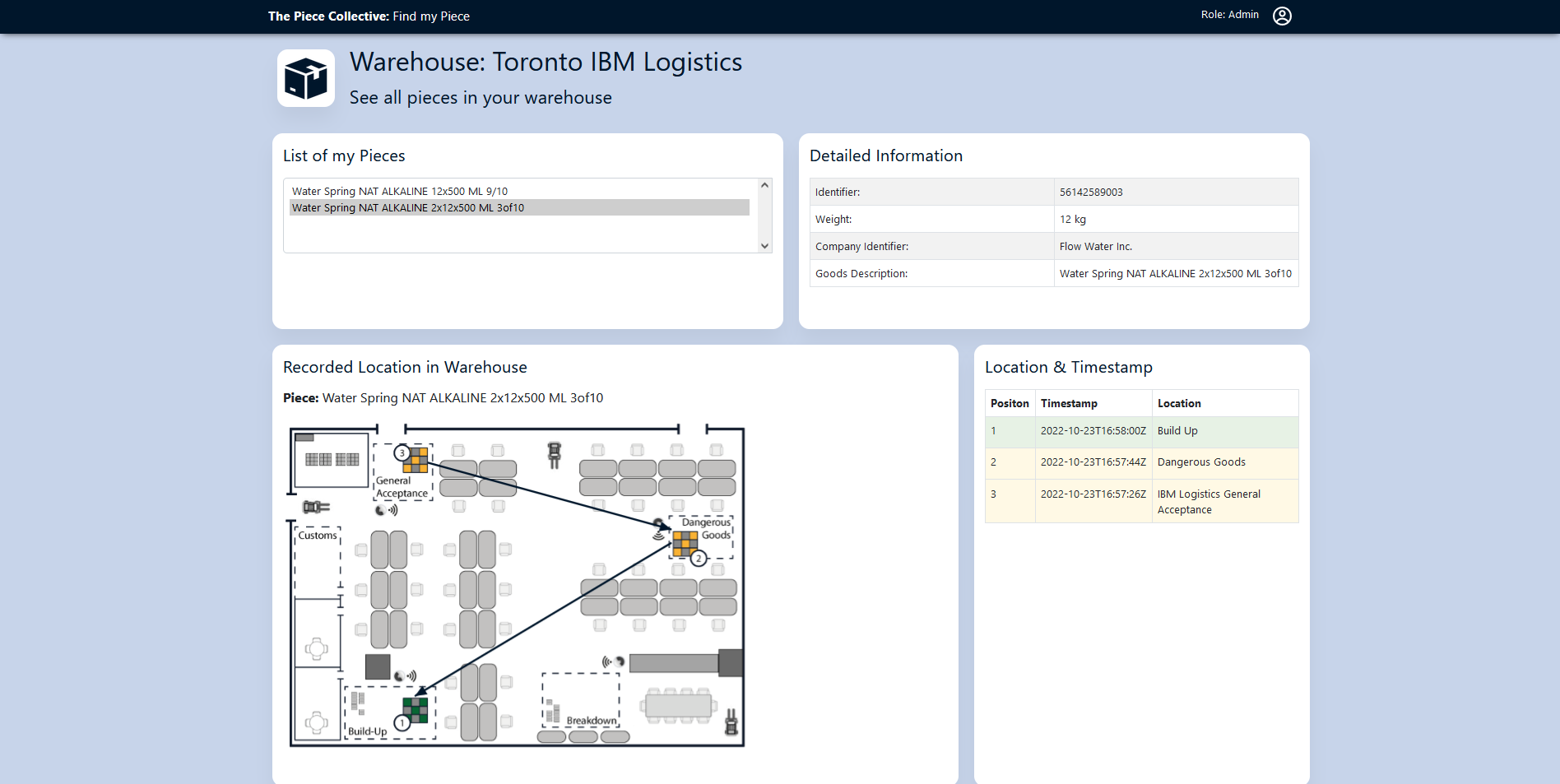
Our WebFrontend (Dashboard)

Inspiration
An Air cargo warehouse is one of the busiest places you can imagine. In an environment like this, chaos takes over at some point. This is why it is important to have an overview of where your pieces are at any time. However in reality locations of pieces are often unknown. This leads to high personal resources being blocked for searching pieces, a huge potential for process improvement is given away, and it can lead to high penalties if pieces can't be provided to authorities upon request. Indoor tracking of pieces in the warehouses with tracking technologies like GPS is usually very inaccurate and existing specialized tracking solutions are expensive and/or have to be permanently installed. Even if location data is available there is no standardized way to share this data at piece level. With our FindMyPiece App we want to address the Warehouse challenge and the open challenge.
What it does
With "FindMyPiece" we have created a simple solution that uses Apple Air Tags as fixed locations (anchors) at relevant locations, e.g. build up or general acceptance ramps. When a user captures a piece in FindMyPiece, the mobile app automatically detects the nearest Apple AirTag (IoTDevice in ONE Record), asks for the Location, and links the Piece to the Location via an ONE Record Event. This data is directly shared via ONE Record. To display the Location within the warehouse we display the journey of the piece in a web frontend. By selecting a piece, you can see all information like the weight of the piece or the shipper. Additionally you get a list with the locations and timestamps of the capture events. Next to it you see a map of the warehouse with the current piece location* highlighted in green and **previous locations connected by arrows that demonstrate the physical flow.
How we built it
- Ideas and the general concept were drafted using a miro board before the hackathon began.
- Tasks were distributed according to the individual expertise
- ONE Record Data Model was applied to our idea
Backend
To realize our solution FindMyPiece we used a variety of technologies: At the core we use the ONE Record Open Source Java Server in combination with a MongoDB database. Containerized with Dockers and deployed to the Microsoft Azure Cloud. This gave us the chance to use some of the benefits of ONE Record out of the box:
- Multi-tenant functionality We modeled three companies in ONE Record: (1) the shipper with its Pieces, (2) the warehouse owner with its location, and (3) The Piecel Collection as the service provider of FindMyPiece with its Apple AirTags as IoTDevices.
- JSON-LD as the data standard is in our locating algorithms written in Python as well as in our mobile app for Apple iOS and in our web frontend. Despite the wide range of technologies, using ONE Record was more or less plug and play.
- ONE Record events and Linked Data to realize real-time visibility by storing a capture events in one record and share them with the other stakeholders
WebFrontend
With FindMyPiece web frontend you have an eye on all the pieces in the warehouse on one single dashboard. Our web frontend (built with ReactJS) consists of four components.
- The individual pieces are fetched from the ONE Record Server and are then displayed in a list view.
- Visualisation of corresponding detailed information about this piece in a bootstrap table.
- Overview of events of the piece are listed with the timestamp and the location.
- Map that visualized the current position and the movements of the pieces.
iOS Frontend
To support the colleagues in the warehouse, we built FindMyPiece as an iOS mobile app. Our mobile app collects Bluetooth signals from Apple AirTags. It also sends the captured Bluetooth signals to the smart locating backend in order to get the nearest location stored in ONE Record.When a piece identifier (e.g. ONE Record URI) is captured with the FindMyPiece App, you automatically assign the nearest location to the piece and submit the data to the ONE Record Server
Challenges we ran into
- Identification of individual Apple Air Tags by Wireless Signal, i.e. BLE. Apple IOS uses a specific function to calculate UUID of Bluetooth devices which are not easy to find and/or re-identify
- The Wifi Log-In
Accomplishments that we're proud of
- 100% ONE Record native backend
- 100% ONE Record native frontend
- Running end to end integration from a mobile app to the backend via a ONE Record Server to the Web Frontend (Dashboard)
What we learned
- Never underestimate Apples efforts to protect the user from getting relevant data (Bluetooth privacy protection)
- Working in an interdisciplinary team and with a broad tech stack is challenging but fun!
What's next for FindMyPiece by The Piece Collective
For the future of FindMyPiece we plan to conduct real testing of our solution in the field. To get more accurate locations we plan to introduce triangulation as well as adding new signals such as UWB, WIFI.
In case the youtube link is not active yet please use the google drive link: https://drive.google.com/file/d/1o6YmBaMlUEXxxIG22RvhoW4sShWOruOB/view?usp=sharing



Log in or sign up for Devpost to join the conversation.