-
-
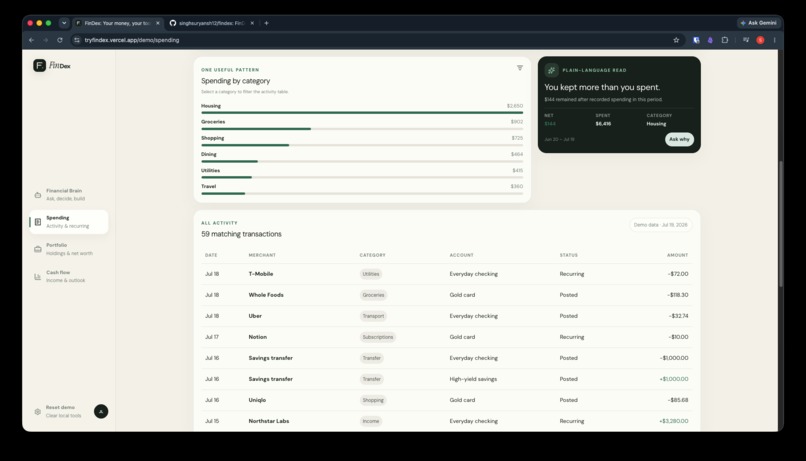
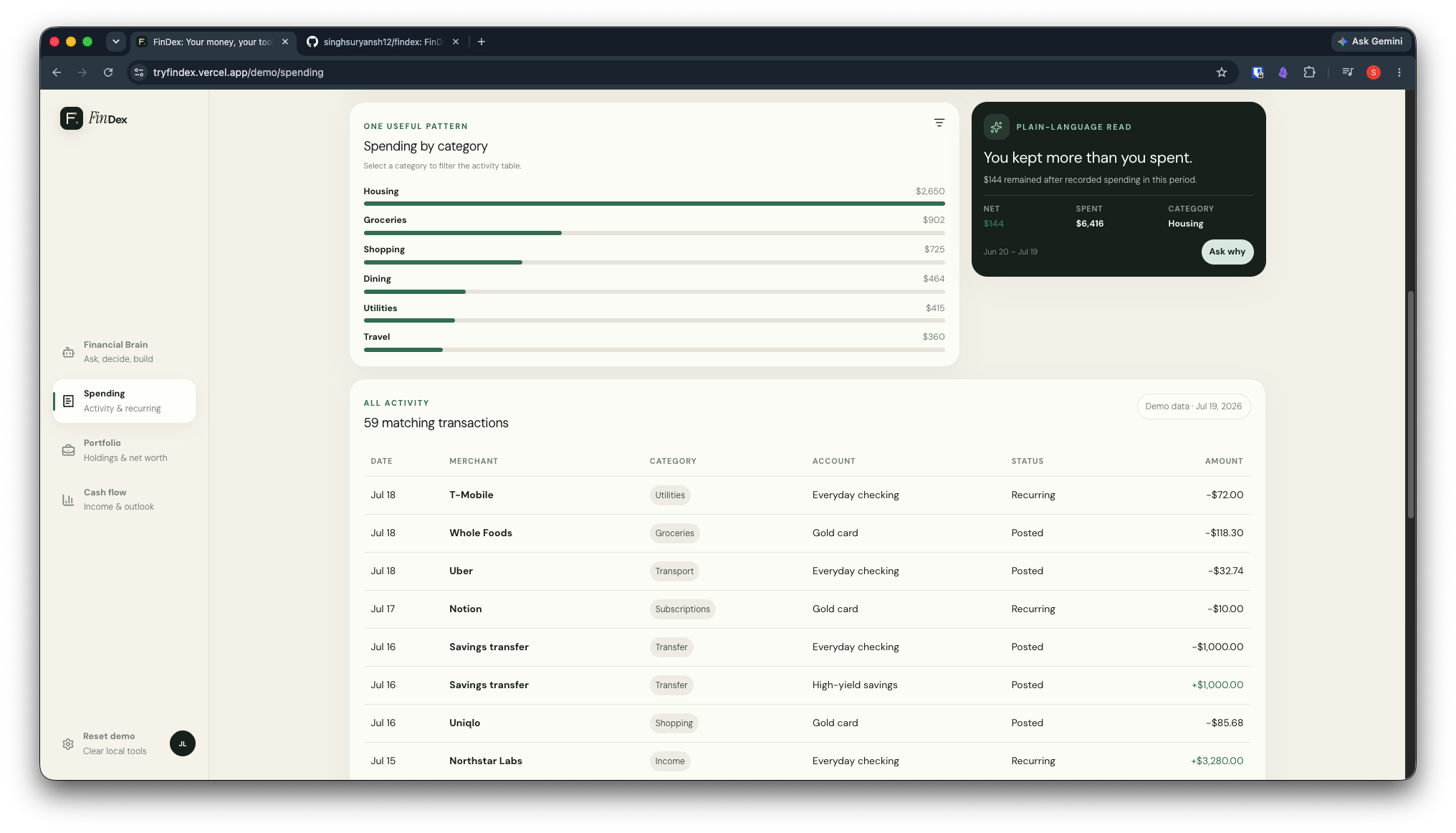
FinDex Spending page - Transactions table
-
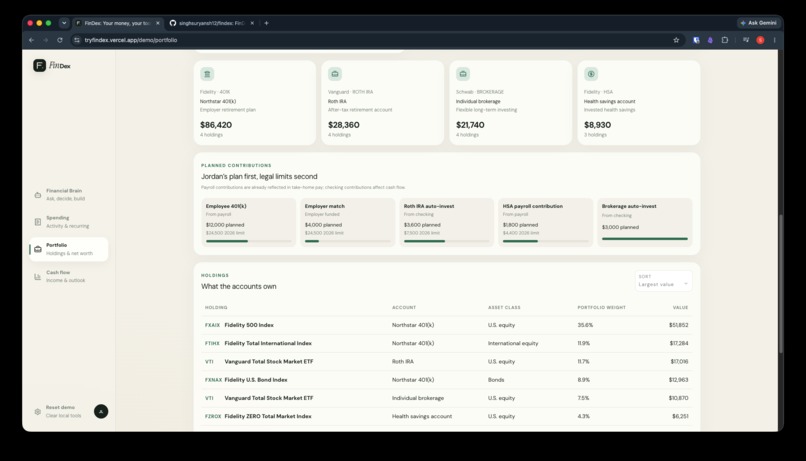
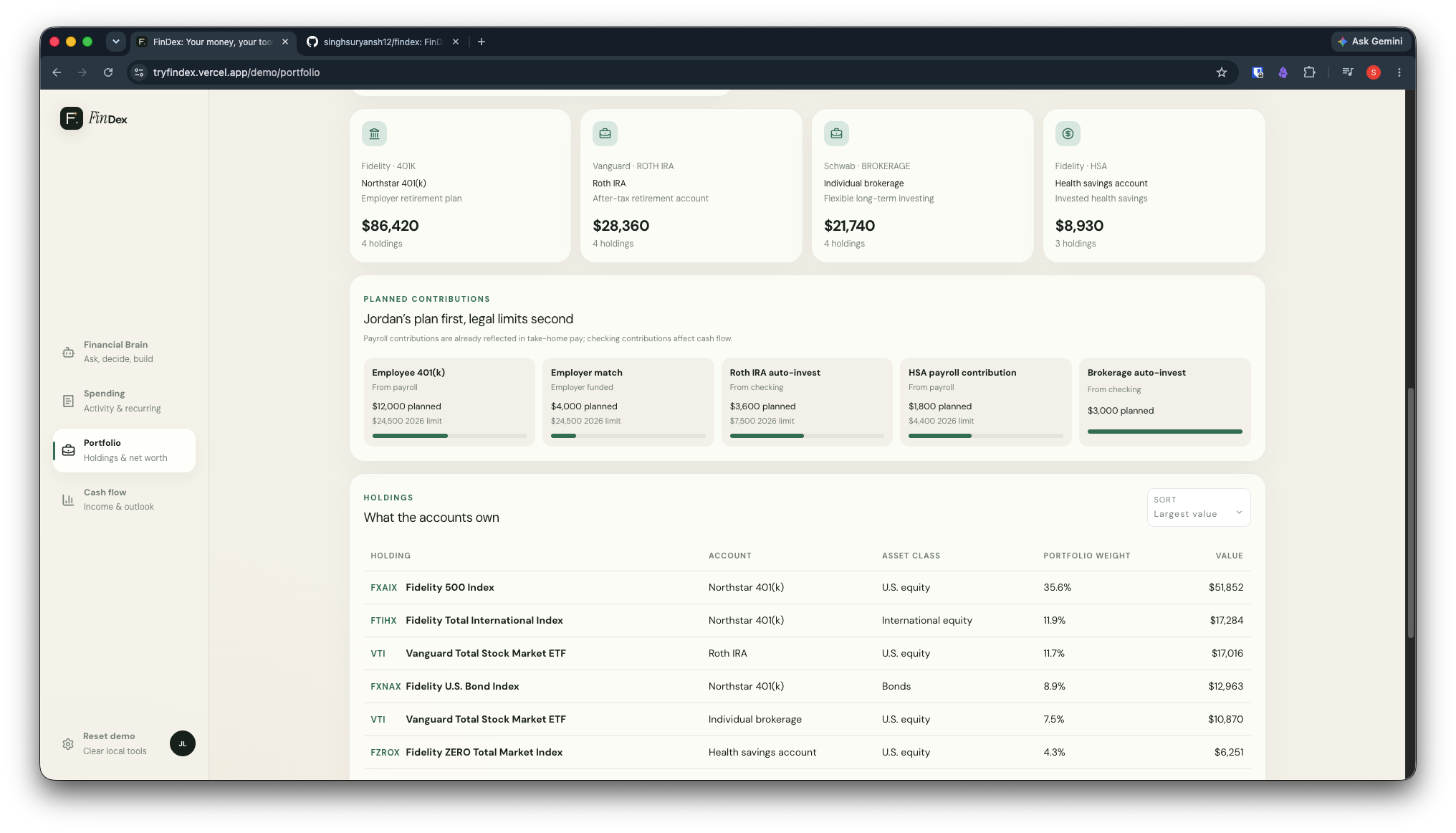
Portfolio Holdings - FinDex
-
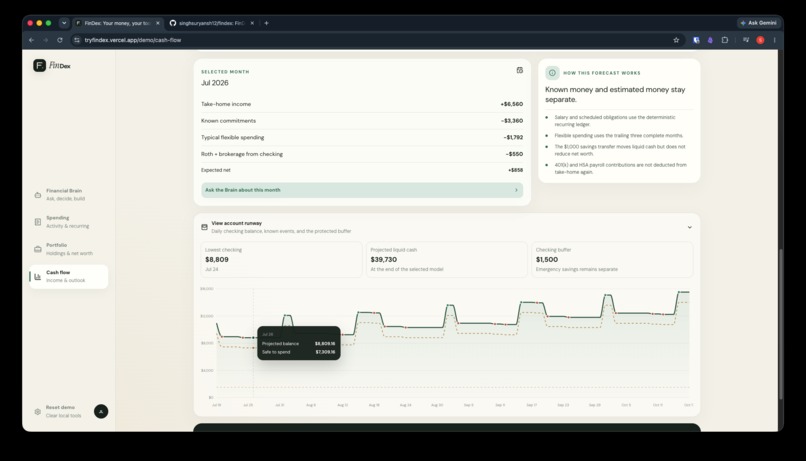
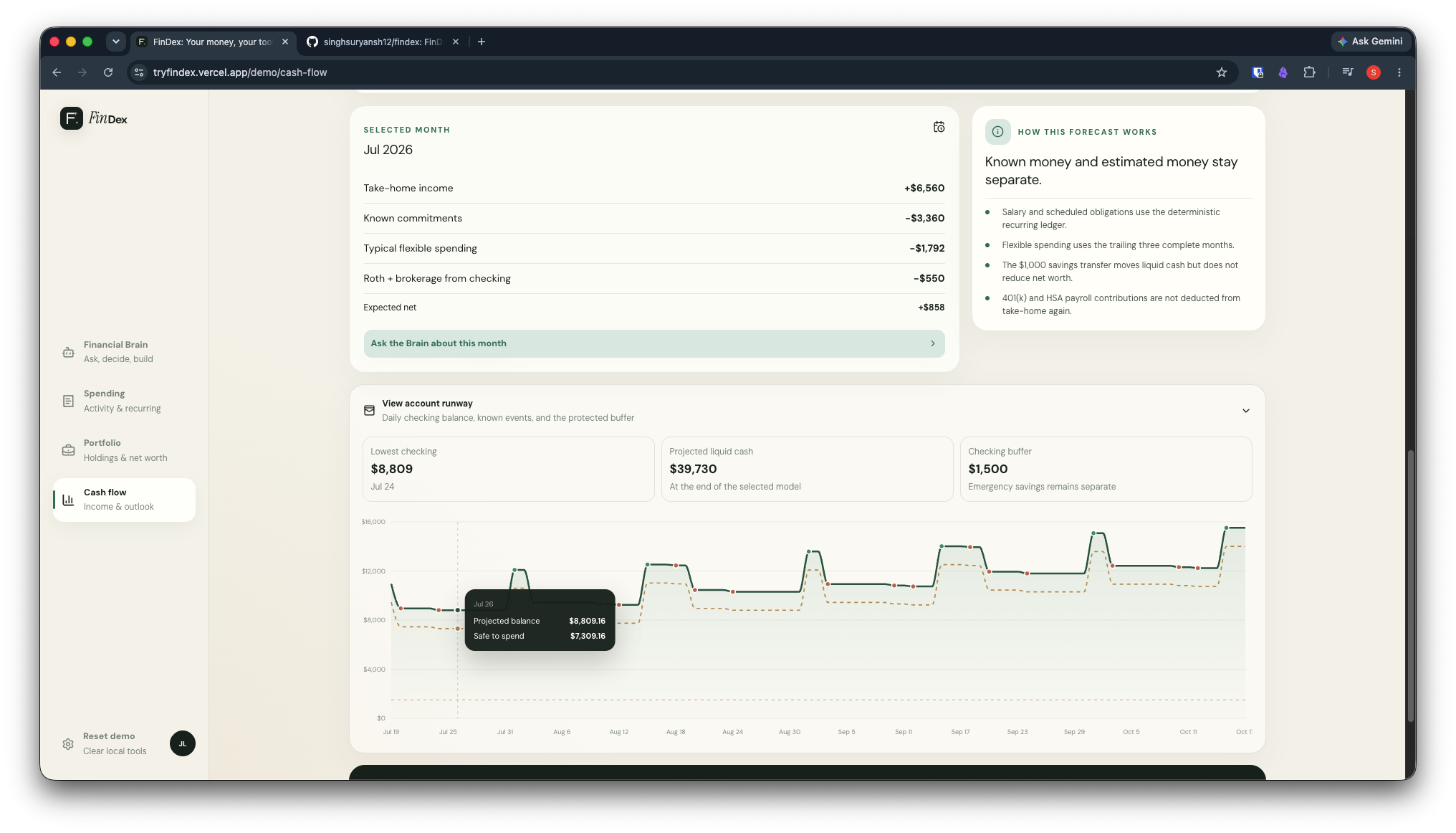
FinDex Cashflow page
-
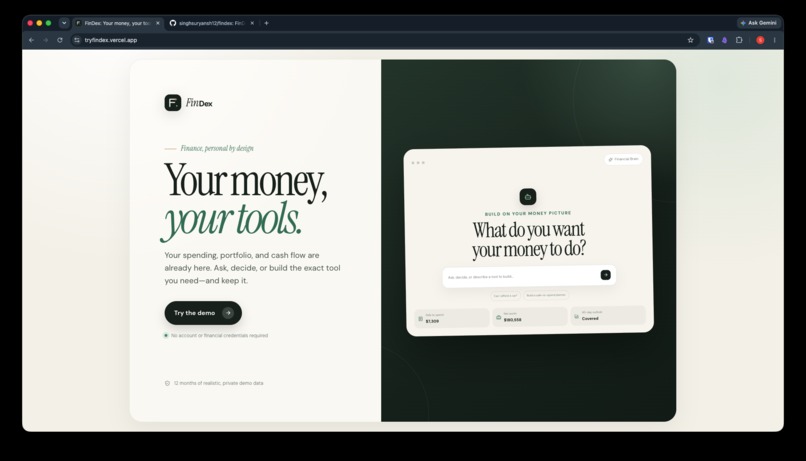
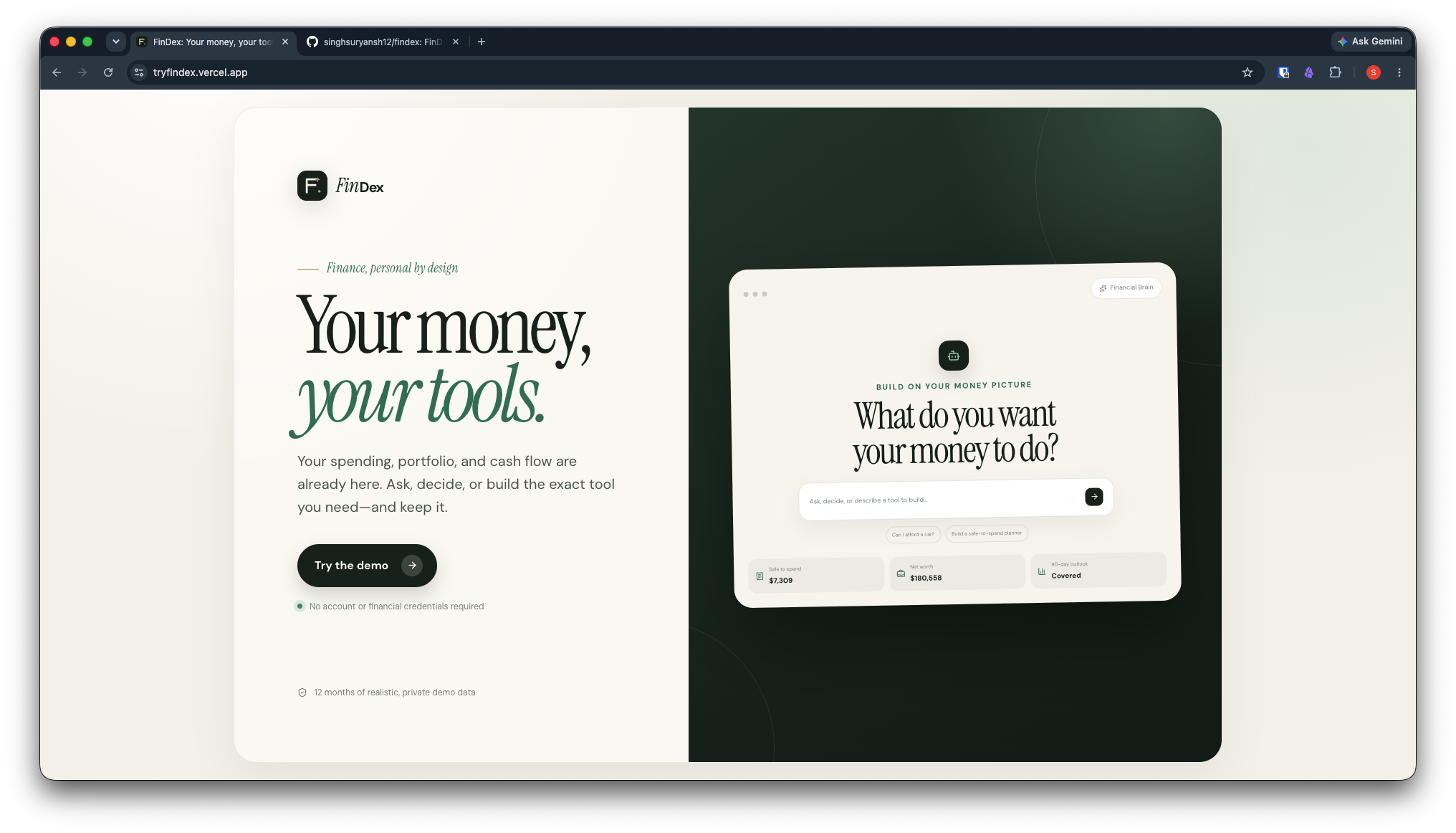
Landing Page - FinDex
-
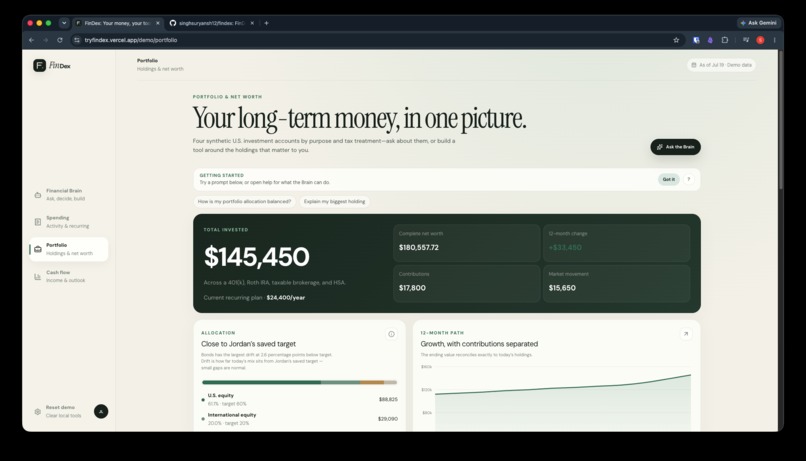
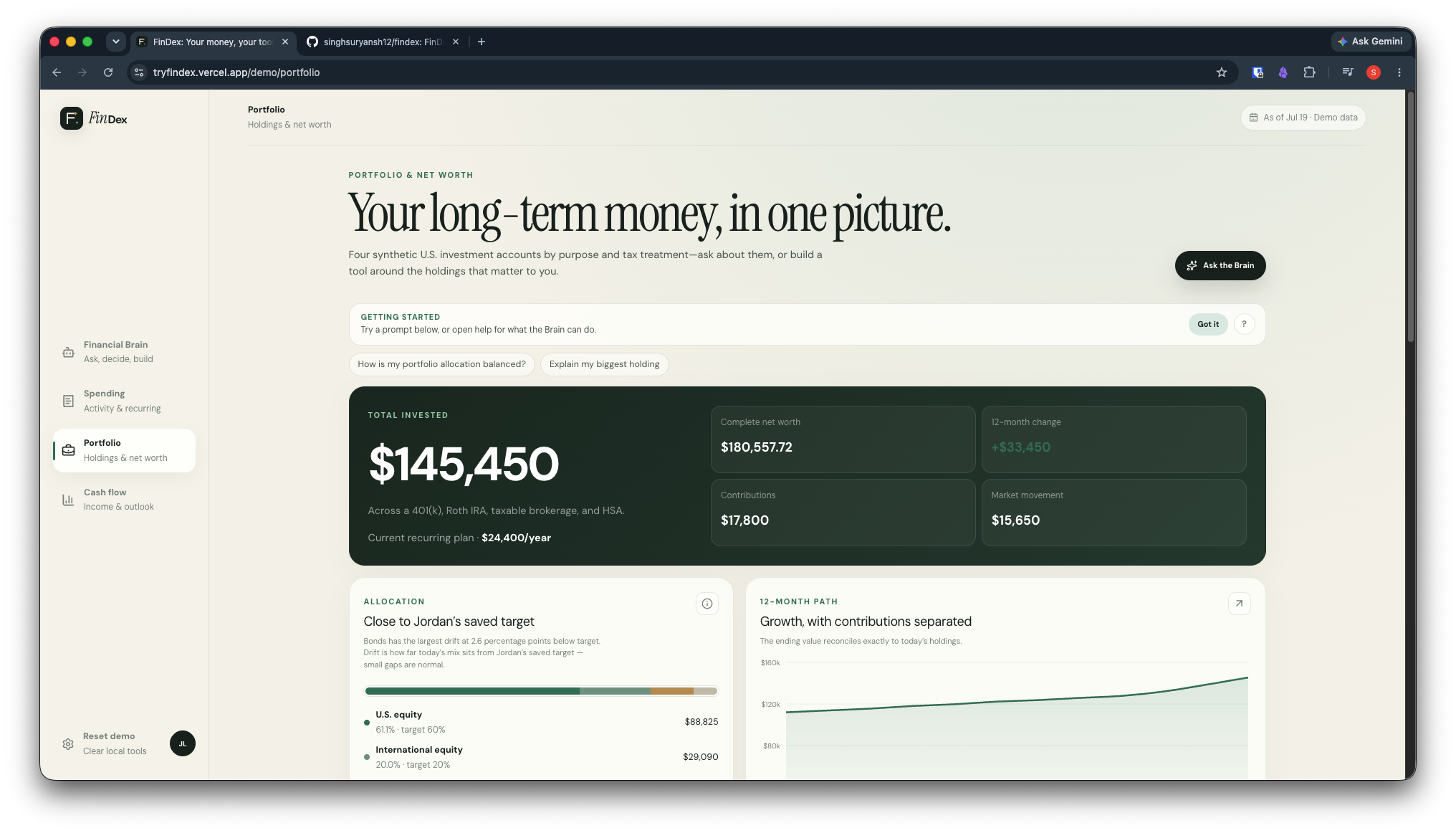
Portfolio - FinDex
-
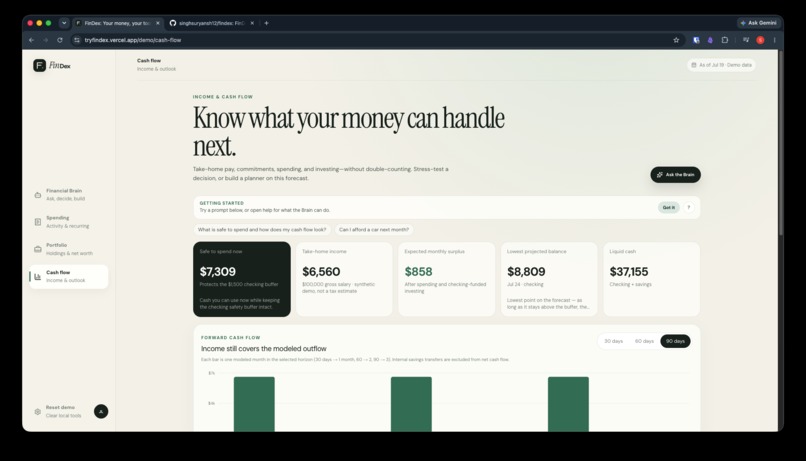
Cashflow page - FinDex
-
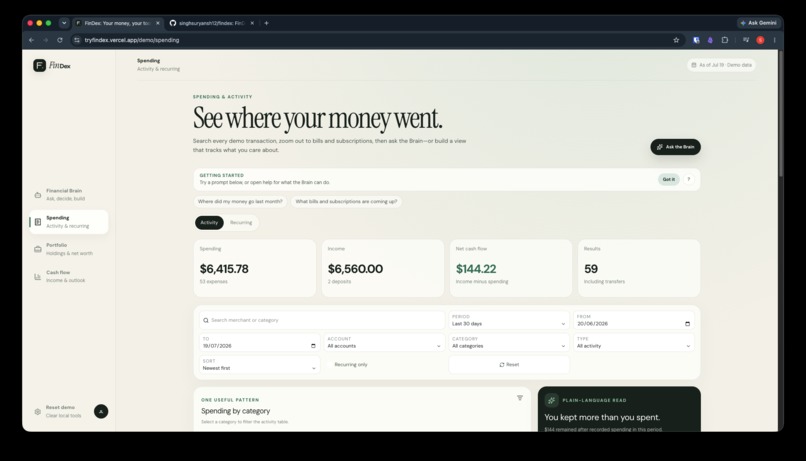
Spending page - FinDex
-
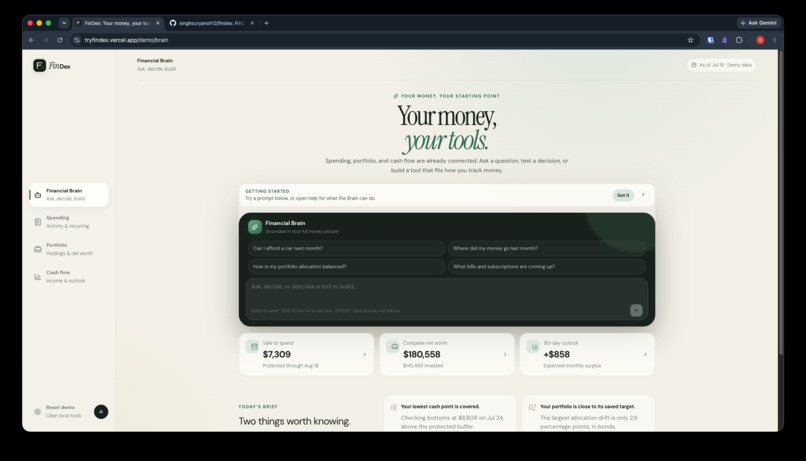
FinDex Brain Chat Interface
-
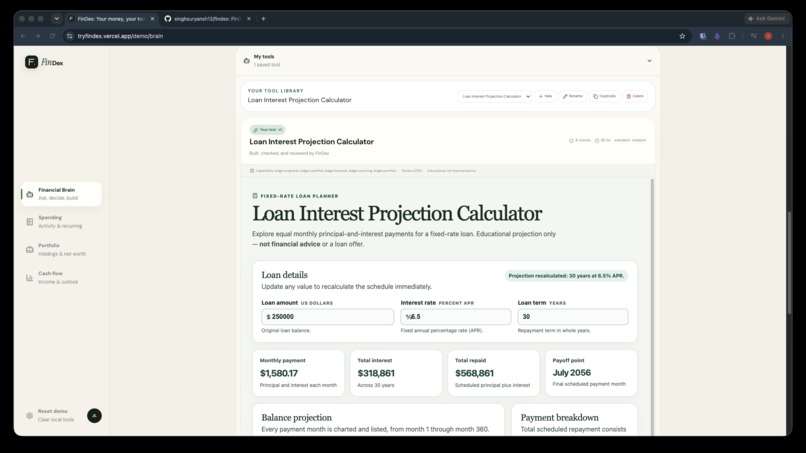
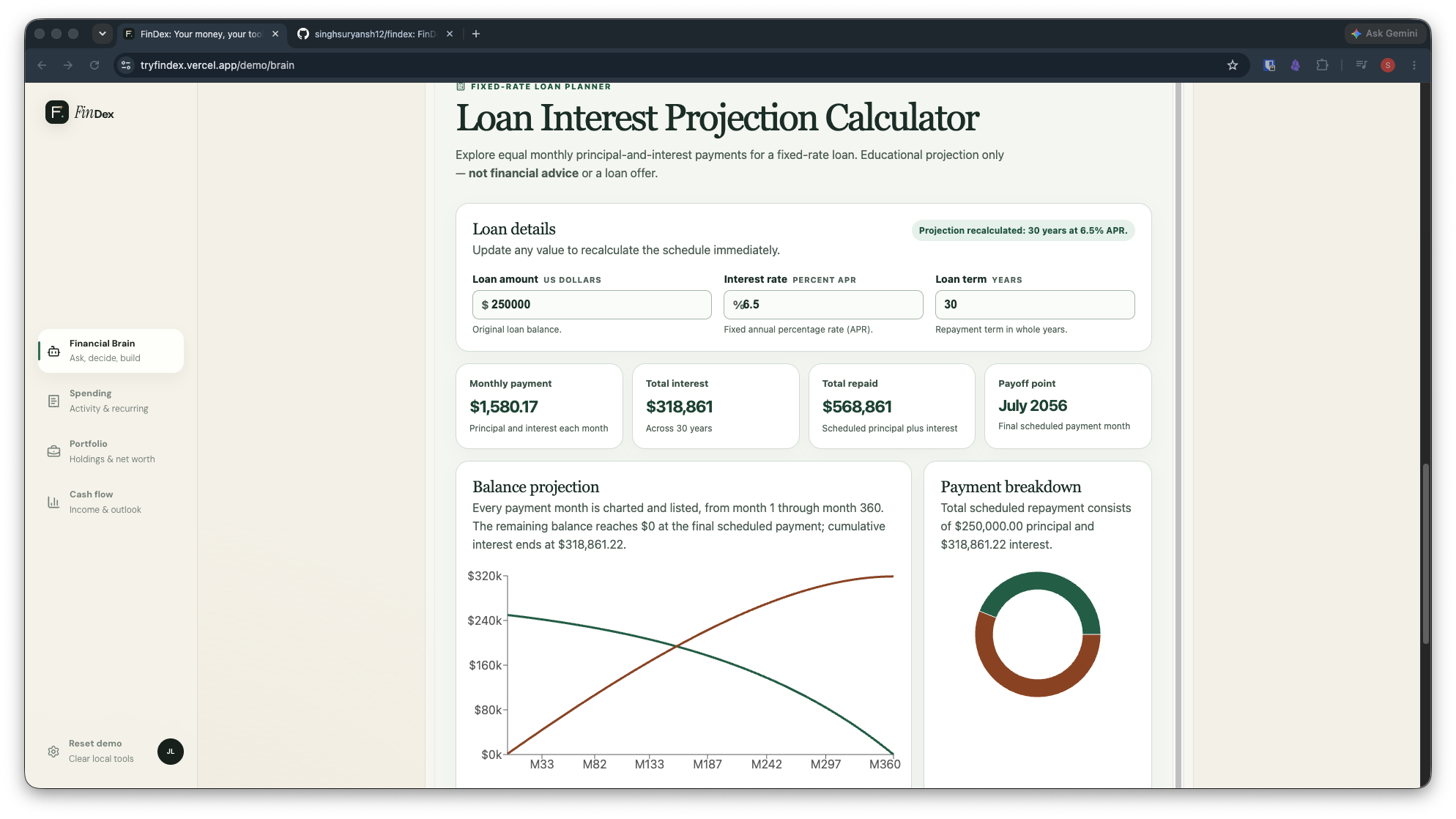
FinDex Brain Tool - Loan Interest Projection Calculator
-
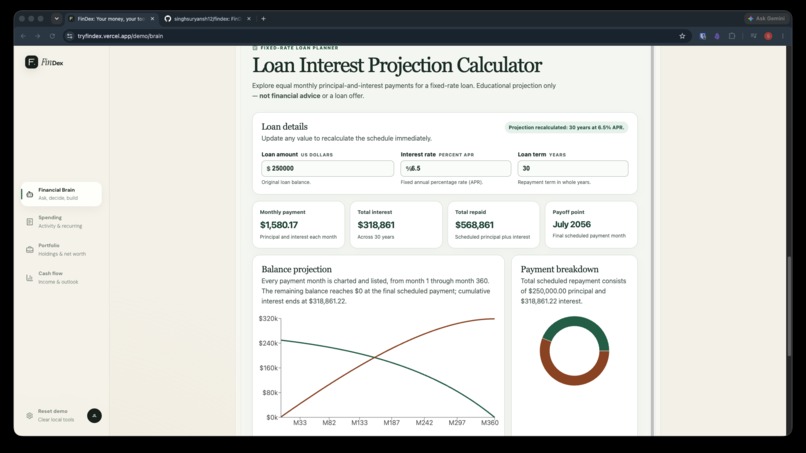
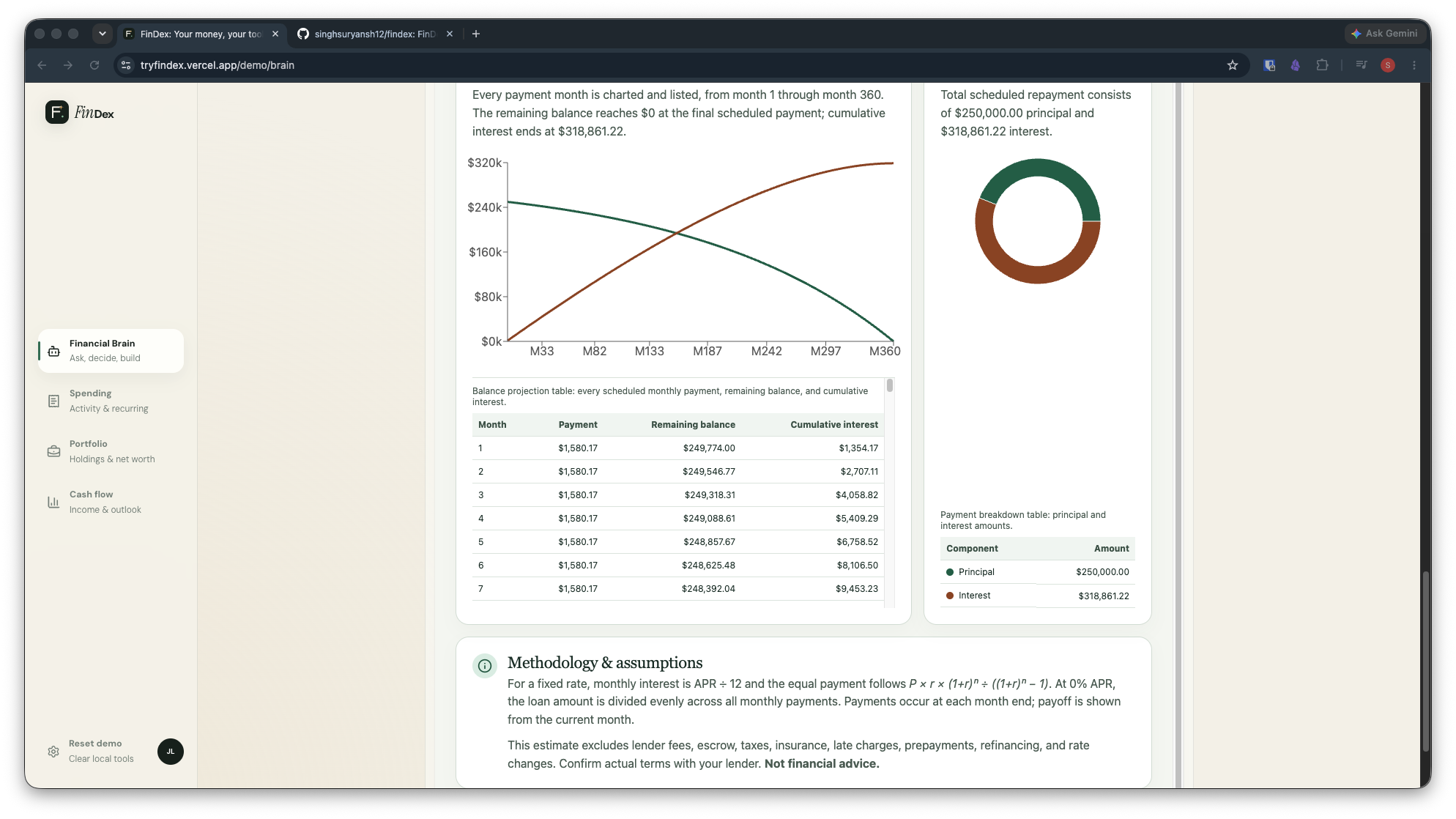
FinDex Brain Tool - Loan Interest Projection Visualisations
-
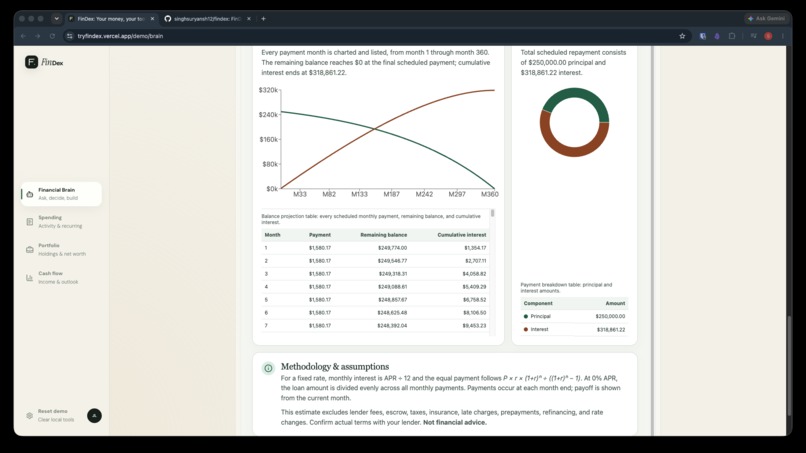
FinDex Brain Tool - Loan Interest Projection Tables
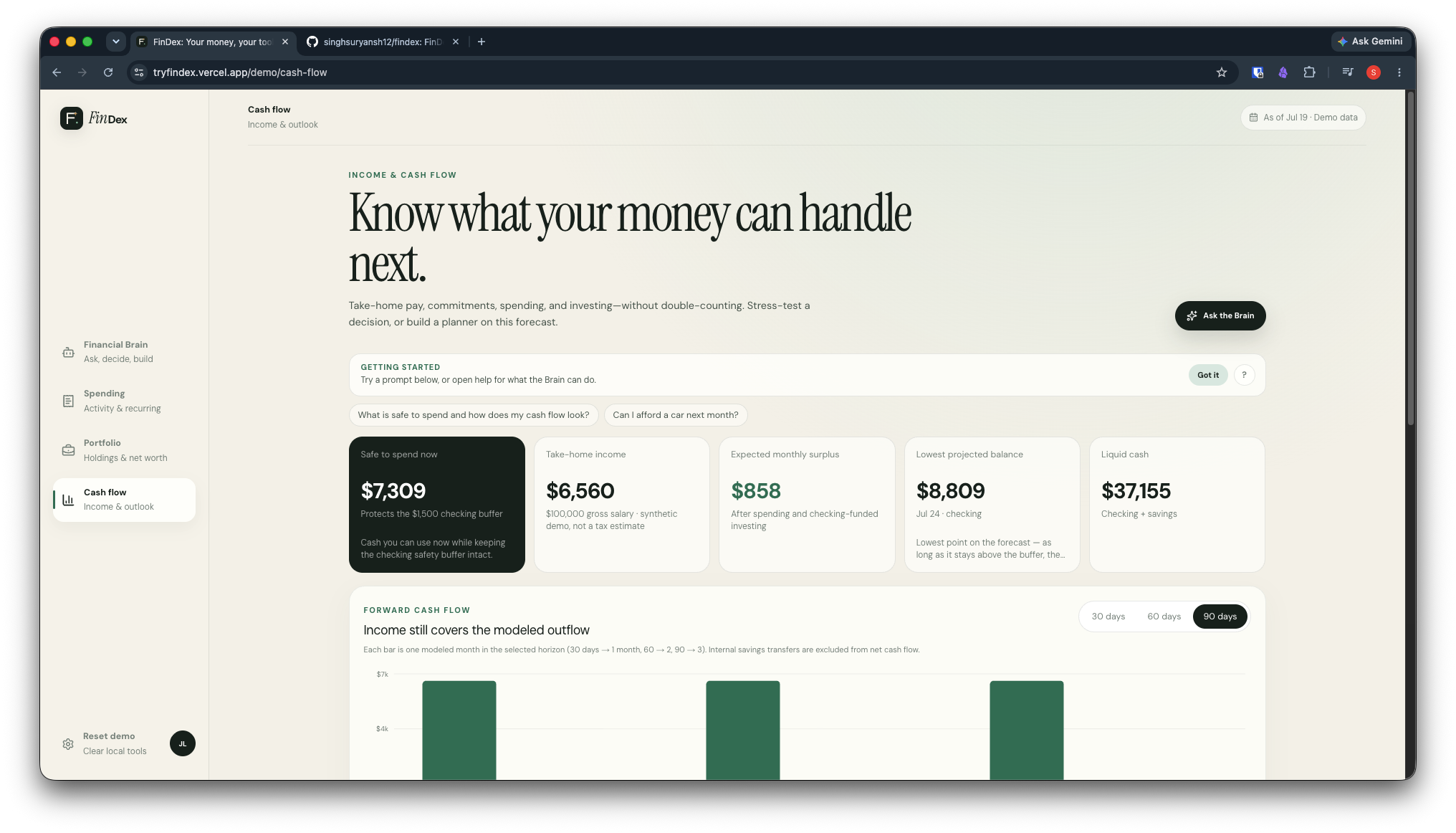
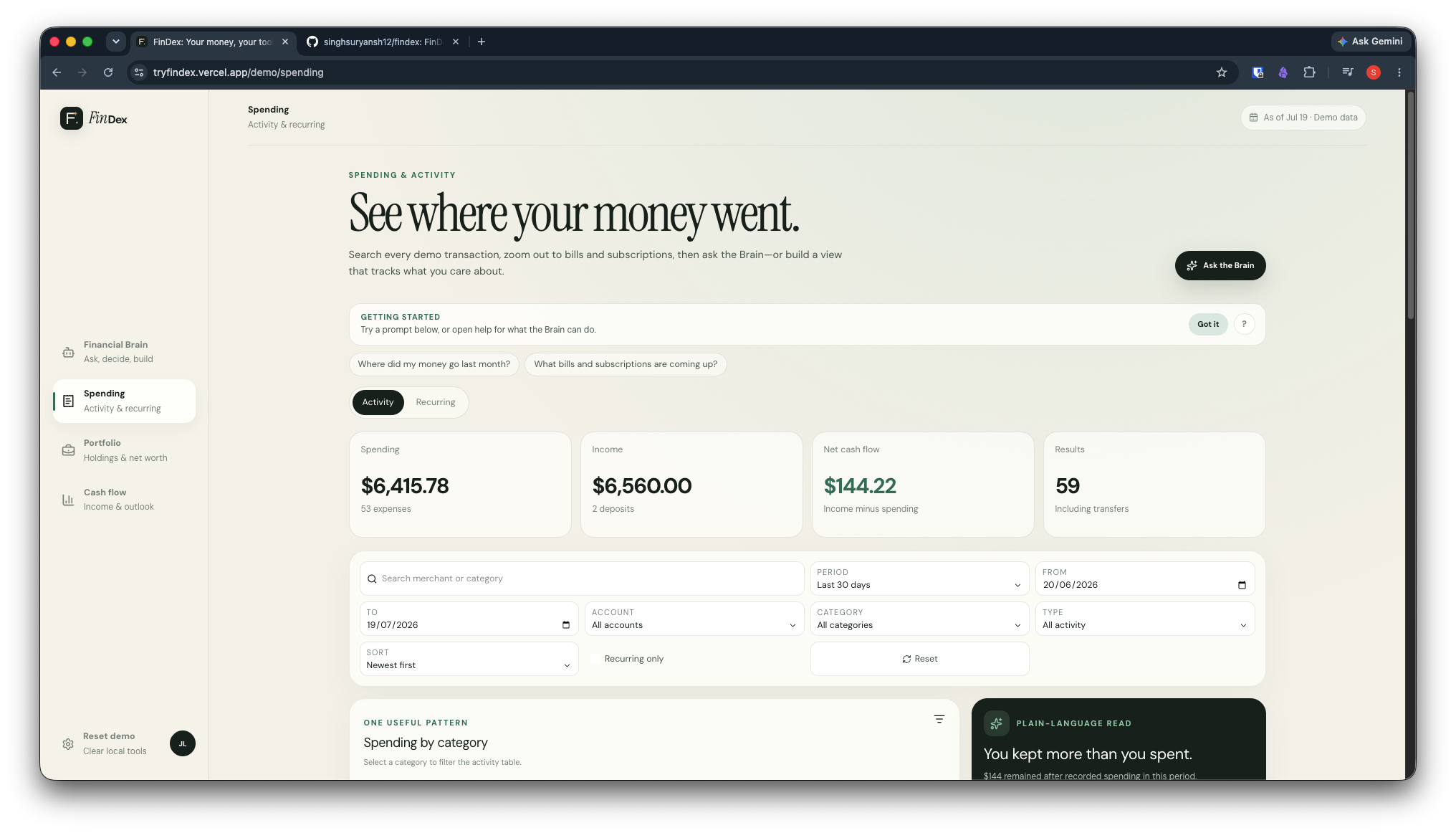
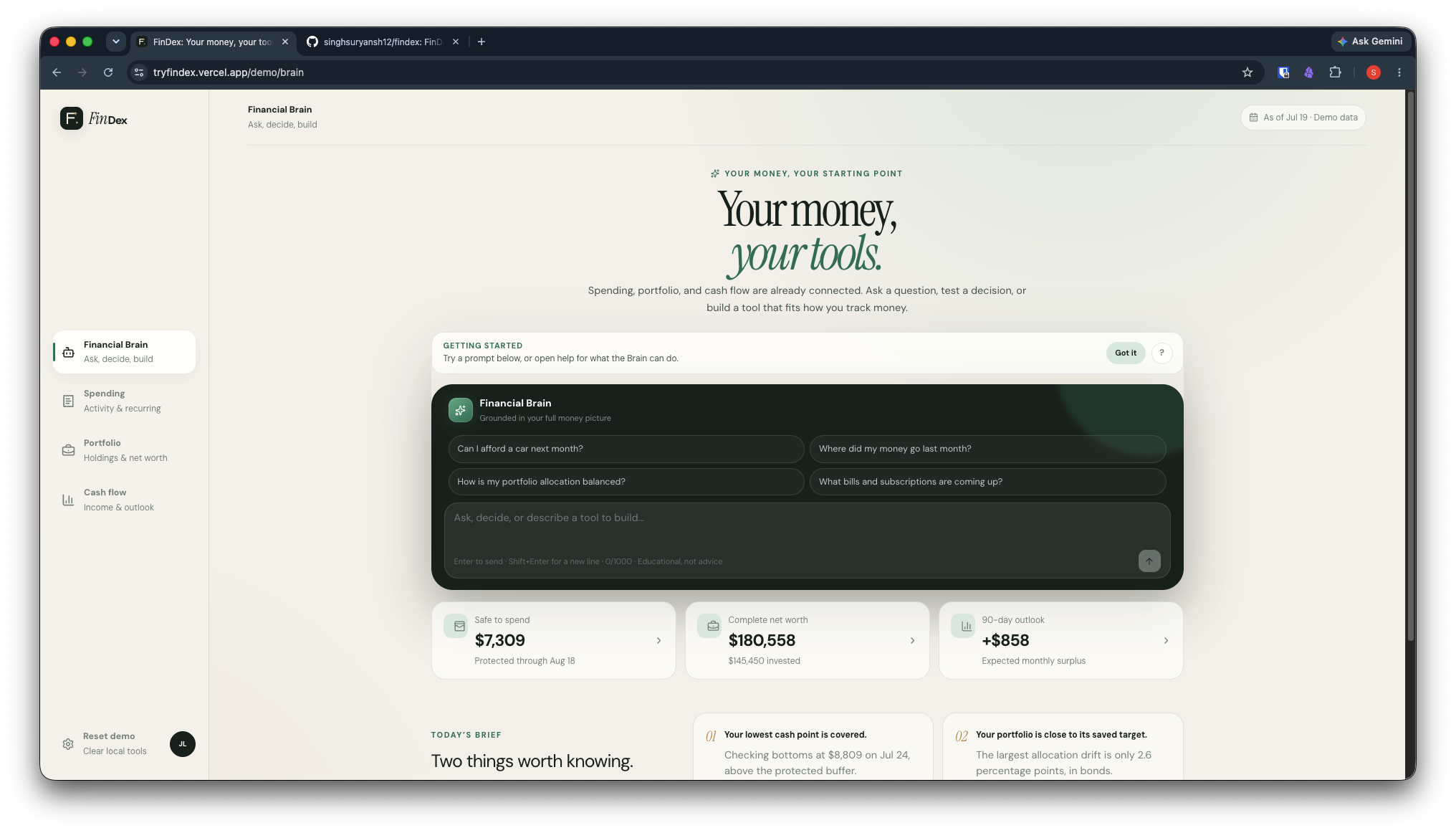
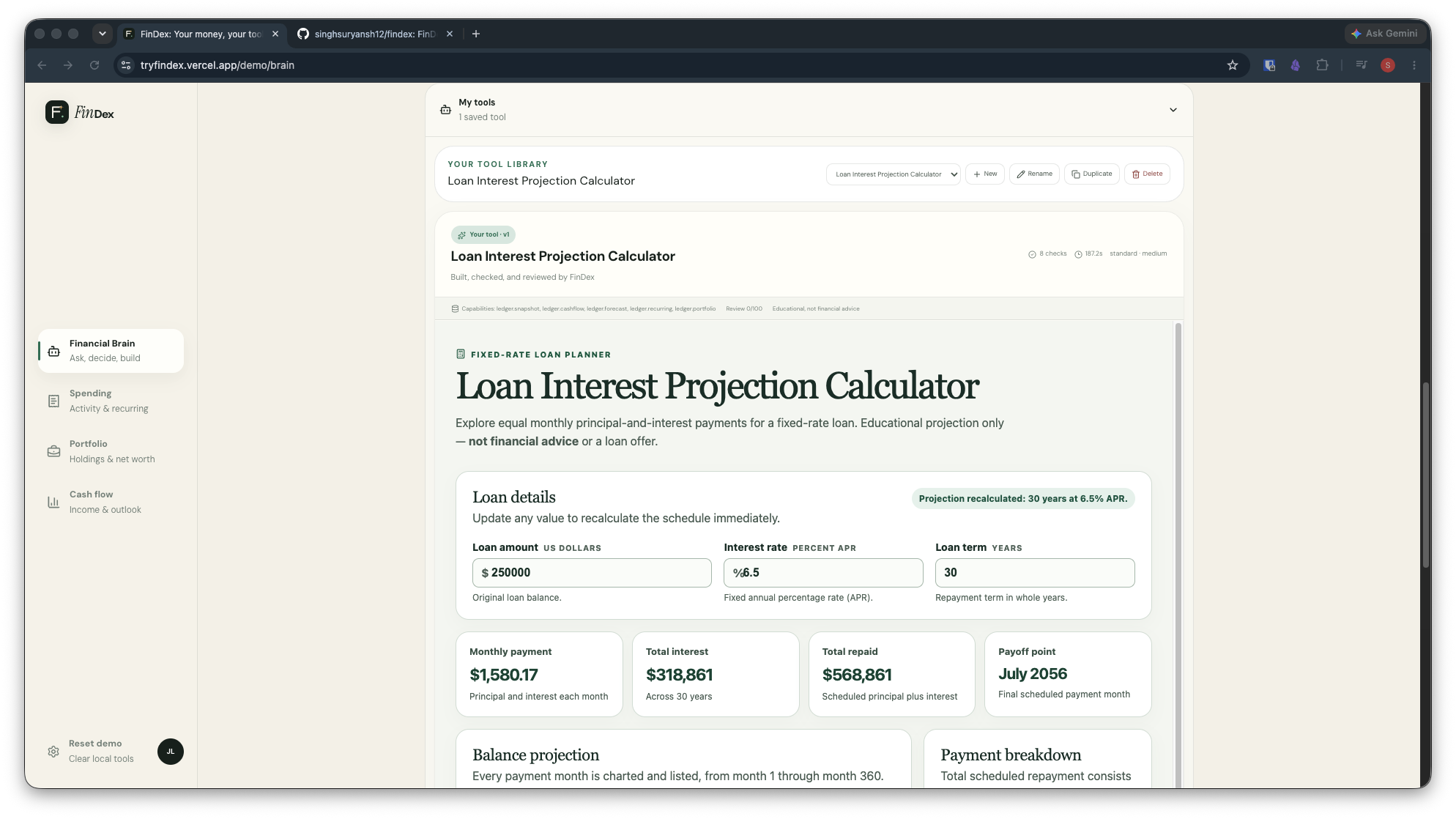
Inspiration
Finance is deeply personal, but personal finance apps aren't. Every budgeting app I've tried forces you into their specific way of thinking about money. If your brain doesn't work that way, the app feels useless.
I wanted to build something where the user doesn't have to adjust to the tool, the tool adjusts to the user. Instead of hardcoding a bunch of fixed dashboards, I realized it made more sense to let users just ask for the exact tool they want, based on their own data.
Also, data silos are incredibly frustrating. I wanted my spending, income, and portfolio all in one place so I could actually forecast my cash flow. FinDex was built to solve both of these problems: keeping all your financial data under one roof, and letting AI build the perfect interface for you to interact with it.
What it does
FinDex is a personal finance app built around a feature called Brain. It’s basically your own financial developer.
You don't get a fixed dashboard; you get a unified view of your spending, portfolio, and cash flow. From there, you can just ask the Brain to build what you need. If you want a specific chart comparing your coffee spending to your dividend payouts, Brain writes the code, builds the UI widget, and saves it to your "My tools" library so you can use it whenever.
Because it connects the dots across all your accounts, you can ask it real, complex questions, like, "Can I afford this trip next month without blowing my investment targets?" and it actually has the data to answer you.
How I built it
I built this entire project using OpenAI Codex as my co-developer, running GPT-5.6 Sol on Extra High effort. It was a wild experience. I used plan mode to design the architecture, especially the tricky parts like the secure iframe sandbox and the Brain routing, and then Codex helped me grind through the implementation to ship a working Next.js app fast.
For the actual app runtime, I built a custom routing engine for GPT-5.6. Simple questions or straightforward tool builds get routed to Terra because it's fast. But complex planning, independent code reviews, or if a build fails and needs fixing, that gets automatically bumped up to Sol. Basically, Codex helped me build the factory, and GPT-5.6 runs it for the user.
Challenges I ran into
The hardest part was making the Brain feel fast while keeping it secure. When a user asks for a new tool, generating the React code, validating it, and rendering it in the browser takes time. If the user has to wait even 5 minutes staring at a spinner, the magic is gone.
I solved this by using a draft-first approach. The app generates a functional "v1" really fast on Terra so the user gets something interactive almost immediately. While they are playing with the draft, a deeper refinement pass runs in the background on Sol to polish the code and fix edge cases.
The other massive headache was security. I couldn't just eval() arbitrary generated code in the browser with access to local storage. I had to build a CSP-locked opaque iframe and a strict capability broker so the generated tools can only access the data they are explicitly allowed to see.
Accomplishments that I'm proud of
I'm really proud of the Brain routing and the secure sandbox. Getting dynamically generated React tools to build, validate, and render safely in the browser while actually looking good and using the user's real data was a really tough engineering challenge, and I’m stoked that it works.
It's also just awesome seeing the app automatically pull in your spending and your investment portfolio to tell you if you can actually afford to buy something. It proves that personal finance doesn't have to be one-size-fits-all.
What I learned
I learned that if you want to let AI build tools dynamically for users, you can't just throw a prompt at a generalized agent loop and hope for the best. You have to own the routing and build incredibly strict trust boundaries. I also learned a lot about balancing speed and cost. Routing easy tasks to Terra and only paying for Sol when the reasoning gets complex was a game-changer for keeping the app snappy.
What's next for FinDex
Right now, the demo runs on a synthetic, hardcoded ledger so people can test it without giving me their bank logins. The obvious next step is to wire it up to real banking and broker APIs, so users can pull in their actual bank and broker data. After that, I need to build out real authentication and user profiles so I can launch this and let people start building their own financial tools.
Built With
- codex
- css
- esbuild
- gpt-5.6
- indexeddb
- javascript
- next.js
- node.js
- openai
- playwright
- react
- recharts
- tailwind
- typescript
- vercel
- vitest
- zod


Log in or sign up for Devpost to join the conversation.