-
-
-
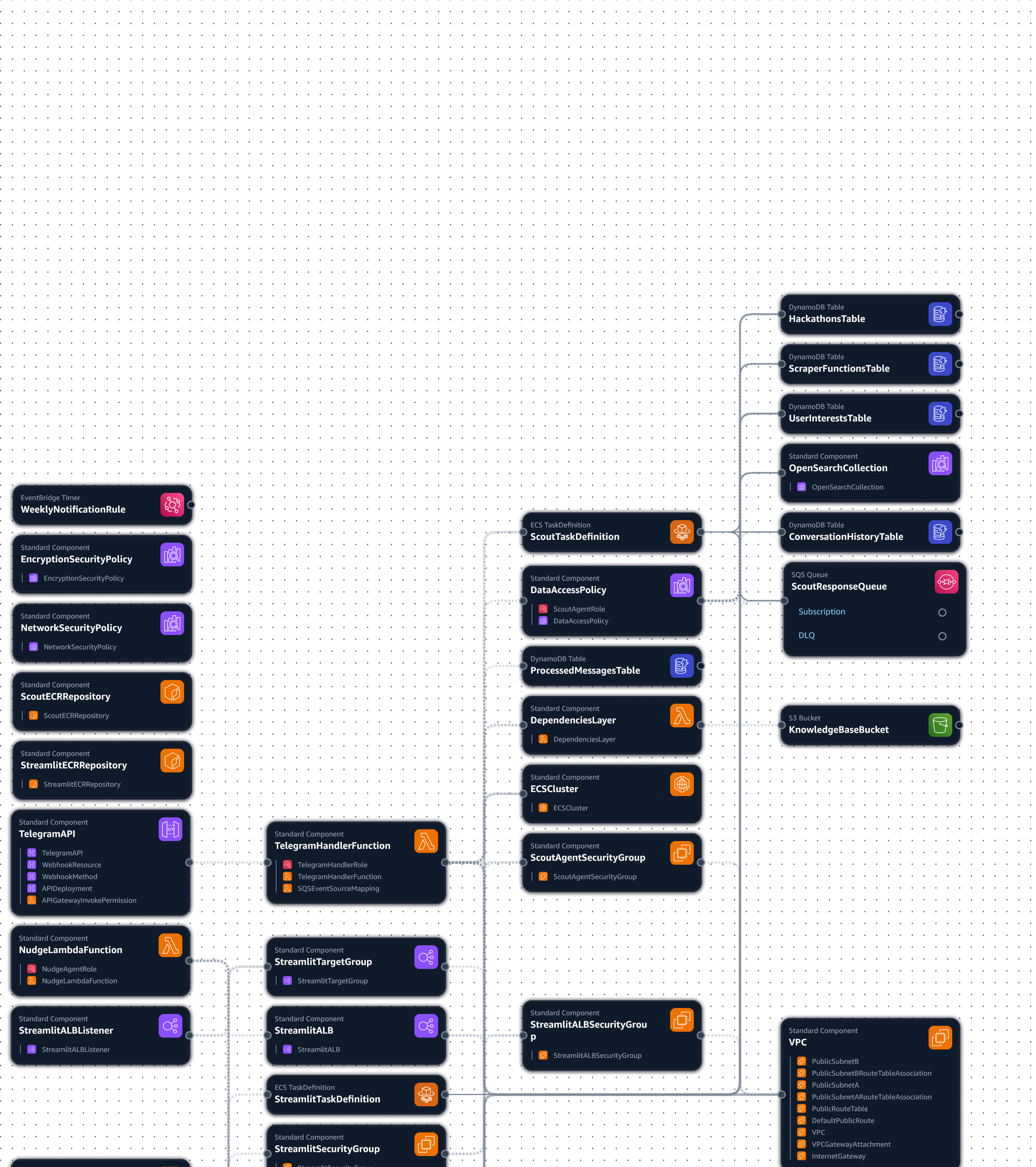
Infrastructure used
-
FindAthon Prime: The Complete Journey of Building and Deploying an Autonomous Hackathon Discovery Engine
Inspiration
As developers, we've all been there—scrolling through endless websites, checking DevPost, HackerEarth, and countless university portals, desperately trying to find hackathons that match our interests. We'd bookmark sites, set manual reminders, and still miss amazing opportunities because we forgot to check that one obscure platform.
The breaking point came when we realized we'd missed a hackathon called Tata Imagination Challenge simply because it was hosted on a platform we'd never heard of. That's when we asked ourselves: "What if AI could do this tedious discovery work for us?" But not just scraping—what if it could actually understand websites and adapt to any platform automatically?
Thus, FindAthon Prime was born and successfully deployed—the world's first autonomous hackathon discovery engine that doesn't just find opportunities, but evolves with the web itself. Today, it's a fully operational system with a live demo website and working Telegram bot.
What it does
FindAthon Prime is a fully deployed multi-agent AI system that revolutionizes how developers discover hackathons. Here's how it works in production:
Autonomous Discovery: Tell it "find hackathons on any-new-site.com" and watch it work. It analyzes the website structure, searches for APIs, and if none exist, generates custom Python scrapers in real-time.
Self-Learning: Every tool it creates is saved and reused. The system builds an ever-growing library of discovery methods, becoming smarter with each new platform.
Intelligent Notifications: The Nudge Agent learns your preferences and proactively alerts you to relevant opportunities. No more manual checking—it comes to you.
Real-Time Updates: Through Telegram integration, you get live progress updates as the Scout Agent works, making the discovery process transparent and engaging.
Enterprise-Grade: Deployed on AWS with serverless architecture, it scales from individual developers to enterprise teams handling millions of users.
Live Demo: Experience the system through our interactive website and working Telegram bot integration.
How I (and Q) Actually Built It
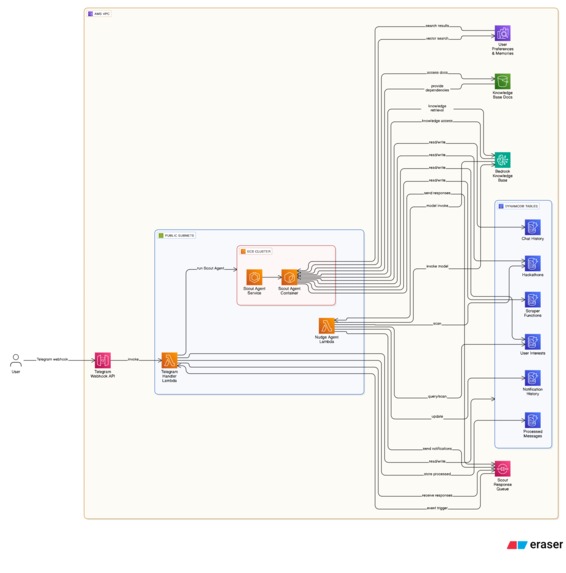
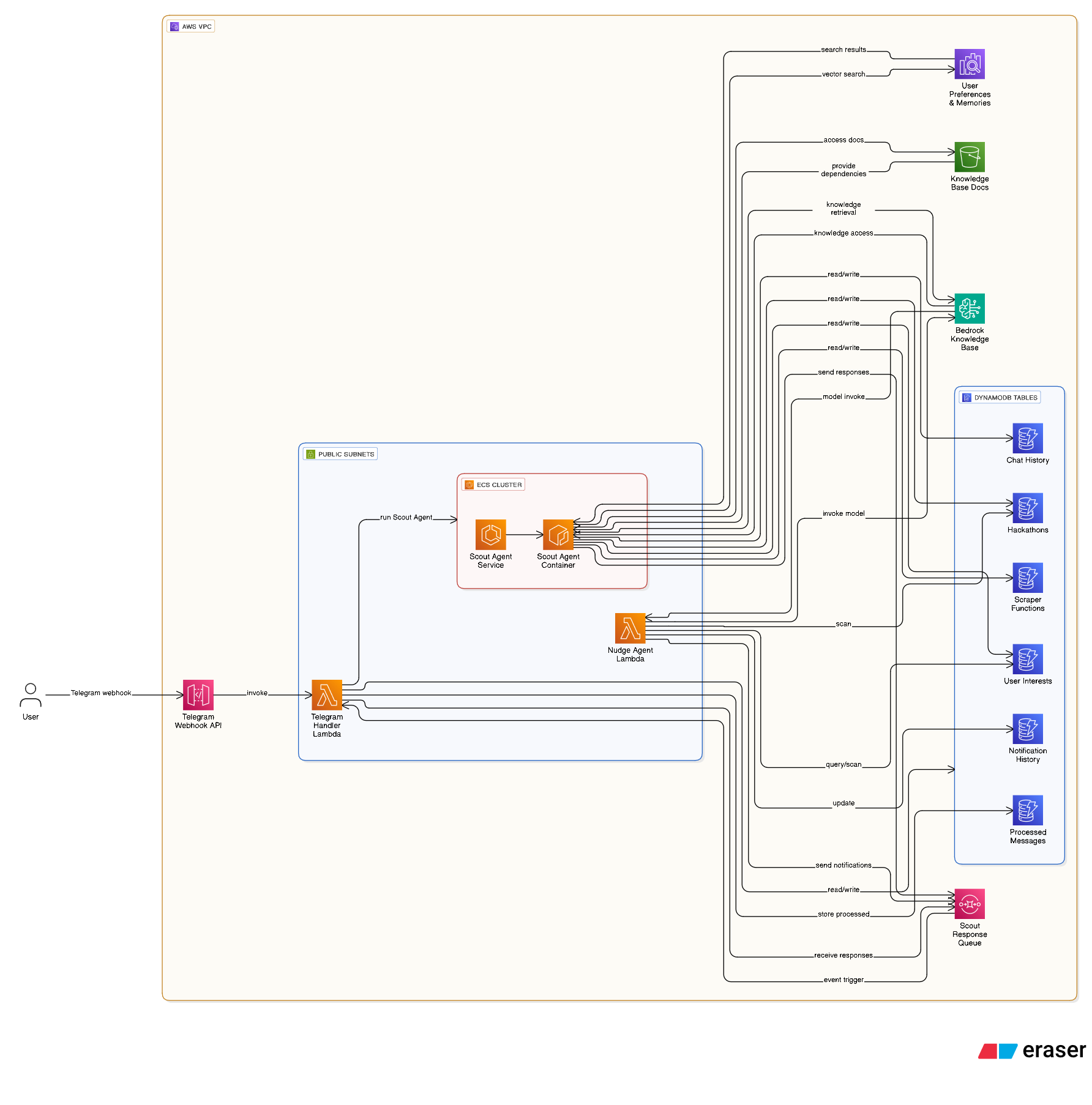
Architecture: We successfully deployed a three-brain system:
- Scout Agent (Claude Sonnet + ECS Fargate): Handles complex discovery and tool generation
- Nudge Agent (Claude Haiku + Lambda): Manages intelligent notifications
- Knowledge Base (Bedrock KB + OpenSearch): Provides trusted source grounding
I’d worked with Bedrock before, but this was my first time using Strands — and man, it was not love at first sight. At first, I thought this combo of Q + Strands + Bedrock would be a dream team. Spoiler: they weren’t. It felt like putting two geniuses in the same room and watching them argue instead of collaborate.
I was genuinely excited when I spun up the first test — Q reasoning through architectures like a boss, Bedrock handling embeddings smoothly… and then boom — everything broke. Turns out, Strands’ mem0_memory and Bedrock models were natural-born enemies. For hours, I sat there convinced it was my fault. I debugged, refactored, redeployed — rinse and repeat — until I realized it wasn’t a bug, it was just them. They were never meant to be friends.
So, I did what every desperate dev does: built my own solution. I ditched mem0_memory completely and created a custom memory system using DynamoDB + OpenSearch Serverless + Bedrock Titan embeddings. Suddenly, things clicked. It could actually remember, retrieve, and respond properly. I swear I almost did a little dance when that first successful query came back.
Throughout all this, Q became my accidental coding buddy. It wrote IAM policies faster than I could type “access denied” and caught mistakes I didn’t even know existed. There were moments I’d literally argue with it — out loud — before it realizing was right. (Happens more often than I’d like to admit.)
And somehow, between all the late nights, debugging loops, and caffeine-fueled rebuilds, FindAthon Prime came to life — this time, actually working end-to-end.
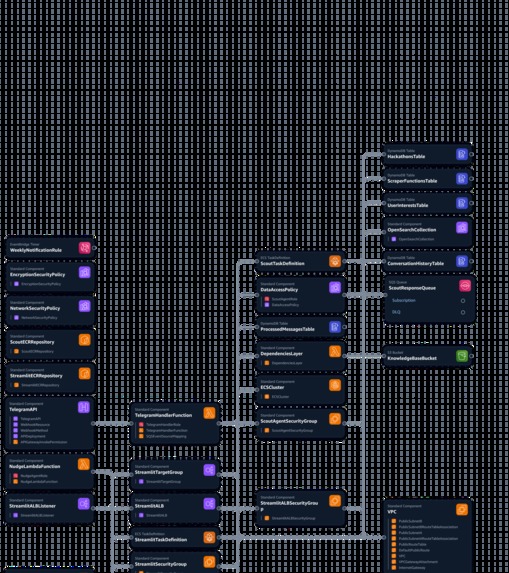
Deployed Infrastructure:
- 35+ AWS Resources: Complete CloudFormation stack with complex dependencies
- Custom VPC: Multi-AZ networking with security groups and route tables
- 6 DynamoDB Tables: Hackathons, scrapers, users, chat history, notifications, deduplication
- ECS Fargate: Containerized Scout Agent with auto-scaling (0-N instances)
- 3 Lambda Functions: Telegram handler, Nudge agent, with shared dependency layer
- OpenSearch Serverless: Vector search with encryption and access policies
- API Gateway + SQS: Real-time webhook processing and async communication
- IAM Security: 3 specialized roles with least-privilege permissions
- Monitoring: CloudWatch logs, ECS metrics, Lambda insights
Key Innovation: The deployed autonomous tool generation workflow that reverse-engineers any website and creates custom extraction tools without human intervention - now live and operational.
Challenges we overcame
1. When Q Met Strands (and It Went Terribly Wrong) This one deserves a movie title. I really thought Q and Strands would vibe — nope. Their memory systems just refused to sync. Half the time it broke, half the time it pretended to work. I eventually gave up and rolled out my custom Bedrock-based memory system, which honestly turned out way better.
2. The OpenSearch Serverless Maze Security policies on OpenSearch Serverless are evil. If you don’t create them in a very specific order, CloudFormation just explodes. I probably deployed this stack 40+ times before I figured out the correct sequence. By the end, I had CloudWatch logs burned into my dreams.
3. CloudFormation Hell Managing 30+ AWS resources in a single template was like juggling knives blindfolded. Every dependency had to line up perfectly. I eventually built a custom deploy script that handled everything — Docker builds, Lambda packaging, ECR pushes, and parameter checks. Watching that script finally run without errors felt like winning a mini hackathon on its own.
4. Real-Time Updates from the Void I wanted users to actually see what the Scout Agent was doing, but ECS Fargate doesn’t talk to Telegram directly. So, I built an SQS-based relay system — basically a little message chain that let the container whisper progress updates to users in real time. Worked like magic once it finally worked (emphasis on finally).
Accomplishments that we're proud of
🚀 First-of-its-Kind Innovation: We deployed the world's first autonomous tool generation system for web discovery—AI that writes code to solve problems it encounters, now live and operational.
🏗️ Production-Ready Architecture: Successfully deployed enterprise-grade infrastructure with proper security, scalability, and monitoring—handling real user requests.
🧠 Multi-Agent Orchestration: Deployed specialized AI agents working together seamlessly in production, each optimized for specific cognitive tasks.
⚡ Problem-Solving Excellence: Overcame and resolved complex integration challenges between cutting-edge frameworks and AWS services in the live system.
📊 Complete Deployment: Delivered a fully operational system with working website, Telegram bot, deployment automation, and comprehensive documentation.
🔧 Custom Solution Mastery: When mem0_memory failed with Strands, built custom DynamoDB + OpenSearch memory tools that provide reliable persistent memory with vector similarity search in production.
🌐 Live Demo Website: Created an interactive showcase website demonstrating all capabilities with integrated Telegram bot access.
What we learned
Technical Insights:
- Multi-agent systems require careful orchestration and clear responsibility boundaries
- AWS serverless architecture can handle complex AI workloads with proper design
- Integration challenges between new frameworks often require custom solutions
- Real-time user feedback dramatically improves AI system usability
Development Lessons:
- Infrastructure-as-Code is essential for complex multi-service deployments
- Security considerations must be built in from the start, not added later
- Comprehensive error handling and logging are crucial for debugging AI systems
- User experience matters as much as technical capability
AI/ML Learnings:
- Different AI models excel at different tasks—Claude Sonnet for complex reasoning, Haiku for quick responses
- Persistent memory via vector embeddings requires careful OpenSearch integration
- Tool-based AI agents are incredibly powerful when properly implemented
- Grounding with knowledge bases prevents hallucination and improves reliability
What's next for FindAthon Prime
Current Status: FindAthon Prime is now fully operational with a live website, working Telegram bot, and deployed AWS infrastructure handling real user requests.
Phase 2: Enhanced Intelligence
- Calendar Integration: Automatically add hackathon deadlines to user calendars
- Team Formation: AI-powered matching of developers with complementary skills
- Submission Tracking: Monitor application status across multiple platforms
- Prize Analytics: Historical data analysis and success prediction models
Phase 3: Platform Expansion
- Mobile Applications: Native iOS and Android apps with push notifications
- Browser Extension: One-click hackathon discovery while browsing
- Slack/Discord Bots: Team collaboration and opportunity sharing
- API Marketplace: Allow third-party developers to build on our discovery engine
Phase 4: Market Intelligence
- Trend Analysis: Industry insights from hackathon data patterns
- Opportunity Scoring: ML models to predict hackathon success likelihood
- Corporate Integration: Enterprise dashboards for talent acquisition teams
- Global Expansion: Multi-language support and regional platform coverage
Long-term Vision: Transform FindAthon Prime into the definitive platform for developer opportunity discovery, expanding beyond hackathons to include conferences, job opportunities, grants, and collaborative projects. Our deployed autonomous discovery engine is already revolutionizing how professionals stay informed about opportunities.
Final Thoughts (NO AI Here)
Well this was a blast to work on, I had only recently learnt how to use langchain and how to make AI models work for you. (you can even check out my github, there is a learning ai lol) So anyway, back to the subject, after langchain and getting a basic idea of how to build using tools like this and bedrock, I decided to take part in this hackathon. Honestly, it kicked my butt, it was one of the most difficult things I have attempted and well I was obviously new, I had completed my course of langchain and gen ai around 17th and thats when I started working on the project. Previous deadline was REALLY tight for me and I submitted a sorry excuse of a project (it was not working at all), but then the good news came on Diwali that the dates had been extended and I will not lie, IT FUELED ME TO FINISH THIS ***** and well so i did. (kinda, there could be a lottt of improvements)
The future of opportunity discovery is autonomous, intelligent, and adaptive and FindAthon Prime is already here, deployed and leading the way.
Built With
- amazon-web-services
- amazonq
- bedrock
- opensearch
- python
- strands

Log in or sign up for Devpost to join the conversation.