-
-
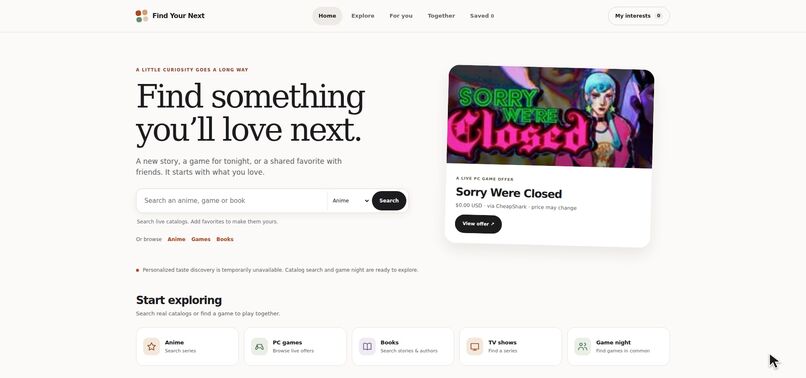
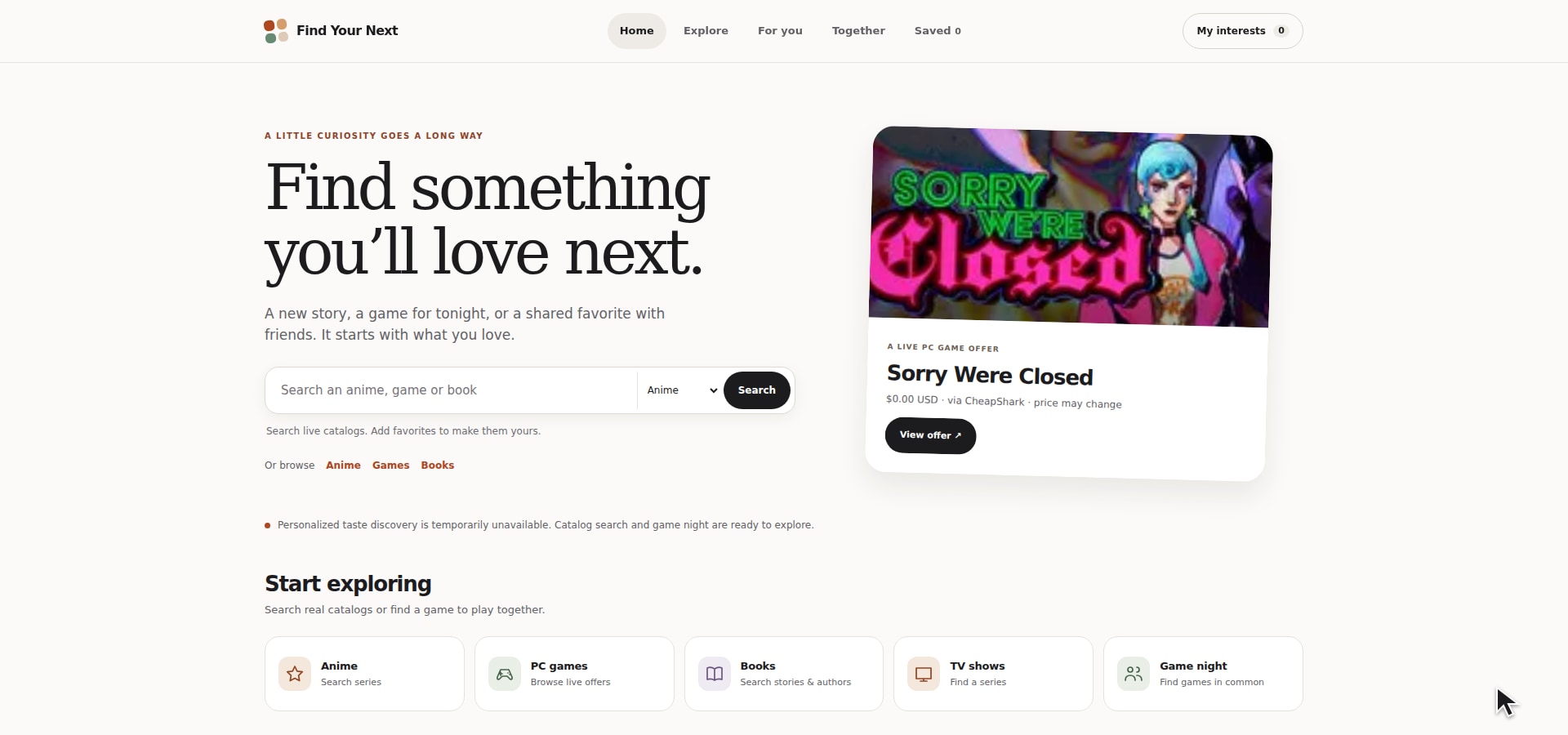
Start with what you love: one workspace for catalog search, saved titles and Qloo-powered discovery.
-
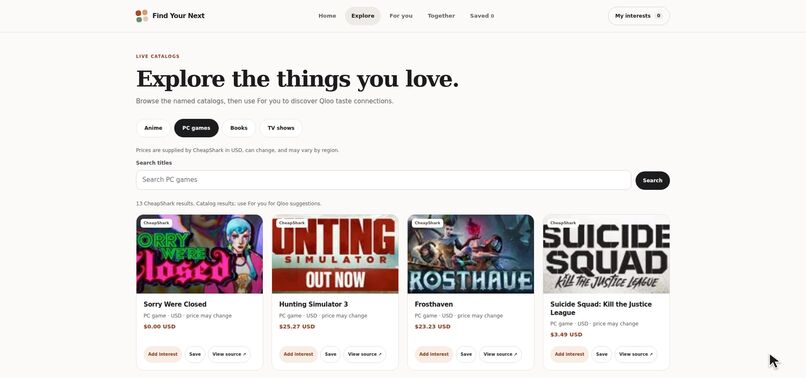
Explore books, PC games, TV and anime, with each catalog source clearly identified.
-
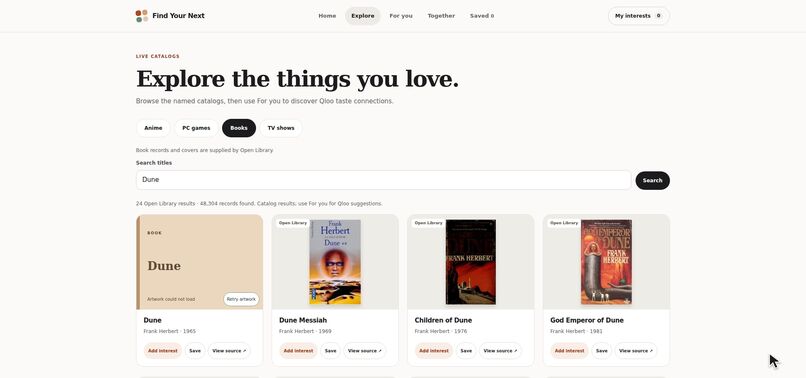
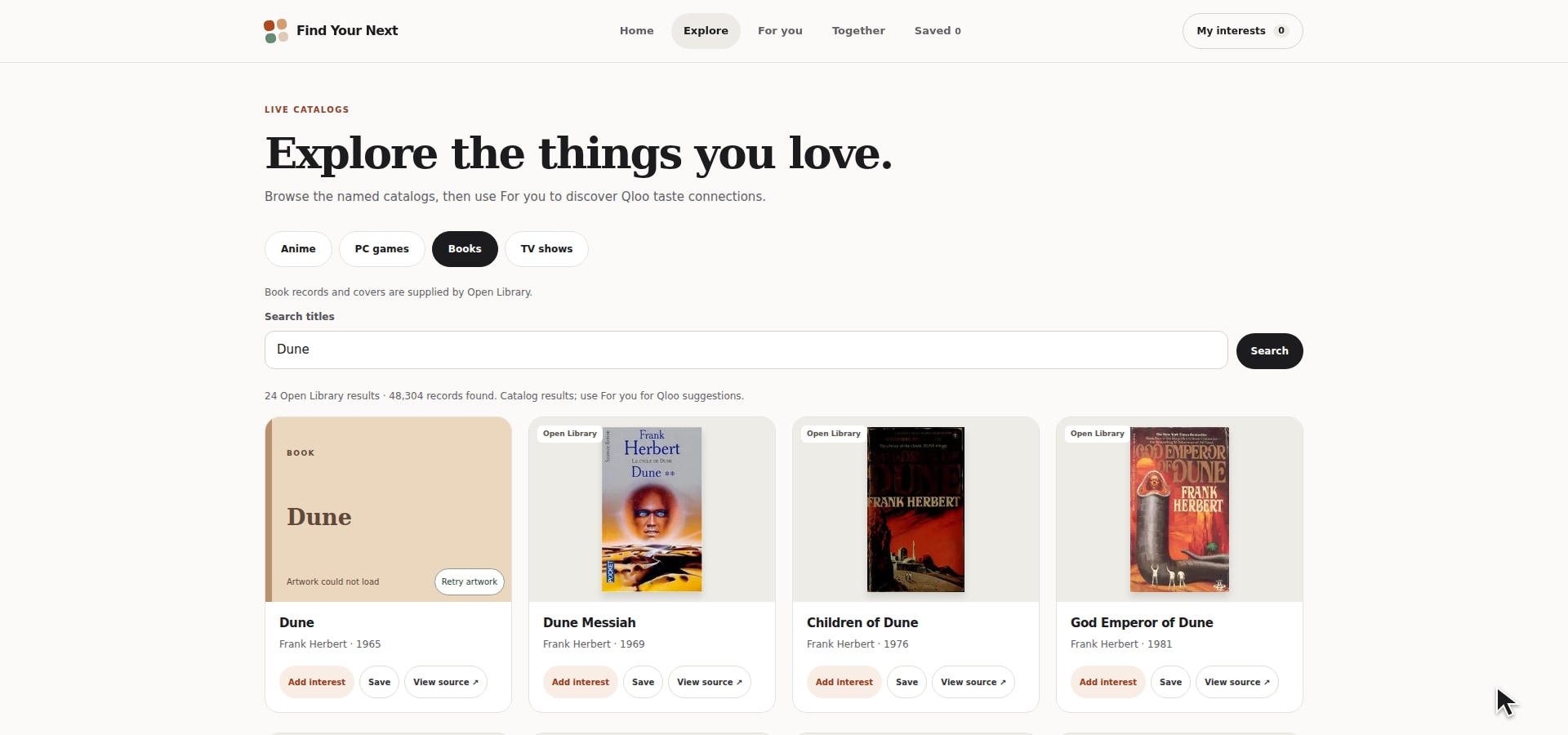
Search Dune in Open Library. These are real catalog records, separate from Qloo taste recommendations.
-
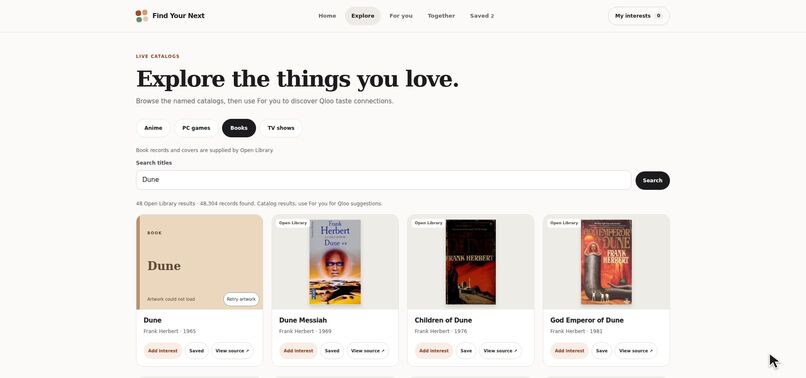
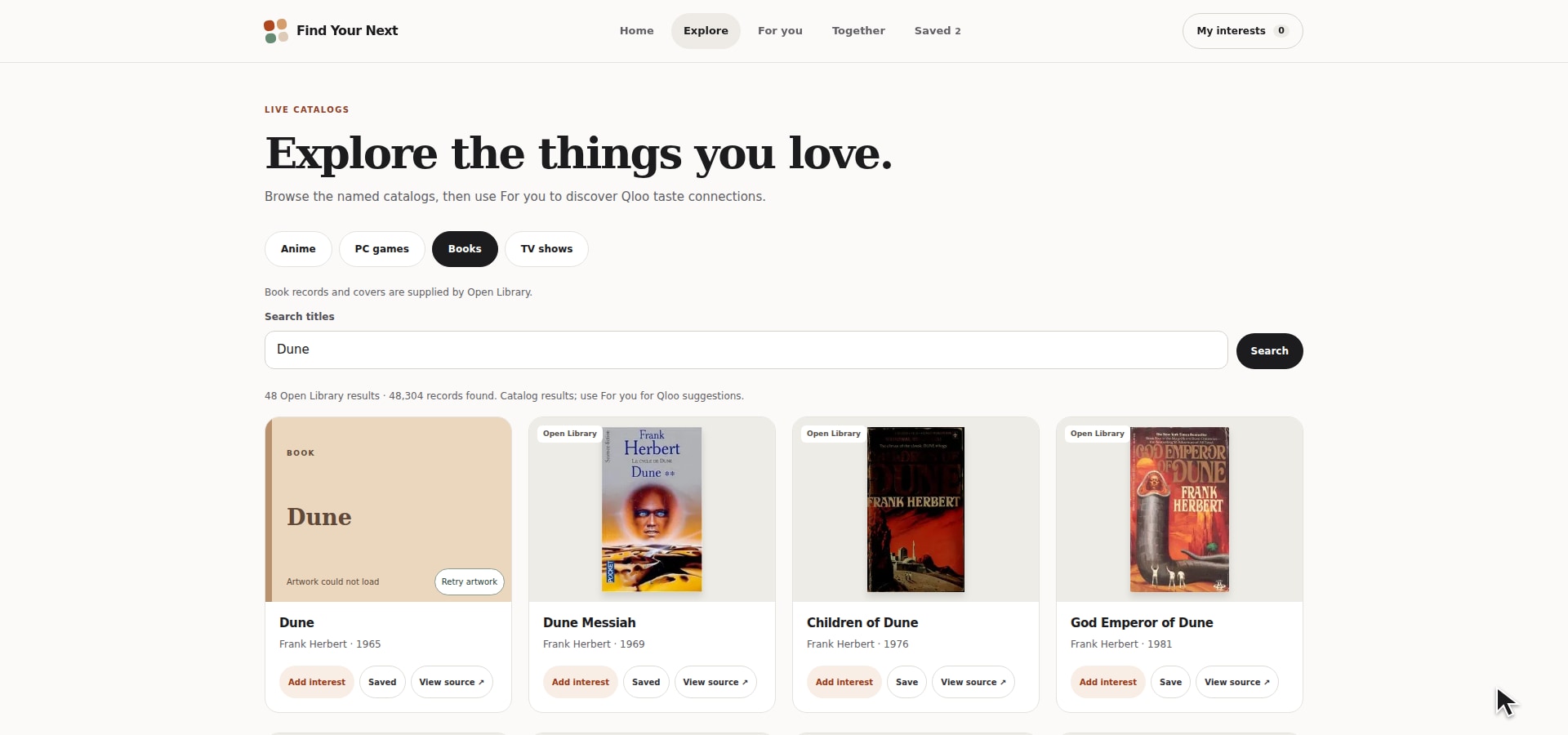
Load more appends another source page. Saved titles stay in your collection as you continue browsing.
-
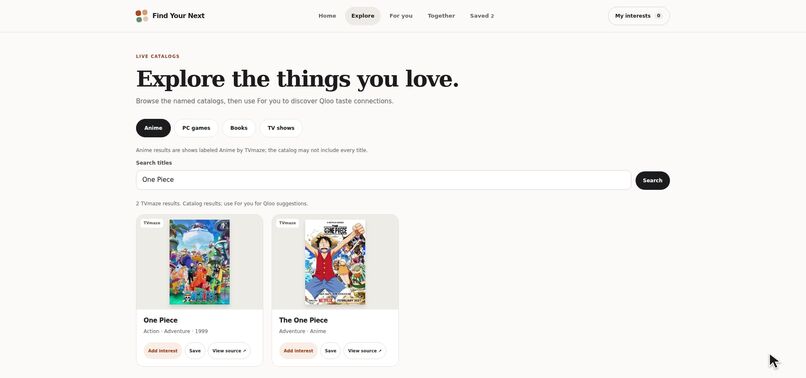
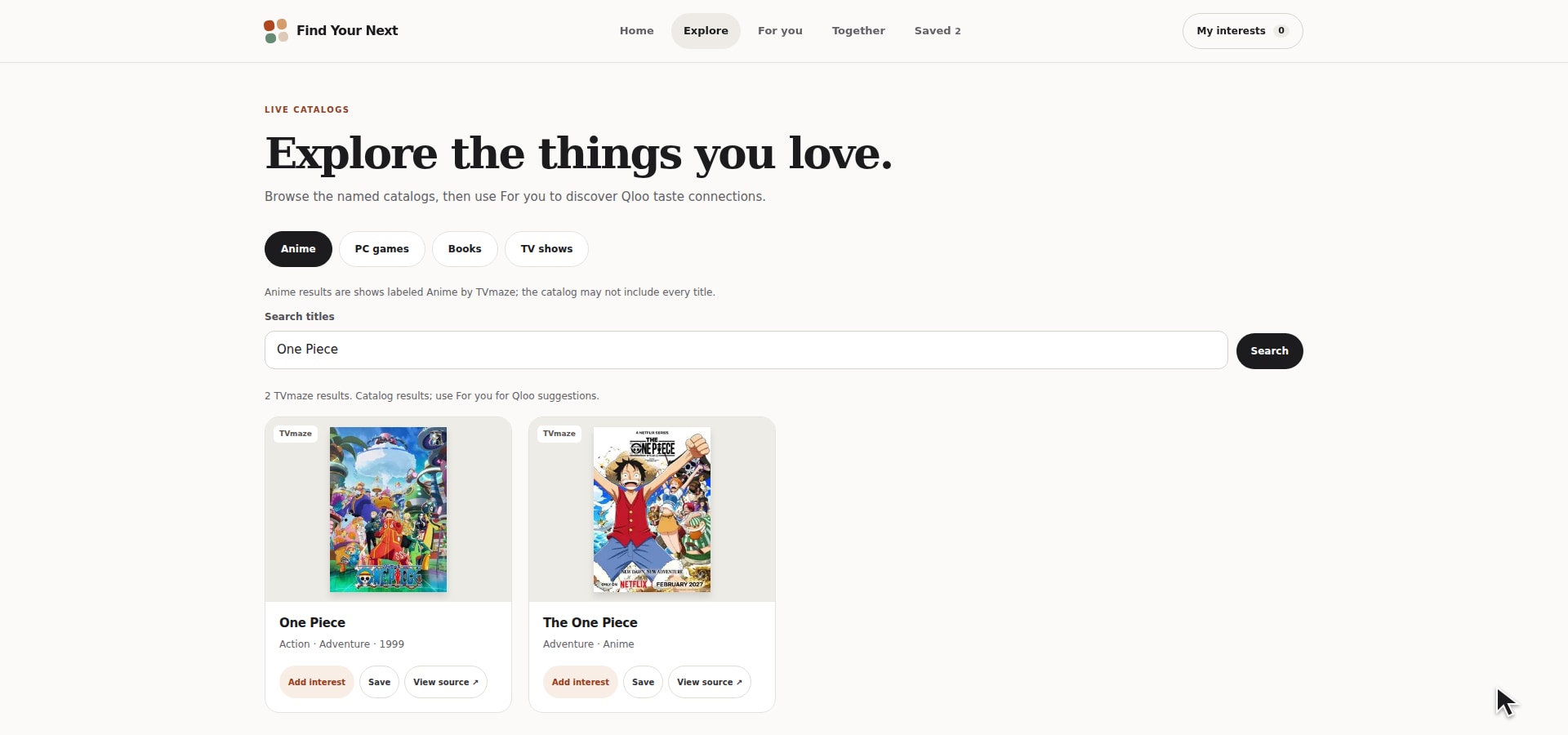
TVmaze supplies anime titles, cover art and release years, helping distinguish versions with the same name.
-
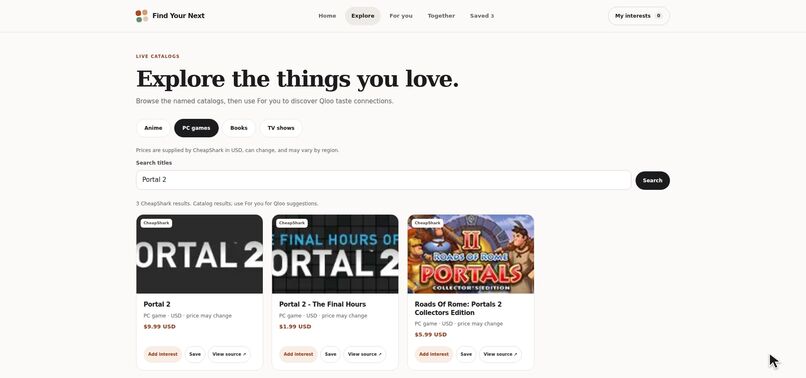
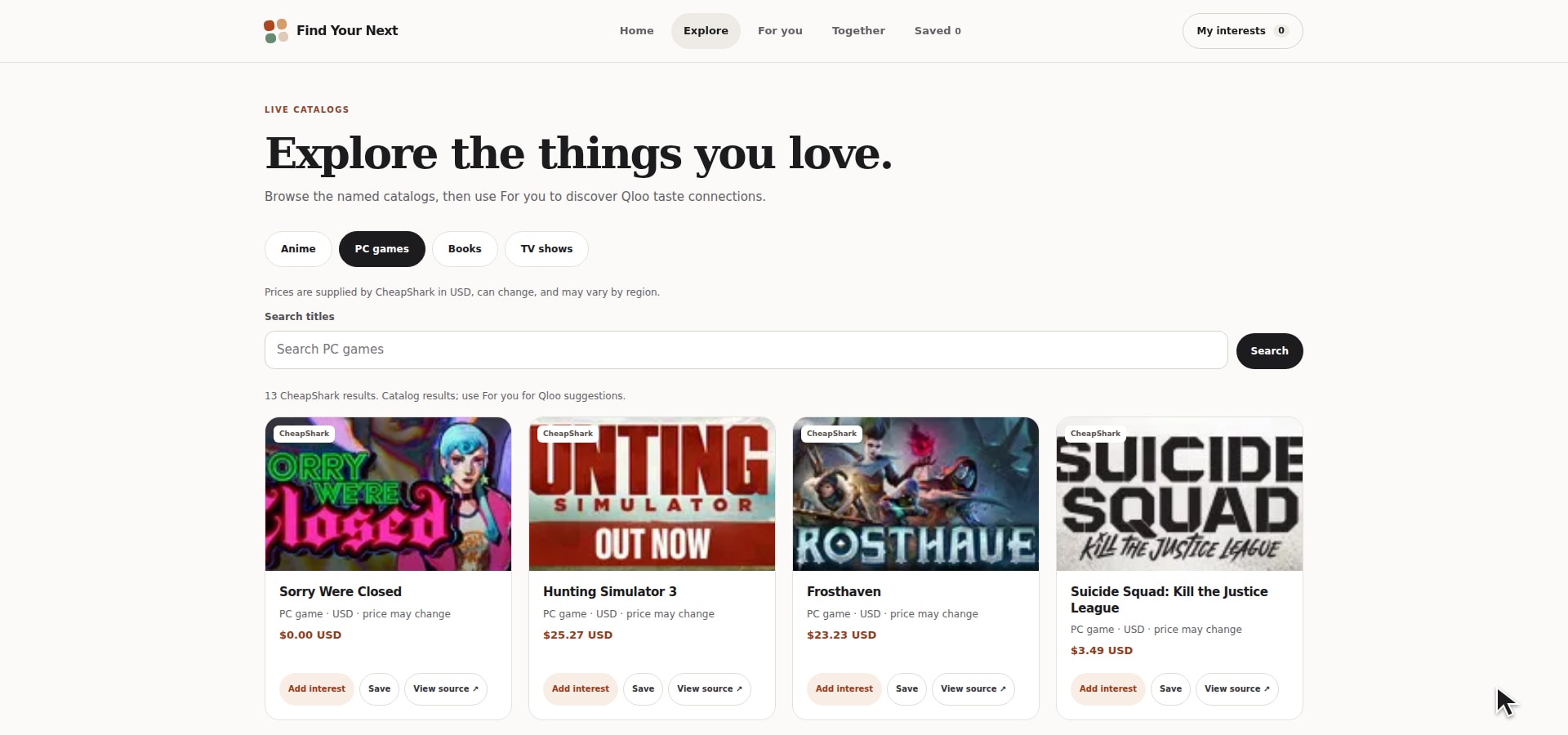
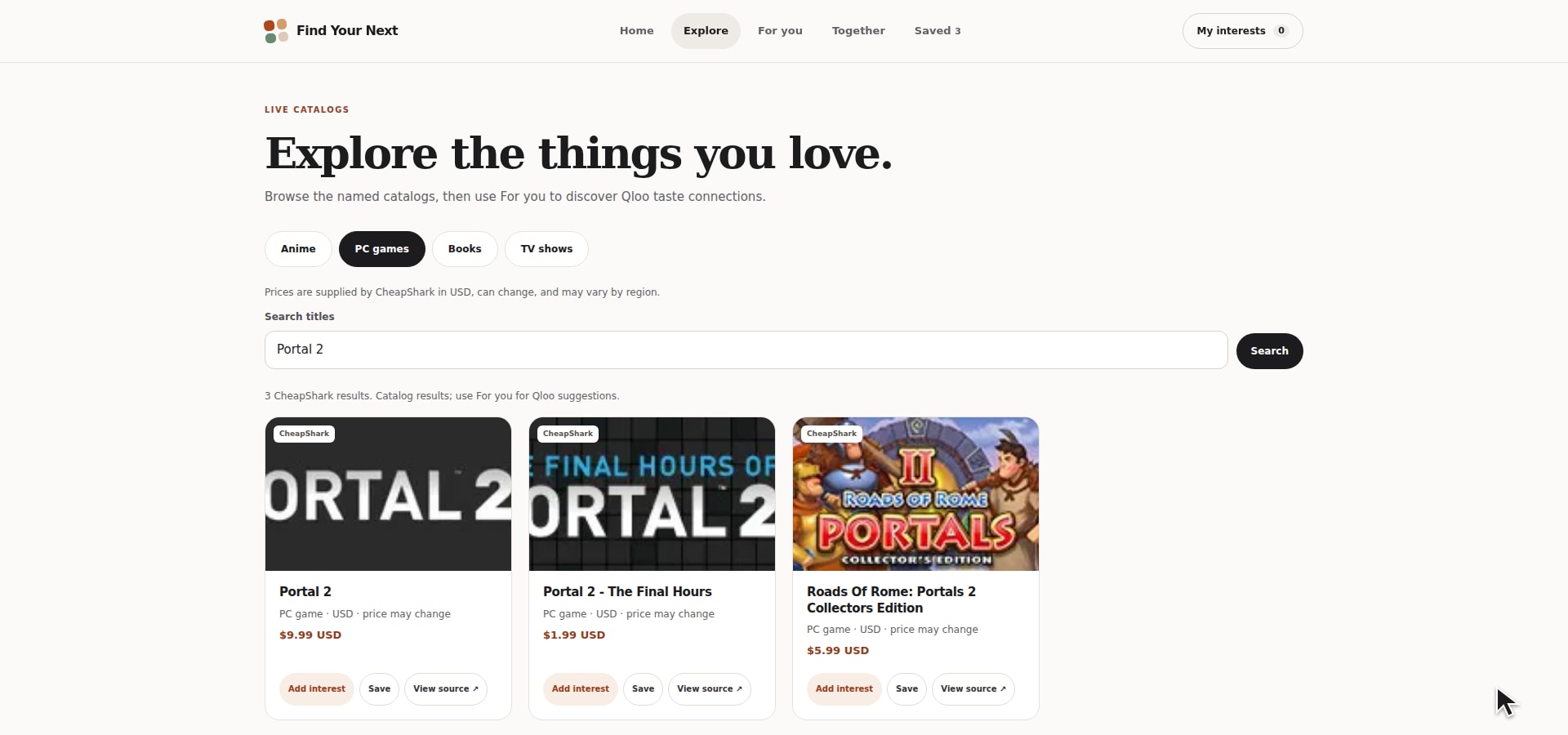
Find Portal 2 offers through CheapShark. Prices are source-reported in USD and may change.
-
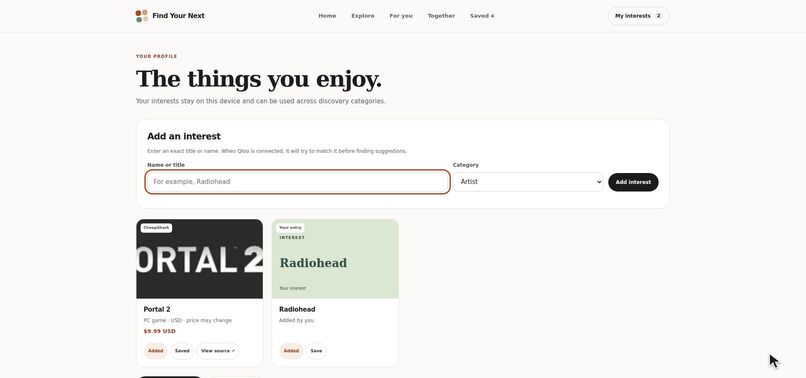
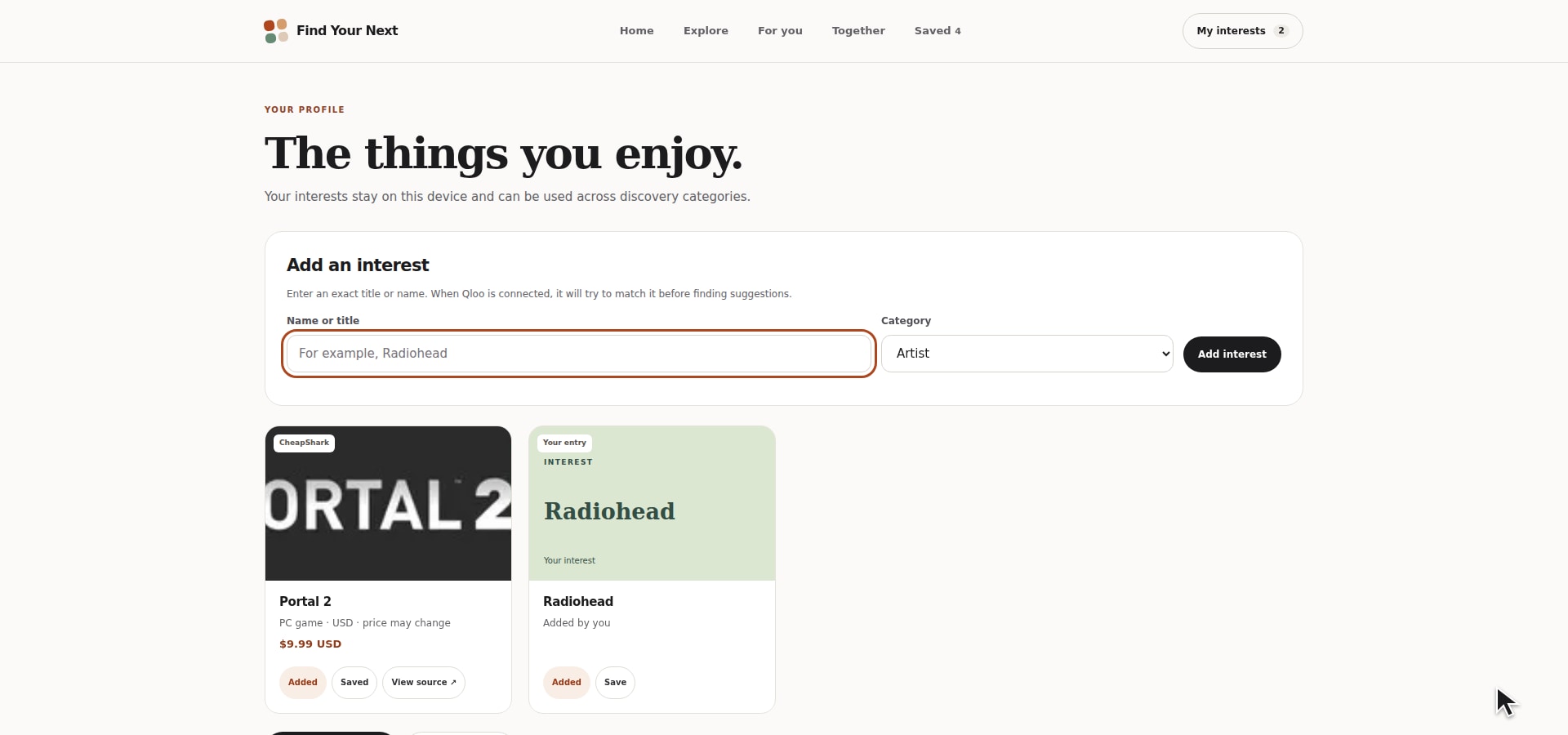
Add favorites from catalogs or enter an exact name. Interests remain under your control.
-
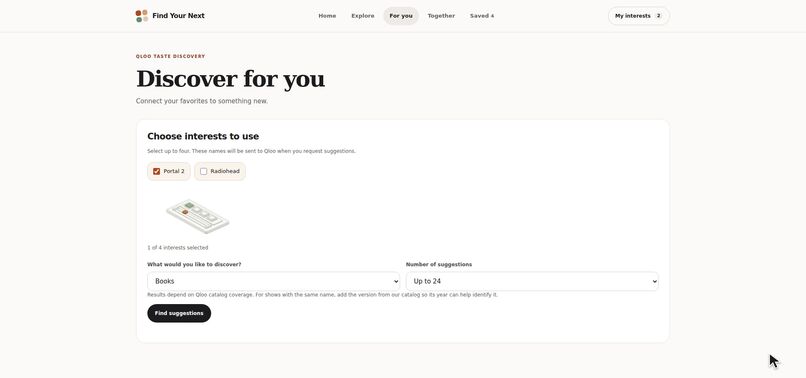
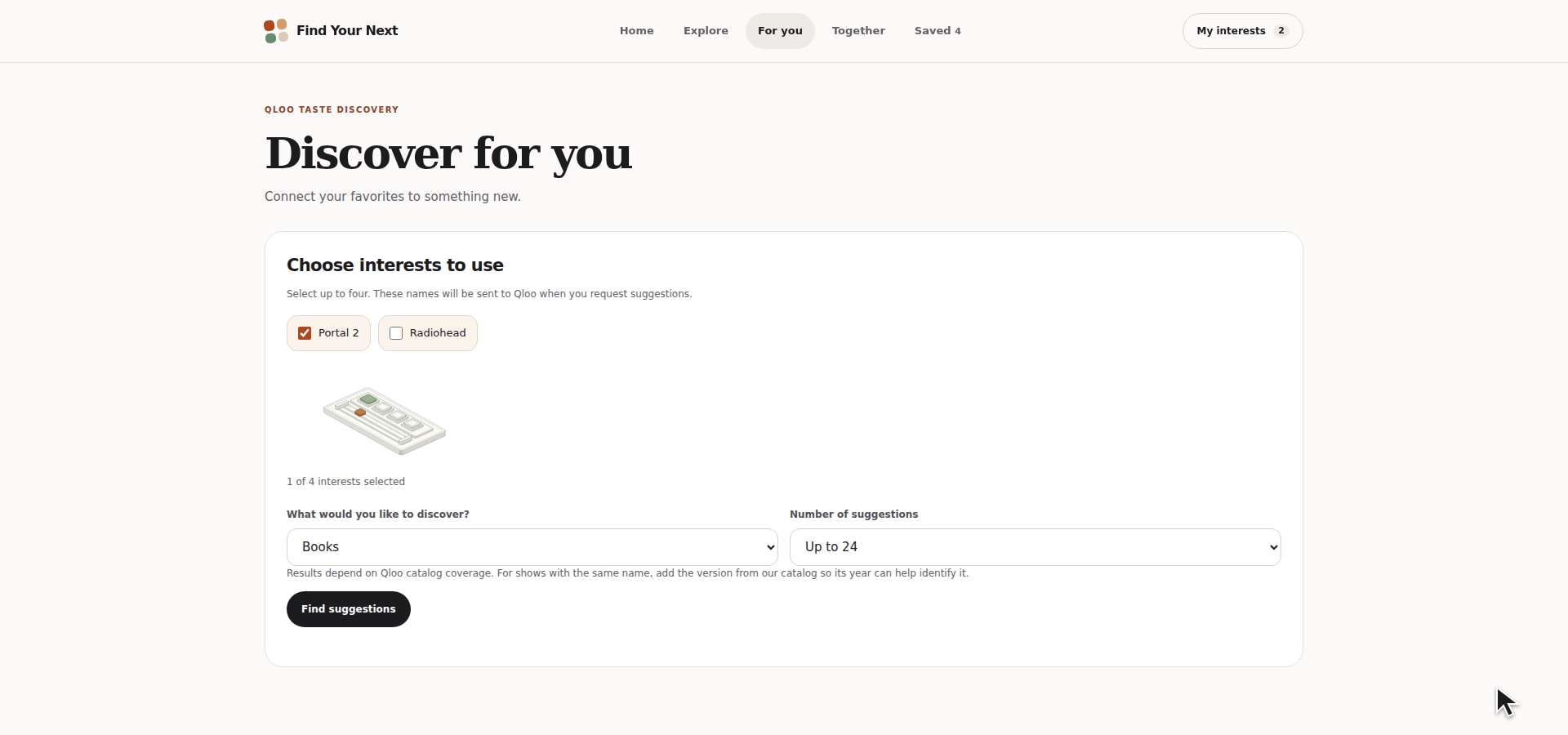
Select Portal 2, choose Books and request up to 24 suggestions. The selected names are sent to Qloo.
-
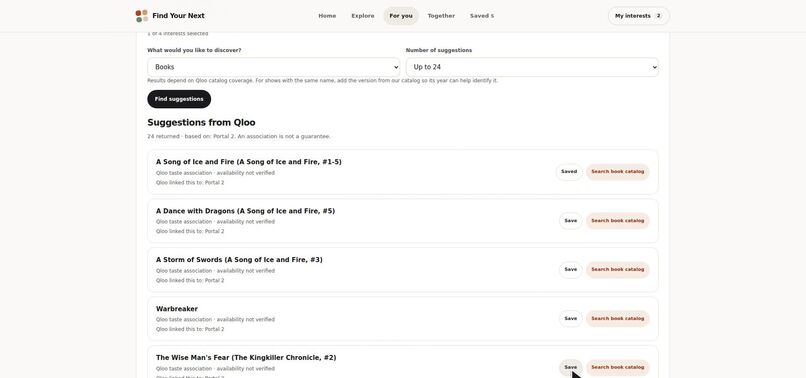
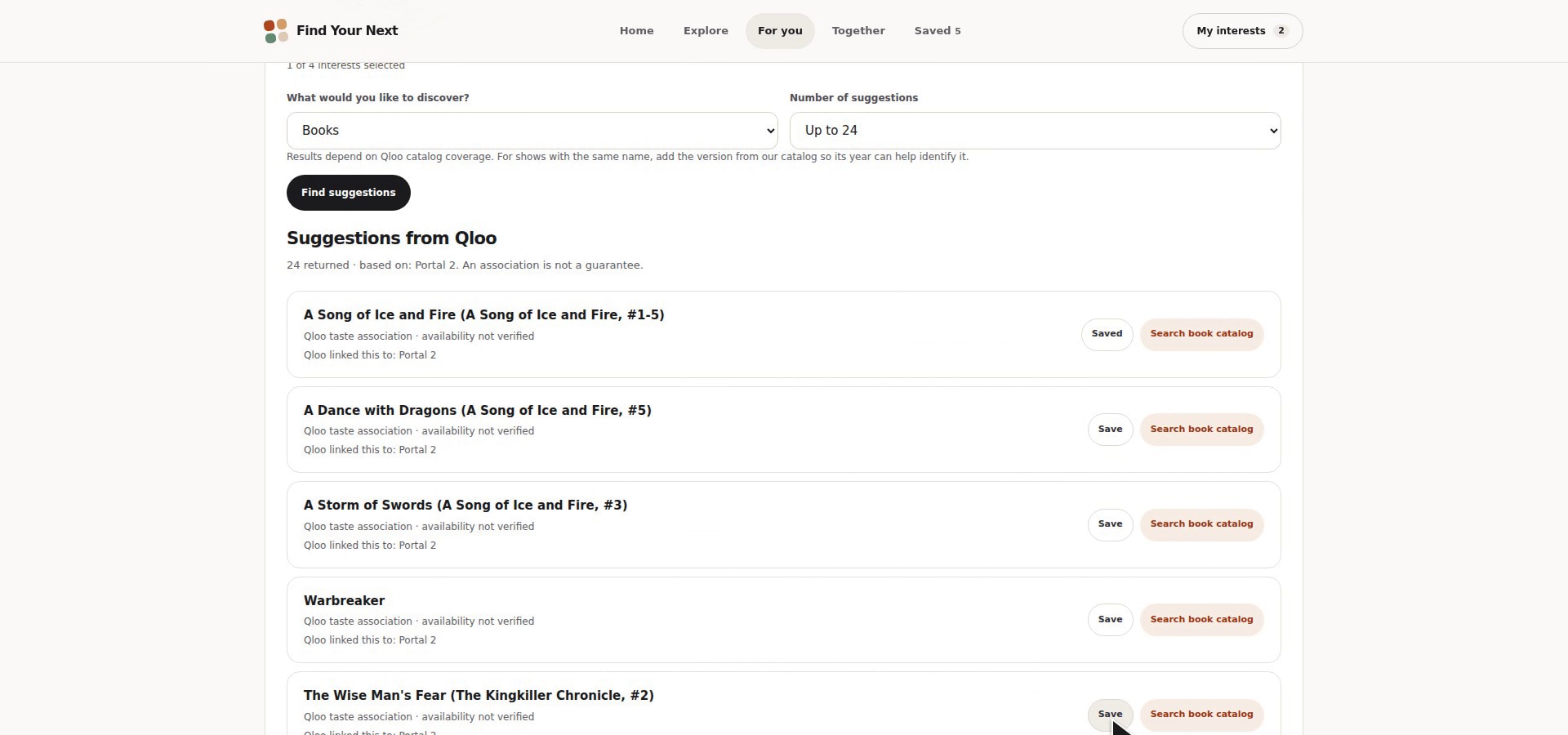
Live Qloo book associations for Portal 2 include per-interest explanations. Associations are not guarantees.
-
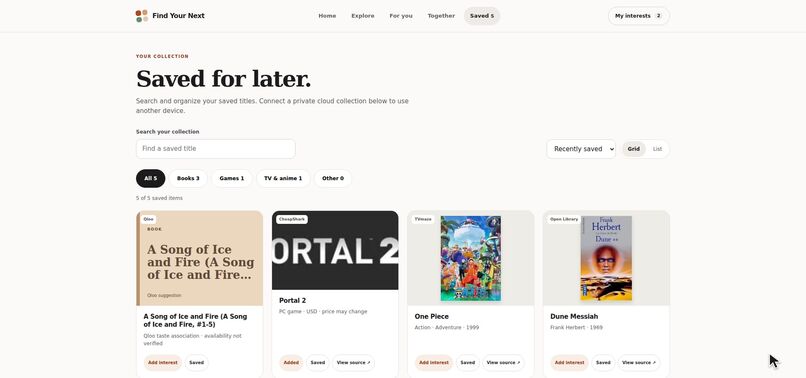
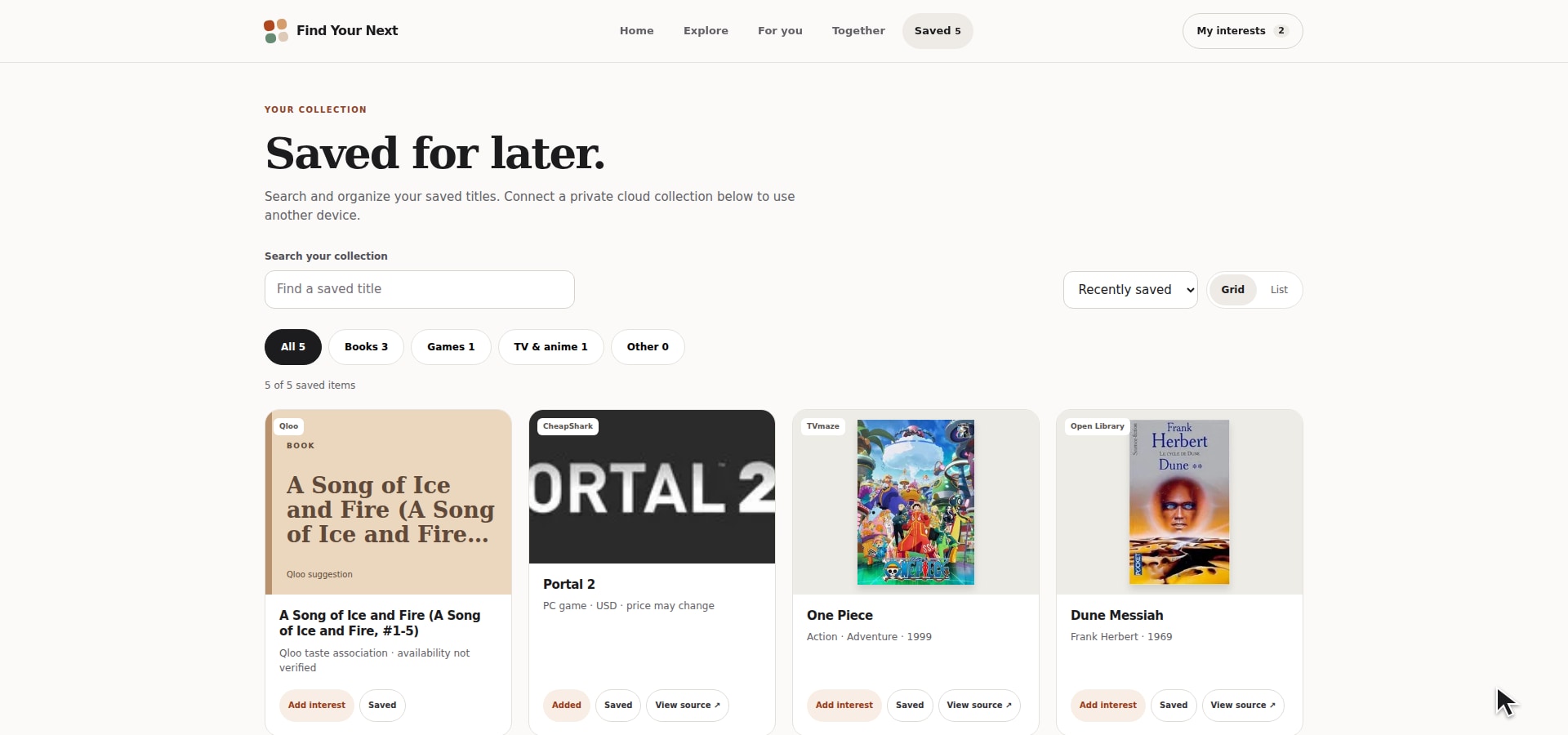
Keep catalog titles and Qloo discoveries in one saved collection, with search, sorting and category filters.
-
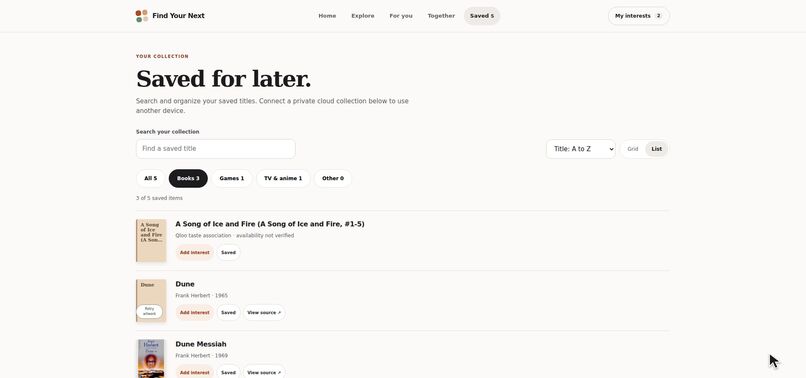
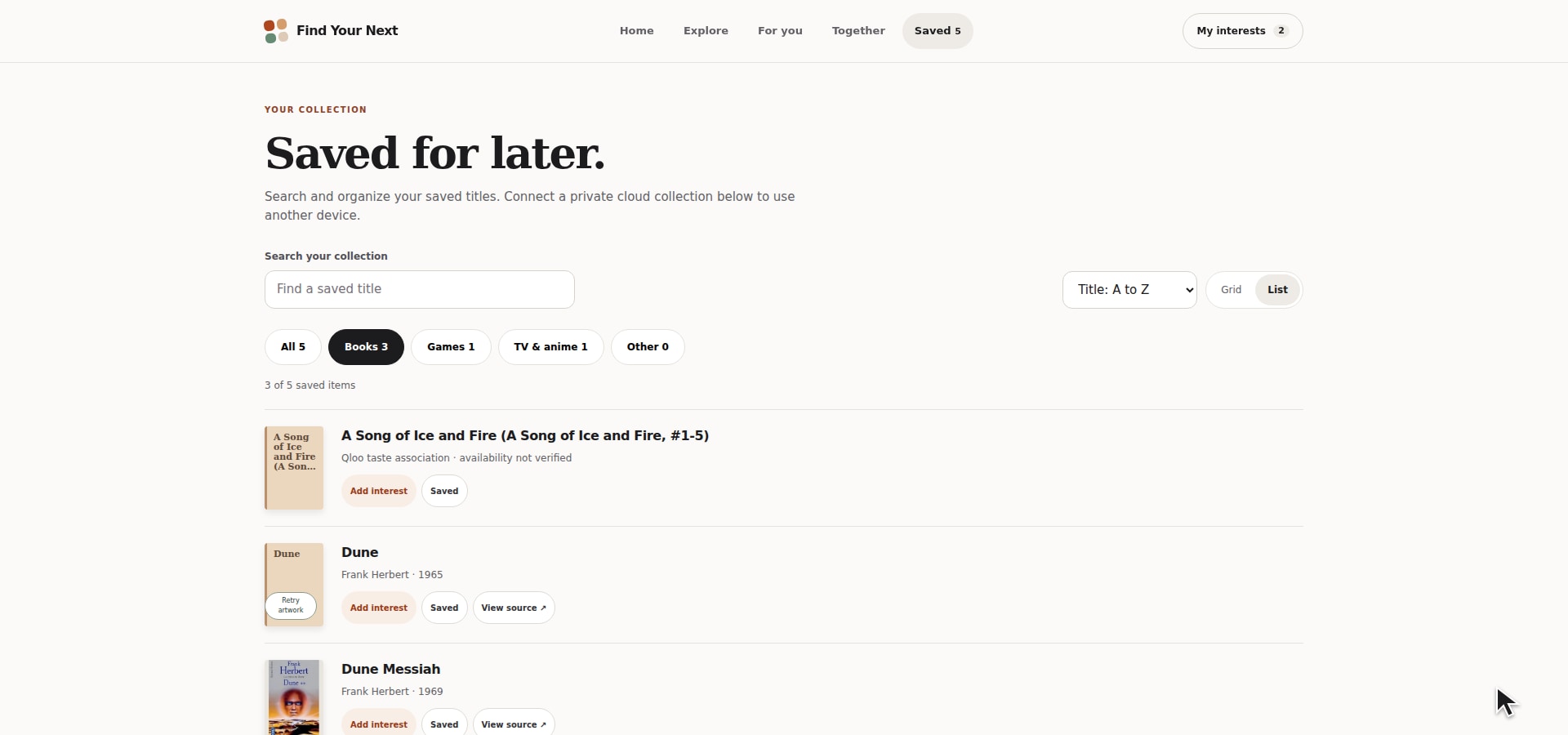
Filter saved books, sort A to Z and switch to a compact list. The layout preference is remembered.
-
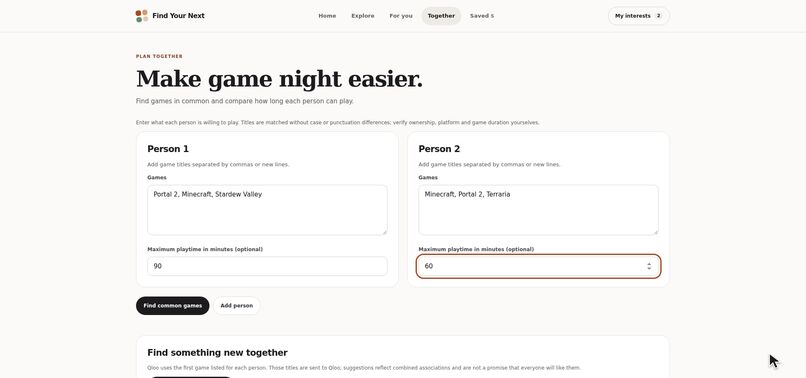
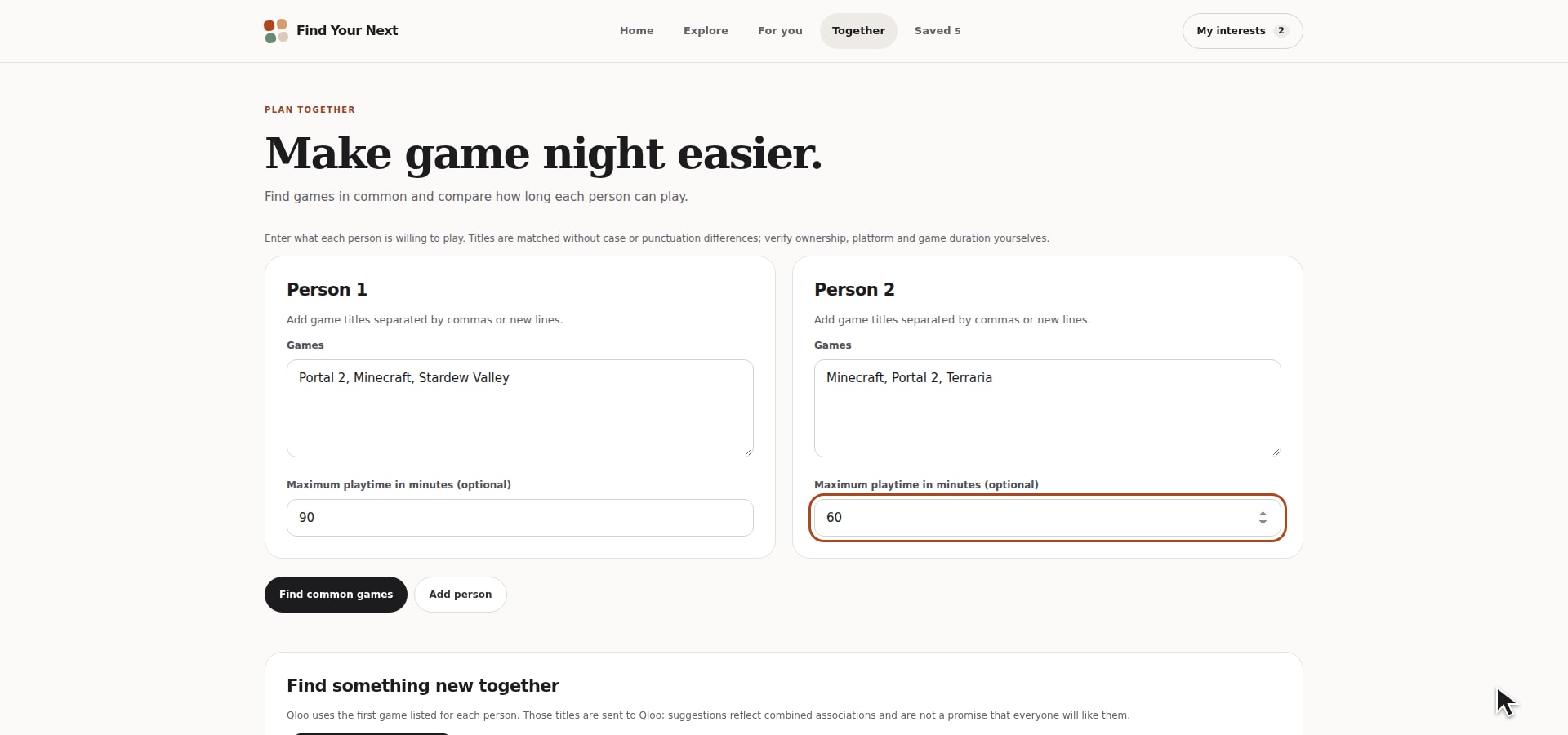
Compare games entered by two to four people. Optional playtimes help identify the shortest available session.
-
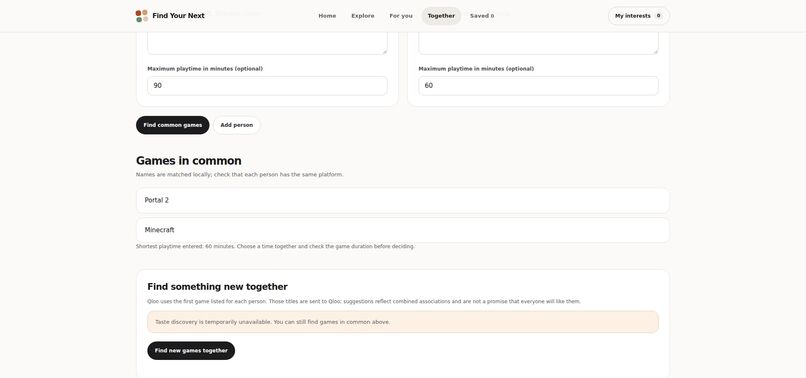
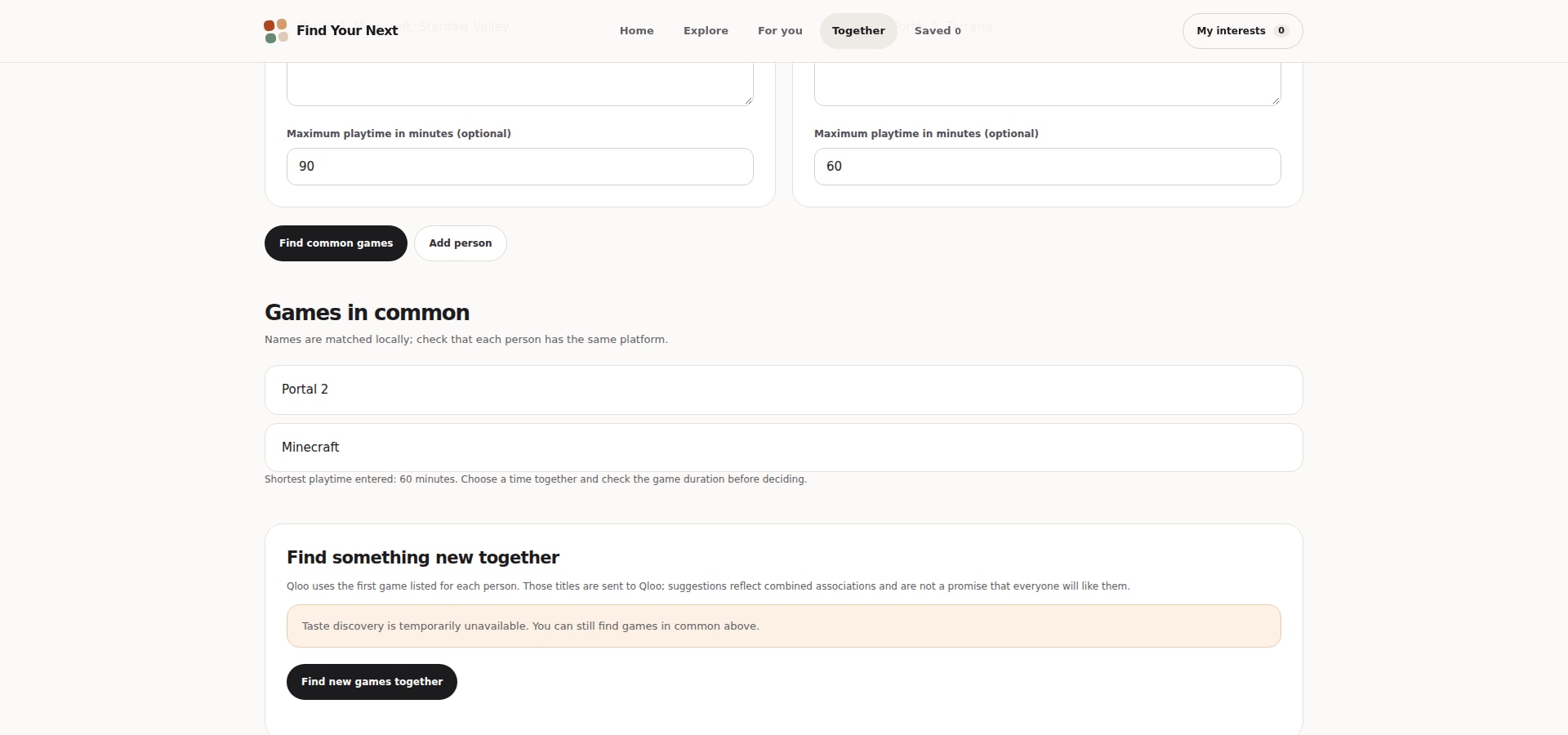
Exact overlap is matched locally: Portal 2 and Minecraft, with a shortest entered playtime of 60 minutes.
-
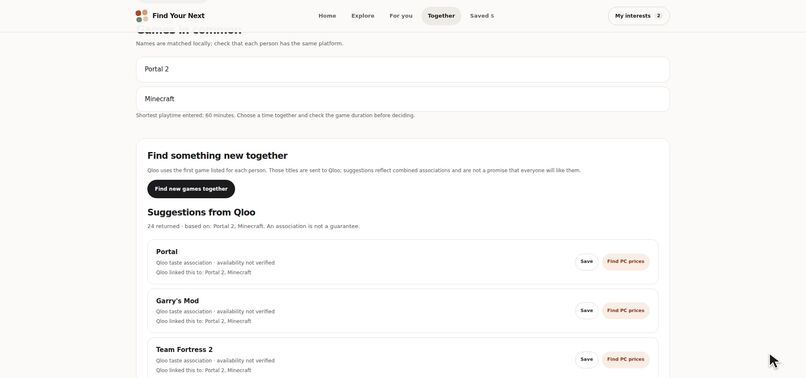
Qloo combines each person’s first game to find new associations beyond the titles already in common.
-
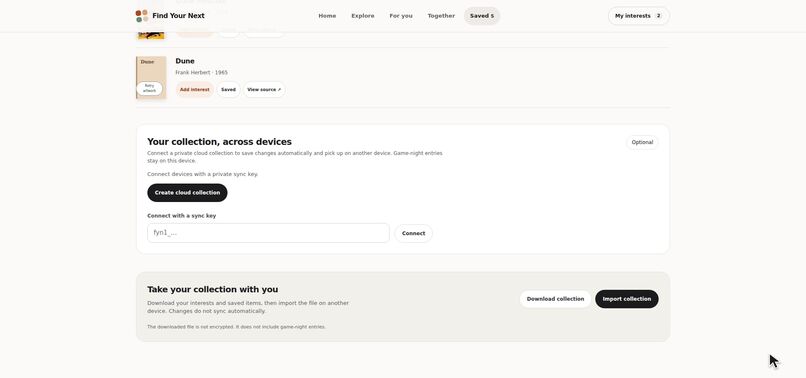
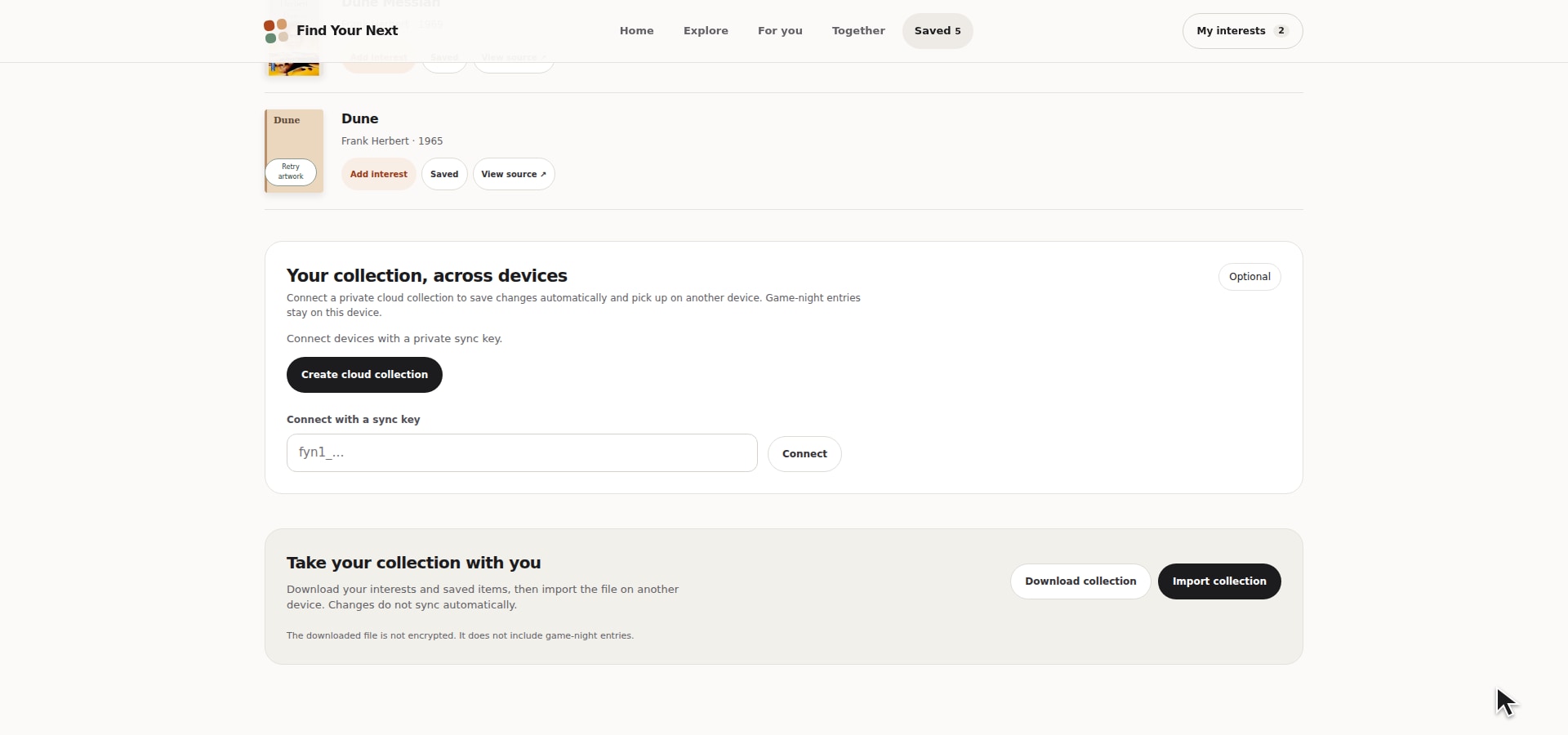
Optional encrypted cloud collections use a private sync key. Local saving and manual transfer remain available.

The problem
Choosing what to watch, read or play means moving between disconnected catalogs. Choosing a game with friends adds another step: finding common ground. Find Your Next brings chosen interests, catalog search and Qloo-powered discovery into one workspace.
What you can do
Search TV and anime through TVmaze, books through Open Library and PC game offers through CheapShark. Save titles and build an interest profile. In Together, two to four people can compare entered games and see exact titles in common. Optional playtimes show the shortest duration; the app does not check calendars or ownership.
The released interface includes collection search, type filters, alphabetical sorting and remembered grid/list layouts. Optional private cloud collections synchronize interests and saved titles with browser encryption and a private recovery key. Manual JSON download/import is also available; those files are unencrypted and exclude game-night entries. No email account is needed, and anyone holding the sync key can access or delete that cloud collection.
Catalogs and Qloo remain separate sources. Books and game offers have 24-record source pages and a Load more action. Game offers are combined by game, so one page can contain fewer unique cards. TVmaze returns its own finite search set. For You offers up to 12, 24 or 48 Qloo results rather than silently truncating everything to twelve.
Try it in a few steps
Open My interests, add Portal 2 with category Game, then open For you. Select Portal 2, choose Books and request suggestions. Qloo resolves the interest and returns cross-category associations with explanations. To try the group flow, enter Portal 2 and Minecraft for each of two people in Together, compare common titles, then request new games together.
Where Qloo fits
The discovery workflow sends up to four selected interests to our server, resolves them to unambiguous Qloo entities and requests related entities in another category. A favorite game can lead to books or artists. Where Qloo returns explanation data, the interface shows which named interests contributed. Together can combine one game from each person as input. Suggestions are associations, not a guarantee that everyone will like them or that an item is available.
Live verification: the public app returned 24 book suggestions for Portal 2 and 24 game suggestions for Portal 2 + Minecraft, with Qloo explanation data. Protected Preview checks also returned 48 books for Portal 2 and 24 destinations for Radiohead. These were real requests using the server-side key, not catalog fixtures. They demonstrate the tested journeys, not universal coverage or measured recommendation quality.
How we built it
HTML, CSS and JavaScript provide the interface. Node.js serverless functions on Vercel fetch catalogs and Qloo data; the Qloo key stays on the server. A private shared quota record reserves calls before a workflow. Exact name matching and TVmaze release years help distinguish entities; ambiguous matches remain unresolved instead of being guessed.
For optional cloud collections, Web Crypto generates a high-entropy sync key and derives separate identifiers, access credentials and an AES-GCM encryption key. Supabase stores the encrypted envelope, revision and counters. Browser roles cannot read the tables or call the private RPC. Anyone holding the complete sync key can access or delete the collection; there is no email recovery. Local browser data and manual downloads remain plaintext. Game-night entries stay on the device.
The source passes 70 automated tests. Browser emulation covered search, saving, manual transfer, group matching, cloud sync and failure/retry behavior. Thirty-four automated accessibility states reported no detected violations; three states included incomplete contrast checks. Browser resizing passed 48 route/width combinations from 320 to 1920 pixels. These checks do not replace physical-phone, VoiceOver/NVDA or independent penetration testing. Recommendation quality and user impact have not been measured.
Challenges and what we learned
Identical titles can refer to different works. Year-aware matching helps, and the app reports unresolved inputs when it cannot disambiguate them. Catalog search is kept distinct from Qloo associations so ordinary search results are never described as personalized recommendations.
Artwork now uses the actual source record, a shared host policy and bounded WebP optimization with CDN caching. Missing game covers were traced to an omitted legitimate source host; all thirteen unique games in the tested Preview page subsequently loaded their covers. The Anatomy instrument now animates separate pad/carriage layers and respects reduced motion.
Cloud synchronization also needs clear conflict behavior: offline additions combine, removals of previously synchronized items win over concurrent retention, and a stale revision is retried without silently overwriting another device. Tests cover incorrect keys, authenticated-encryption tampering, access denial and stale edits. These are bounded engineering checks, not proof against every attack.
The production quota error was traced to conditional-write validator handling and repaired without resetting the budget or exposing the key. A live security probe also found a malformed-JSON 500; the platform parser error now becomes a safe client error with a regression test. Next we need real-user and assistive-technology studies. Event pages suggest places and artists; they do not provide verified schedules, tickets or reservations.
Team and sources
Adeel Falak Sher and Raouf Khalid.
Catalog and artwork sources: TVmaze, Open Library and CheapShark. Taste connections use Qloo. The interest illustration uses the MIT-licensed Anatomy kit; attribution is in the repository. The implemented collection layout follows list/grid patterns reviewed on Mobbin, using original app branding and assets.
Open the app · Source code and setup · Testing details
About the gallery and walkthrough
The fifteen gallery images show actual application states. The walkthrough uses a local copy of the released frontend with real Production API responses, recorded and edited in Hyperframes. Idle loading is trimmed and English narration is synthetic. No provider fixtures or invented user-impact figures appear in the media.
Built With
- cheapshark
- css3
- html5
- javascript
- node.js
- open-library
- postgresql
- qloo
- sharp
- supabase
- tvmaze
- vercel