-
-
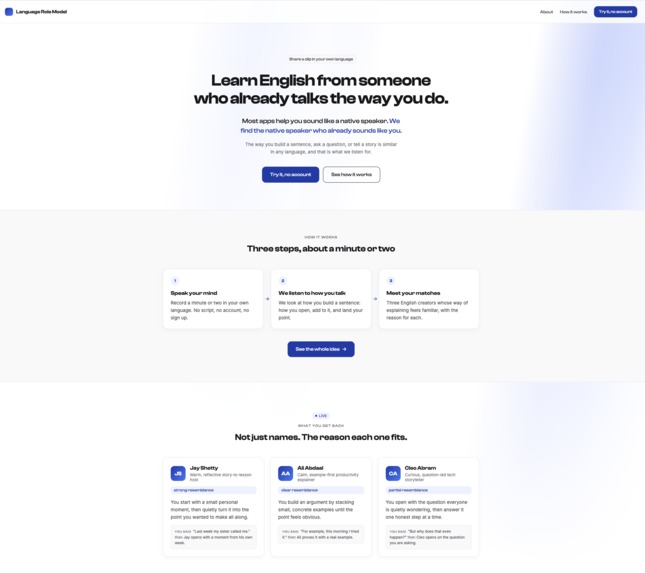
Man Home
-
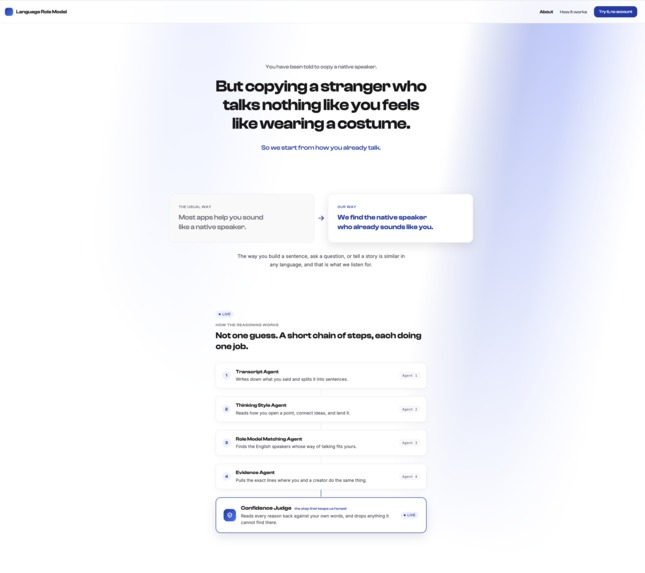
About - How it works
-
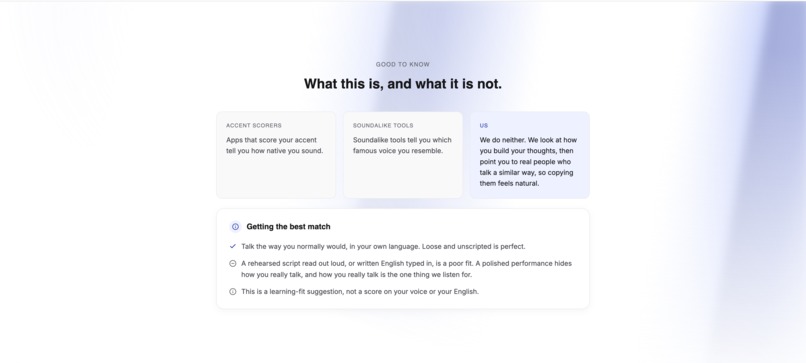
About - What's different from other apps
-
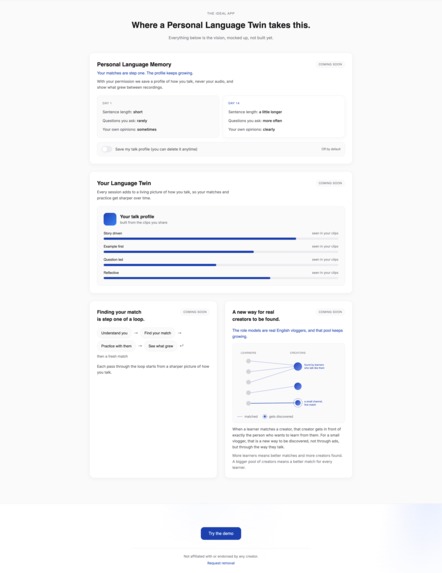
More in the future
-
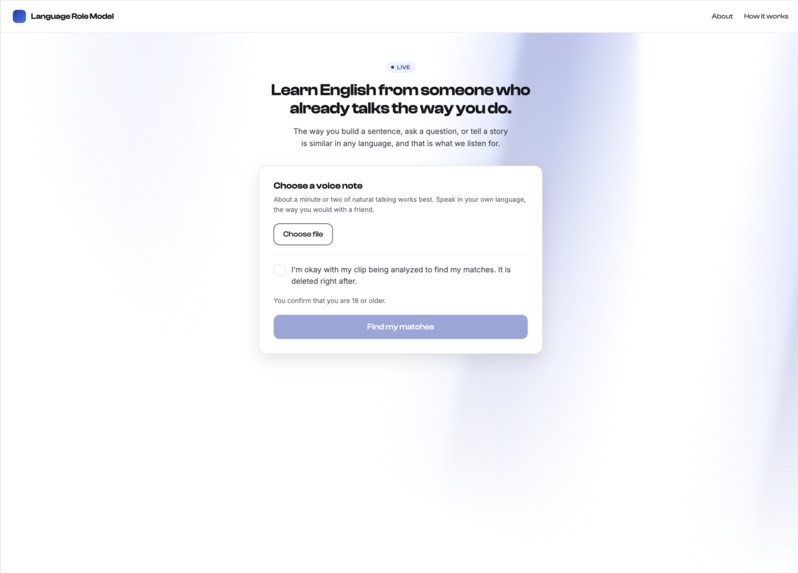
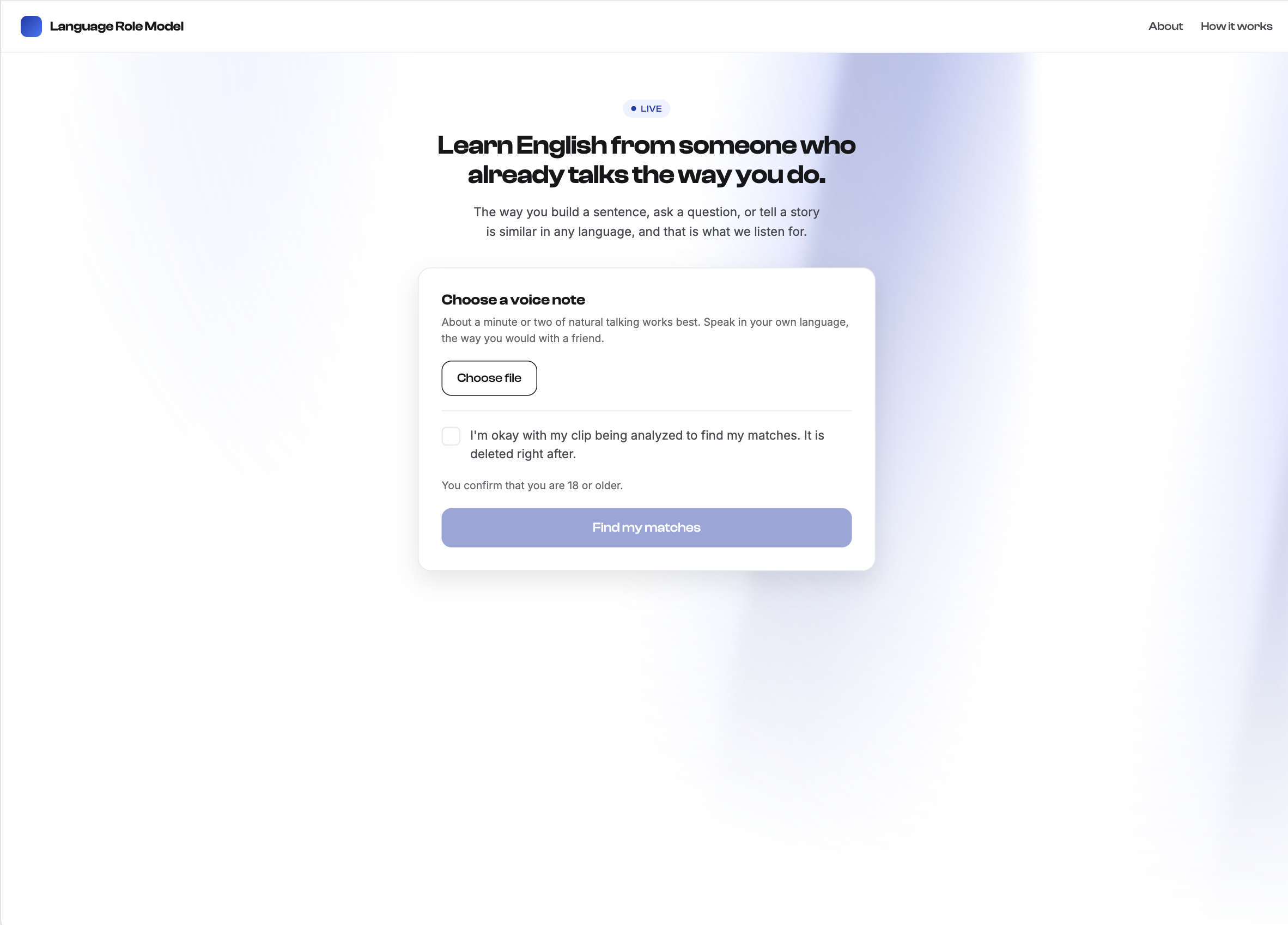
App - Upload
-
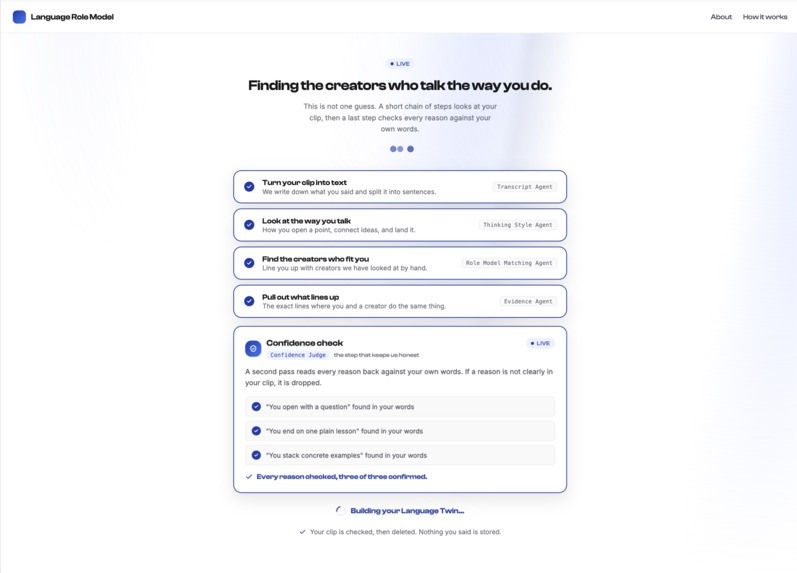
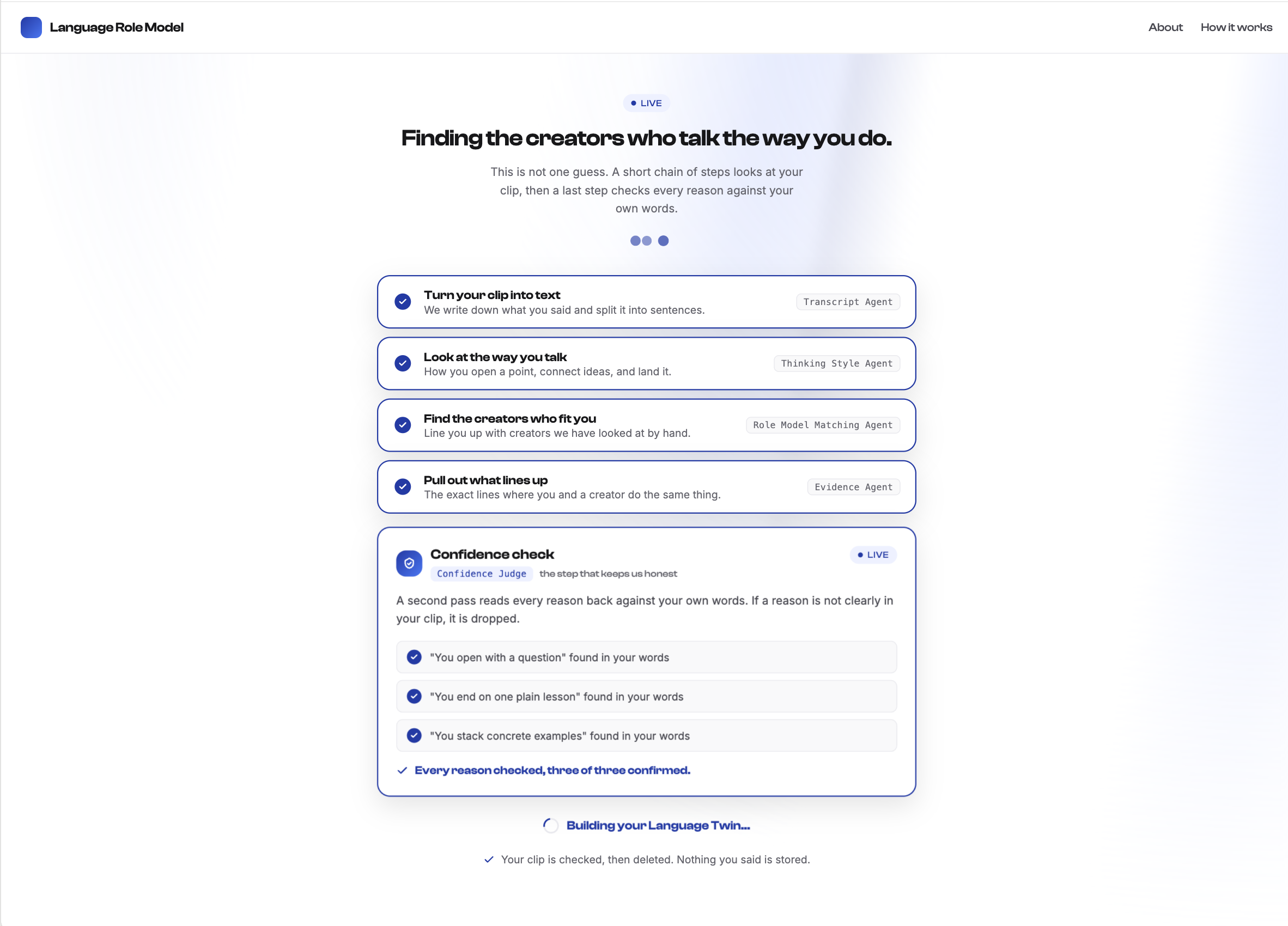
App - Processing
-
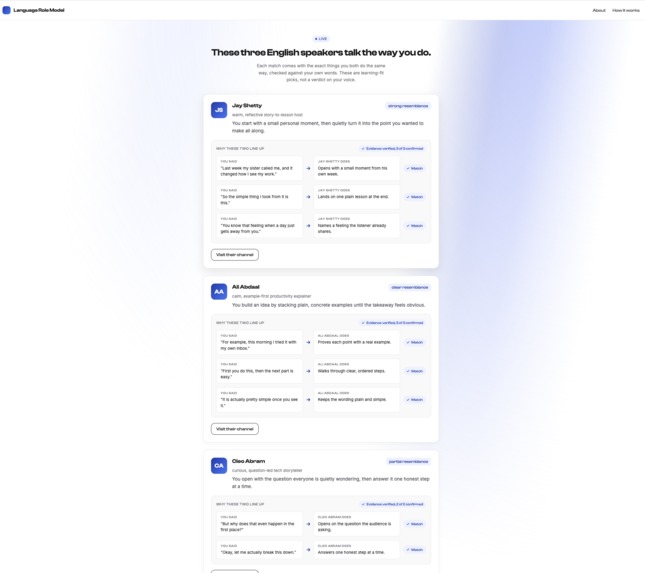
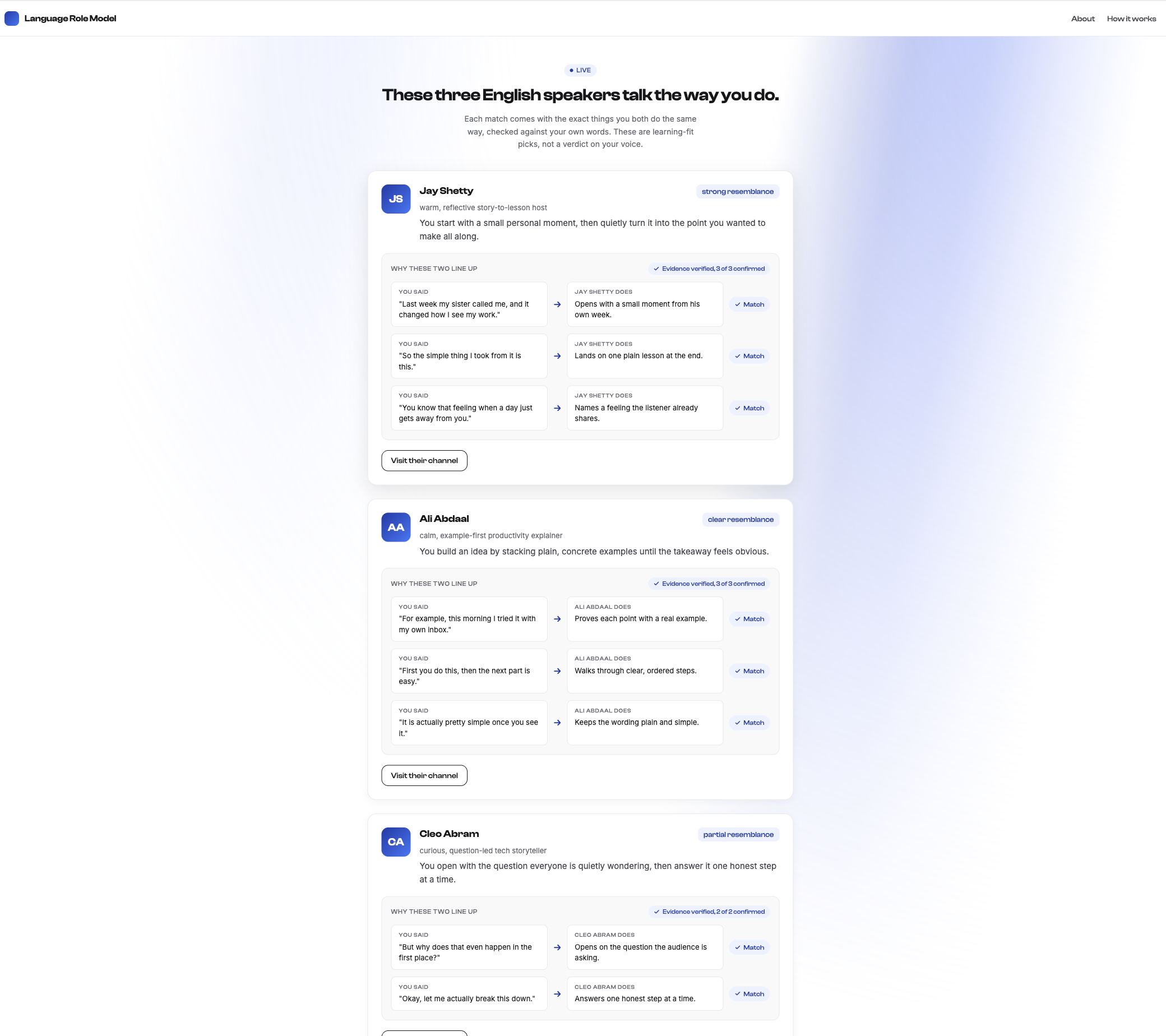
App - Results
-
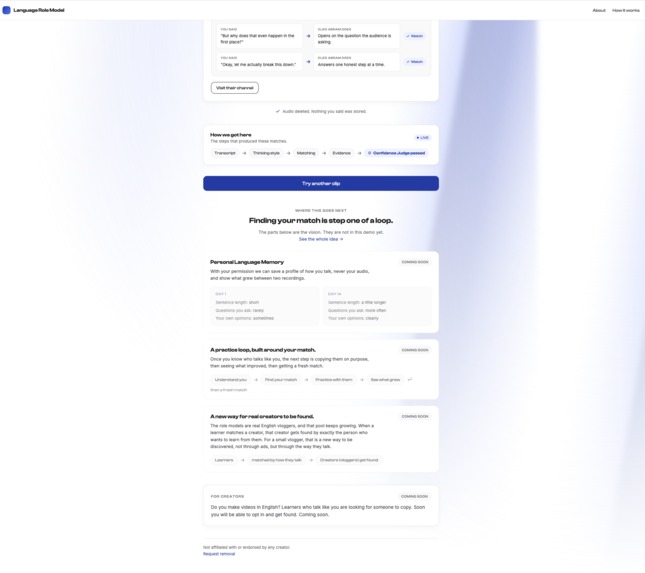
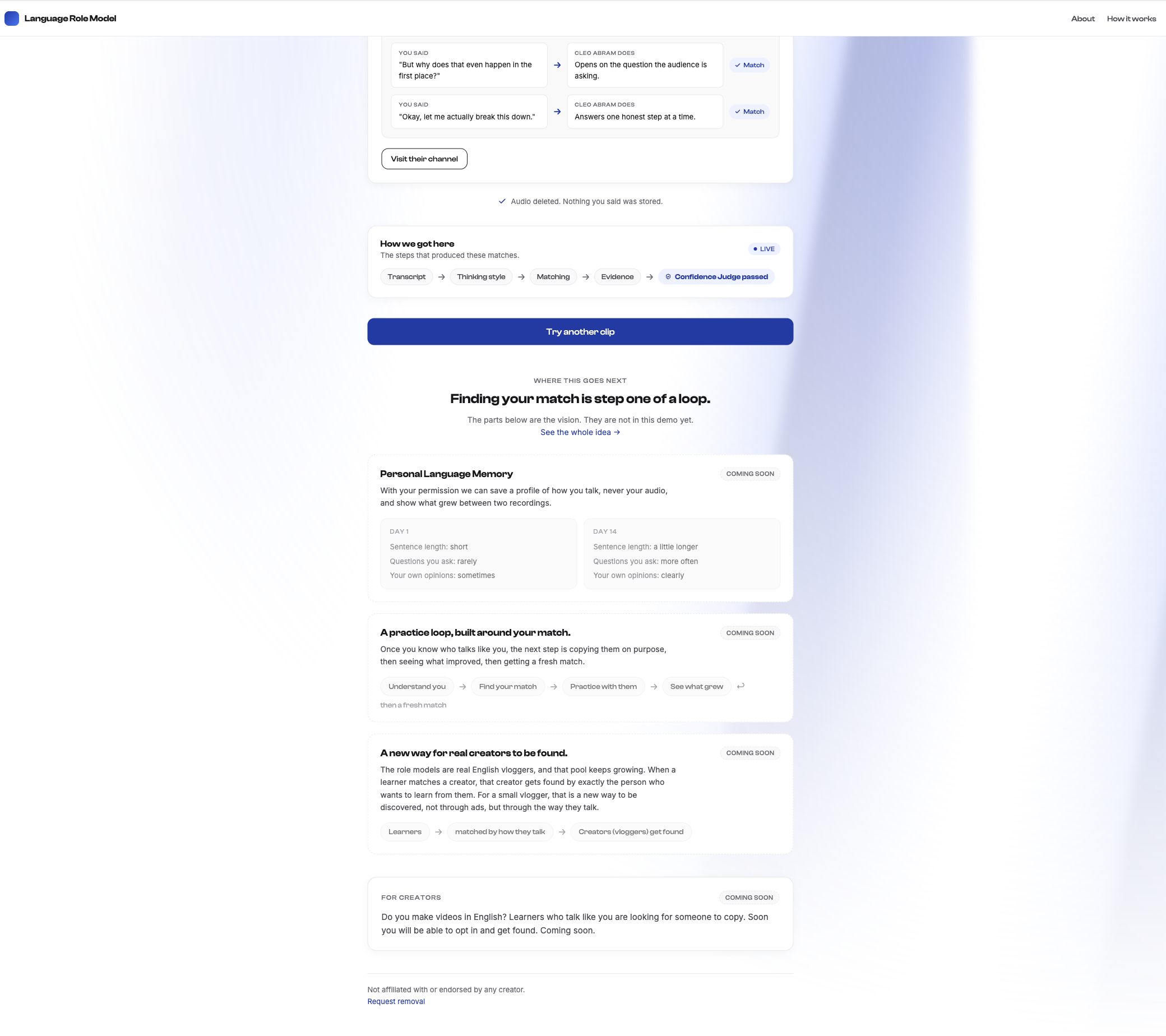
App - Results 2
Inspiration
“Just shadow a native speaker” is common advice for English learners. But copying a famous YouTuber often feels unnatural: their rhythm, arguments, and way of thinking do not feel like ours. We mistake that mismatch for a lack of ability.
We built Your Ideal Role Model around a different idea: fluency becomes easier when you shadow an English creator whose thinking style already resembles your own. If they open, hedge, question, and persuade in familiar ways, English stops feeling like a foreign mold. It starts to feel like your voice in another language.
What it does
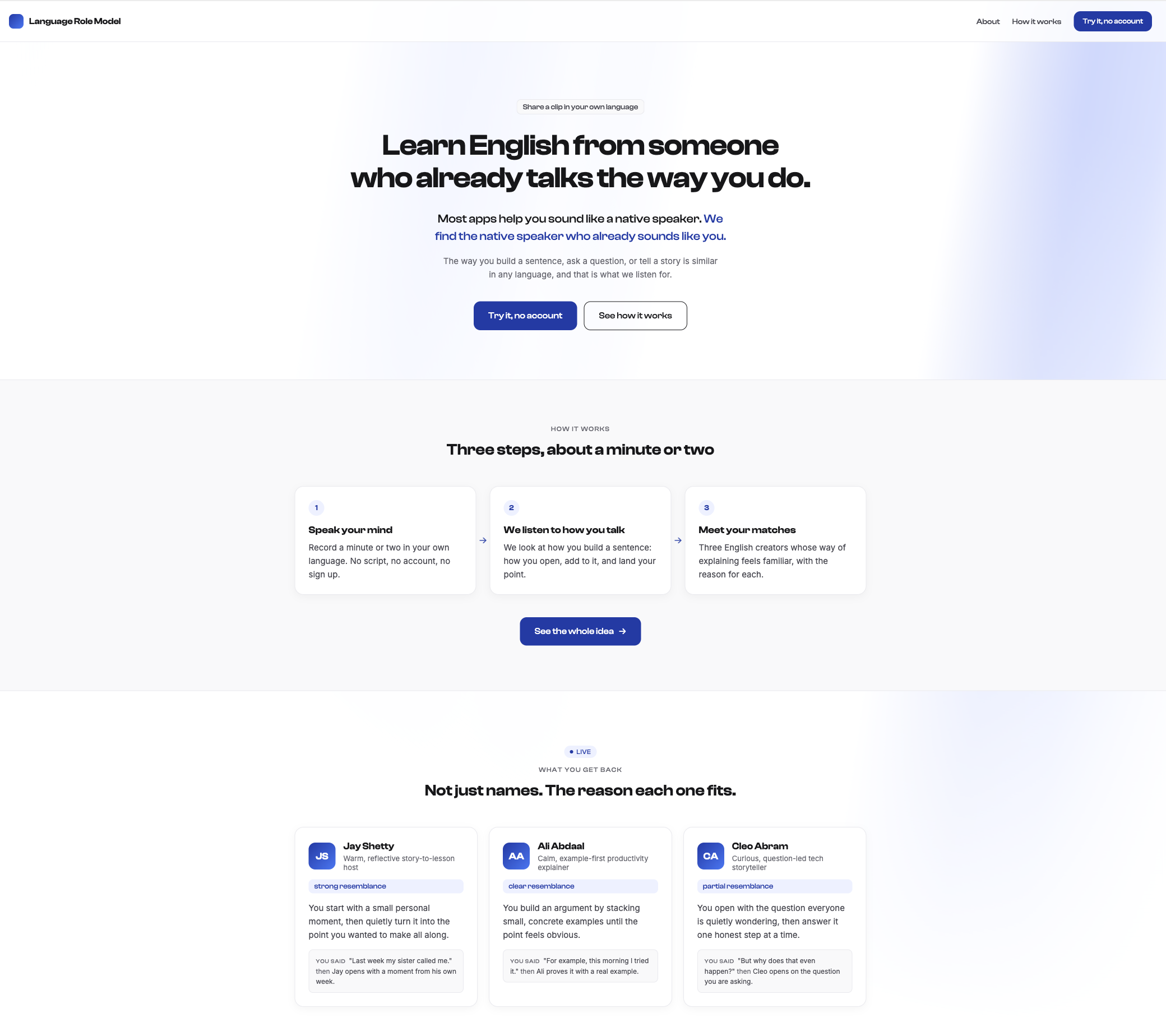
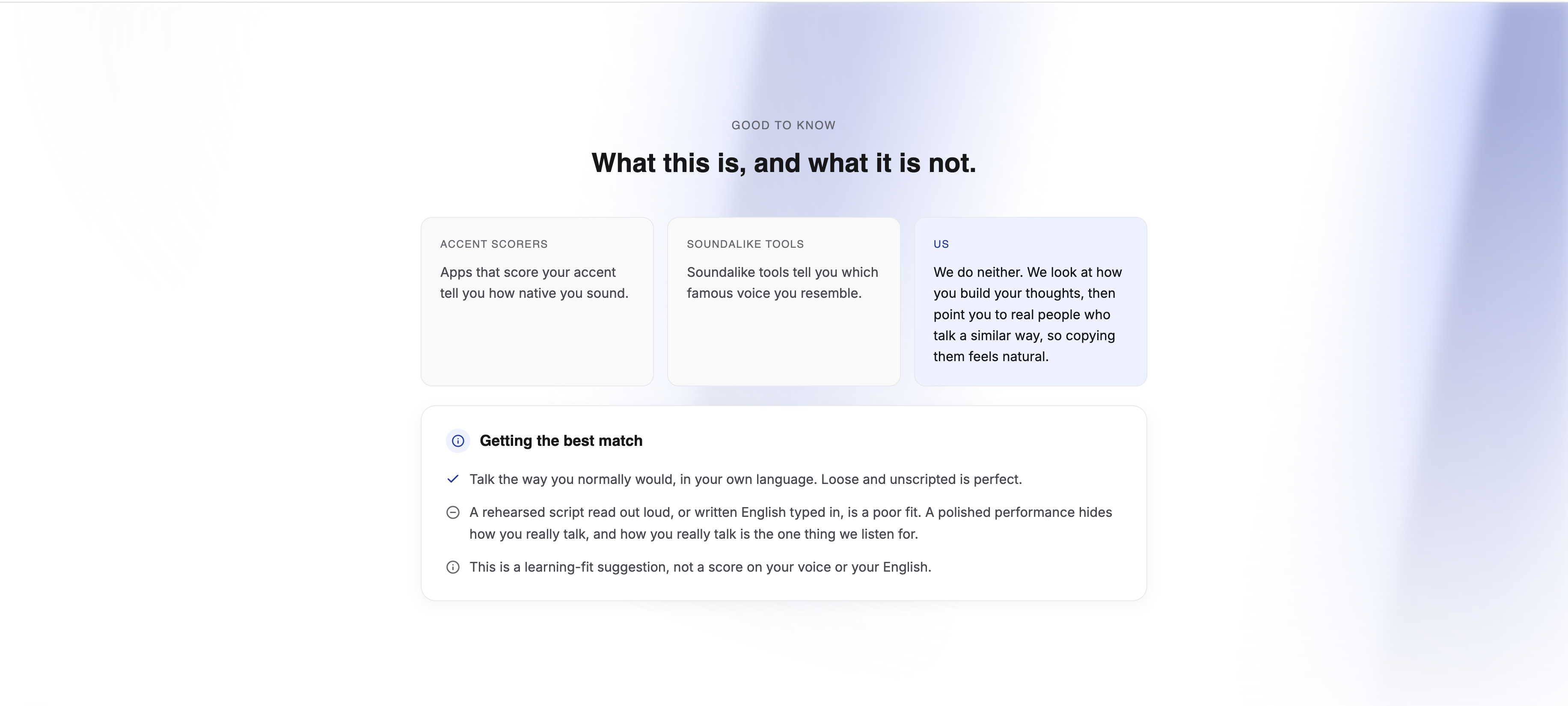
Your Ideal Role Model matches a learner with English creators whose communication style resembles theirs—without judging their English, accent, or topic.
- The learner records about two minutes in their native language. No script or account is required.
- Groq Whisper translates the recording into English; raw audio is deleted immediately afterward.
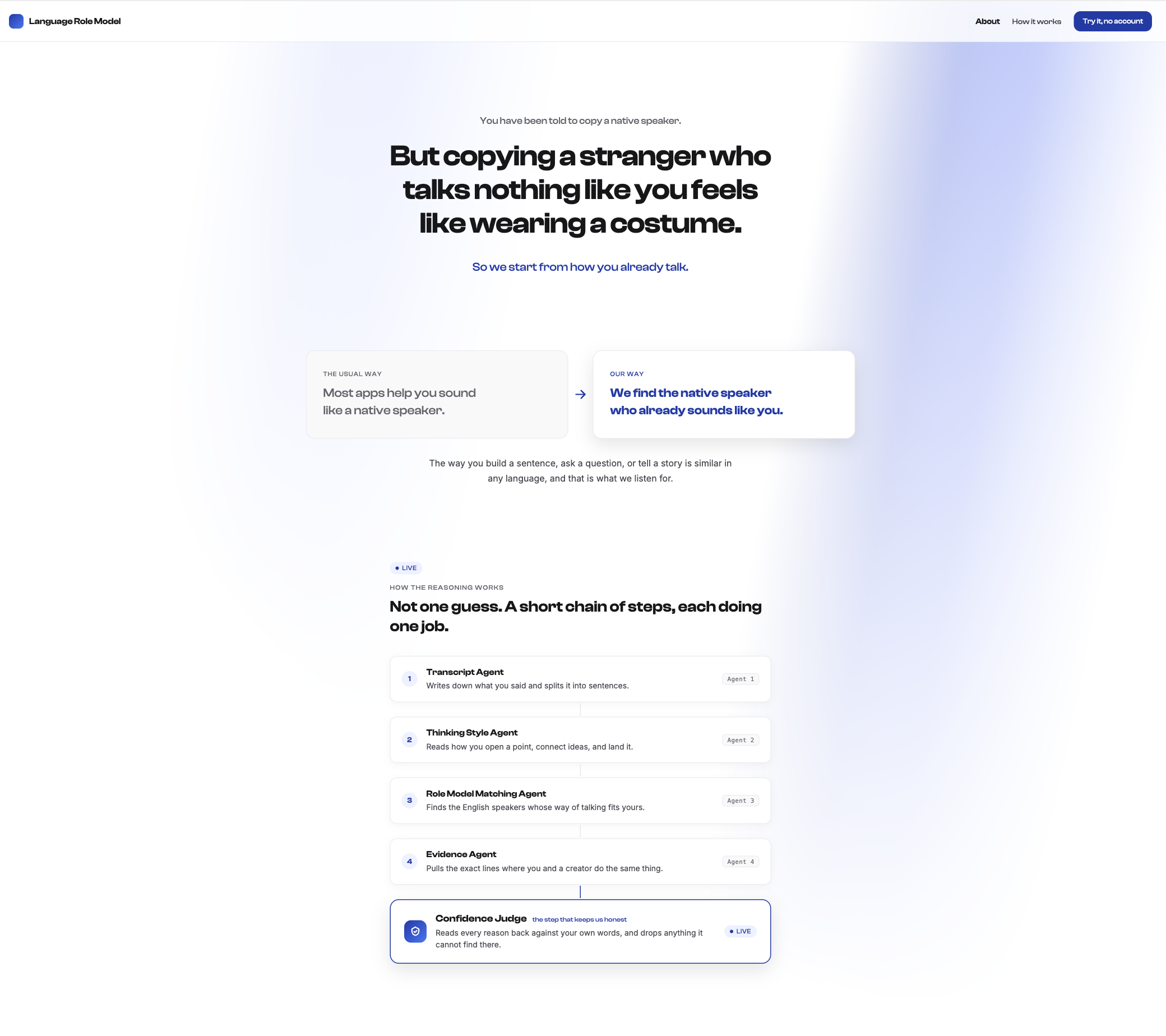
- GPT-5.6 identifies observable style traits—how the learner opens, qualifies claims, asks questions, and builds an argument—each tied to a real transcript sentence.
- Centered cosine k-NN searches a 140-creator corpus and returns the top three matches. A tiebreaker runs only for genuine ties.
- The system produces a checkable chain of evidence: You said → Creator does → Why it matches.
- An independent Confidence Judge removes unsupported claims and reports resemblance as a word—strong, clear, or partial—rather than a misleading percentage.
The result is a practical starting point for shadowing: real creators, real channels, and evidence learners can inspect.
How we built it
- Style signal: We translate first, then embed the English transcript using
StyleDistance/styledistance. - Matching: An in-memory centered cosine k-NN search matches learners against 140 creator profiles.
- Reasoning: Separate GPT-5.6 stages read style, write evidence, and verify confidence. A deterministic Python supervisor—not an LLM—controls the workflow, thresholds, timeouts, and fallbacks.
- Stack: FastAPI, Next.js 15, React 19, and NumPy.
- Demo: The judged demo uses a pre-seeded cache, so it runs with no API keys or deployment. The live pipeline also runs end-to-end in about 57 seconds.
- Built with Codex: Codex helped build the backend, corpus tooling, validation, matching logic, and test suite.
Challenges we ran into
Our biggest question was simple: does a person’s style survive translation? We treated that as a hypothesis to test before building the product.
- Directly embedding native-language transcripts failed: language differences overwhelmed the style signal.
- A “better” LLM translator also failed. Its cleanup and sentence restructuring erased the conversational quirks the model needed to recognize. Plain Whisper translation—even with disfluencies—preserved a more useful signal.
- Centering the embedding space fixed an important matching problem: nearest-neighbor cosine similarity dropped from an unhelpful 0.997 to 0.95, making close styles meaningfully separable.
- There is no objective ground truth for “style similarity,” so we avoided overclaiming. Our corpus has 10 human-verified creators and 130 clearly labeled AI-drafted candidates, with validation that prevents those labels from being mixed up.
Accomplishments that we're proud of
- We validated the riskiest assumption before committing to the product.
- We made a subjective recommendation inspectable: every claim points back to the learner’s own transcript.
- We built graceful failure into the system through independent stages, deterministic controls, timeouts, and fallbacks.
- We fixed a real retrieval-geometry issue instead of hiding it behind polished output.
- We built a zero-setup demo that judges can run immediately.
What we learned
Style lives beneath language—but only when we preserve its messy, human details. Cleaning up the input can erase the very idiolect we are trying to match.
More broadly, we learned to challenge the core hypothesis first. The cheapest early experiment saved us from building an entire app on the wrong technical foundation. We also learned that honest uncertainty makes a product more credible: show evidence, label limitations clearly, and avoid fake precision.
What's next for Your Ideal Role Model
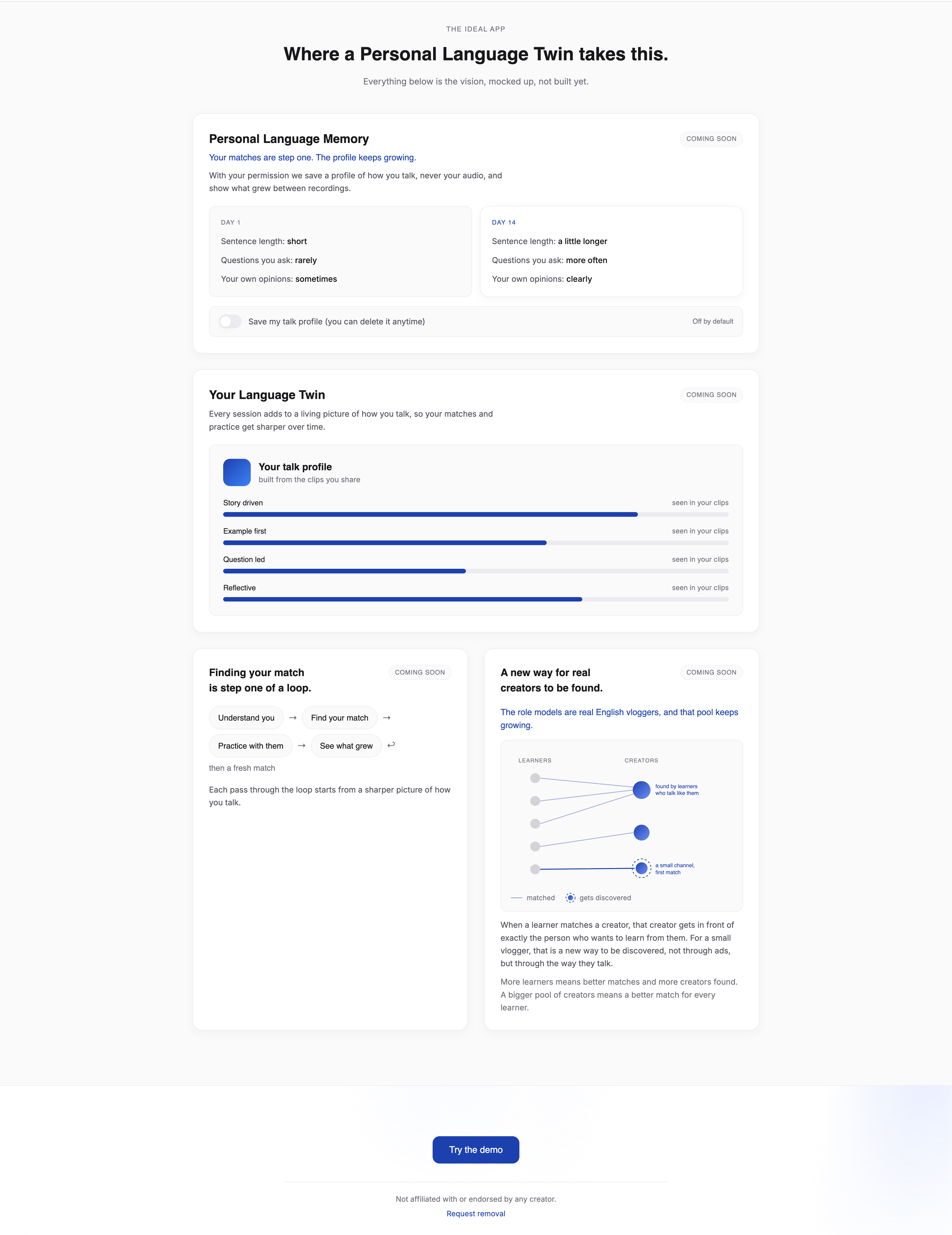
- Practice loop: Match learners, help them practice with that creator, then measure growth and rematch over time.
- Personal Language Memory: An opt-in history of how a learner’s communication style changes—without retaining raw audio.
- A larger, better-verified corpus: Promote creator candidates through a blinded evaluation process.
- Creator discovery: Help smaller English creators reach learners who naturally connect with their communication style.
- Clear boundaries: We analyze and link out only—no voice cloning, rehosting, mass scraping, or use of a creator’s likeness for marketing.
Built With
- anthropic
- claude
- cosine-similarity
- groq
- huggingface
- mstyledistance
- next.js
- pgvector
- postgresql
- python
- railway
- sentence-transformers
- styledistance
- vercel
- vercel-ai-gateway
- whisper


Log in or sign up for Devpost to join the conversation.