Vantage — Location Intelligence for the Rest of Us
Inspiration
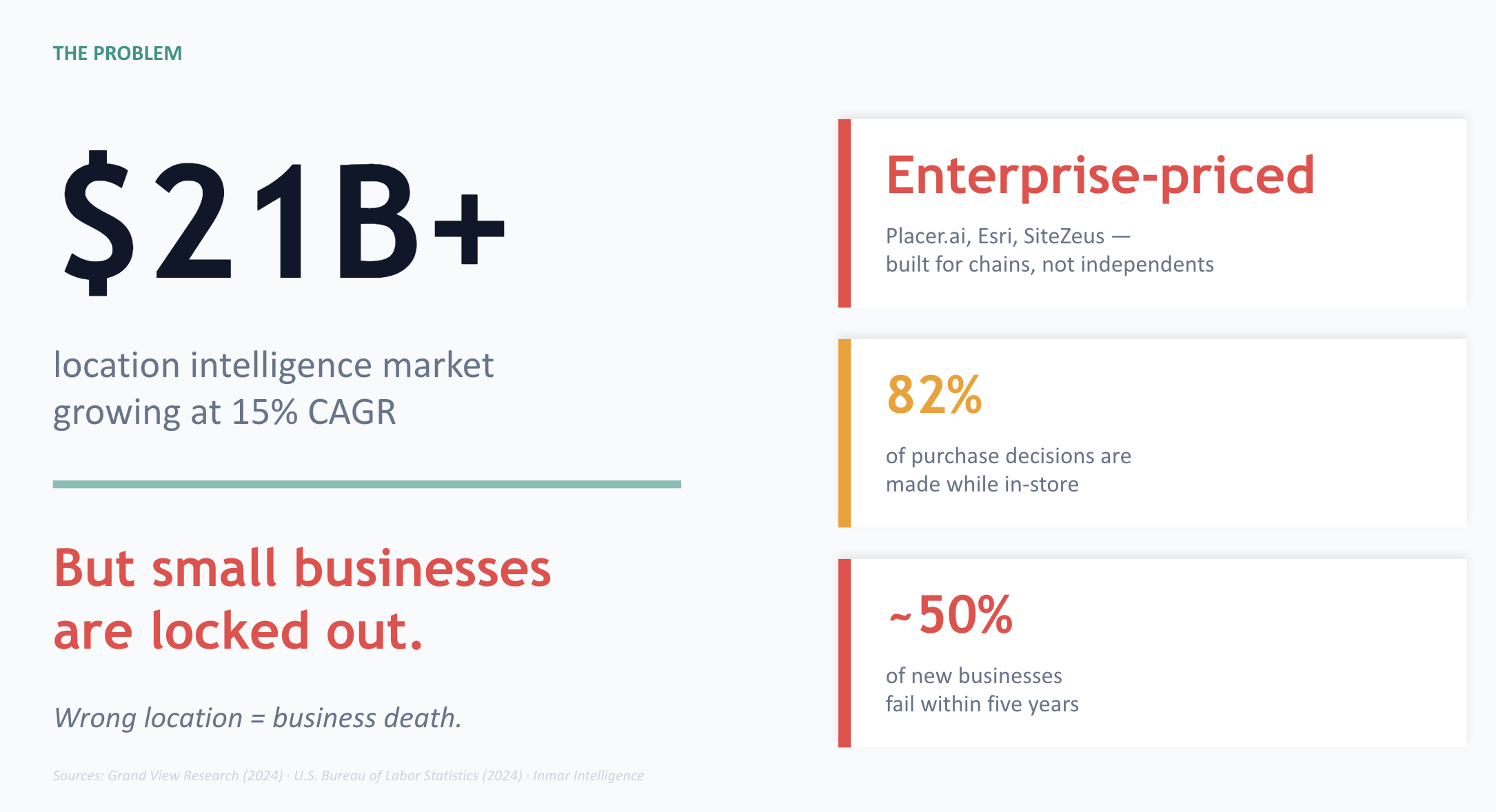
The location intelligence market is worth over $21 billion and growing at 15% CAGR (Grand View Research, 2024). Every major tool in that space — Placer.ai, Esri, SiteZeus — is enterprise-priced and built for chains deciding where to put their 200th store.
Meanwhile, nearly 50% of new businesses don't survive to year five (U.S. Bureau of Labor Statistics, 2024). The number one controllable factor in whether a brick-and-mortar business succeeds? Where it opens. And right now, first-time business owners make that decision based on a Google search and gut instinct.
Site selection consulting runs tens of thousands of dollars. Enterprise analytics platforms require training, onboarding, and annual contracts. There is no tool that serves the person who's about to sign a lease on their first business.
We built Vantage to fix that.
What it does
You type one sentence: "I want to open a boba shop in NYC targeting students with an $8.5K rent budget."
Vantage returns a complete location intelligence package in about 60 seconds:
- Scored location recommendations — each neighborhood rated 0–100 with transparent breakdowns across foot traffic, target demographic fit, transit access, competition gap, and rent fit
- Live competitor intelligence — pulled from Google Places in real-time, with gap analysis identifying underserved niches (e.g., "no late-night boba option within this radius")
- Revenue projections — three scenarios (conservative, expected, optimistic) with breakeven timeline, all assumptions visible
- Interactive demographic heatmaps — population density, income levels, age distribution layered on Google Maps with Deck.gl overlays
- AI-generated storefront mockup — your business concept visualized in the actual neighborhood via Stability AI
- Downloadable PDF report — one click generates a professional location intelligence report ready for a landlord or bank meeting
Change your rent budget and new locations unlock instantly. Scores recalculate in real-time. Every number shows its confidence level (HIGH / MEDIUM / LOW) and the data source behind it. No black boxes.
How we built it
Multi-Agent Architecture
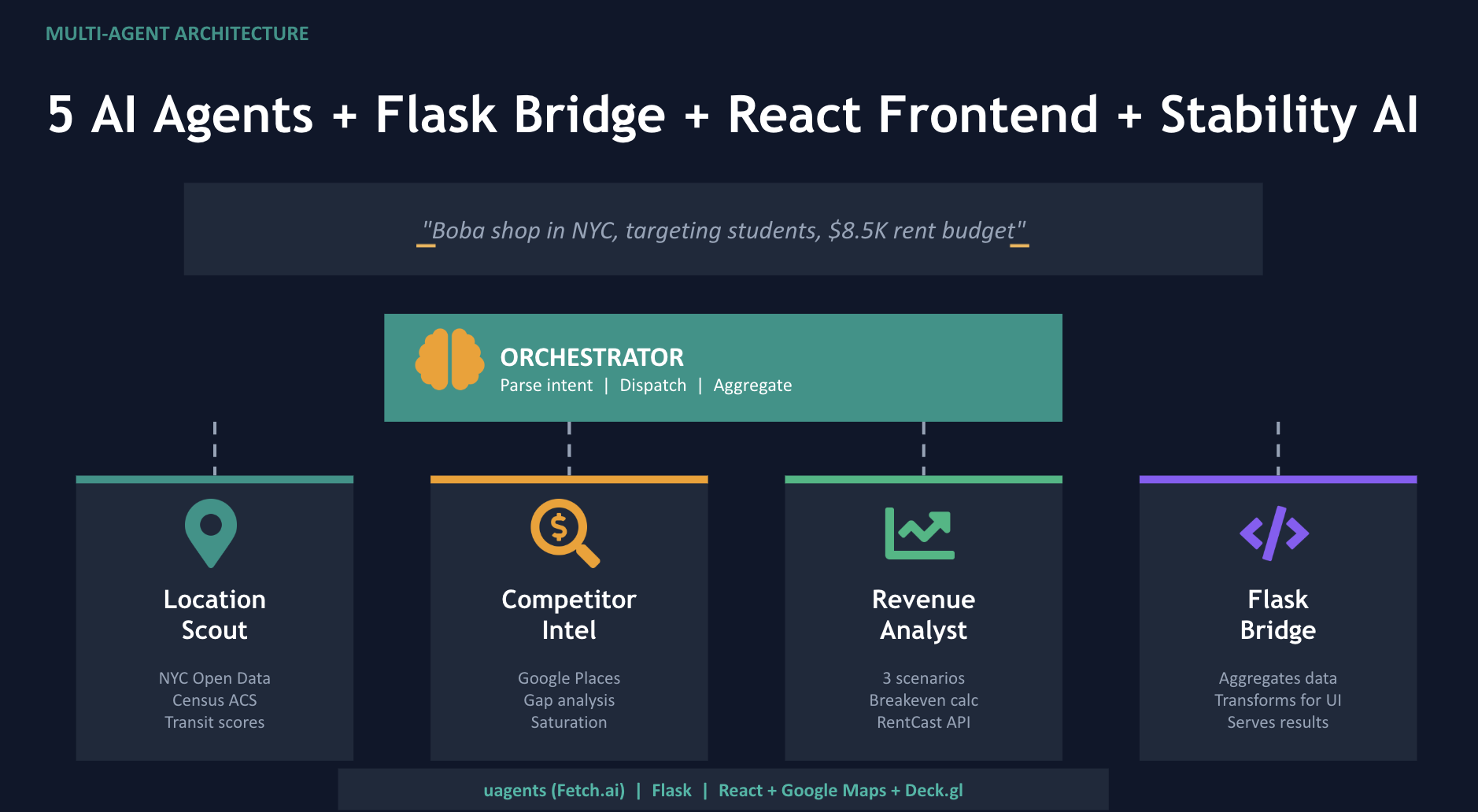
Vantage runs on 5 Fetch.ai agents coordinated by an orchestrator:
User query ("Boba shop in NYC, students, $8.5K budget")
       │
       ▼
┌──────────────────────────┐
│    ORCHESTRATOR AGENT    │
│  Parse intent → Dispatch │
│  → Aggregate → Score     │
└──────┬───────────────────┘
       │
       ├──► Location Scout Agent
       │    └─ Google Places API → neighborhood candidates
       │
       ├──► Competitor Intel Agent
       │    └─ Google Places + Gemini → competitive analysis
       │
       ├──► Revenue Analyst Agent
       │    └─ Gemini → financial projections + breakeven
       │
       └──► Storefront Visualizer Agent
            └─ Stability AI → AI-generated storefront mockup
Why multi-agent, not monolithic? A single LLM call can't do real-time API lookups, competitive analysis, financial modeling, and image generation simultaneously. Each agent is a specialist — the orchestrator coordinates them like a consulting team. This is compound AI, not prompt chaining.
Tech Stack
| Layer | Technology |
|---|---|
| Frontend | React 19, TypeScript, Vite, Tailwind CSS, Framer Motion |
| Maps | Google Maps API, Deck.gl overlays |
| Agent Framework | Fetch.ai Agentverse (5 agents) |
| LLM | Gemini API (analysis + synthesis) |
| Image Gen | Stability AI (storefront visualization) |
| Voice | ElevenLabs (audio narration of report) |
| Bridge | Flask API connecting React frontend ↔ Agentverse agents |
| Hosting | Vercel (frontend), Agentverse (agents) |
| Reports | html2pdf.js (downloadable PDF reports) |
The Flask Bridge Problem (and Solution)
Agentverse agents live in Fetch.ai's cloud. Our React frontend lives on Vercel. These two worlds don't natively talk to each other.
We built a Flask bridge API that:
- Receives user queries from the frontend
- Translates them into Agentverse-compatible messages
- Fans out to all 5 agents simultaneously
- Aggregates responses with timeout handling
- Returns a unified JSON payload to the frontend
This is the architectural decision that made the whole system work — and the piece we're most proud of engineering under time pressure.
Challenges we ran into
Team instability: Two of our original teammates dropped before the hackathon. We scrambled to recruit a replacement who then also dropped. At that point we were down to three people building what was designed as a four-person project. We managed to find a final teammate and locked in our team of four, but we lost hours to reorganizing work, redistributing responsibilities, and onboarding someone new. We shipped the full system anyway.
Agent coordination timing: Five agents returning data at different speeds meant we needed a smart aggregation layer. We implemented progressive loading — the map renders first (Location Scout returns fastest), then scores populate, then the storefront image appears last. Users see results building in real-time rather than staring at a spinner.
Confidence calibration: How confident should a revenue projection be when it's based on neighborhood averages, not store-specific data? We built a transparency layer: every score shows its confidence level (HIGH/MEDIUM/LOW) and explains what data it's based on. Judges (and users) can see exactly where the AI is guessing vs. where it has strong signal.
Rate limiting under demo pressure: Google Places API has per-second rate limits. During live demos with rapid re-queries, we hit walls. We added caching with a 15-minute TTL so repeated searches for the same area don't burn API calls, plus graceful fallbacks that serve cached data when limits are hit.
Multi-agent debugging: When the orchestrator returns bad data, which agent failed? We built agent-level logging that traces each response through the pipeline, making it possible to diagnose issues in real-time — critical for a live demo environment.
Accomplishments we're proud of
- 5 agents coordinating in real-time on Agentverse with <3s total orchestration latency
- Transparent AI: Every recommendation shows confidence level + data sources — no black boxes
- "What If" re-runs: Change your rent budget → new locations unlock instantly, scores recalculate
- AI-generated storefronts: Users see their business concept visualized in the actual neighborhood
- Judge-ready reliability: Works live, every time, with graceful fallbacks on every failure path
- PDF export: One click generates a professional location intelligence report
What we learned
Multi-agent systems are powerful but coordination is the hard part. The individual agents were straightforward. Making five of them work together reliably, handle failures gracefully, and return data in a coherent format — that's where 60% of our engineering time went. This is the real lesson of compound AI: the orchestration layer matters more than any single model.
Transparency beats accuracy for trust. Early versions showed scores without explanation. Testers asked "where does this number come from?" Adding confidence ratings and data source attribution didn't improve our algorithms — but it dramatically improved how people received our recommendations. Show your work.
Progressive loading changes UX psychology. When we showed a loading spinner for 3 seconds, testers thought it was slow. When we showed the map first, then scores populating, then the storefront appearing — same 3 seconds felt fast. Perception matters as much as performance.
The real competitor isn't other tools — it's inaction. First-time business owners don't comparison-shop between Placer.ai and SiteZeus. They Google "best neighborhood for boba shop" and hope for the best. Our actual competitor is a Google search and gut instinct.
What's next
Short-term (30 days): User authentication + saved reports. Expand beyond NYC to Boston, Providence, Philadelphia. Side-by-side "What If" comparison mode.
Medium-term (90 days): Lease negotiation intelligence with comparable rents, red flags, and leverage points. Integration with commercial real estate listing APIs (LoopNet, Crexi). Mobile app for on-site location validation. Historical success/failure data for similar businesses in each area.
Long-term (12 months): Predictive demand modeling — "This corridor is underserved for X, opportunity score rising." Multi-location optimization for franchise expansion. B2B API for commercial real estate platforms and franchise consultants. Revenue model: Freemium (1 report/mo) → Pro ($29/mo unlimited) → Enterprise API.
Built With
react typescript vite tailwind-css framer-motion google-maps-api deck-gl fetch-ai agentverse gemini stability-ai elevenlabs flask python html2pdf-js vercel
Try it
Built With
- css
- fetch.ai
- html
- python
- typescript


Log in or sign up for Devpost to join the conversation.