-
-
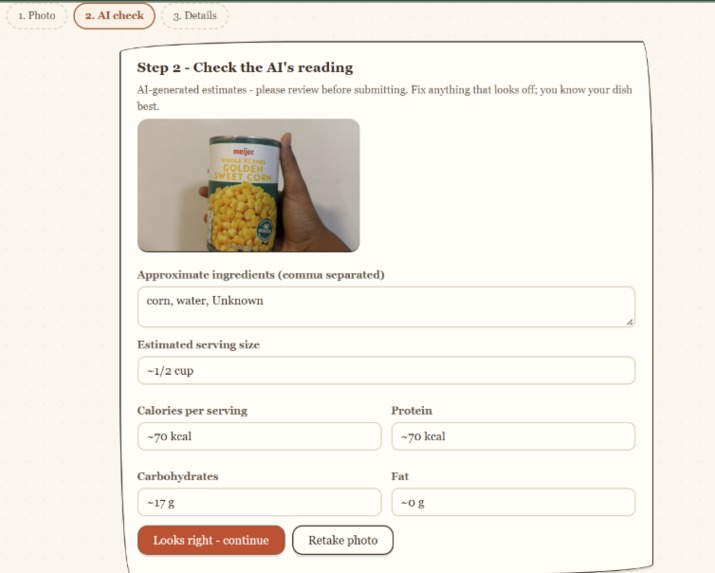
Example of the Donation Form
PlateMate
IMPORTANT: Unexpectedly lost all code an hour utilized jackhammer to create a preview-able protype. This prototype doesn't completely account for all the features we had originally programmed.
Inspiration
Every day, massive amounts of perfectly good, nutritious food go to waste. On college campuses, students frequently find themselves with leftover catering from events, extra grocery staples before breaks, or surplus home-cooked meals they made too much of. At the same time, families and individuals in neighboring communities face deep food insecurity.
We wanted to bridge this gap, but we recognized a glaring bottleneck: security, verification, and logistics. Donors don't always know where to drop food off safely, and recipients need to ensure the food they are getting is safe, properly stored, and dietary-transparent. We built PlateMate to serve as a warm, hand-drawn community bulletin board that eliminates this friction by routing campus and neighborhood donations through verified local non-profits and community intermediaries.
What it does
PlateMate is a full-stack community food redistribution network that coordinates three distinct user roles into a seamless, trusted marketplace:
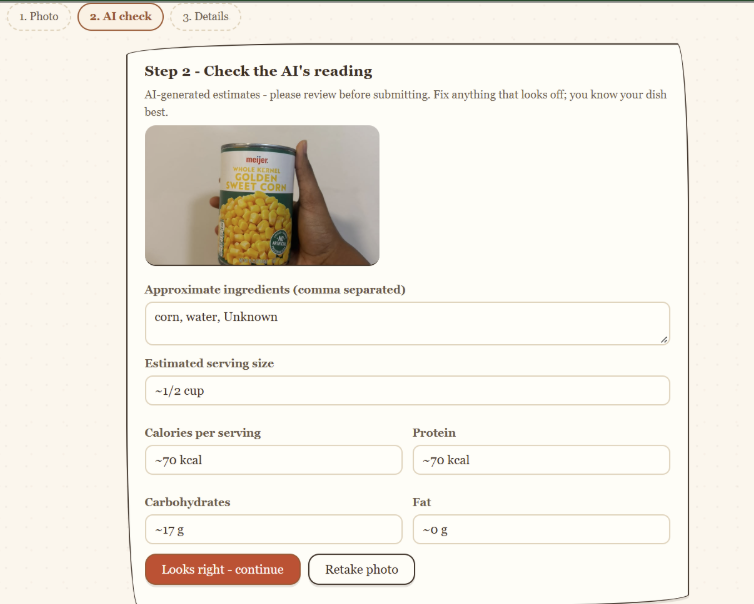
- Donors (College Students/Neighbors): Can take a quick phone photo of extra prepared dishes or groceries. A built-in Vision AI instantly analyzes the image to estimate ingredients, serving size, and macro-nutrition, reducing the friction of manual data entry while providing a helpful safety check. Donors select an intermediary organization and submit the dish.
- Intermediaries (Verified Non-Profits, Pantries, Shelters): Manage a custom organization dashboard. They evaluate incoming donor requests using the AI analysis and physical photos. Once approved, the food instantly goes live on the public community board, backed by the organization's refrigeration capabilities, specific pickup hours, and physical location mapping.
- Neighbors (Recipients): Browse the public community feed of approved, unexpired dishes. They can inspect AI-generated ingredient lists (crucial for allergies) and dynamically claim exact serving portions. Upon making a reservation, the system generates a unique, real-time claim code (e.g.,
FB-1042), locking down those portions securely so they can head over to the non-profit for a dignified pickup.
How we built it
We engineered this platform using a cutting-edge, emerging tech stack anchored around data-spatial graph principles:
- Language & Architecture (Jac): The core backend and client-side page routing are entirely written in Jac, an autonomous, agent-oriented programming language. We leveraged Jac's native architecture—using Nodes to construct data hierarchies (
Profile,Organization,Donation,Reservation) and Walkers to act as independent execution agents executing operations over the graph. - Vision AI Subsystem (via Jac's byLLM): Integrated into our Jac server using the
byllmlibrary. It binds a vision-capable language model (groq/qwen/qwen3.8-27b) to look at uploaded data URLs, enforcing strict semantic schemas (FoodAnalysisandNutritionEstimate) to cleanly deliver structured responses without inventing facts. - Frontend & Styling: Built out natively reactive UI components utilizing JSX elements mapped directly through Jac compiler definitions. We injected a cozy, paper-textured, warm neutral CSS aesthetic to give the application an approachable, neighborly, handwritten aesthetic that builds digital trust.
- Tooling: Managed compiling with the
jacCLI (jac start --dev main.jac), incorporating hot-reloading dev instances alongside a headless browser environment (jac browse) for rapid UI validation and testing.
Challenges we ran into
- The Jac & JSX Syntax Paradigm Shift: Navigating Jac's evolving syntax, which creatively bridges aspects of Pythonic control flow with JSX declarative templates, meant a steep learning curve. Early on, standard JavaScript array methods like
.map()inside comprehensions would break the compiler pipeline, forcing us to rethink how we looped over dynamic file lists using pure primitive iteration counts. - LLM Hallucination Boundaries: Initial iterations of the Vision AI would confidently hallucinate administrative metadata, inventing pickup hours, available quantities, or non-existent organization names. We had to strictly constrain the model using precise semantic anchoring (
sem) to force it to stick exclusively to food facts visible in the image. - Session Management Glitches: We hit a tricky issue where stale tokens from older sessions would cause subsequent signups or private graph walkers (like
GetProfile) to 401-abort and trigger perpetual reloads. We solved this by baking explicitjacLogout()resets and hard window resets straight into our login/signup auth cascades.
Accomplishments that we're proud of
- True Graph Isolation: Designing an authentic multi-tenant graph architecture where every user type gets an isolated root node at signup. Data nodes stay securely sandboxed underneath individual owner roots, and only explicit global actions compile into cross-user exposures using runtime
grant()permissions. - Optimistic Concurrency Controls: Handcrafting real-time serving allocation math. The system dynamically tracks
active_reservedloops across public roots, effectively shielding community fridges from double-claiming races without lagging the user experience. - A Beautiful, Cohesive UI: Escaping the sea of modern, sterile Tailwind templates to create a customized bulletin board vibe featuring playful mascot plates and hand-drawn animations.
What we learned
- Agentic Power: We learned that treating API endpoints as data-walking agents rather than rigid REST controllers allows for incredibly flexible business logic. A walker can naturally pivot its path depending on what node it targets.
- AI as a Companion, Not a Master: Building a reliable system means treating AI data as an estimate. By explicitly rendering the AI data inside a collapsing disclosure element (
<details>) and providing textareas for donors to correct the AI's math, we blended machine learning speed with human precision.
What's next for PlateMate
- Push Notification Webhooks: Integrate live SMS alerts or email pushes to immediately notify neighbors when an intermediary approves a hot meal nearby.
- Geospatial Range Calculations: Incorporate a radius search module to allow college student donors to find the absolute closest physical drop-off bin or pantry relative to their dorm or apartment.
- Predictive Logistics: Train predictive algorithms on historical donation data to help intermediaries forecast which days of the week they are likely to encounter capacity strain or surplus foot traffic.
🚀 Developer Setup Reference
To fire up the dev environment or step through the compiler guides:
# List available guides and view core sheets
jac guide jac-core-cheatsheet

# Start the full-stack PlateMate app with hot-reloading
jac start --dev main.jac
The Advantages/Importance of Jac in PlateMate
1. The Data-Spatial Graph (Nodes & Architecture)
Instead of relying on a traditional relational database (like MySQL or PostgreSQL), the project builds a data-spatial graph using Jac's native object primitives.
- The Core Hierarchy: The application defines its relational entities as
nodetypes insideendpoints.sv.jac.jac node Profile { ... } node Organization { ... } node Donation { ... } node Reservation { ... } - Graph Isolation: Every user type (donor, organization, or recipient) gets an isolated graph root node upon login. Whenever an activity needs to cross these multi-tenant isolation boundaries, explicit Jaseci graph security steps are used. For instance, when a donor submits food, the node is attached to their tree but opened up globally via a permission allocation:
grant(d, level=WritePerm);.
2. Walkers as API Endpoints
Traditional backend routes (like REST or GraphQL endpoints) are replaced entirely by Jac Walkers. Jaseci treats walkers as independent execution scripts that "walk" the data graph to find, modify, or report information.
- Privileged vs. Public Access: Walkers are categorized to define application-level authorization boundaries.
-
walker:priv(e.g.,SubmitDonation,ClaimFood,ApproveDonation) require authenticated sessions and execute mutations under an individual's root node. -
walker:pub(e.g.,ListAvailableFood,ListOrganizations) can execute globally across the platform.
-
- Scanning via
allroots(): To populate feed dashboards without coupling strict dependencies between separate users, public walkers utilize theallroots()function to sweep across the global graph, gather targeted data blocks, and map them back to the caller.
3. Integrating Declarative AI (byllm)
The project utilizes Jaseci's byllm plugin (configured in the jaccloud.toml project manifest) to hook directly into LLMs without writing verbose prompt pipelines.
- Semantic Specifications (
sem): The code sets semantic attributes directly onto objects and functions. This teaches the underlying Jaseci model runner what constraints it must follow:jac sem FoodAnalysis.ingredients = "Approximate visible or likely ingredients, lower case, 3 to 8 short strings..."; - Direct Function Binding: The vision analysis feature uses an abstract function definition bound directly to the environment's configured model via the
by llm()execution block:jac def analyze_food_photo(photo_image: Image, what: str) -> FoodAnalysis by llm();
4. Full-Stack Client UI Architecture (JSX and Client Nodes)
The frontend pages (pages/available.jac, pages/donor_portal.jac, etc.) are written directly in Jac syntax, showing how the Jaseci compiler unifies the front and backend.
- Reactive State Mapping: Frontend files leverage familiar React abstractions blended directly into Jac compiler definitions, like invoking hook states:
(items, set_items) = useState([] as list[dict]);. - Calling the Graph from the UI: Instead of setting up
fetch()orAxiosrequests, client pages dynamically spawn backend execution scripts over Jaseci's graph network natively:jac result = root spawn ListAvailableFood();
5. Local CLI & Server Orchestration
The tooling infrastructure maps directly to the workflows detailed in the project's internal reference guide:
- Compilation & Linting: Running
jac check <file>type-checks the unified fullstack code, drawing directly from native "Agent Skills" specs packaged inside the compiler. - Hot-Reload Dev Instances: Running
jac start --dev main.jackicks off a multi-tiered development framework. The Jac API server spins up on one port (http://0.0.0) to handle graph mutations, while a Vite bundle automatically tracks client-side layout adjustments via hot-module replacement (HMR).
Built With
- jac

Log in or sign up for Devpost to join the conversation.