💡 Inspiration
Protocol SIFT is a genuinely clever idea: take the SANS SIFT Workstation — 200+ forensic tools — and put a Claude Code agent in front of them so a responder can investigate at machine speed. It works. But the hackathon brief says the quiet part out loud: "It also hallucinates more than we'd like."
I've spent years building an AI SOC, and I know exactly why it hallucinates. The agent
runs a forensic tool, gets back a 50,000-line text dump, and then eyeballs it to pull out
indicators. That's where reality breaks: a defanged evil[.]ru gets read back as .com, an
IP's last octet gets transposed, powershell.exe gets called "the malware." Free-text
reading of huge dumps is precisely the task LLMs are worst at — and in DFIR a wrong
indicator means a wrong containment decision at 3 AM.
So I didn't try to make the agent "read more carefully." I took the reading away from it. 🛡️
🧩 What it does
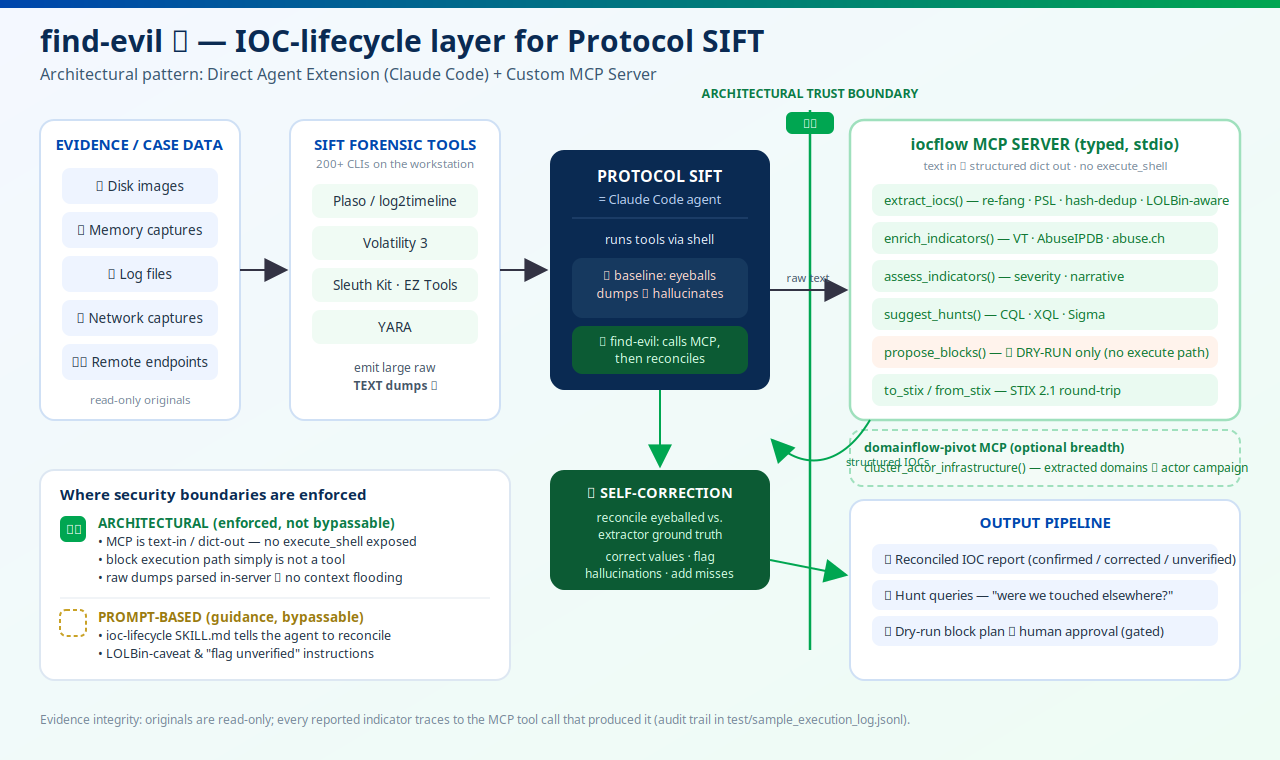
find-evil bolts my open-source iocflow IOC
lifecycle onto Protocol SIFT as a custom MCP server plus one skill. Now, whenever a
forensic tool emits text, the agent doesn't guess — it routes that text through a
deterministic, false-positive-defended extractor and then reconciles its own eyeballed
findings against ground truth:
- ✅ Extract — IOCs pulled from Plaso timelines, Volatility
strings/netscan, YARA hits, logs: IPs, domains, URLs, hashes, CVEs, emails, MITRE techniques, threat actors, malware families — re-fanged, PSL-validated, hash-deduped, LOLBin-aware. - 🔁 Self-correct — the skill forces the agent to compare what it would have reported against the extractor's set, correct wrong values, flag anything unverified as a possible hallucination, and add what it missed.
- 🎯 Hunt — generate "were we touched elsewhere?" sweeps in CrowdStrike CQL, Cortex XQL, and Sigma for the confirmed set.
- 🚫 Contain (dry-run) — a block plan a human can approve. The execute path is deliberately not a tool.
In a real headless run (in the repo at test/sample_execution_log.jsonl), the agent was
handed an analyst report with three planted errors and a raw Volatility dump. On its own it
corrected evil-domain.com → evil-domain.ru, corrected 185.220.101.50 → 185.220.101.5,
kept powershell.exe but reclassified it as a LOLBin, added 8 indicators the analyst
missed, and generated 14 validated hunt queries. Every finding traces to a specific tool
call.
🎯 Real case results — SANS evidence (graded/)
I then ran it for real against the SANS Example Compromised System Data — a clean host and a compromised one. Memory + disk, read-only, SHA256 hashed before and after (unchanged).
- 🦠
base-wkstn-05— real evil found. A 2018 APT scenario:WmiPrvSE → powershell → rundll32execution chain, a fileless PowerShell Empire gzip-base64 stager (H4sI…), and external C2www.venetodns.trade. Disk corroborated the how — WinRM/PSRemoting lateral movement under a stolen SQL service account (shieldbase\spsql), plus Empire injection IOCs (CreateRemoteThread ×75, named pipes ×5,445). - ⟲ The money-shot self-correction.
netscanshowed only internal peers (a proxy at172.16.4.10:8080). The eyeball read was "no external C2 — contained." Wrong. The real C2 egresses through the proxy, so it never appears as a foreign IP in the connection table — the extractor surfaced it from the PowerShell command text instead. The agent corrected itself: there IS external C2; the connection table alone misled me. Genuine, not staged. - 🧮 False-positive discipline. 15 suspicious external domains were present in strings;
only
venetodns.tradeis tied to the intrusion. The other 14 are Outlook mail-spam (*.ru,keto*.trade) — reported 1 confirmed C2, 14 unverified, not a "15 malicious domains" headline.cluster_actor_infrastructurereturned 0 campaigns rather than fabricate an attribution, andpropose_blocksstayeddry_run: true. - 🧼
base-wkstn-01— clean baseline. 0 confirmed evil, 0 retained hallucinations. Four scary-looking artifacts each cleared with a tool: proxy egress explained,malfindempty (refutes injection),subject_srv.exe= F-Response IR agent, andMnemosyne.sys= F-Response's signed acquisition driver, not a rootkit. Honesty cuts both ways: it found evil where it existed and refused to invent it where it didn't.
Full trace — every finding → the exact tool call — is in graded/FINDINGS_RECONCILIATION.md
and graded/wkstn05/FINDINGS_RECONCILIATION.md; the headless log is
graded/graded_execution_log.jsonl.
🛠️ How I built it
The first hour of recon changed everything: Protocol SIFT isn't an MCP framework — it is
Claude Code configured on the SIFT box (~/.claude/CLAUDE.md, a permissions
settings.json, and five skills/*/SKILL.md). That's a gift, because Claude Code natively
loads MCP servers and skills. So the integration is small and first-class, not a hack:
iocflowMCP server —iocflowalready ships an MCP server (iocflow-mcp, FastMCP over stdio) exposing the lifecycle as typed functions:extract_iocs,enrich_indicators,assess_indicators,suggest_hunts,propose_blocks(dry-run), and STIX round-trip. Noexecute_shell. Raw tool output is parsed inside the server, so the 50,000-line dump never floods the agent's context window.- The
ioc-lifecycleskill — a 6th SIFT skill that changes the agent's procedure: extract → reconcile (self-correct) → hunt, instead of asserting by eye. install.sh— an idempotent bolt-on that runs after Protocol SIFT's own installer:pip install iocflow[mcp], register the MCP server, drop the skill.
This is two supported architectural patterns at once: Direct Agent Extension (Claude Code) and Custom MCP Server — the one the brief calls "the most sound architecture in the evaluation."
🧗 Challenges I ran into
- "Any case data" anxiety.
iocflowparses text, not disk images. Would it even apply to forensics? I de-risked it before writing a line of prose: SIFT tools emit text, and feeding real Plaso/Volatility output straight in surfaced clean, re-fanged IOCs. The data type never mattered — the tool output is the interface. - Proving self-correction without a SIFT image. Because Protocol SIFT is Claude Code, I could reproduce the entire agent→MCP→iocflow loop headlessly on a Linux box and capture a real execution log — the planted-error test above — before ever booting the OVA.
- Honest false positives. The extractor surfaces
powershell.exe/rundll32.exeas filenames. Those are LOLBins — context, not IOCs. Rather than hide it, the skill teaches the agent to caveat them, and the accuracy report documents it as a known class.
📚 What I learned
The strongest guardrail isn't a better prompt — it's an architecture where the dangerous
action doesn't exist as a tool. The agent can't spoliate evidence or push a block through
find-evil because the MCP server is text-in / dict-out and never exposes those verbs. That
turns "please be careful" (prompt-based, bypassable) into "you physically cannot"
(architectural). The same shift fixes hallucination: don't ask the LLM to read carefully —
hand the reading to a deterministic parser and make the LLM reconcile.
🚀 What's next
- Expose
iocflow's ATT&CK coverage-gap (assess_coverage) as an MCP tool so the agent also answers "can we even detect this?" inline. - Wire live enrichment (VirusTotal / AbuseIPDB / abuse.ch) on the SIFT box for verdicts.
- A reconciliation benchmark: run with and without
find-evilover labeled cases and publish the hallucination-rate delta as a community baseline. - Upstream the
ioc-lifecycleskill to Protocol SIFT.
Built With
- claude-code
- crowdstrike-cql
- domainflow
- fastmcp
- iocflow
- mitre-att&ck
- model-context-protocol
- plaso
- python
- sans-sift
- sigma
- sleuth-kit
- stix
- volatility3
- yara

Log in or sign up for Devpost to join the conversation.