Inspiration
Several of us are graduating soon and starting to look at job offers in different cities — and we kept running into the same confusing moment: an offer with a higher salary that felt like a pay cut once we accounted for state taxes, city taxes, and cost of living. A $10,000 raise in one city can mean less money in your pocket than staying put, but there was no simple tool to actually show that math. So we built one.
What it does
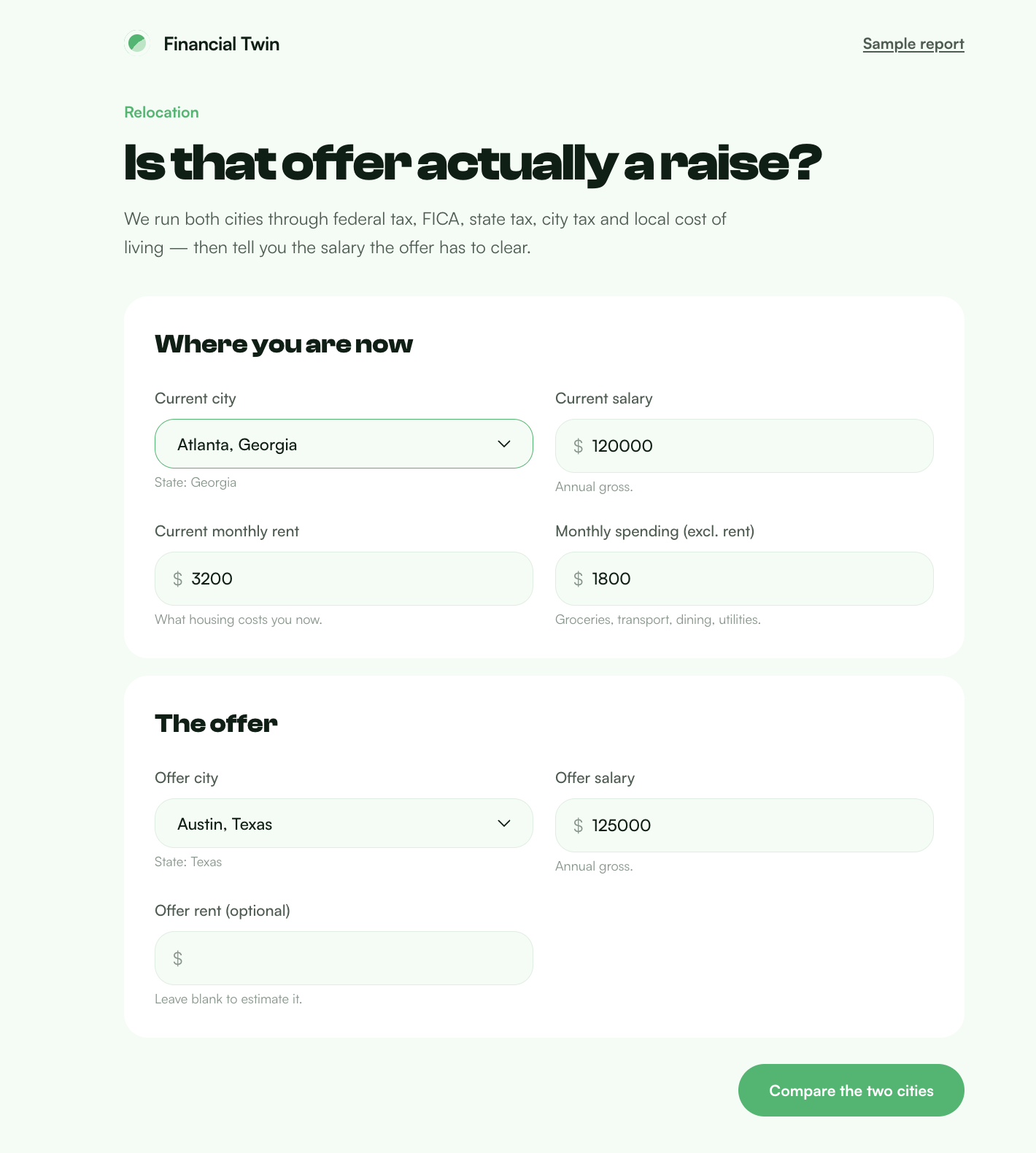
Financial Twin takes your current city, salary, rent, and monthly spending, along with the same details for a job offer in a new city, and runs both through a real financial model — federal tax, FICA, state tax, and local tax — then subtracts housing and living costs.
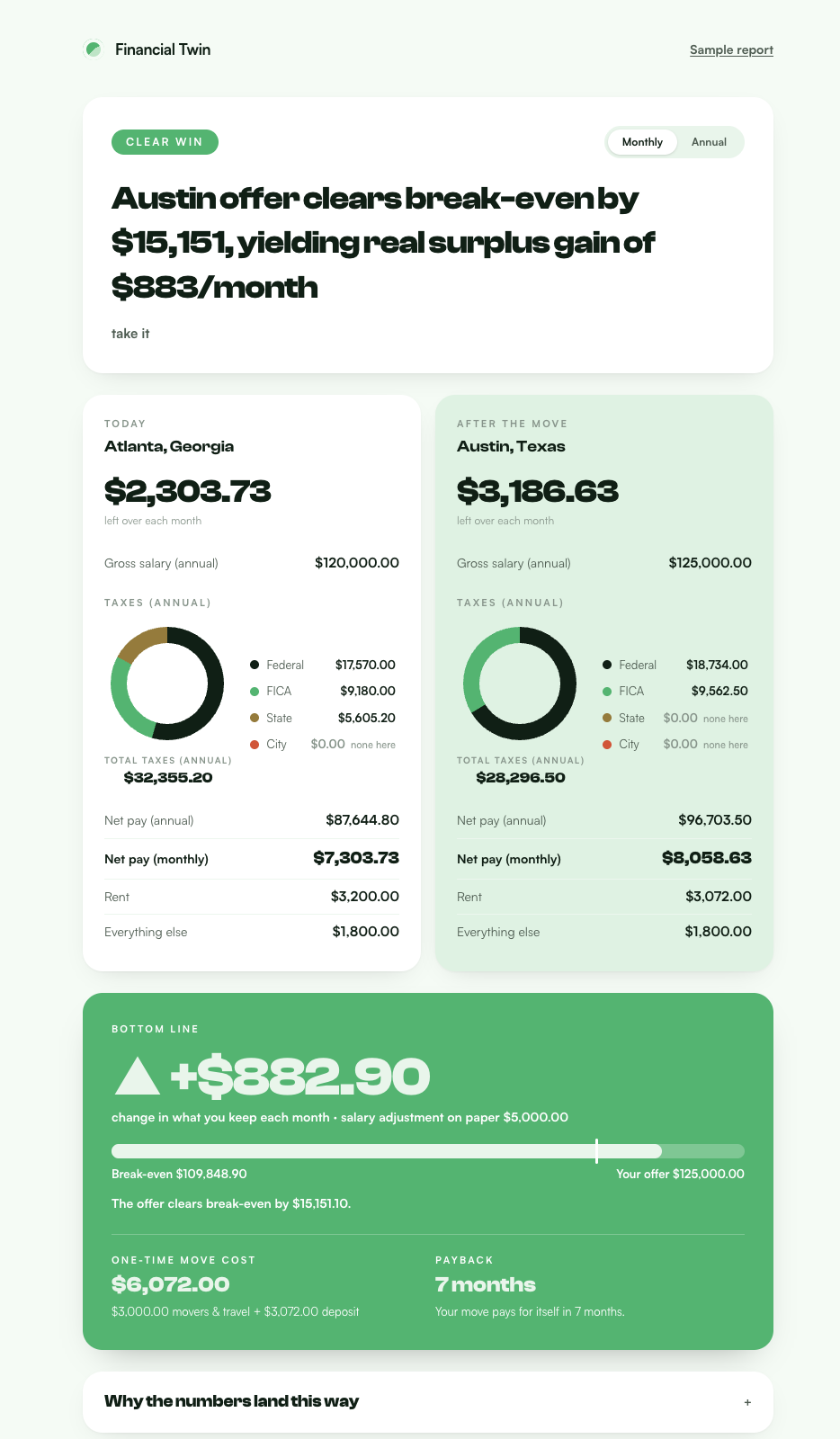
The output isn't just gross salary vs. gross salary. It's your actual monthly surplus in each city: what you truly have left after taxes and cost of living. We then calculate the break-even salary the offer needs to clear to make the move worth it, how far above or below that line the offer actually falls, and how many months it would take to recoup relocation costs.
The result is a clear verdict — take it, or don't — backed by real numbers, not just a gut feeling about "the offer sounds bigger."
How we built it
We built the frontend and financial logic using Lovable, iterating on the UI and calculation flow in real time. The core engine models:
- Federal income tax brackets
- FICA (Social Security + Medicare)
- State income tax (including $0 for no-income-tax states like Texas)
- Local/city tax where applicable
- Cost-of-living adjustments for rent and monthly non-rent spending
From there we compute the net monthly surplus for both the current and offer scenarios, the delta between them, and a break-even salary threshold — the minimum offer salary needed for the move to make financial sense.
We connected the project to GitHub for version control and deployed it live so judges (and future users) can actually run their own numbers instead of just seeing a static demo.
Challenges we ran into
- Modeling real tax logic accurately — federal brackets, FICA caps, and the fact that some states/cities have zero income tax (like Texas) while others stack state and local tax on top of federal, meant our model had to branch correctly per state rather than using one flat formula.
- Making the numbers trustworthy, not just impressive — it was tempting to oversimplify, but we wanted the break-even calculation and recoup timeline to reflect something a person could actually rely on before making a real relocation decision.
- Turning raw numbers into a clear verdict — the hardest part wasn't the math, it was translating a wall of numbers (taxes, surplus, break-even) into one sentence a person could act on immediately.
- Time — building the full tax model, comparison logic, and a clean UI in 24 hours meant constantly prioritizing what mattered most for a convincing demo versus what could be simplified.
What we learned
We learned a lot about how uneven the U.S. tax landscape actually is — state and local tax differences alone can be worth thousands of dollars a year, often more than the raise itself. We also learned how much value there is in translating complex financial data into a single, decisive answer, rather than just presenting more numbers and letting the user figure it out themselves.
What's next
- Pulling live, more granular tax data instead of simplified bracket estimates
- Supporting more cities and international relocations
- Adding a save/history feature so users can compare multiple offers over time
Built With
- css
- date-fns
- drizzle-orm
- eslint
- javascript
- lovable
- lucide-react
- nemotron
- node.js
- postgresql
- prettier
- radix-ui
- react
- react-hook-form
- recharts
- sonner
- supabase
- tailwindcss
- tanstack-query
- tanstack-router
- tanstack-start
- typescript
- vite
- zod

Log in or sign up for Devpost to join the conversation.