-
-
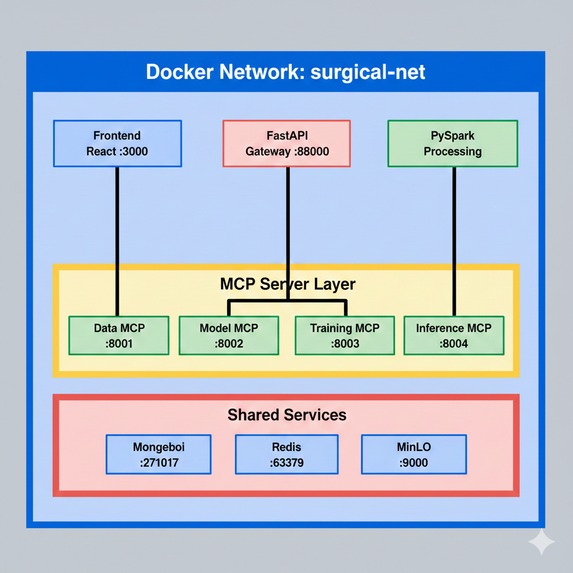
Architecture
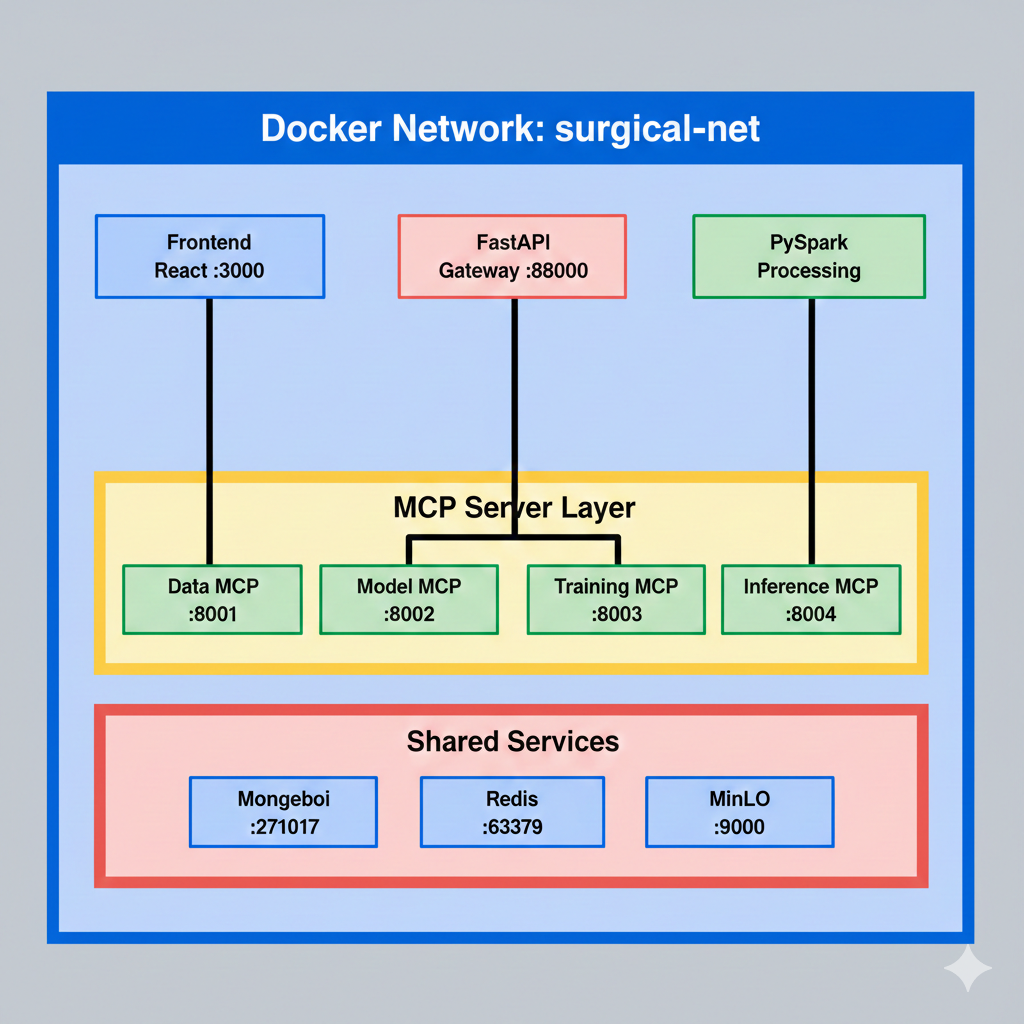
This hackathon project introduces a Multi-Scale Agentic AI System designed to detect surgical tools in real-time using Dendritic Neural Networks. By mimicking the complex, segment-wise computations of biological neurons, the system achieves higher accuracy and parameter efficiency than traditional models.
## Core Innovation: Dendritic Computation
Traditional AI uses simplified "neurons." This project implements Dendritic Layers that process information in segments, much like real biological cells.
- Dendritic Gating: Learns to prioritize specific features (e.g., fine textures for graspers vs. broad context for irrigators).
- Multi-Scale Detection: Processes images at three different resolutions () to capture both tiny tool details and the overall surgical scene.
- Efficiency: Achieved a 7% improvement in accuracy ( mAP) with only a 14% increase in parameters.
## System Architecture: The Agentic Approach
The project isn't just a model; it’s a production-ready ecosystem of 13 microservices coordinated via the Model Context Protocol (MCP).
| Component | Technology | Role |
|---|---|---|
| Orchestration | FastAPI Gateway | Routes traffic and manages multi-step workflows. |
| Data Engine | PySpark & MinIO | Distributed processing of surgical video frames. |
| Real-time Layer | Redis & WebSockets | Provides sub-100ms dashboard updates. |
| Inference | PyTorch (CPU-optimized) | Delivers predictions in 15ms (approx. 66 FPS). |
## Challenges & Lessons Learned
- Hardware Constraints: Switched to CPU-only Docker images to ensure the system could be deployed in hospitals without expensive GPU clusters.
- Gradient Flow: Biological models don't naturally "backpropagate" well. Adding residual connections was essential to make the dendritic layers trainable.
- Async Performance: Using asynchronous database drivers (Motor for MongoDB) resulted in a 10x speed improvement for the API.
## Future Impact
This work bridges the gap between biological research and clinical application. By providing a "vertical slice" of a working system, it sets the stage for:
- Safety Monitoring: Alerting surgeons to misplaced tools in real-time.
- Autonomous Robotics: Providing "tool awareness" for surgical robots.
- Edge Deployment: Running high-accuracy AI on low-power medical devices.
Next Step: Would you like me to generate a simplified code snippet demonstrating how the Dendritic Gating mechanism is implemented in PyTorch?


Log in or sign up for Devpost to join the conversation.