-
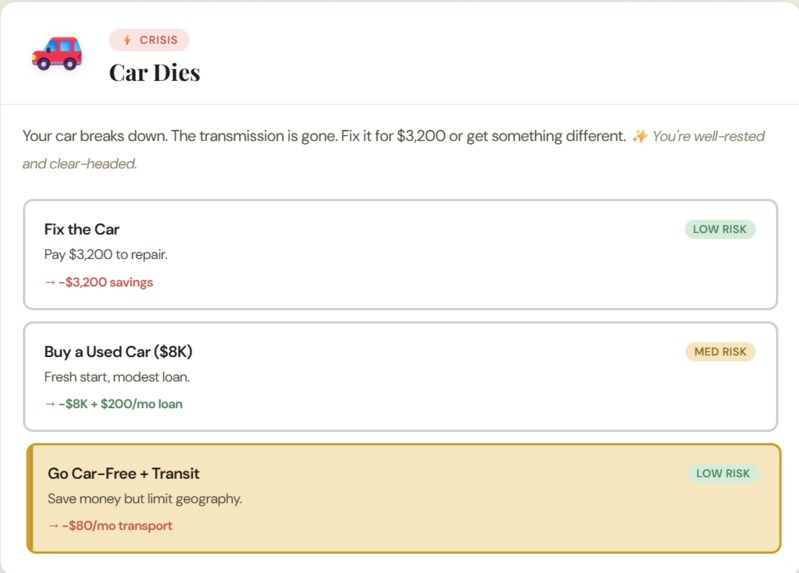
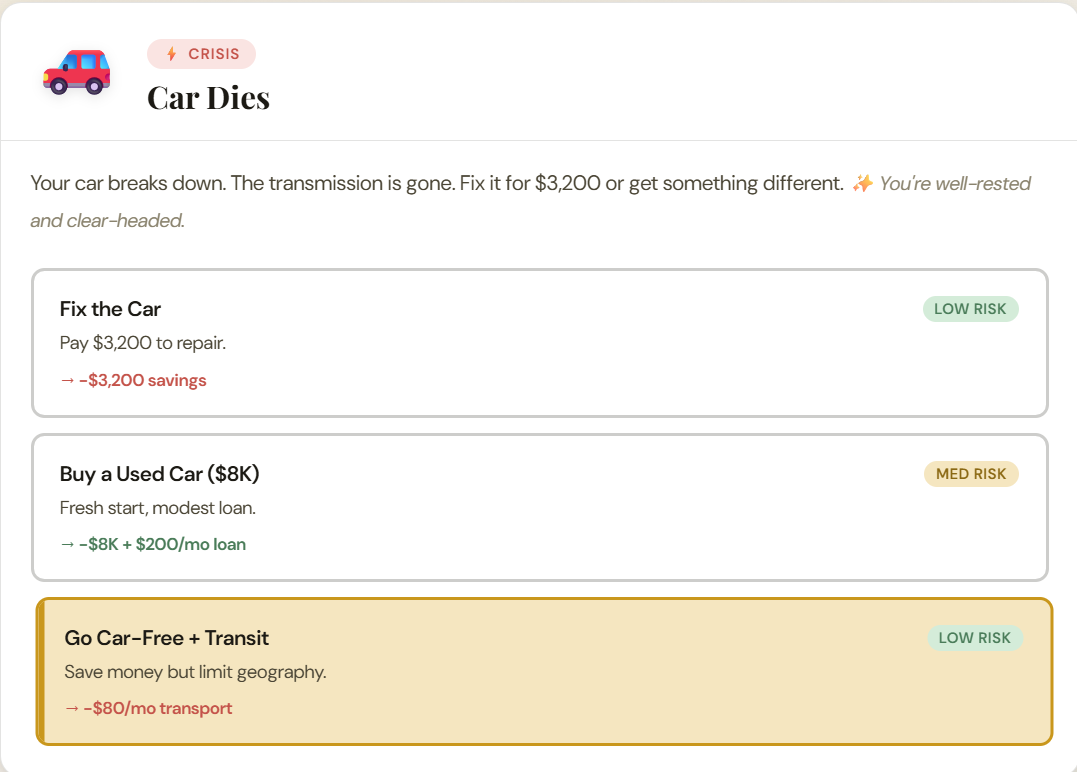
Example of a decision
-
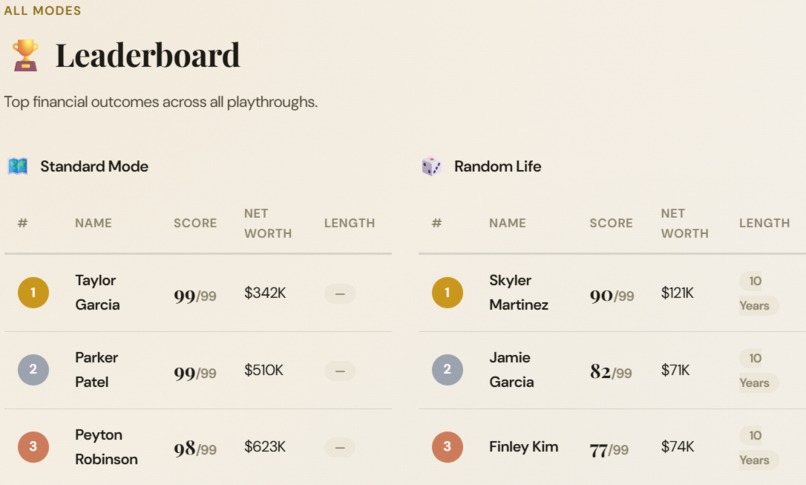
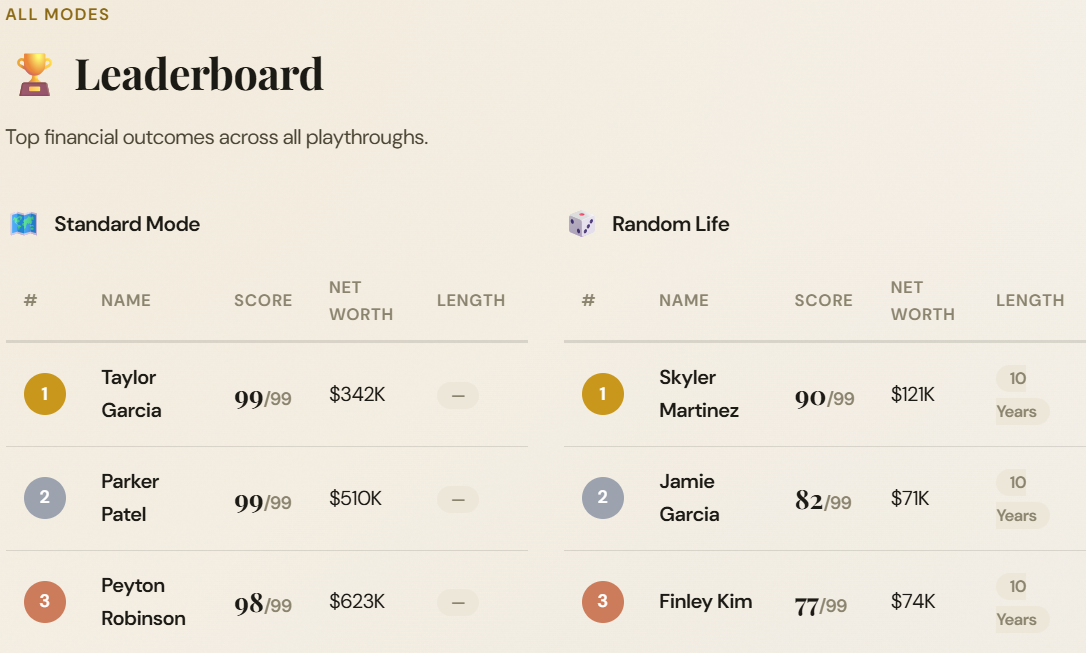
The leaderboard for two of the modes
-
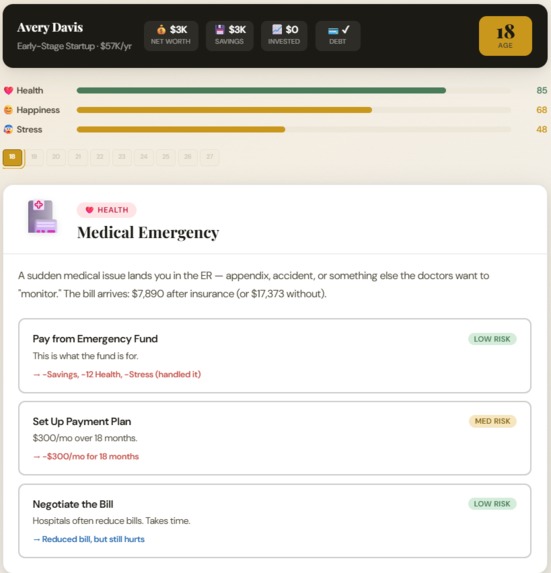
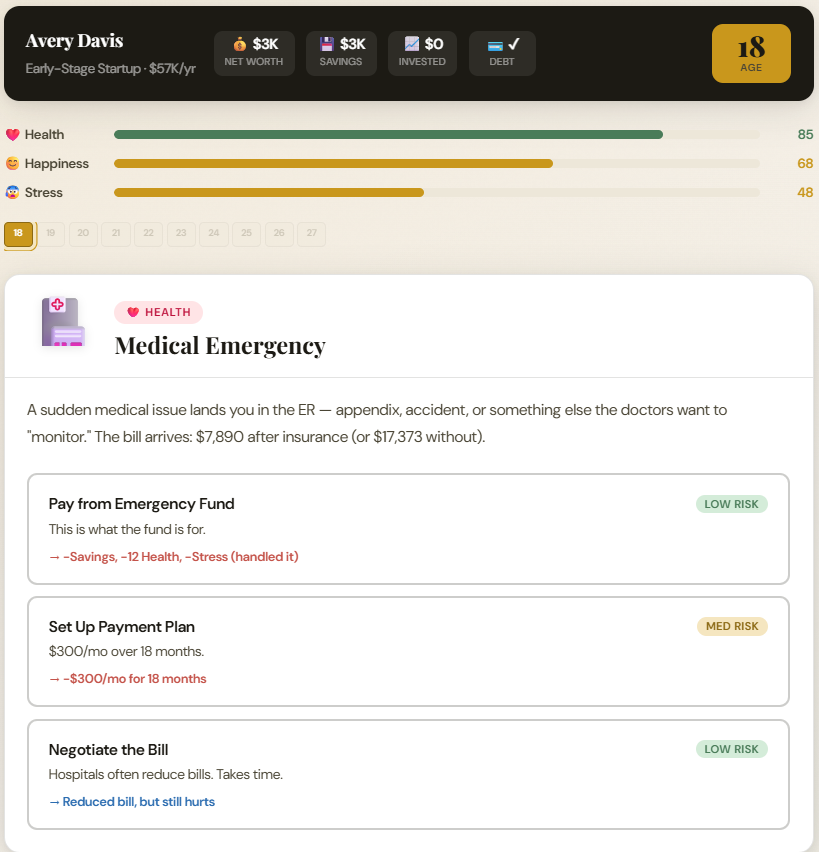
Decision before starting the next year + stats update
-
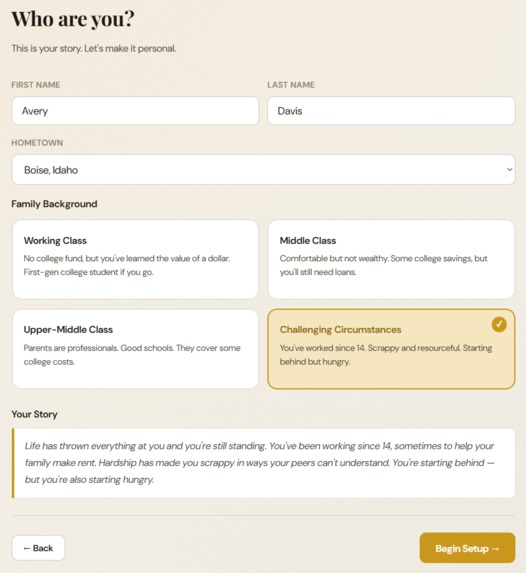
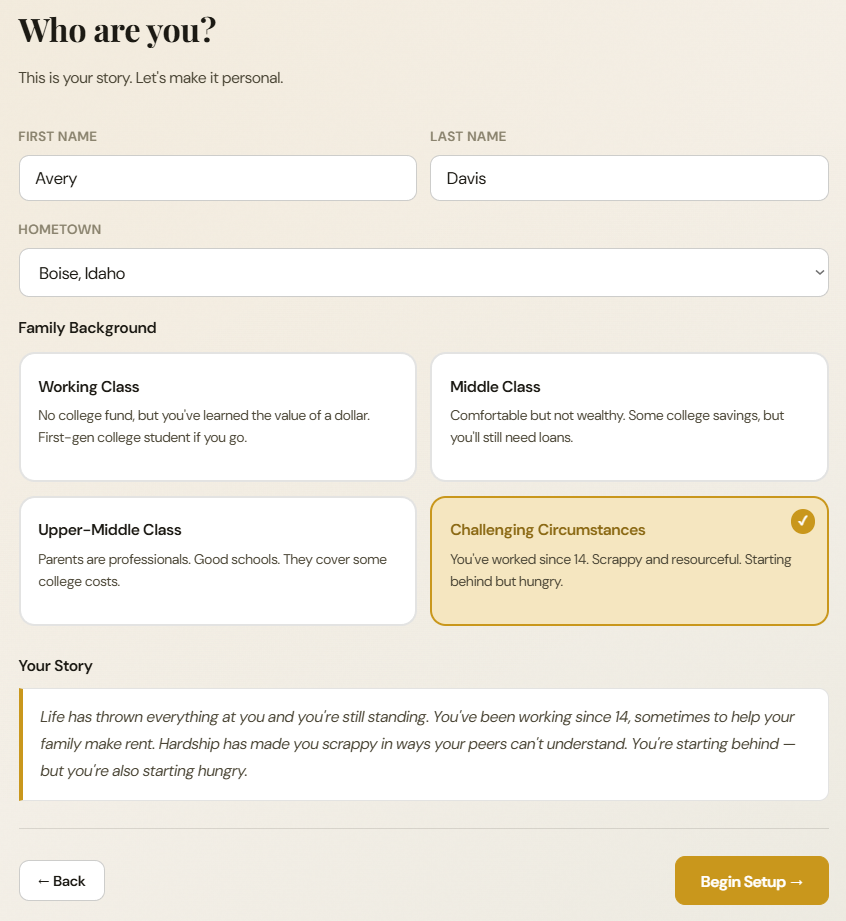
Picking characteristics
Inspiration
We wanted to make financial literacy feel more engaging and less intimidating by turning it into something interactive and experiential rather than instructional. The goal was to give users a space to safely explore real-life money decisions through learning by doing.
• Designed the experience around real-world financial decision-making in a low-risk environment
• Focused on translating abstract concepts like budgeting and investing into tangible, interactive outcomes
• Framed financial choices as a guided, game-like journey to increase engagement and understanding
• Aimed to build confidence and curiosity in users when approaching personal finance
Overall, the inspiration came from making financial learning feel active, accessible, and experience-driven rather than overwhelming or theoretical.
What it does
The platform is a modular, API-driven game built around structured, choice-based scenarios. Players can either create a custom character or start with a randomized “play the hand dealt” profile that sets different starting conditions and backgrounds.
• Built multiple game modes, including custom character creation and randomized start profiles with contextual backgrounds
• Designed a system where players choose how many years to simulate, affecting the length and complexity of each run
• Created branching decision paths where each choice triggers measurable changes in core metrics like income, debt, savings, and investments
• Expanded tracking to include personal factors such as health, stress, and happiness alongside financial outcomes
• Integrated an AI opponent mode that uses its own decision logic to simulate alternative strategies
• Implemented a leaderboard system to compare and rank results across different runs
Overall, the focus was on building a flexible system where every decision has meaningful, data-driven consequences across both financial and personal outcomes.
How we built it
We built a modular, API-driven system with a focus on scalable simulation logic and state management.
• Designed a branching scenario engine to handle decision paths and outcomes dynamically
• Implemented a centralized state system to track and update player metrics across runs
• Built financial computation logic for income, expenses, debt, and investment growth over time
• Structured data models to support customizable player profiles and variable simulation lengths
• Developed an AI opponent system to generate alternate decision strategies for comparison
• Integrated a leaderboard system to evaluate and rank performance across simulations
We used Claude AI to expand or refine specific sections of existing code, mainly to speed up iteration and help with implementation details.
Overall, the work focused on building a flexible backend architecture that could reliably handle complex, evolving simulation logic.
Challenges we ran into
The biggest challenges we faced came from trying to make everything work together cleanly while also handling sensitive information responsibly.
• Getting the API to integrate with our system wasn’t straightforward, and we ran into a lot of moments where data wasn’t behaving the way we expected or didn’t fit neatly with our game logic
• We also struggled with how quickly things broke when small changes were made, which made debugging and keeping everything consistent more difficult than anticipated
• Another major challenge was realizing how easy it would be to accidentally expose our API key while working in a shared GitHub environment, which forced us to rethink how we were managing and organizing our project early on
• Ensuring an appropriate degree of difficulty for our first time in a hackathon
Accomplishments that we're proud of
We’re proud of bringing together several complex pieces into a functioning, cohesive experience.
• Successfully implemented API integration to drive dynamic, real-time updates throughout the game
• Built a fully functioning UI with a clean, responsive design, including a working dark mode
• Balanced and tuned difficulty to ensure the experience felt challenging but still fair and engaging across different runs
• Developed multiple game modes, including a “hand you’re dealt” style mode and customizable simulation settings
• Integrated an AI-driven game mode where players could directly compete against alternative decision-making logic
• Learning how to balance having an AI engine help us refine the code without relying too heavily on it
Overall, we’re proud of creating a system that feels complete, intentional, and replay-able, with multiple layers of interaction working together smoothly.
What we learned
• Learned how to work with APIs and handle integration between external data and our own system
• Gained experience debugging and adapting our code to properly use API responses within our game logic
• Improved understanding of how to structure a project so external services can be used reliably and securely
• Learned how to use AI as a supportive development tool for refining and expanding existing code, rather than relying on it to generate full implementations
• Strengthened our ability to problem-solve through iteration, testing, and refining system behavior step by step
What's next for LifeLedger
• Developing a mobile app version to make the experience more accessible and easy to use on the go
• Adding a “daily mode” with short, quick scenarios that simulate everyday financial decisions
• Expanding into multiplayer so users can compare choices and outcomes in real time
• Building tools that allow teachers or facilitators to create and customize their own scenarios for classroom or group use
Overall, the goal is to expand the platform into a more social, flexible, and widely accessible learning tool for financial decision-making.


Log in or sign up for Devpost to join the conversation.