-
-
1
-
2
Inspiration
Financial data is often difficult to understand, especially when it comes in inconsistent formats or requires multiple calculations before meaningful conclusions can be drawn. We wanted to simplify this process by building a tool that could take raw financial data and turn it into understandable insights.
The idea behind Financial-Analyzer was to combine traditional financial analysis with Generative AI, making financial analysis more automated, accessible, and easier to interpret.
What it does
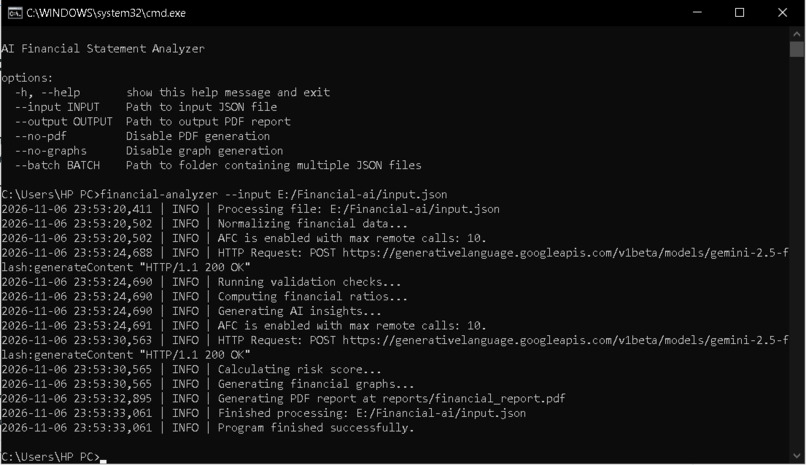
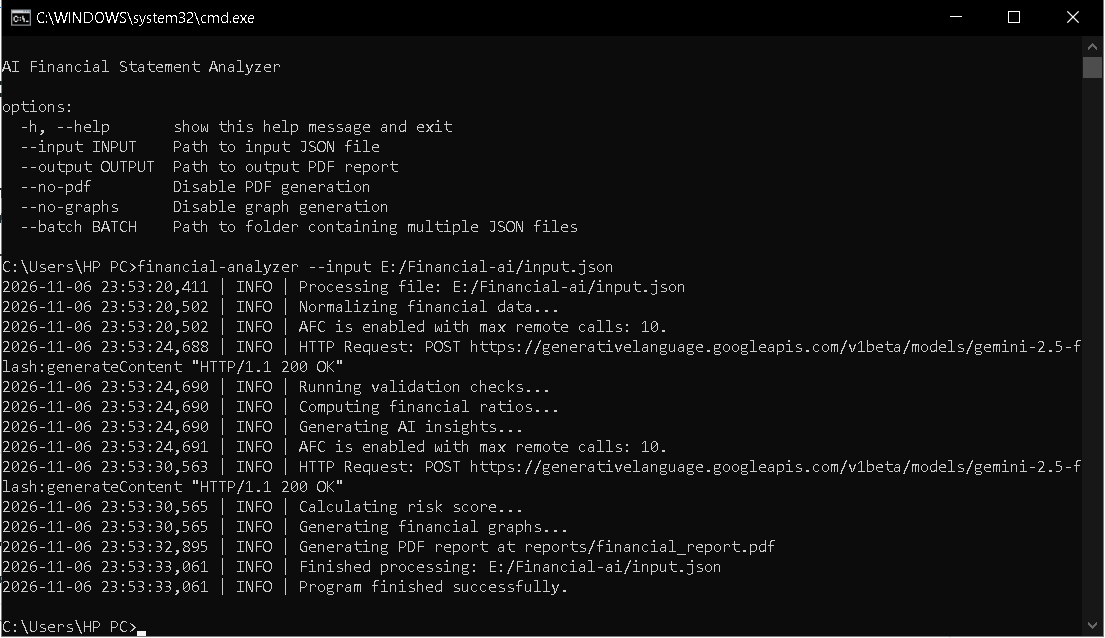
Financial-Analyzer is an AI-powered Python tool that automates financial data processing and analysis.
Its key features include:
- AI-Powered Data Normalization: Uses Google's Gemini API to interpret and normalize inconsistent financial inputs.
- Data Validation: Checks financial data for missing, invalid, or inconsistent values.
- Financial Ratio Analysis: Calculates important financial ratios to evaluate financial performance.
- Risk Scoring: Analyzes financial indicators to generate risk assessments.
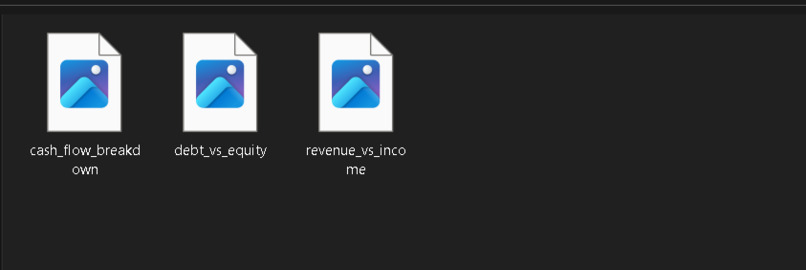
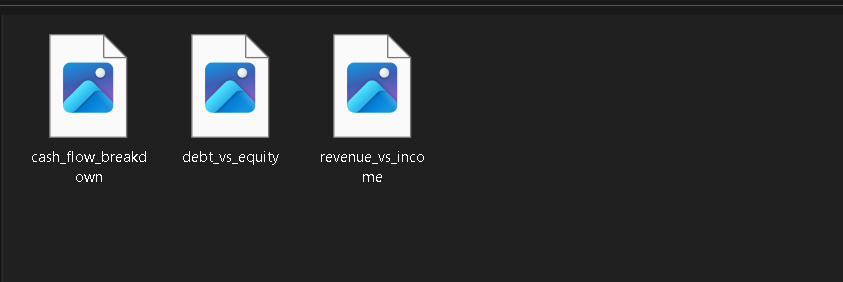
- Data Visualization: Creates graphical representations of financial metrics using Matplotlib.
- PDF Report Generation: Generates structured financial reports containing calculations, visualizations, and analysis.
- Batch Processing: Supports processing multiple financial records efficiently.
- Logging: Maintains logs to help track processing activities and errors.
The goal is to reduce manual effort and make financial information easier to understand and analyze.
How we built it
We built Financial-Analyzer using Python, combining AI capabilities with traditional financial computation.
Our technology stack includes:
- Python: Core programming language and application logic.
- Google Gemini API: AI-powered financial data interpretation and normalization.
- NumPy: Numerical operations and financial calculations.
- Matplotlib: Generating financial charts and visualizations.
- ReportLab: Creating downloadable PDF reports.
- Python Logging: Tracking application execution and errors.
- PyPI: Packaging and publishing the project so other developers can install and use it.
The application follows a modular approach, separating data processing, validation, financial calculations, visualization, and report generation into individual components.
We also packaged the project and published it on PyPI to make installation and reuse easier.
Challenges we ran into
One of the biggest challenges was handling inconsistent financial data. Financial information can arrive in different formats, contain missing values, or use different naming conventions.
Integrating Gemini into the data normalization process required us to ensure that AI-generated outputs could be converted into a consistent structure before performing calculations.
Other challenges included:
- Designing reliable validation mechanisms for financial inputs.
- Ensuring accuracy in financial ratio calculations.
- Handling unexpected or incomplete data without interrupting the workflow.
- Integrating visualizations into automatically generated PDF reports.
- Packaging the application correctly and resolving dependency and distribution issues while publishing it to PyPI.
These challenges helped us understand the importance of combining AI flexibility with deterministic validation and calculation logic.
Accomplishments that we're proud of
We are proud to have developed a complete financial analysis workflow rather than just a standalone AI-powered application.
Some of our key accomplishments include:
- Successfully integrating Google's Gemini API into a financial analysis workflow.
- Building an automated pipeline from raw financial data to structured reports.
- Implementing financial ratio calculations and risk scoring.
- Generating visualizations and PDF reports automatically.
- Packaging and publishing the project on PyPI, making it reusable outside our development environment.
Most importantly, we built something that combines AI, data processing, financial calculations, and software distribution in one project.
What we learned
Throughout development, we learned how to integrate Generative AI into a practical Python application and how to use AI for structured data processing.
We also gained experience in:
- Working with Google's Gemini API.
- Building modular and reusable Python applications.
- Validating AI-generated outputs before using them in calculations.
- Performing financial computations and visualizing results.
- Generating professional PDF reports programmatically.
- Packaging and publishing Python projects on PyPI.
- Handling dependencies, errors, and real-world input inconsistencies.
This project taught us that AI is most useful when combined with reliable traditional programming techniques rather than being used as a replacement for them.
What's next for Financial-Analyzer
We see Financial-Analyzer as a foundation that can grow into a more comprehensive financial intelligence platform.
Our future plans include:
- Interactive Dashboard: Building a web-based dashboard to explore financial metrics and reports.
- Advanced Financial Analysis: Adding more financial ratios, forecasting techniques, and deeper performance analysis.
- Multi-Format Support: Supporting additional input formats such as Excel, CSV, and financial statements in PDF.
- Historical Comparison: Comparing financial performance across multiple periods.
- Improved Risk Assessment: Introducing more sophisticated risk evaluation models.
- AI-Powered Explanations: Providing easy-to-understand explanations of financial metrics and identifying important trends.
- Cloud Integration: Making financial analysis accessible through a hosted application and API.
Our long-term vision is to make financial analysis simpler, more accessible, and more informative through the combination of AI and data-driven computation.
