Inspiration
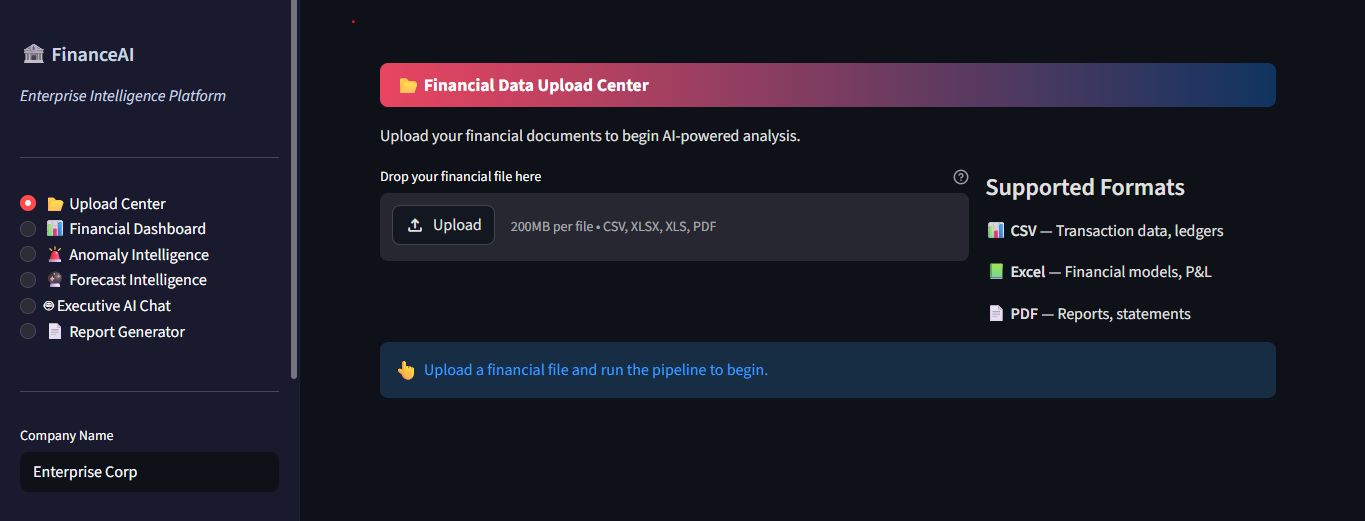
FinanceAI was inspired by a growing gap in financial decision-making tools: most platforms either focus on raw data dashboards or overly simplified personal finance apps. We wanted to build something in between — an AI-native financial intelligence system that can reason over financial data, detect anomalies, and assist in decision-making using agent-based architecture.
The rise of LLMs and AI agents made it clear that finance workflows (analysis, forecasting, risk detection) could be partially automated with intelligent systems rather than static dashboards.
What it does
FinanceAI is an AI-powered financial intelligence platform that combines multiple specialized agents to analyze financial data and generate actionable insights.
Key capabilities:
📊 Financial data analysis and summarization 🚨 Anomaly detection in transactions or metrics 🤖 Multi-agent reasoning system for layered financial insights 📈 Intelligent reporting for decision support 🔍 Structured backend APIs for extensibility and integration
The system is designed to simulate a lightweight “AI financial analyst team” working together.
How we built it
We built FinanceAI using a modular backend-first architecture:
Backend: FastAPI for high-performance API development AI Layer: Agent-based architecture (multiple specialized agents for analysis, anomaly detection, and reasoning) Python ecosystem: Core logic, data processing, and ML workflows Version control: Git/GitHub for collaboration and iteration Architecture design: Decoupled services to allow independent scaling of agents
Each agent is responsible for a specific financial intelligence task and communicates through structured APIs.
Challenges we ran into
Designing a multi-agent system that stays consistent in reasoning without conflicting outputs Structuring financial data so it could be reused across different analytical agents Managing backend complexity while keeping APIs clean and scalable Debugging asynchronous agent interactions and ensuring predictable outputs Balancing simplicity of MVP vs. extensibility for enterprise use cases
Accomplishments that we're proud of
Successfully implemented a working multi-agent financial analysis system Built a clean and scalable FastAPI backend architecture Created a foundation for an enterprise-grade AI financial platform Designed the system to be extensible for future ML models and tools Achieved modular separation between analysis, anomaly detection, and orchestration layers
What we learned
How to design and structure agent-based AI systems Practical challenges of integrating AI reasoning into real backend services Importance of clean API design in complex AI systems Trade-offs between model intelligence and system reliability How financial use cases require strict structure, not just free-form LLM outputs
What's next for FinanceAI
Adding a frontend dashboard for real-time financial visualization Integrating live market and banking APIs Expanding agents into: Risk management agent Portfolio optimization agent Forecasting agent (time-series ML models) Adding authentication + multi-user enterprise support Deploying as a cloud-based SaaS platform for financial analytics


Log in or sign up for Devpost to join the conversation.