-
-
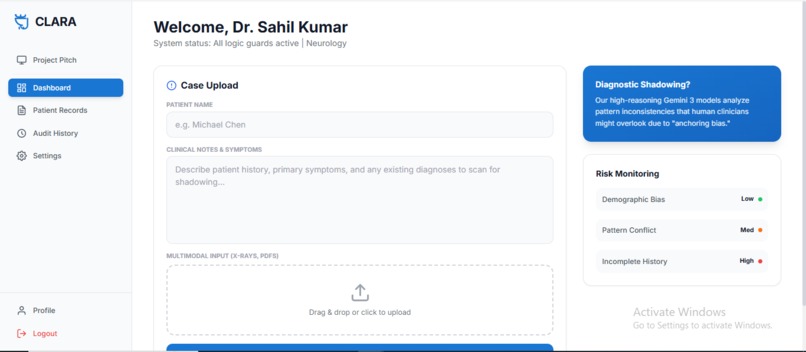
https://aistudio.google.com/apps/drive/1objVMgqApQNOisV46MnKLCo4IgCSZqiA?fullscreenApplet=true&showPreview=true&showAssistant=true
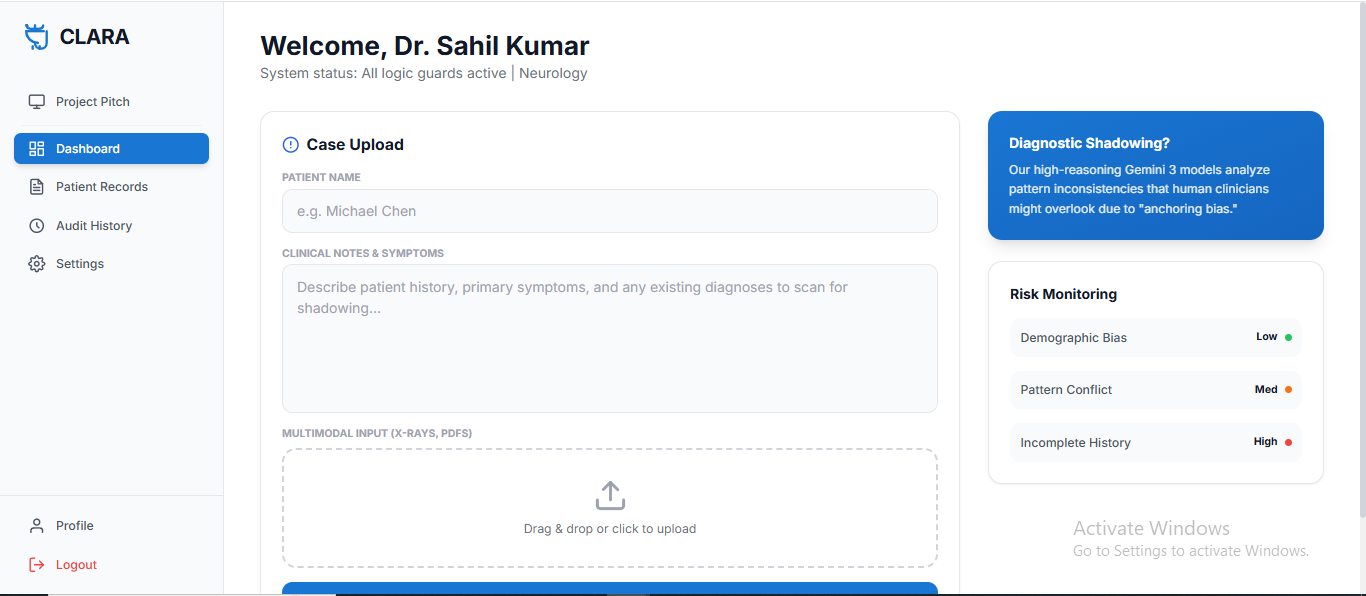
In clinical medicine, a patient’s history is their lifeline—but it can also be a blindfold. Diagnostic shadowing occurs when a clinician subconsciously attributes new, dangerous symptoms to a patient’s pre-existing conditions (like mental illness, chronic pain, or disability). When the "obvious" answer hides the "lethal" one, patients are harmed not by a lack of data, but by a lapse in logic.The Breakthrough: An Autonomous CollaboratorWe built CLARA (Clinical Logic Assistant) to be the objective observer that never sleeps. Built on Gemini 3 Pro, CLARA doesn't just scan data; it thinks across formats. By leveraging Native Multimodality, it "sees" the subtle opacity on a high-resolution X-ray while simultaneously "reading" the nuance in a physician’s admission notes.The "Wow" Moment: Deep Think ReasoningThe true power of CLARA is revealed when it detects a logical friction point. While a human might see a known respiratory patient and assume a standard flare-up, CLARA’s Deep Think reasoning flags the discrepancy: The visual evidence in the scan doesn't match the historical trajectory. It doesn't just issue an alert; it maps out an Explainable Diagnostic Reasoning Path, showing the clinician exactly why the current path might be a shadow, and where the real danger lies.Key Impact PillarsFeatureClinical ValueShadow DetectionStops the misattribution of symptoms to existing history.Multimodal SynthesisBridges the gap between imaging (DICOM) and text (EHR).Explainable AIProvides a transparent "Reasoning Path" to build clinician trust.
Built With
- high-speed-dashboard-that-clinicians-can-use-at-the-bedside.-tailwind-css:-for-a-clean
- low-cognitive-load"-ui-design.-d3.js-/-framer-motion:-used-to-visualize-the-diagnostic-reasoning-path
- react
- tailwind
- turning-complex-logical-steps-into-a-clear

Log in or sign up for Devpost to join the conversation.