
AI-Powered Financial Advisor
Inspiration
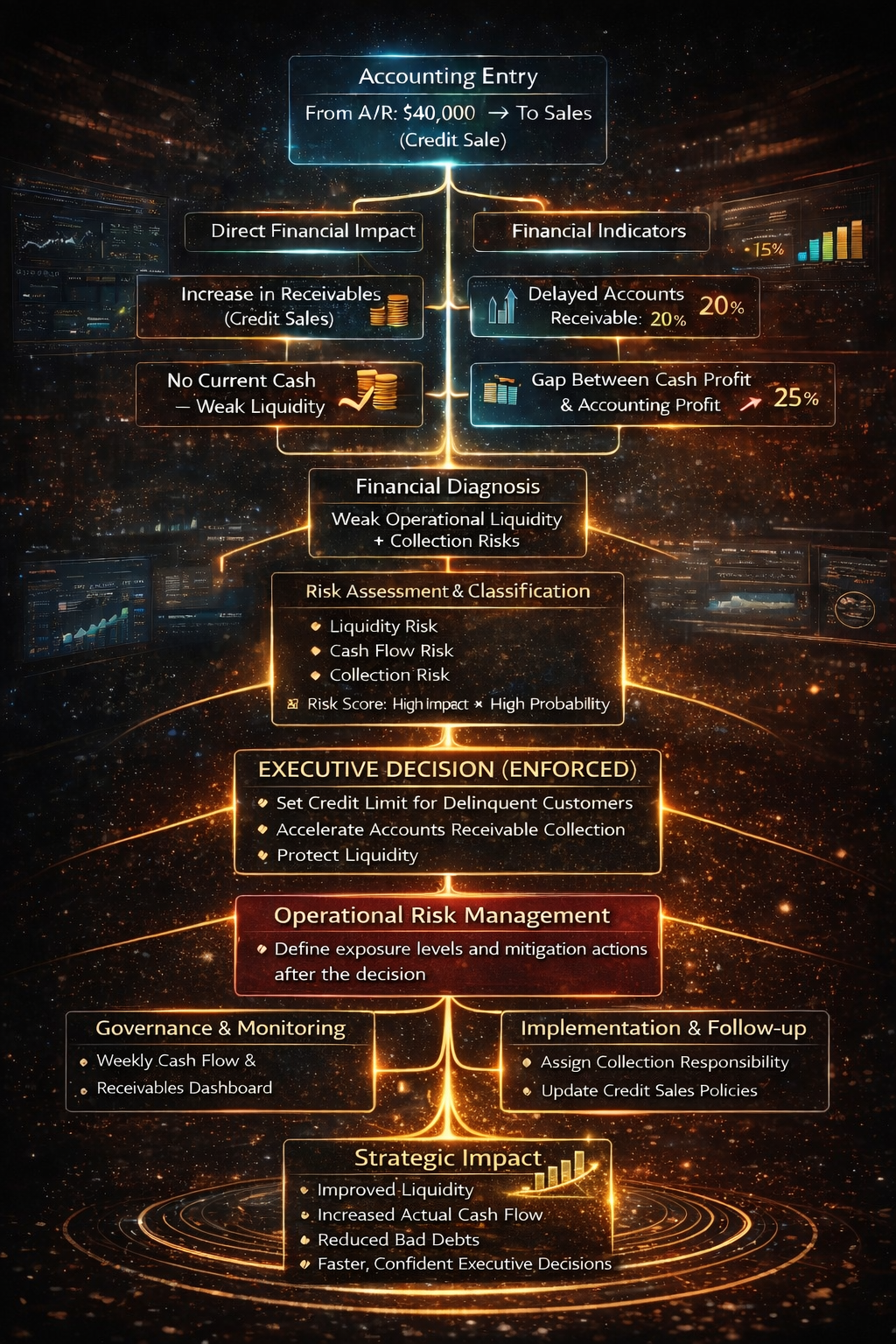
I drew inspiration from the fact that companies, despite having financial systems, often suffer deficits and losses that lead to business failure and increased unemployment in society. After researching, I found that the problem is not accounting errors, but the gap between financial data and timely executive decision-making. I transformed the mindset of the Chief Financial Officer (CFO) into a system that converts (accounting entries into executive decisions )– this is the AI-Powered Financial Advisor.
"The danger is not in making the wrong decision, but in not making a decision in time."
What it does
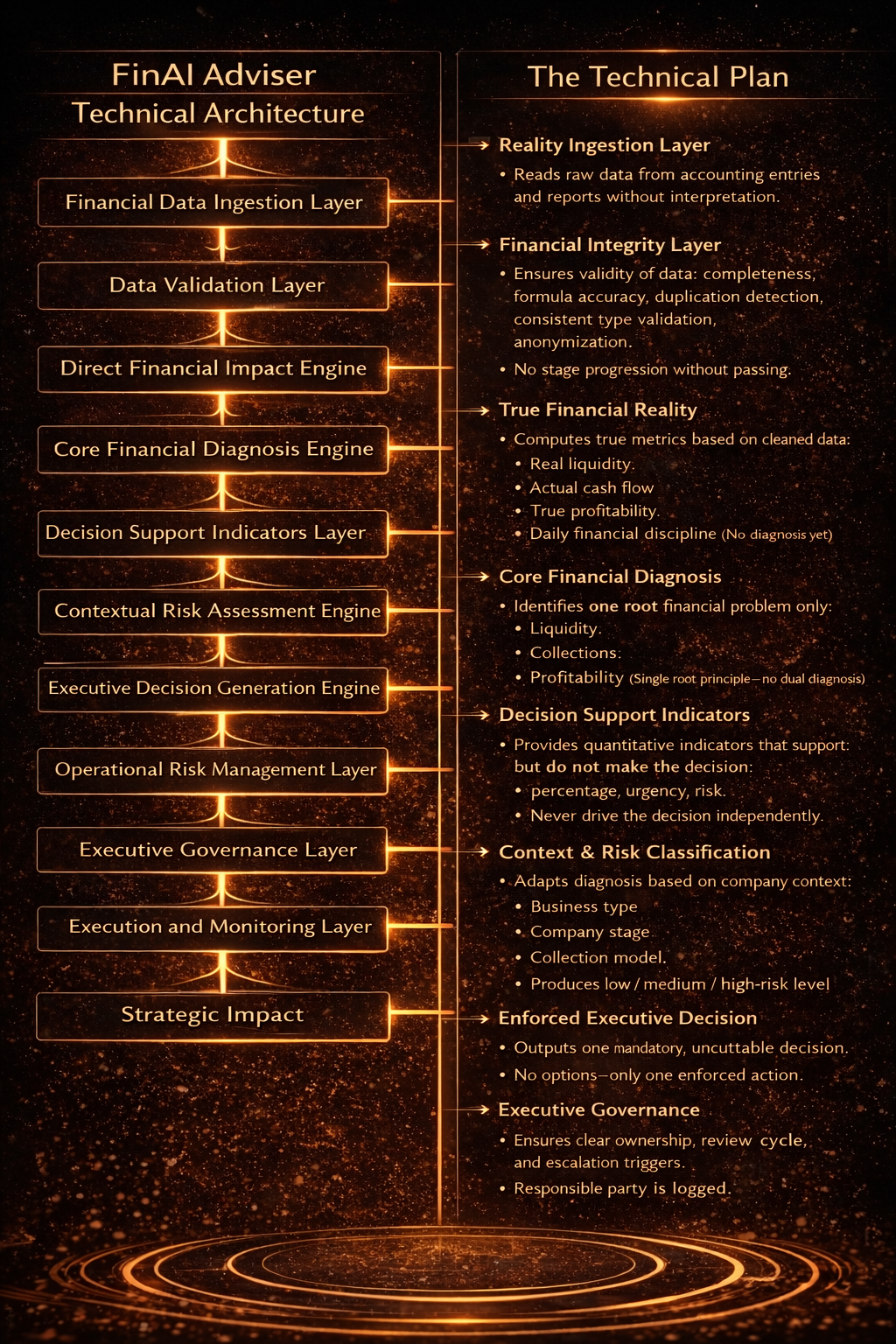
Core Engine: Converts accounting entries and financial reports into direct financial reality such as actual liquidity, cash flow, profitability quality, and financial discipline.
Diagnostic Engine: Identifies the root problem for each financial cycle (liquidity, collection, profitability, or operations).
Executive Decision Engine: Generates a mandatory decision for each cycle, with low-risk supporting recommendations.
Artificial Intelligence: Analyzes additional measurable indicators (liquidity trends, the gap between cash and accounting profit, overdue customers…).
Smart MNEE Layer: Each financial decision or recommendation can be directly converted into a programmable transaction using MNEE, such as:
- Automatic payment of invoices or salaries upon meeting certain conditions.
- Automating transfers between accounts according to system recommendations.
- Linking AI with stablecoins to provide safe and programmable cash flow.
How we built it
Frontend: React + Next.js + Tailwind CSS to display interactive and flexible dashboards, with clear colors and design that makes all system layers easy to understand and interact with smoothly.
Backend: Python + FastAPI for processing accounting entries, financial reports, and executing analytical engines.
Database: PostgreSQL to store historical data and executive decisions.
Artificial Intelligence: Supports data analysis and recommendations while maintaining the core engine’s role in decision-making.
MNEE Integration: The system can link financial decisions directly with MNEE on the Ethereum network to execute automated digital payments and transactions.
Application Workflow
Data Analysis ⟶ Data Verification ⟶ Direct Financial Impact ⟶ Financial Diagnosis ⟶ Decision Support Indicators ⟶ Risk Classification ⟶ Executive Decision Generation ⟶ Risk Management ⟶ Governance ⟶ Execution and Monitoring ⟶ Strategic Impact ⟶ Automated MNEE Transactions
"MNEE digital transaction support is included in the code and project text to facilitate automated financial flows, without adding it to the video to avoid technical complexity."
Challenges
- Simulating the CFO mindset within a multi-layer engine.
- Training AI to provide accurate recommendations without affecting the core decision.
- Integrating stablecoins through MNEE to make financial transactions safe, transparent, and automatable.
Achievements
- An integrated financial engine that identifies the root problem and generates mandatory executable decisions.
- Integration of AI and MNEE layer to support transfers and smart transactions.
- Interactive user interface that displays all layers for decision review and practical learning.
What we learned
- Integrating a multi-layer engine with AI and support for programmable digital transactions.
- Maintaining executive decision accuracy while automating financial flows.
- Ability to expand the system to include large institutions and banks and link it with stablecoins.
Next Steps
- Deeper integration with ERP systems and APIs of large companies.
- Developing more performance indicators and enhancing automated financial recommendations.
- Expanding the system to include all financial institutions and small and medium enterprises, with the ability to automate cash flows via MNEE.
- Adding the Institutional Adaptation Layer: To adapt the system to various institutions (banks, hospitals, universities, companies, government entities), adjust institutional indicators, and transform raw data into a unified model, enhancing the accuracy of diagnosis and decision-making.
Built With
- automated
- decision
- financial-analytics
- machine-learning
- python

Log in or sign up for Devpost to join the conversation.