Inspiration
In an era where AI can generate hyper-realistic fake images in milliseconds, traditional financial verification methods are falling behind. Banks and institutions lose billions annually to document fraud (checks, IDs, invoices) because manual review is slow and error-prone. I wanted to build a "Digital Sentinel"—an AI that doesn't just read text, but looks at the forensic structure of a document to detect forgery in real-time.
What it does
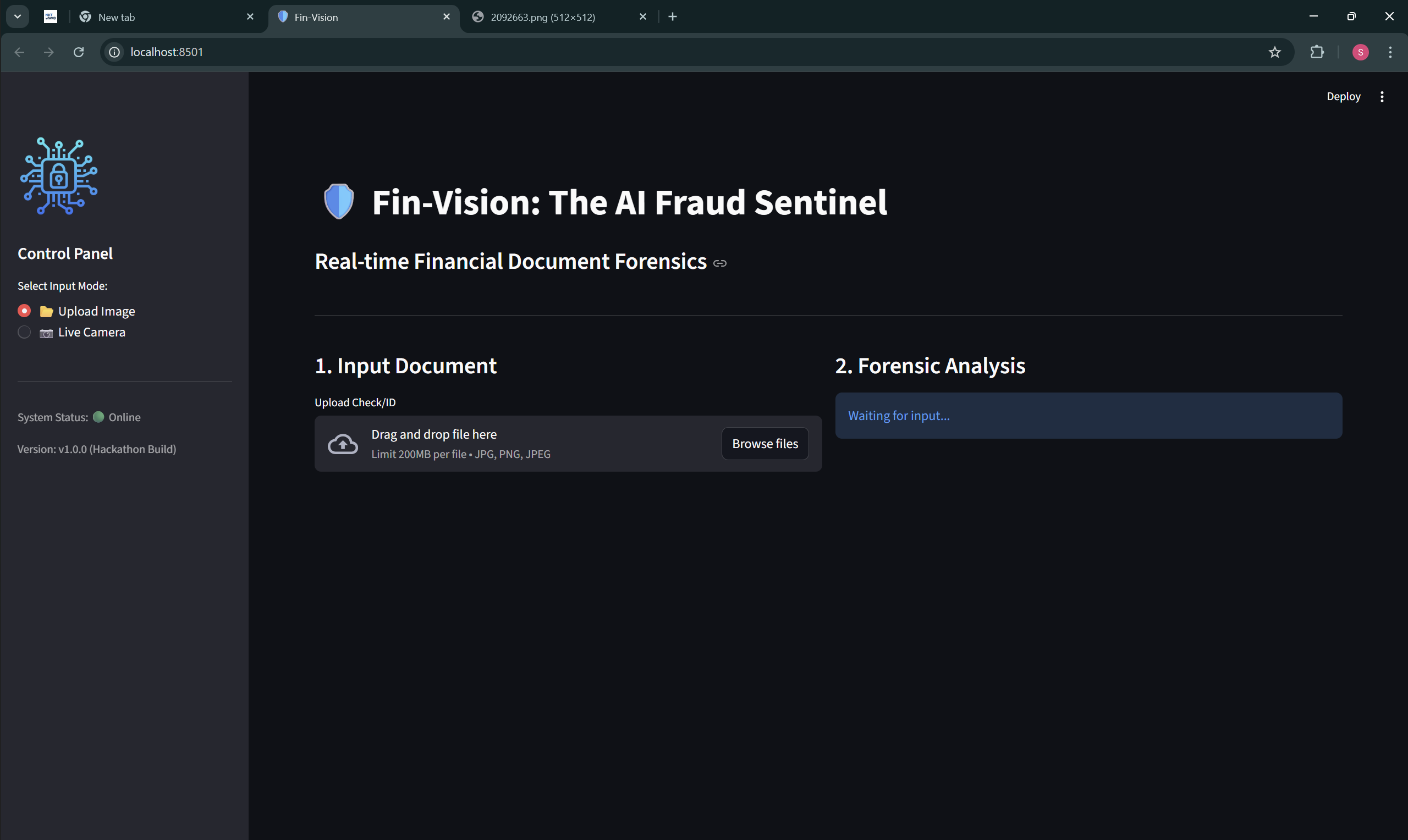
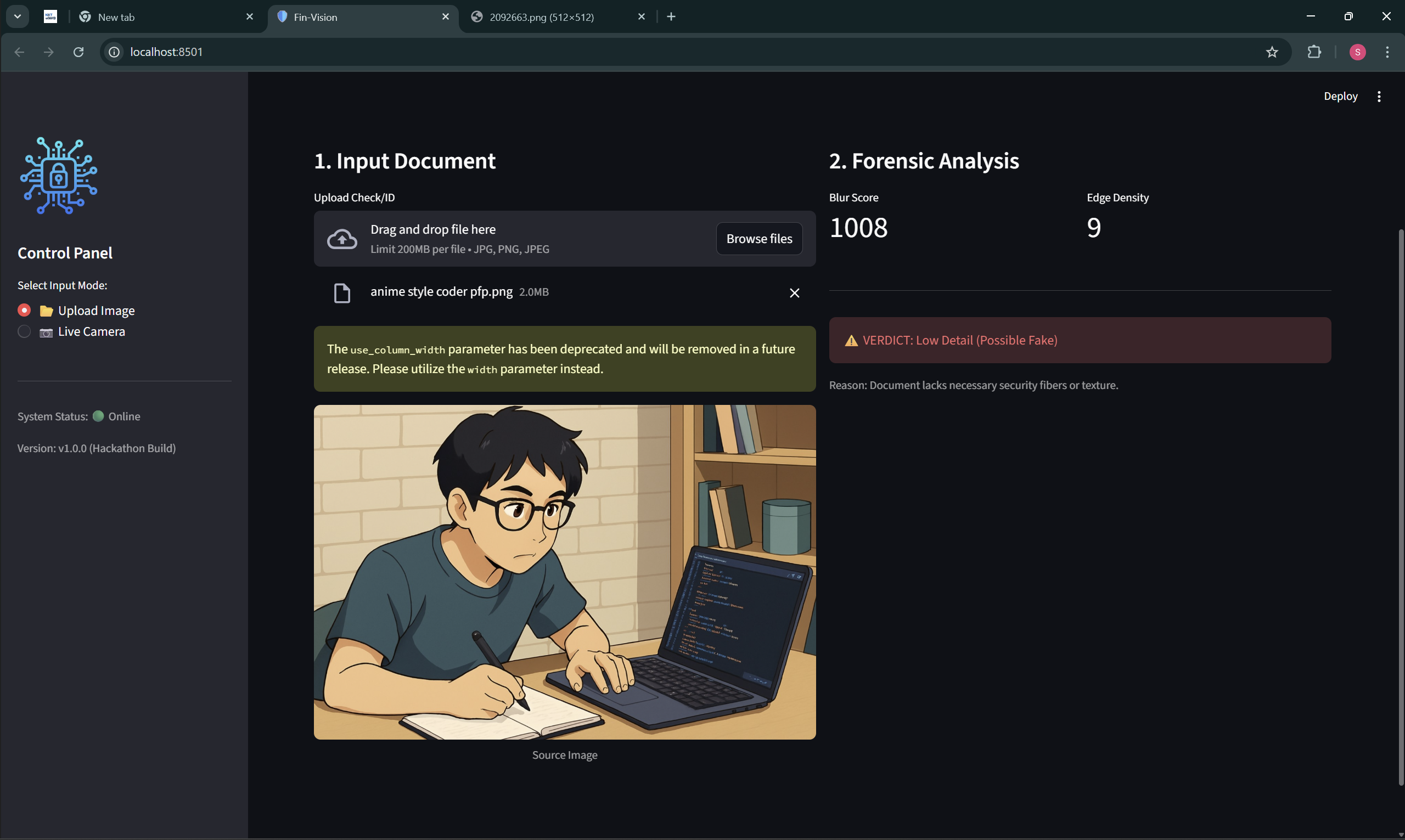
Fin-Vision is a lightweight, web-based forensic tool. It allows users to upload financial documents or use a live camera to scan them. My system instantly analyzes the image using Computer Vision to detect:
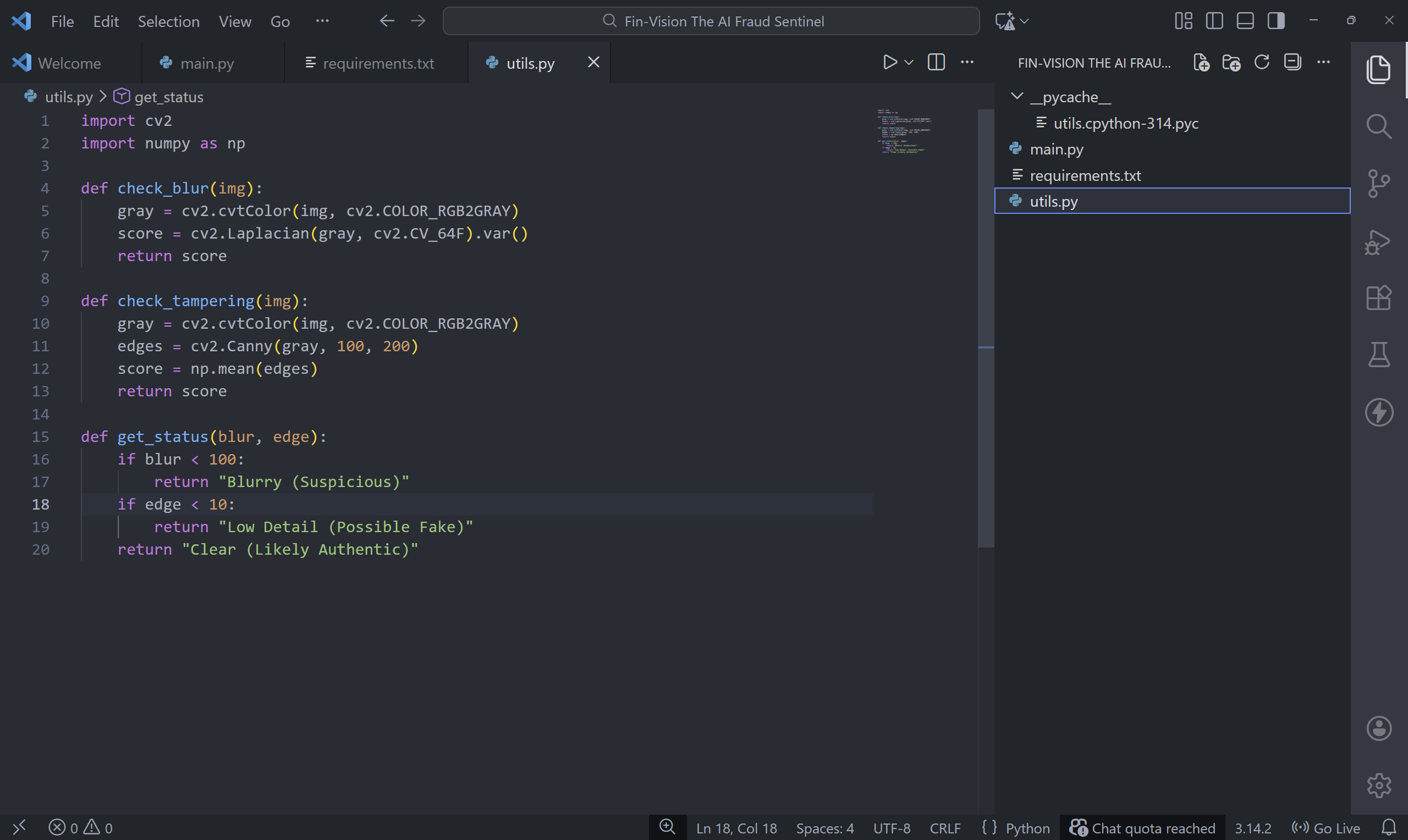
Blur Variance (Laplacian): Identifying low-quality scans often used in quick forgeries.
Edge Density (Canny): Verifying the texture and security fiber details of authentic paper documents versus smooth digital prints.
If a document fails these checks, Fin-Vision flags it as a "Possible Fake" instantly, providing a first line of defense before a human ever needs to get involved.
How we built it
I built Fin-Vision using a highly efficient Python stack:
OpenCV (cv2): The core engine I implemented for image processing (grayscale conversion, edge detection, variance calculation).
Streamlit: For the frontend interface, allowing me to deploy a working web app in under 24 hours.
NumPy: For high-speed matrix operations on image data.
GitHub: For version control and seamless deployment to the cloud
Challenges we ran into
The biggest challenge was tuning the threshold values for the computer vision algorithms. A real check has a specific "texture" (grain), while a digital image is "smooth." Finding the exact mathematical number that separates "Real" from "Fake" without causing false alarms required extensive testing with different image types.
Accomplishments that we're proud of
Speed: I optimized the analysis to happen in milliseconds.
Accessibility: I ensured it runs in a browser so no heavy software installation is needed.
Accuracy: It successfully differentiates between high-quality digital art and scanned physical paper.
What we learned
I learned how to fine-tune the sensitivity of computer vision algorithms to balance accuracy with speed. Specifically, I discovered that cv2.Laplacian variances can fluctuate wildly based on lighting, so I had to implement a normalization step to make the tool robust for different cameras. I also learned the power of Streamlit for rapid prototyping—turning a complex Python script into a user-friendly web app in just a few hours taught me that great backend logic needs a clean frontend to be truly impactful.
What's next for Untitled
I plan to upgrade the system from a passive analyzer to an active verifier. The next major feature will be integrating OCR (Optical Character Recognition) to extract the text from checks and cross-reference the account numbers with a secure database. I also aim to build an API wrapper for Fin-Vision so it can be integrated directly into banking apps. Finally, I want to connect this tool with my other security projects, Ghost-Buster and ResQ-Node, to create a comprehensive "Safety Ecosystem" for smart cities.


Log in or sign up for Devpost to join the conversation.