Inspiration
What it does
How we built it
Challenges we ran into
Accomplishments that we're proud of
What we learned
What's next for FILO.ai
Inspiration
In an era where we generate gigabytes of personal and professional data daily, finding that one specific thought or document has become a digital needle in a haystack. Traditional search tools are brittle—they rely on exact keyword matches and fail if you can't remember the precise filename. We were inspired to build FILO.ai (File Intelligence) to create a "Second Brain" that actually understands you. Our goal was to bring the power of LLMs to your local file system, providing a privacy-first, semantic search experience that feels like having a conversation with your own data.
What it does
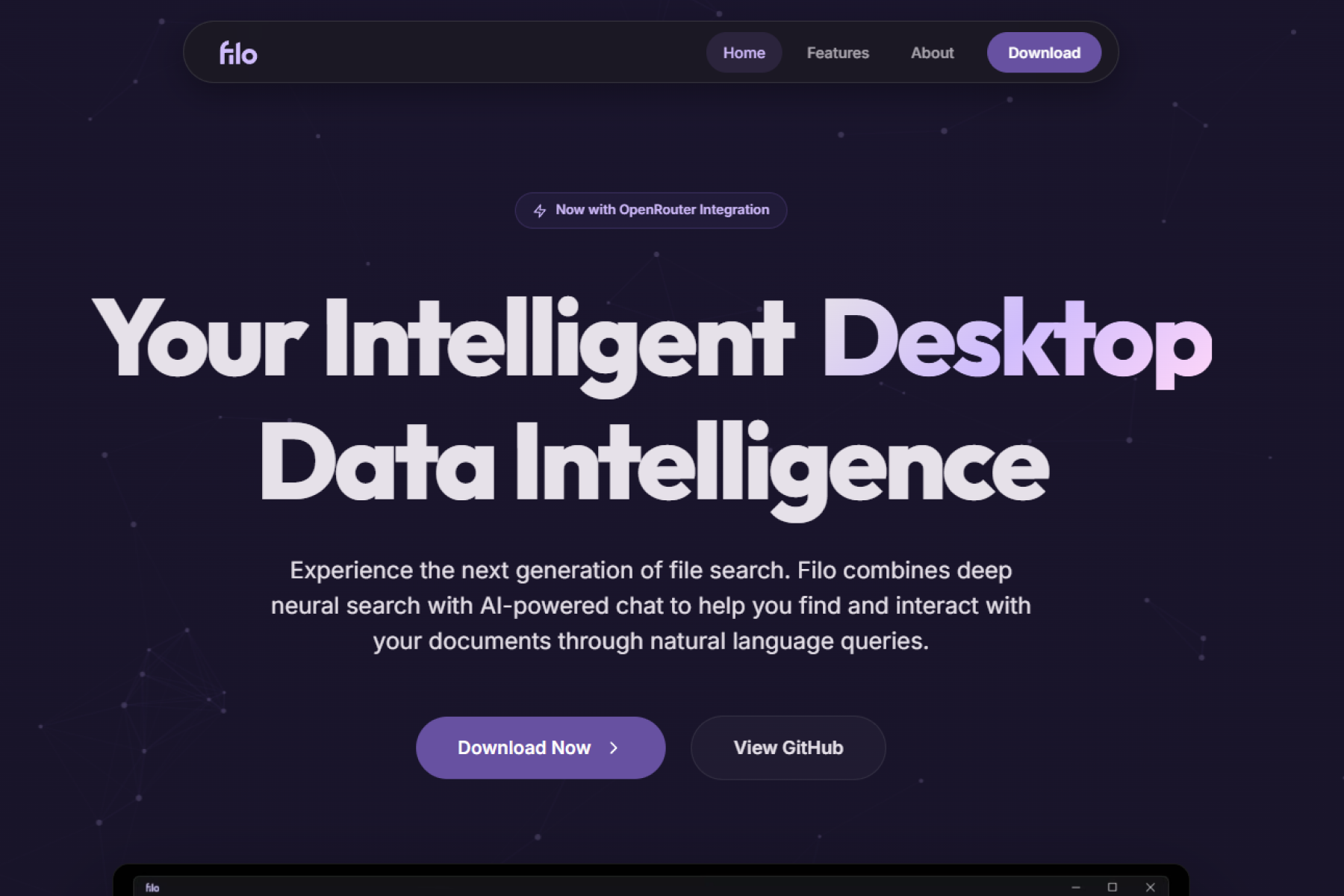
FILO.ai is an intelligent desktop assistant that transforms your local files into a searchable knowledge base.
- Semantic Search: Find documents by meaning, not just keywords (e.g., searching for "financial planning" finds your "Tax_2024.pdf" and "Budget_Sheet.xlsx").
- AI Agent Interface: A natural language "Butler" that can summarize documents, answer complex cross-file queries, and manage indexing tasks.
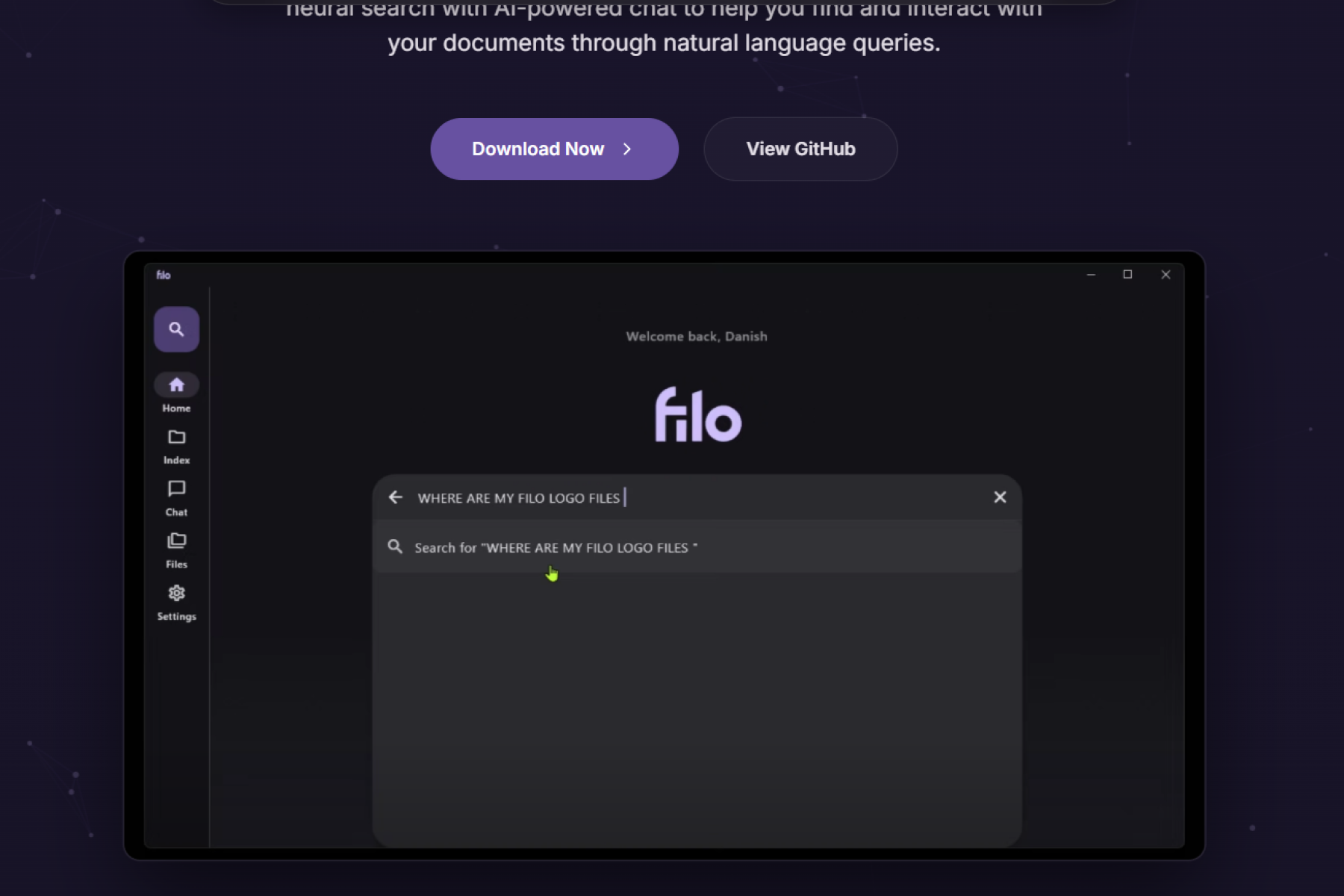
- Raycast-Style Overlay: A lightning-fast, global hotkey-driven search bar for instant access to your knowledge without leaving your current workspace.
- Auto-Tagging & Organization: Automatically categorizes files by primary topic, entities, and document type using AI.
- Privacy-First: All file processing and indexing happen locally, ensuring your sensitive data never leaves your machine.
How we built it
We chose a high-performance, modern stack to ensure the app felt premium and responsive:
- Frontend: Built with Flutter for a beautiful, consistent desktop experience across Windows, macOS, and Linux.
- Backend: Powered by Serverpod, a heavy-duty Dart-based backend framework that handles our API logic and background indexing jobs.
- Database: PostgreSQL with the pgvector extension for storing and querying high-dimensional vector embeddings.
- AI Orchestration: Integrated via OpenRouter to access state-of-the-art models (like Claude 3.5 Sonnet and Gemini 1.5 Flash) for embeddings and reasoning.
- Website: A sleek marketing presence built with React, Vite, and GSAP for high-end animations and micro-interactions.
Challenges we ran into
- Large-Scale Indexing: Processing thousands of local files (PDFs, Markdown, Code) while maintaining system performance required implementing a robust multi-chunking and pooling strategy.
- Desktop UI Nuances: Squashing platform-specific bugs, such as a persistent
doublevsboolerror in Flutter’sExpansionTileand ensuring smooth scrolling across nested flex layouts. - Local Vector Management: Optimizing PostgreSQL migrations and
pg_trgmindices to work seamlessly with vector similarity searches was a steep learning curve. - The "Overlay" Experience: Achieving a truly native-feeling "Raycast" overlay on Windows involved complex window management and focus-handling logic in Flutter.
Accomplishments that we're proud of
- True Semantic Understanding: Seeing the system successfully retrieve a document based on a vague conceptual query for the first time was a "eureka" moment.
- Integrated Design System: We moved from hardcoded styles to a centralized design token system, resulting in a UI that feels cohesive and premium.
- High-Performance Pipeline: We successfully built a pipeline that can extract, chunk, embed, and index files with real-time progress monitoring in the dashboard.
- The Agent Workflow: Implementing a multi-step agent that can "think" and execute search tools to answer complex user questions.
What we learned
- Vector Database Density: We learned the intricacies of chunking strategies—how the size and overlap of text segments directly impact the quality of AI retrieval.
- State Management at Scale: Using Riverpod to manage the complex states of background indexing, real-time server health, and AI streaming taught us the importance of unidirectional data flow.
- Desktop UX is Different: Moving from web to desktop development highlighted the importance of global hotkeys, system tray integration, and installer management (MSIX/DMG).
What's next for FILO.ai
- Real-time Monitoring: Implementing "Watch Folders" that automatically index new or modified files the moment they saved.
- Hybrid Search: Combining traditional fuzzy keyword search with semantic vector search for the ultimate "can't-miss" retrieval experience.
- Mobile Companion: A mobile app to browse your indexed desktop knowledge on the go.
- Enterprise Connectors: Beyond local files—integrating with Slack, Google Drive, and Notion to create a unified search layer for all your work.
Built With
- dart
- serverpod


Log in or sign up for Devpost to join the conversation.