-
-
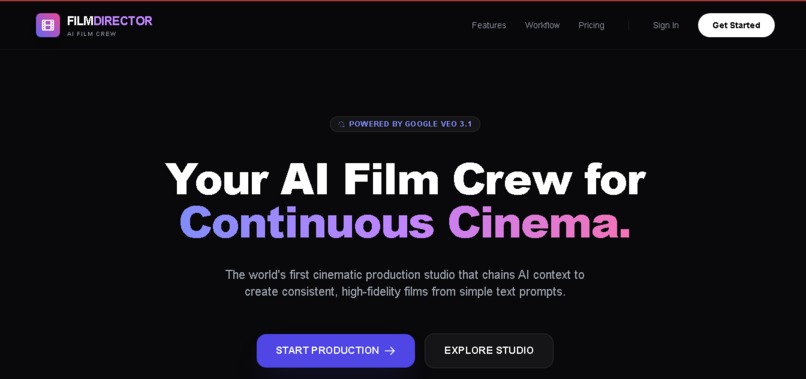
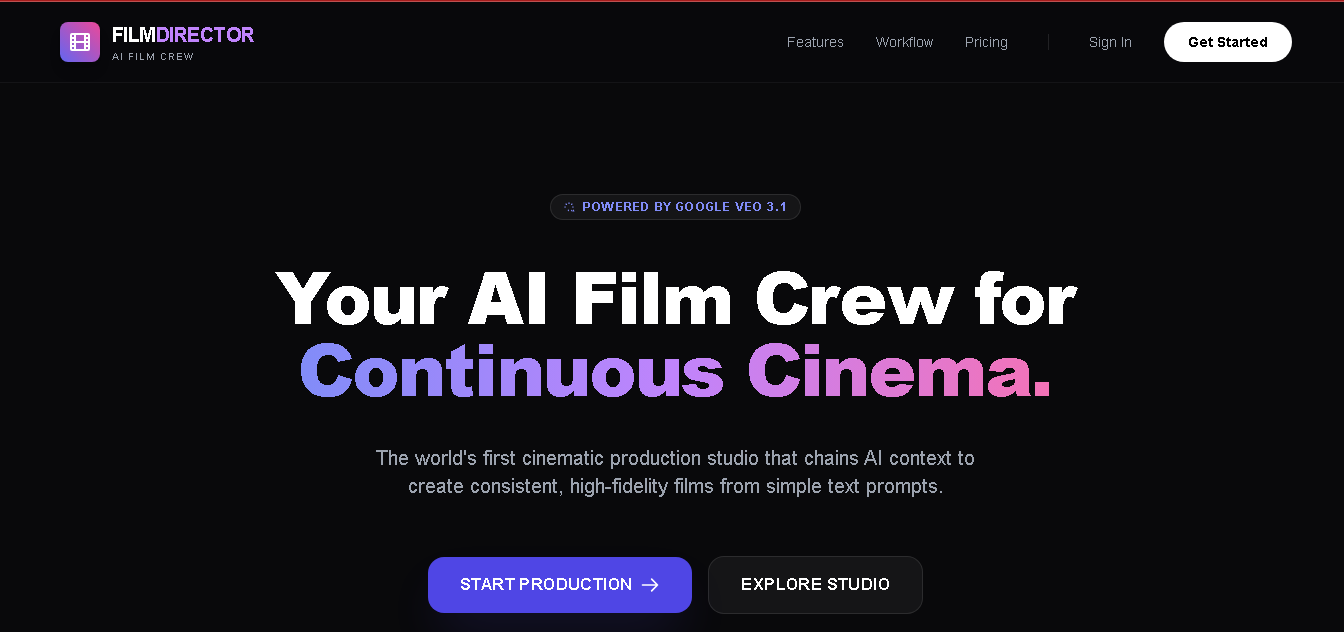
landing pge
-
login page
-
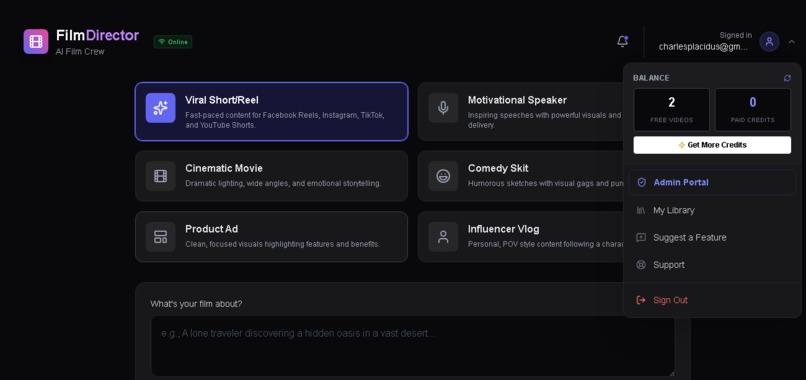
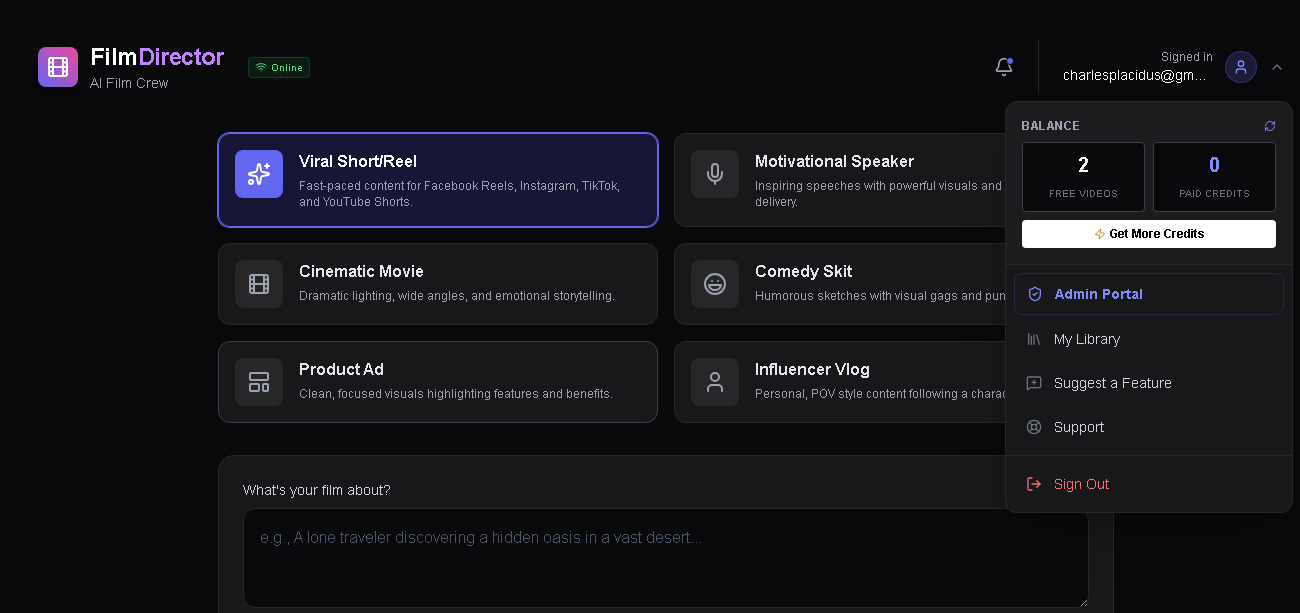
dashboard
-
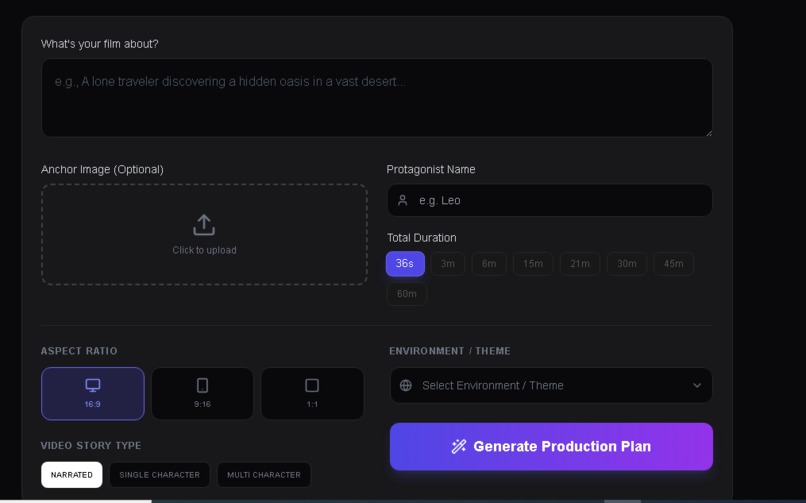
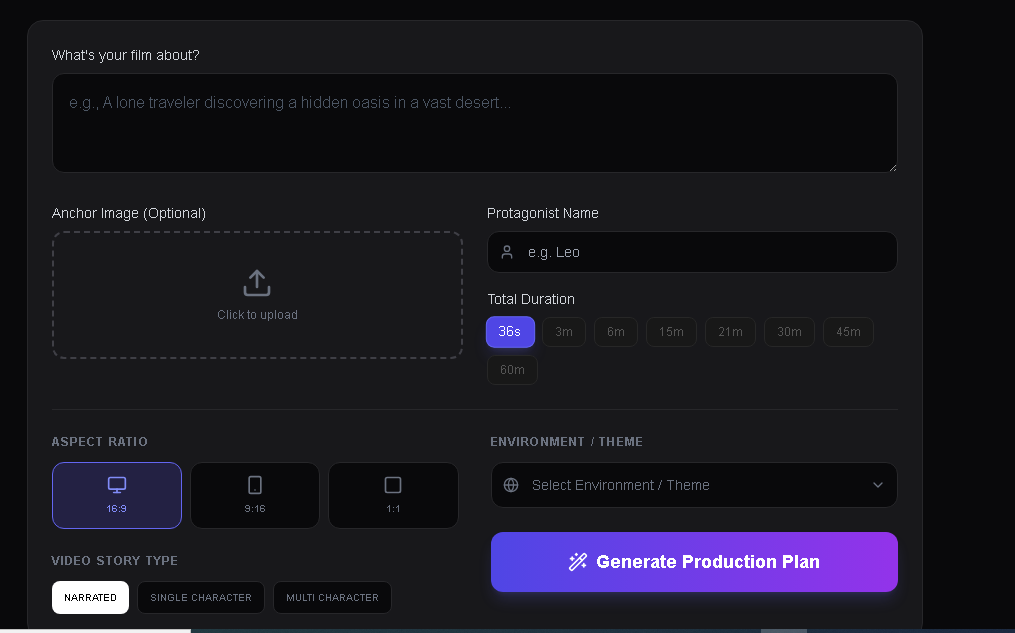
dashboard
Inspiration
Filmmaking is not a single AI generation task. Turning an idea into a film requires a chain of interconnected decisions across story, script, characters, scenes, shots, visual development, video and editing.
FilmDirectorAI originally began as “AI Film Crew”—the idea that a creator should be able to work with an intelligent AI production team rather than a collection of disconnected creative tools.
We built FilmDirectorAI around that idea: what if an AI agent could take responsibility for moving a film project through the production workflow, while the human creator remains the creative director?
The result is FilmDirectorAI: an agentic filmmaking system designed to transform an initial idea into production-ready visual content.
What it does
FilmDirectorAI takes a creator from idea to production-ready visual content through an interconnected filmmaking workflow:
Idea → Story → Script → Characters → Scenes → Shot Planning → Visual Development → Video Generation → Editing & Production Assets
Instead of treating each step as an isolated prompt, FilmDirectorAI maintains the project context and uses the output of one stage to inform the next.
A creator can start with a simple idea, and the system progressively develops it into a structured production.
The agent can help:
- develop the story
- create and refine the screenplay
- develop characters
- break the story into scenes
- plan shots
- develop the visual direction
- generate video
- prepare editing and production assets
The goal is to move from “generate something” to “execute the filmmaking workflow.”
How we built it
We built FilmDirectorAI as an agentic workflow rather than a traditional chatbot.
The system uses Gemini as the reasoning layer to understand the project and make decisions across the filmmaking pipeline. The filmmaking stages are represented as structured tasks so that outputs from one stage become context for subsequent stages.
The architecture separates the user-facing experience from the AI production workflow and the individual production capabilities.
The agent can progressively move a project through:
Narrative → Screenplay → Characters → Scenes → Shots → Visual Development → Video → Editing Assets
The system is deployed on Google Cloud, with the agent architecture designed to support asynchronous execution, persistent project state and specialized production tasks.
For the hackathon implementation, we focused on demonstrating that the agent can do more than converse: it performs a multi-step workflow and produces tangible production outputs.
Gemini → reasoning and understanding the film project (story expansion, script writing, keyword filtering etc) SDK Veo → video generation, if you're actually using it GCS - storage Cloudrun - hosting
Challenges we ran into
The hardest part was not generating individual pieces of content. It was maintaining coherence across the entire production.
A change to a character can affect scenes.
A change to a scene can affect shots.
A change to the visual direction can affect generated video.
This meant we had to think about filmmaking as a connected system rather than a sequence of independent prompts.
We also had to balance agent autonomy with creative control. A filmmaker wants AI to handle the heavy lifting, but does not want the system making irreversible creative decisions without them.
Another challenge was designing the workflow so that each stage produces structured information that can be reliably consumed by the next stage instead of simply passing large amounts of unstructured text between prompts.
Finally, we had to make the system demonstrably agentic: the hackathon judges specifically want to see agents performing real actions rather than simply chatting, so proving the workflow execution became an important part of the build.
Accomplishments that we're proud of
We built an end-to-end AI filmmaking workflow that goes far beyond a text-to-video prompt.
FilmDirectorAI can take a project from:
Idea → Story → Script → Characters → Scenes → Shot Planning → Visual Development → Video Generation → Editing/Production Assets
The biggest accomplishment is that these stages are connected into a single production experience.
We are particularly proud of turning our original AI Film Crew concept into a working product architecture.
Instead of building another chatbot that tells a filmmaker what to do, we built toward an agent that can actually do the work across the production pipeline.
We also designed the system with a larger vision in mind: specialized AI production capabilities that can eventually collaborate as an intelligent film crew.
What we learned
We learned that agentic systems become much more valuable when they operate on structured workflows with meaningful intermediate state.
A filmmaking project has an enormous amount of context. Characters, scenes, shots, visual style and production assets cannot be treated as independent conversations.
We also learned that the most useful role for AI is not necessarily to replace the human decision-maker.
It is to remove the operational burden surrounding the decision-maker.
That led us to a principle that now guides FilmDirectorAI:
The creator should direct. The AI should handle the production complexity.
We also learned that building an agent is fundamentally different from building a chatbot. The system needs state, task boundaries, structured outputs, failure handling and clear points where humans can intervene.
What's next for FilmDirectorAI
The next step is to evolve FilmDirectorAI from an end-to-end AI workflow into a true AI Film Crew.
We want specialized agents to collaborate across the production:
AI Director — manages creative intent and production decisions.
AI Writer — develops and refines narrative and screenplay.
AI Cinematographer — translates scenes into shots and camera language.
AI Production Designer — develops worlds, locations and visual direction.
AI Continuity Agent — maintains consistency across characters, environments and scenes.
AI Editor — assembles and iterates on the final production.
The long-term vision is for a filmmaker to provide an idea and have an intelligent production team autonomously handle much of the work required to bring that idea to the screen—while keeping the human creator in control.
FilmDirectorAI is moving from AI-assisted filmmaking to an AI-native production system.
Our ultimate goal is simple:
Make professional-grade storytelling accessible to anyone with a story worth telling.

