-
-
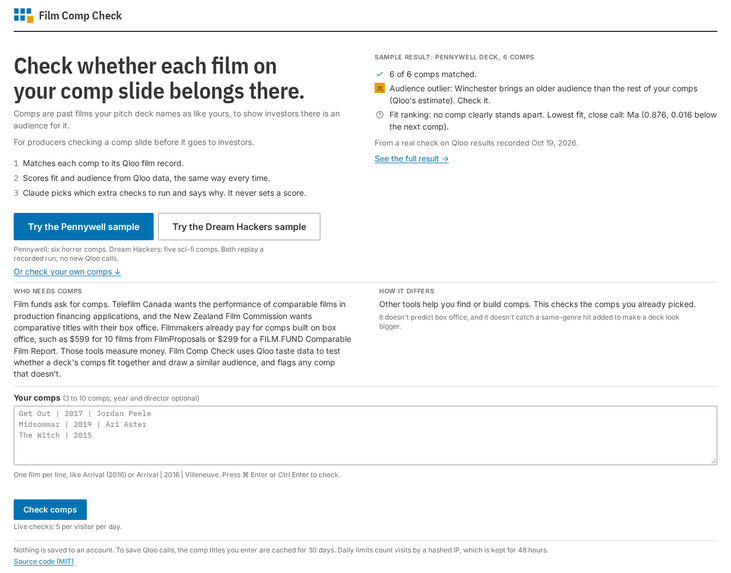
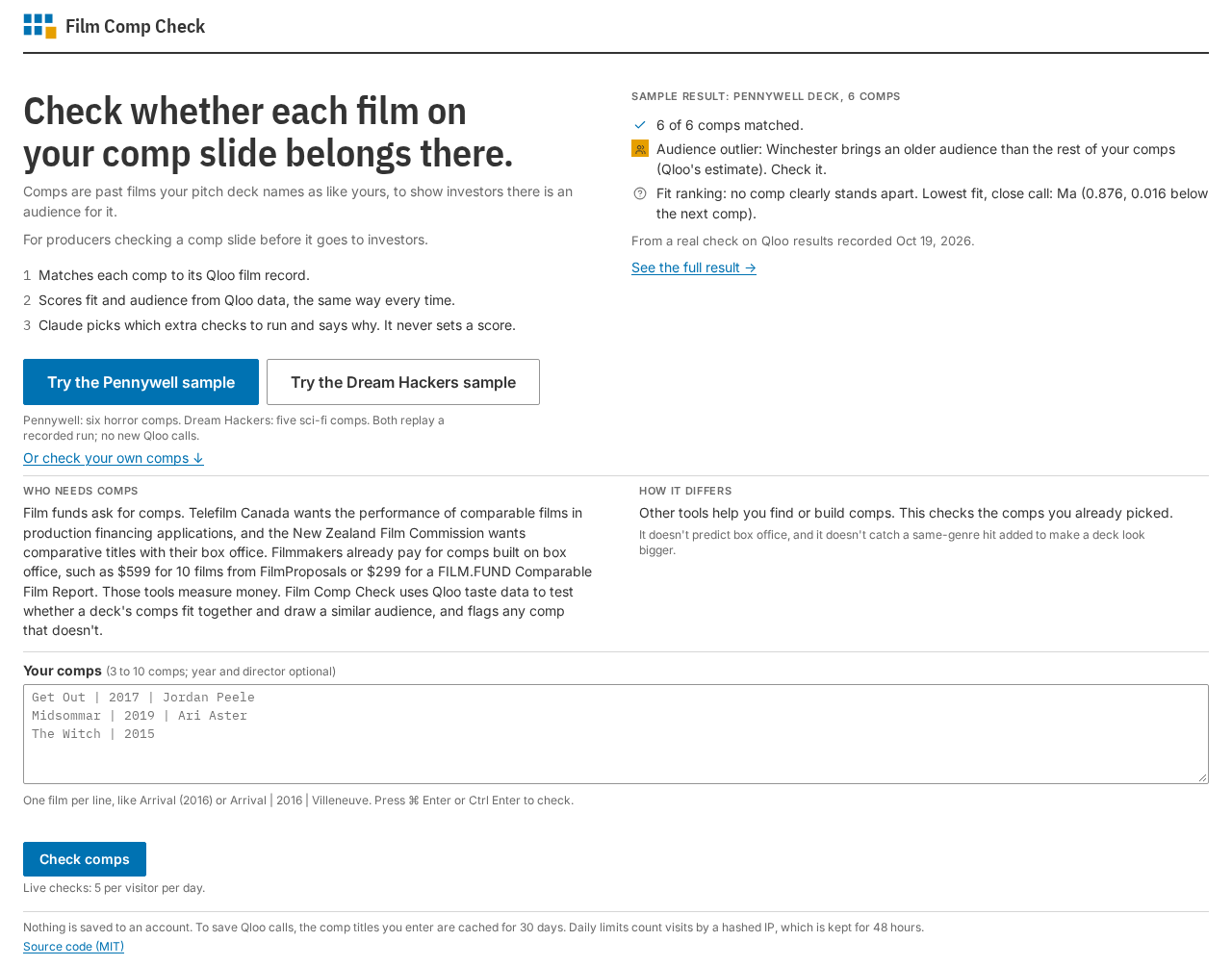
Paste your comp list and see which films share your audience.
-
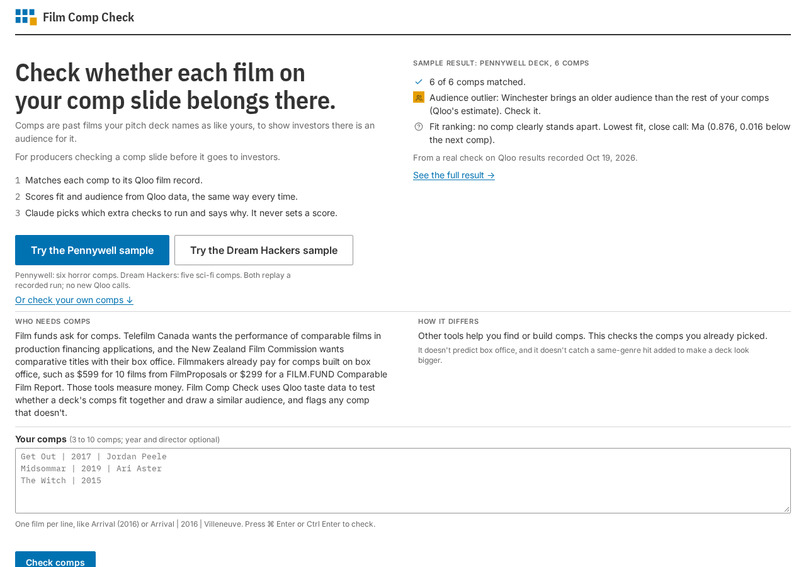
Comps explained in one line, with no login needed.
-
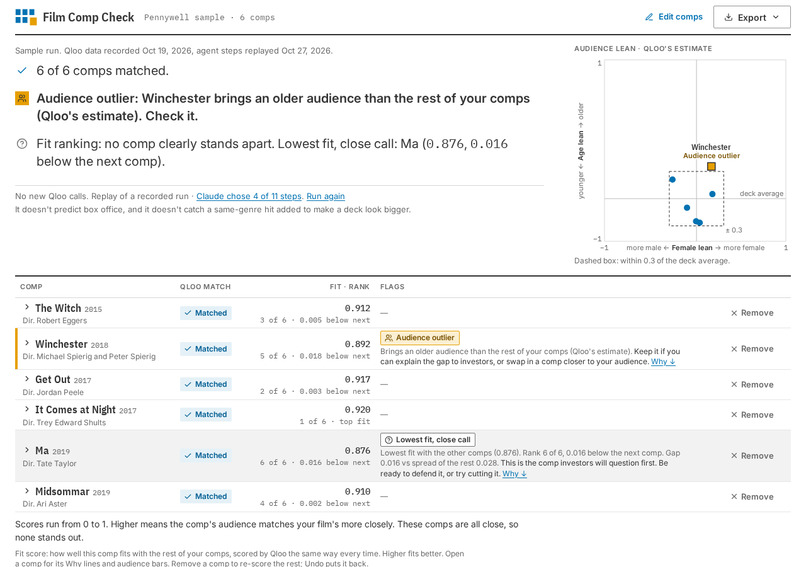
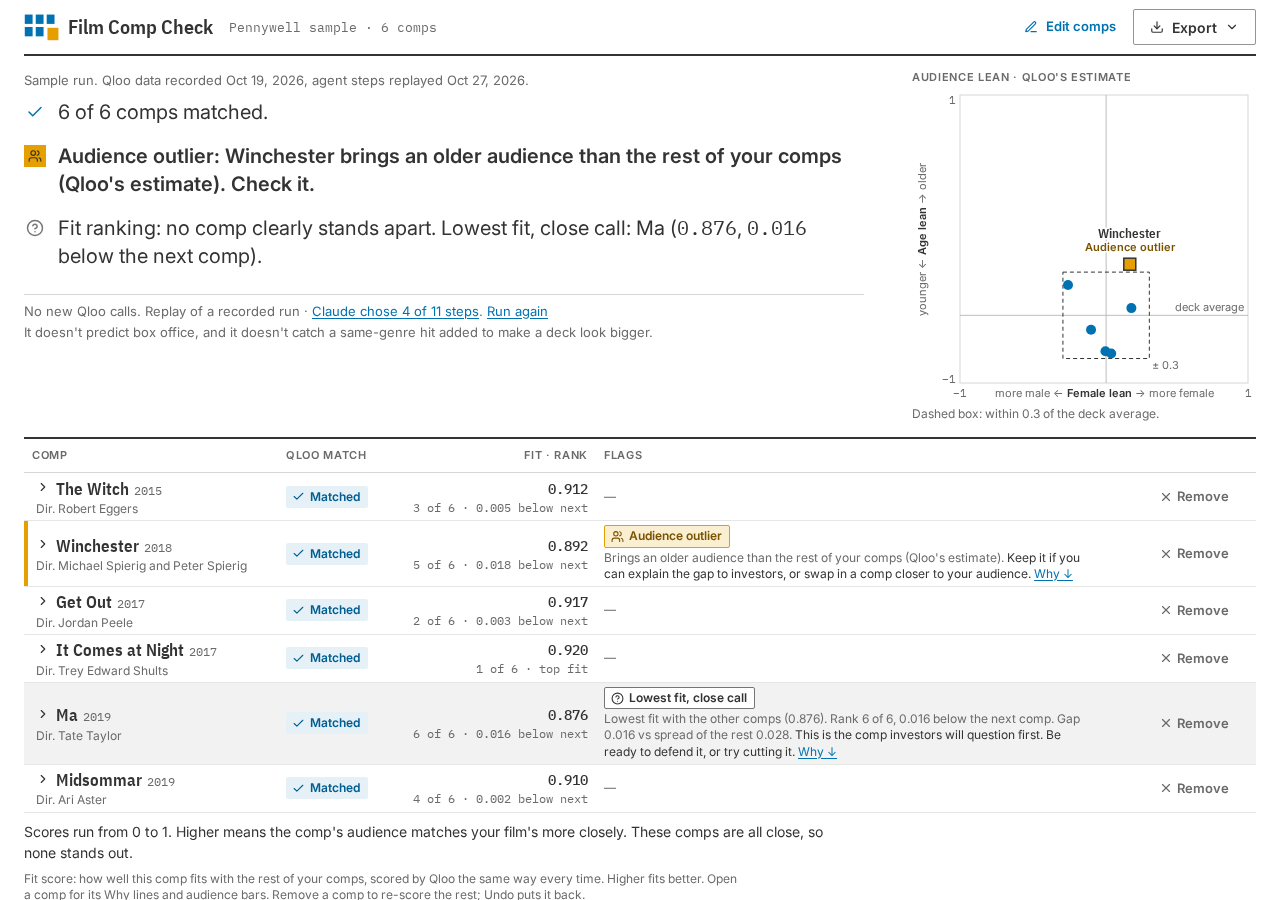
The Pennywell sample: Qloo measures each comp's audience fit.
-
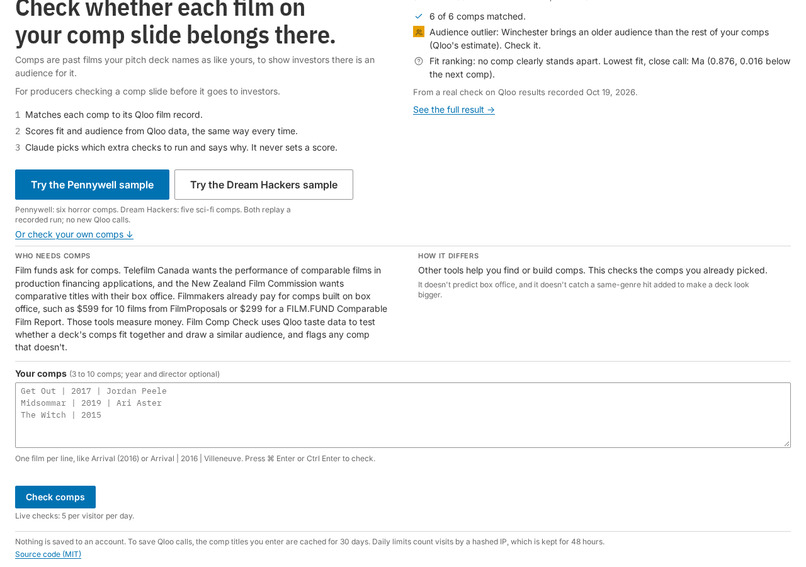
Open source under MIT, with the code linked from the site.
-
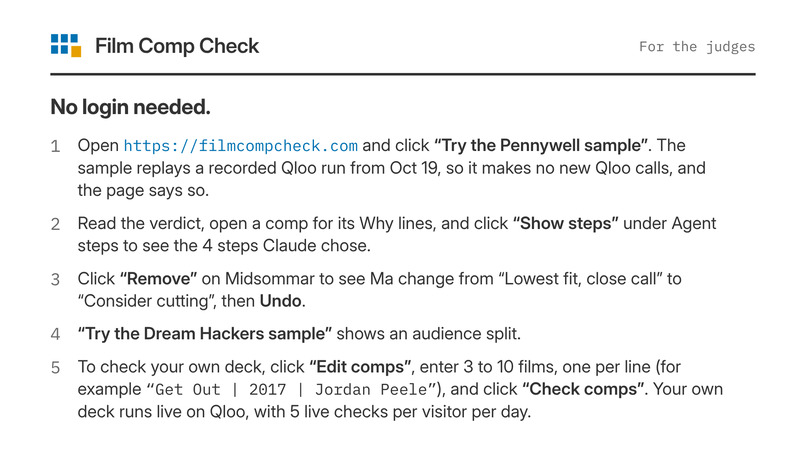
Try-it instructions for judges
Who it's for
Indie producers and small distributors building a pitch deck. One slide lists "comps": past films they say are like theirs, picked to show investors there's an audience.
What they do now
They pick comps from memory and box office lists, or pay for a comp write-up. Cinelytic, Largo.ai and FILM.FUND help you build comps or forecast revenue. None we found scores whether the comps you already picked share an audience.
Who pays
Producers already pay $299 to $799 for comps reports: $299 for a FILM.FUND Comparable Film Report, and $599 for 10 films or $799 for 20 from FilmProposals.
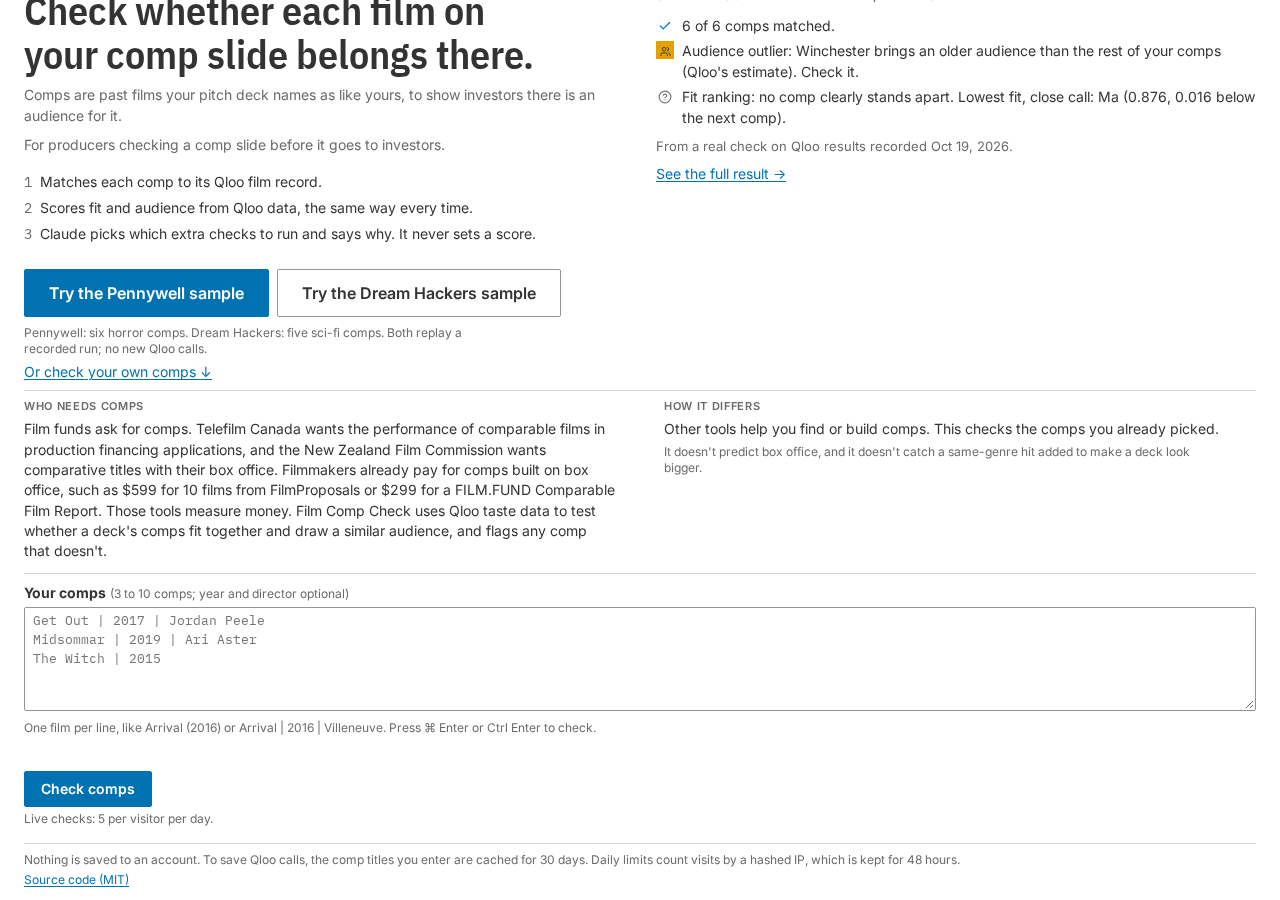
Film funds ask for comps. Telefilm Canada wants the performance of comparable films in production financing applications, and the New Zealand Film Commission wants comparative titles with their box office. Those reports measure money. Film Comp Check uses Qloo taste data to test whether a deck's comps fit together and draw a similar audience, and flags any comp that doesn't.
What it does
- Matches each comp to a real Qloo film record, with year and credits, or marks it Unmatched so you can fix it.
- Scores how well each comp fits the rest of the deck, from 0 to 1. Higher means the comp's audience matches your film's more closely, and the page says so in a line under the table. Run it again and the app compares the fit scores to 6 decimals and tells you whether they match.
- Flags a comp whose audience differs from the rest, using Qloo's age and gender estimates, labeled "Qloo's estimate". Each flag says why, then gives a next step, such as "Keep it if you can explain the gap to investors, or swap in a comp closer to your audience."
- An agent built on Claude then chooses extra lookups, such as a closer look at one comp's Qloo tags or a Wikipedia pageview check. Each choice is marked "Claude chose" next to what it found, and the steps that always run are marked "Always runs".
- Exports a one-page print sheet, Markdown or a CSV to put behind the slide, or copies a share link.
Example, the Pennywell sample deck: Winchester is flagged for an older audience than the rest (Qloo's estimate). In our recorded run, Claude chose 4 of 11 steps. One was a closer look at Winchester's tags, which found it shares 54 of 221 Qloo tags with the rest of the deck and is the only comp tagged "Haunted house". Ma ranks 6 of 6 at 0.876, 0.016 below the next comp, so the page calls it "Lowest fit, close call" instead of telling you to cut it, with a next step: "Be ready to defend it, or try cutting it." Remove Midsommar and Ma drops to 0.854, 0.045 below the next comp, and changes to "Consider cutting". On the sample decks, Remove re-checks the comps that are left from the Oct 19 recording, so it makes no new Qloo calls. On your own deck, Remove runs a new live check of the comps that are left, which counts as one of your 5 live checks for the day. If that exact list was checked in the last 30 days, the cached result is used instead.
"No comp clearly stands apart" is a real answer. When that's true, the tool says so.
Why Qloo
Genre alone says Winchester fits the Pennywell deck: it's a horror film like the other five. Qloo's audience data says it draws an older crowd. On Qloo's age estimate, Winchester sits 0.355 from the deck average, further than any other comp (from the Oct 19 recording, shown on the live sample as "+0.355 outlier"). A language model sees genre. Qloo measures audience. Film Comp Check uses:
- Audience age and gender estimates for each comp.
- Fit scored the same way on every run:
/v2/insightsin direct-score mode, leaving one comp out at a time. - Each title matched to a real record through
/search, so a made-up or misnamed comp shows up as Unmatched.
The model never sets a score
Every score and label is computed in code before Claude runs. Claude only picks extra lookups and writes reasons, and any number in a reason must trace to the Qloo result it came from, or the reason is rejected.
How it differs
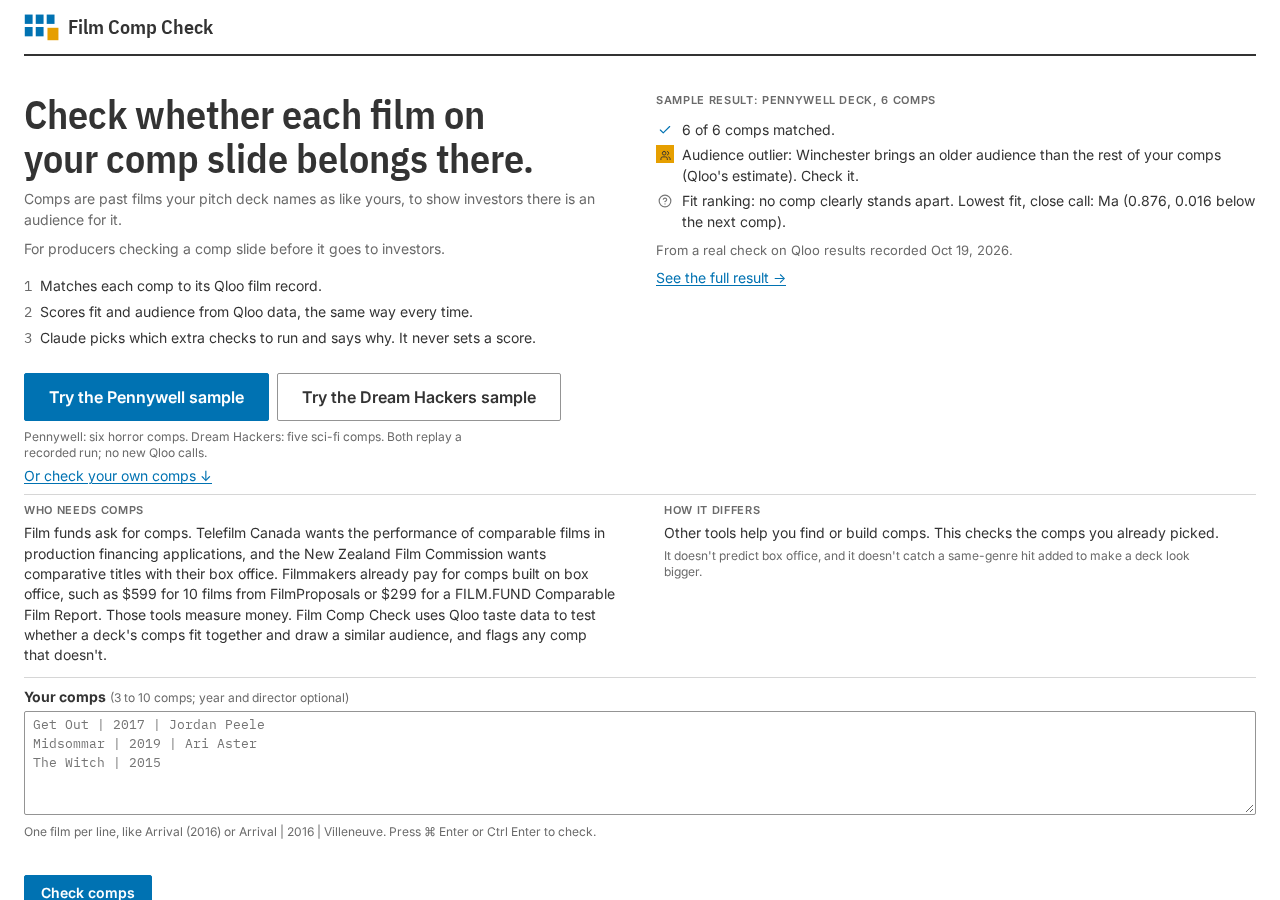
Other tools help you find or build comps. This checks the comps you already picked.
Limits
- It doesn't predict box office, and it doesn't catch a same-genre hit added to make a deck look bigger. If Qloo has no audience estimate for a comp, the screen says so and leaves it out of the deck average.
- The sample decks replay Qloo results recorded Oct 19, kept in private server storage rather than the public repo, so daily limits never block them. Your own deck runs live on Qloo, with 5 live checks per visitor per day.
- Nothing is saved to an account. Comp titles you enter are cached for 30 days to save Qloo calls, and daily limits count visits by a hashed IP kept for 48 hours.
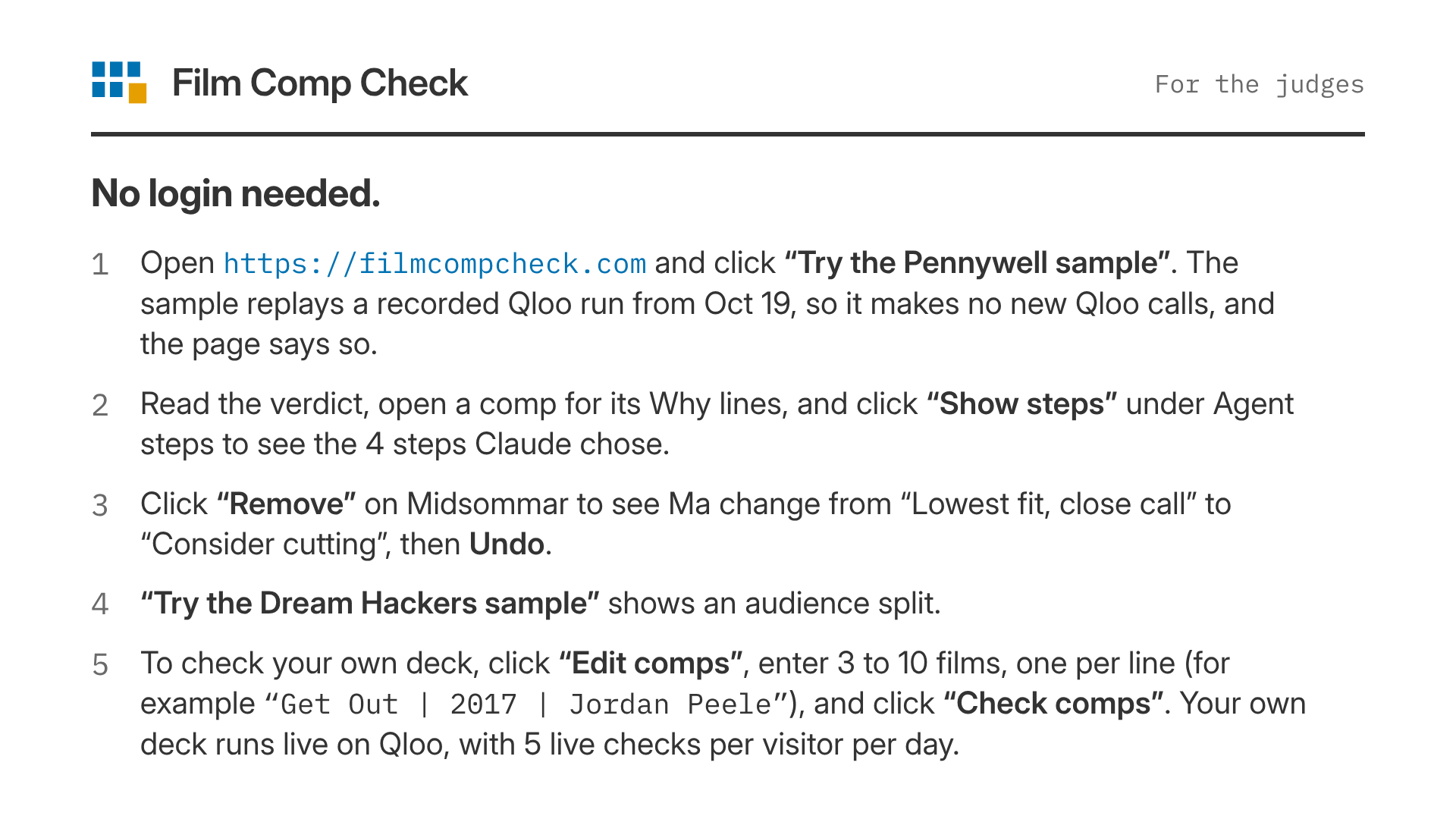
Try-it instructions for judges - No login needed
- Open https://filmcompcheck.com and click "Try the Pennywell sample". The sample replays a recorded Qloo run from Oct 19, so it makes no new Qloo calls, and the page says so.
- Read the verdict, open a comp for its Why lines, and click "Show steps" under Agent steps to see the 4 steps Claude chose.
- Click "Remove" on Midsommar to see Ma change from "Lowest fit, close call" to "Consider cutting", then Undo.
- "Try the Dream Hackers sample" shows an audience split.
- To check your own deck, click "Edit comps", enter 3 to 10 films, one per line (for example
Get Out | 2017 | Jordan Peele), and click "Check comps". Your own deck runs live on Qloo, with 5 live checks per visitor per day.
Built With
- anthropic-messages-api
- claude-sonnet-5.5
- next.js
- playwright
- qloo-api
- react
- typescript
- upstash
- vercel
- vitest
- wikipedia-pageviews-(wikimedia-rest-api)

Log in or sign up for Devpost to join the conversation.