1) Prototype link (Please submit a link to a playable prototype, not a link to your design file)
2) Describe your project (max 150 words)
In an era where AI is redefining what it means to be human, many view AI as a threat to learning and growth. However, when used correctly, AI is a beneficial tool that can overcome the barriers between humans and improve connections with others.
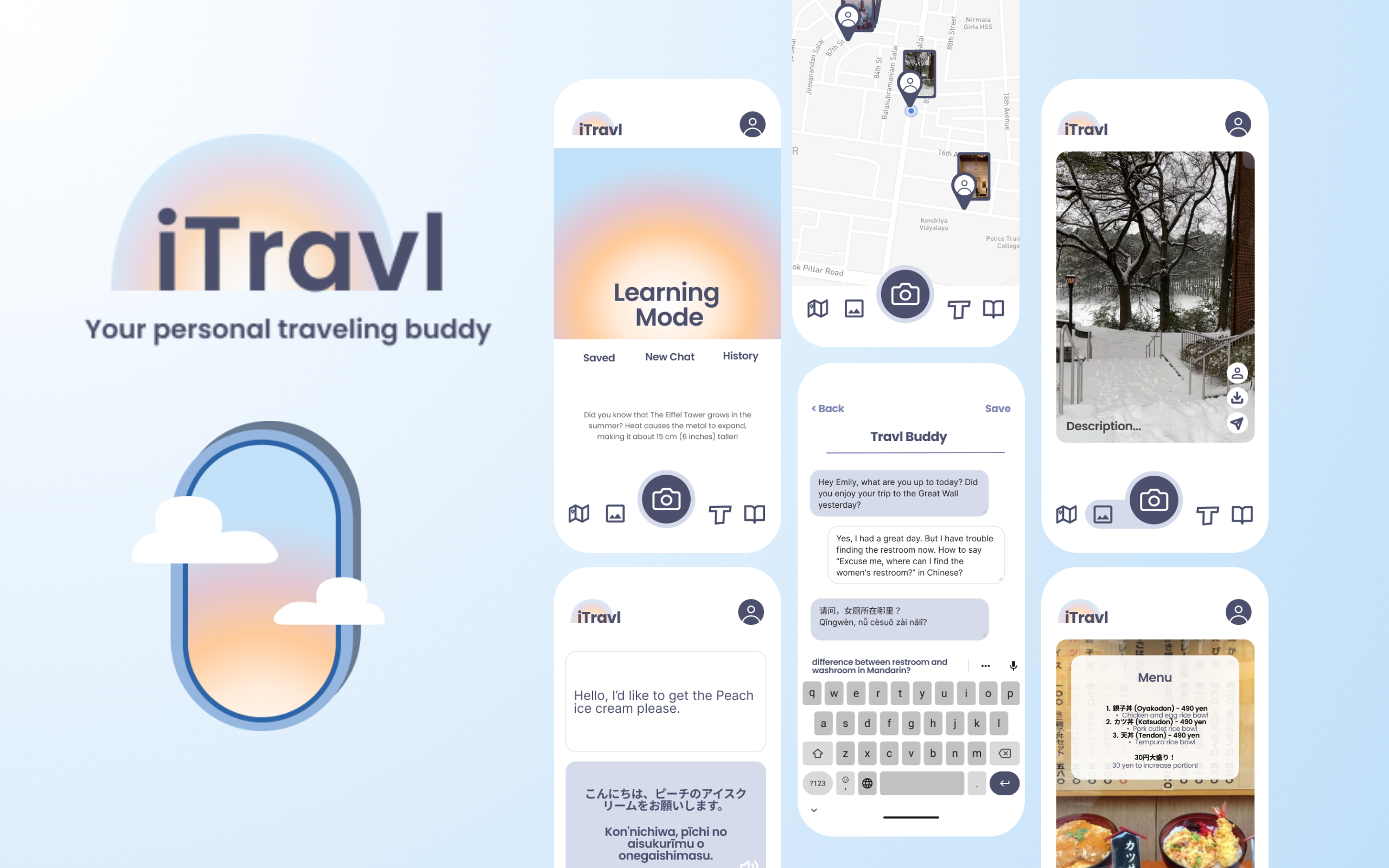
iTravl is the ultimate travel app which encourages travelers to exchange cultures and effectively learn languages through features such as introducing local attractions, social norms, and the option to share travel experiences through Captures. Instead of diminishing human interactions, this AI powered app automatically recognizes the user input language and helps travelers through social and cultural interaction with understanding of tone and slang. With a Learning Mode, quick Translation mode, and our conversational AI helper, Travl Buddy, travelers are thoroughly prepared.
By breaking language and cultural barriers, iTravl transforms your journey into one of authentic, global human connection like never before.
3) Describe your research process and findings. If you conducted any surveys or interviews, please include the survey form and/or interview questions here. If you conducted secondary research by pulling from online sources, please include a link to your sources. (Max 500 words)
Our Survey: https://docs.google.com/forms/d/e/1FAIpQLScJBEfkSx_UyM879VmgCKnxY9PSuqF-UC1wKW_jcibUIhwfPQ/viewform
For our user research, we combined a user survey and secondary research to understand how AI can assist users in travel and daily life. Our survey collected qualitative and quantitative data from 20 users through multiple-choice and long-answer questions, focusing on self-improvement, AI usage, and language barriers in travel.
Self-Improvement Areas:
- 30% (6/20) want better time management.
- 20% (4/20) aim to improve writing & communication.
- 25% (5/20) seek discipline, focus, and efficiency.
AI’s Impact on Personal Skills:
- 55% (11/20) say AI enhances their abilities.
- 25% (5/20) believe AI diminishes their skillset.
Preferred AI Uses:
- 35% (7/20) for academic learning & organization.
- 25% (5/20) for daily automation (chores, scheduling, reminders, etc.).
Language Anxiety in Travel (Scale 1-10):
- 40% (8/20) rated high anxiety (7-10).
- 40% (8/20) rated moderate anxiety (4-6).
Common Travel Challenges:
- 45% (9/20) face language barriers.
- 25% (5/20) struggle with reading signs and menus.
Travel Preferences:
- 50% (10/20) prioritize interacting with locals & learning culture.
- 40% (8/20) focus on excursions & sightseeing.
Translation App Opinions:
- 30% (6/20) find them useful but not perfect.
- 25% (5/20) say they lack contextual accuracy.
Many users prefer sightseeing over cultural engagement, likely due to language barriers and impractical translation tools. Responses suggest that translation apps lack cultural nuance, making interactions shallow and communication difficult.
Secondary Research: AI Translation Apps & Limitations
A video we watched: https://youtu.be/LahFSeaa6Lw?si=Cwr86V21q_CrQp92
We explored existing AI translation tools to understand their effectiveness.
- Google Translate: Supports multilingual text, voice, and image translation, but lacks context and translates literally.
- DeepL & Other AI Translators: More accurate but web-based, making real-time use inconvenient.
- Samsung Live Translation: Offers real-time translation but is exclusive to Samsung users and not intuitive.
Key Problems in Existing AI Translation Solutions:
- Literal Translations – Lacks contextual accuracy.
- Limited Capabilities – Few support real-time voice/image translation.
- Inaccessibility – Exclusive or not user-friendly.
Our research highlights the need for AI-driven translation improvements, such as:
- Context-Aware AI to adjust tone for different situations.
- AI Speech Assistance to provide spoken translations.
- Image-Based Translations allowing users to select words from images to form sentences.
- Cultural Adaptation for more natural communication.
By addressing these gaps, we aim to design a more engaging and effective travel tool.
4) Describe your most important design decisions. What research findings and/or user testing results led you to make these decisions? (Max 500 words)
Our research guided us in designing three key features: Translation Mode, Learning Mode, and Capture Mode. These features enhance self-improvement, global interaction, and cultural learning while addressing existing AI translation gaps.
Translation Mode This serves as the home page for quick translations. It recognizes text, audio, and visual input, providing audio and text output. Users can easily toggle between microphone and camera for input. If the translation lacks clarity, Travl Buddy offers a more context-aware explanation, addressing issues seen in Google Translate’s literal translations. Translation history is saved, encouraging language learning.
Learning Mode This mode allows users to chat with Travl Buddy, review saved translations, and prepare phrases. It provides a deeper understanding of language and culture, helping users overcome language barriers—a major challenge identified in our survey. Unlike existing AI tools, Travl Buddy adapts to context, tone, and cultural nuance to improve learning.
Capture Mode & Map Inspired by our research on cultural exchange and engagement, the Map feature lets users post Captures of their experiences with comments from locals and travelers. This helps users connect beyond language barriers, a common frustration in travel. Unlike existing AI tools that lack real-time image translation, Capture Mode allows users to select words from images, letting AI construct sentences with cultural and contextual accuracy.
By integrating context-aware translation, speech assistance, and cultural learning, our app bridges the gaps of current AI translation solutions, making communication more intuitive, accurate, and immersive.
Built With
- figma


Log in or sign up for Devpost to join the conversation.