-
-
Memlore
Memlove
1 Prototype link
2 A video demo with a maximum of 3 minutes:
3 Responses to questions about the user research and design thinking process
Describe your project (Max 150 words)
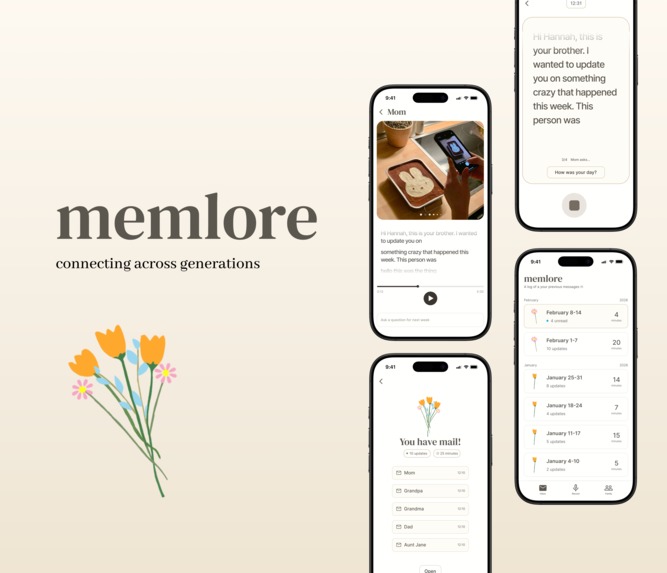
Memlore is an all-in-one communication app designed to help families stay emotionally connected across generations, distances, and busy schedules. Research shows that nearly 95% of time spent with parents happens before age 18, yet adulthood introduces physical distance, mismatched schedules, and differing communication preferences—such as Gen Z favoring text while Gen X prefers phone calls. Memlore bridges this gap through versatile voice memos that can be sent and listened to anytime, anywhere. Each memo includes optional photos, subtitles for accessibility, and a visible duration so users can choose what fits their moment. To reduce friction, Memlore also provides conversation prompts to help users start meaningful conversations when they don’t know what to say. By meeting users where they are and adapting to individual lifestyles, Memlore makes staying connected feel natural rather than scheduled, helping families preserve relationships across generations.Describe your research process and findings. If you conducted any surveys or interviews, please include the survey form and/or interview questions here. If you conducted secondary research by pulling from online sources, please include a link to your sources. (Max 500 words)
To understand how families communicate across generations, we conducted user interviews and secondary research focused on specifically long-distance family relationships.
We started by interviewing 12 participants about their families and how they stay in touch. Our sample consisted of UCLA students (both in and out-of-state), parents, and grandparents. We asked the following questions:How often do you text your parents, grandparents, and/or children each week
What communication method do you use most often (text, call, FaceTime, etc.)?
What do you guys often talk about?
What is the biggest barrier in staying in touch?
How often do you call your parents, grandparents, and/or children?
Are you satisfied with how much you contact your parents, grandparents, and/or children?
Our findings indicated that students felt torn between wanting deeper emotional connection and needing communication methods that fit into their busy, unpredictable schedules. 9/12 participants said phone calls felt emotionally meaningful but were hard to schedule. On the other hand, 8/12 participants said texting felt easier but often became shallow or purely logistical. Older participants expressed frustration with texting, while younger users felt anxious about phone calls. 4 participants said texting felt easier but often became shallow or purely logistical.
We also supported our findings with online research on generational communication preferences:
Key Findings:
- 50% of Gen X prefers phone calls
- 75% of Gen Z prefers texting
Links:
These findings revealed a clear gap: families want deeper connection, but existing tools force users to choose between convenience and emotional depth.
Describe your most important design decisions. What research findings and/or user testing results led you to make these decisions? (Max 500 words)
Our design decisions were driven by a fundamental goal of making this app highly accessible, considering it will be used by people of different generations. One of the first things we considered was the difference in communication style between generations. Through our research, we found that many students and young adults didn’t have enough time to call and stay connected with family. The opposite was true of older generations, who wanted more talking time with their children and grandchildren. Furthermore, one large communication gap wasn’t actually because of age differences. Instead, it was how families spread across the country or world had difficulty finding the right time to call because of the time zone differences. So, our design took these things into account and we created a way for family members to record voice memos and capture photos throughout the week, and then on Sunday, all the memos are released. This allows for more flexibility when it comes to family members’ schedules while keeping them consistent week by week.
Another key design decision was prioritizing an extremely straightforward user flow so Memlore could be easily used by all generations. We found that even small points of friction like too many buttons, unclear labels, or unnecessary steps discouraged older users from adopting our app. So, we intentionally minimized the number of steps required to send or listen to a memo. One key example of this is inside the memo listening page, where the audio automatically plays and the photos automatically scroll to lessen user interactions.
Finally, a consistent pain point across interviews was not knowing what to talk about, especially when conversations felt infrequent or long overdue. Users described feeling pressure to “have something important to say,” which often led to procrastinating communication altogether. To address this, we integrated generated conversation prompts that help users easily start meaningful voice memos.If applicable, describe how you utilized AI in your design process in detail. Please explain where AI fit into your workflow, which tools you used, and the specific purpose AI served at that stage. Include a concrete example of how AI influenced a design decision. (Max 500 words)
We did not use AI in our design process.
Built With
- figma
- procreate

Log in or sign up for Devpost to join the conversation.