Prototype link (Please submit a link to a playable prototype, not a link to your design file) Link
Describe your project (max 150 words)
In the age of AI and digital distractions, authentic communication is increasingly overshadowed by fast-paced, superficial interactions. AI-driven recommendations on social media platforms encourage endless scrolling, often numbing our emotional needs. Young adults, already balancing work, studies, and personal responsibilities, struggle to find time for meaningful conversations with their long-distance loved ones.
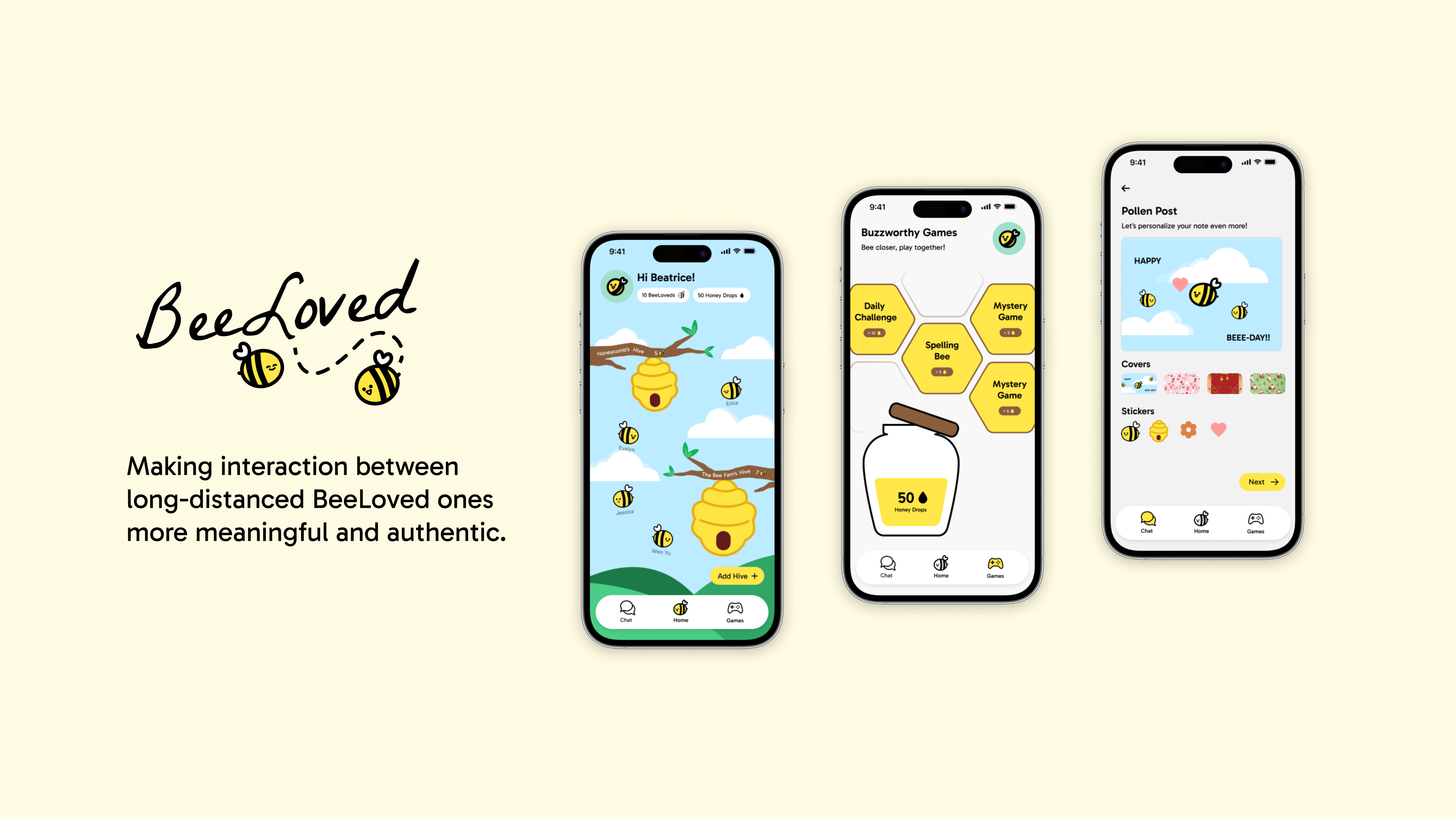
BeeLoved is a mobile application designed to help young adults reconnect with their long-distance loved ones through more meaningful communication. By utilizing recorded videos that provide true, undivided attention and personalized prompts, along with daily games to foster more frequent interaction, the app fosters authentic relationship-building. With a focus on quality over quantity, BeeLoved ensures that even in a world of constant digital noise, relationships can thrive through intentional, dedicated communication.
- Describe your research process and findings. If you conducted any surveys or interviews, please include the survey form and/or interview questions here. If you conducted secondary research by pulling from online sources, please include a link to your sources. (Max 500 words)
To better understand how young adults (ages 18–22) communicate with their long-distance loved ones, we conducted a mixed-methods study, including 93 survey responses and 5 in-person, one-on-one interviews. Our goal was to explore communication habits, challenges, and emotional connections in maintaining long-distance relationships.
In the age of AI and digital distractions, many of us are constantly engaged with other media, often spending less time having real, meaningful conversations. With the added challenge of physical distance, our research found that communication with long-distance loved ones has decreased for many individuals. While digital tools make it easier than ever to reach out, they also compete for attention, making it harder to sustain deep connections.
Our survey gathered quantitative data through multiple-choice and checkbox questions. One key question asked participants: "What forms of communication do you usually use to stay in touch with your long-distance loved ones?". Responses showed that 93.1% communicate via text messages, though many acknowledged that texting can feel impersonal and lack emotional depth. 61.2% of participants prefer to share important news via calls or video chats, suggesting that more personal forms of communication are reserved for significant moments. Despite these tools, ~50% of participants feel they are not well connected with their long-distance loved ones, and 63.4% miss them at least a few times a week, with 63.9% feeling this more acutely on bad days.
To complement these findings, we conducted 5 one-on-one interviews that provided deeper insights into how young adults navigate long-distance relationships. Participants noted that text messaging often leads to misinterpretations due to the lack of nonverbal cues, making it difficult to convey emotions accurately. However, one major insight from our survey was that people overwhelmingly opt for video calls when they have big news to share or are feeling vulnerable. Whether it’s celebrating a milestone, delivering important updates, or seeking emotional support, participants expressed that seeing a loved one's face makes a significant difference. Video chats help bridge the emotional gap that digital distractions and physical distance often create, reinforcing the idea that while quick texts dominate daily interactions, real connection happens in moments of deeper conversation.
Furthermore, we conducted secondary research focusing on existing studies about long-distance relationships and communication. According to a study from the U.S. National Library of Medicine, proximity is the strongest indicator of contact between relatives and is closely related to “higher quality of ties and more assistance.” This aligns with our findings that physical distance often weakens communication frequency and emotional connection. Additionally, a survey from the American Association of Retired Persons found that approximately 33% of people believe distance has negatively impacted their relationships with family; as more distance from family is correlated with less contact. This further corroborates our participants' struggles with maintaining consistent, meaningful contact due to physical separation.
- Describe your most important design decisions. What research findings and/or user testing results led you to make these decisions? (Max 500 words)
One of the most important design decisions for BeeLoved was the inclusion of video calling as the central method of communication within the app. Our research and user testing revealed that while text-based communication remains dominant, many young adults still value deeper, more personal interactions for sharing important news or vulnerable moments. According to our user survey, 61.2% of interviewees prefer to communicate important updates with their long-distance loved ones via call or video call. This highlighted a clear need for a more meaningful form of connection that could go beyond simple text messages.
The decision to emphasize video calls stemmed from the understanding that communication long-distance often lacks the richness of body language, tone, and emotions. Our interviews revealed that many users felt frustrated by text-based communication, as it often led to misinterpretations or a lack of emotional depth. As one interviewee mentioned, “You can’t always convey your tone or feelings through text. You might feel misunderstood.”
Further, 63.9% of survey respondents reported that they miss their loved ones, especially on bad days. This emotional insight guided us to prioritize video calls in a way that would allow users to feel more connected and supported during difficult moments. By offering a dedicated space for video interactions, the app ensures that users have an opportunity for true, undivided attention in their conversations, fostering a sense of presence despite the physical distance.
User testing reinforced this design choice, with many users sharing that they felt much closer to their loved ones when engaging through video calls compared to text messages. For example, one user shared that “Seeing someone’s face and hearing their voice makes a huge difference, especially when it’s something important to share.” These responses emphasized the value of face-to-face interaction, even in a digital space, and solidified the decision to center the app’s communication features around video.
In addition to video calls, we integrated gamification activities as a way to help users connect with each other emotionally and have fun. During 1-on-1 interviews, many users mentioned that they often played online games with their long-distance loved ones as a way to bond, reminisce about old times, and create shared experiences. These activities helped them feel emotionally connected and gave them something to look forward to beyond casual chats.
Inspired by this, we incorporated interactive games and challenges within BeeLoved, encouraging users to share lighthearted moments and compete in friendly activities. These games offer a fun way to engage and allow users to reminisce, laugh, and build emotional memories, fostering a deeper connection beyond typical conversations.
Built With
- design
- figjam
- figma
- procreate
- ux


Log in or sign up for Devpost to join the conversation.