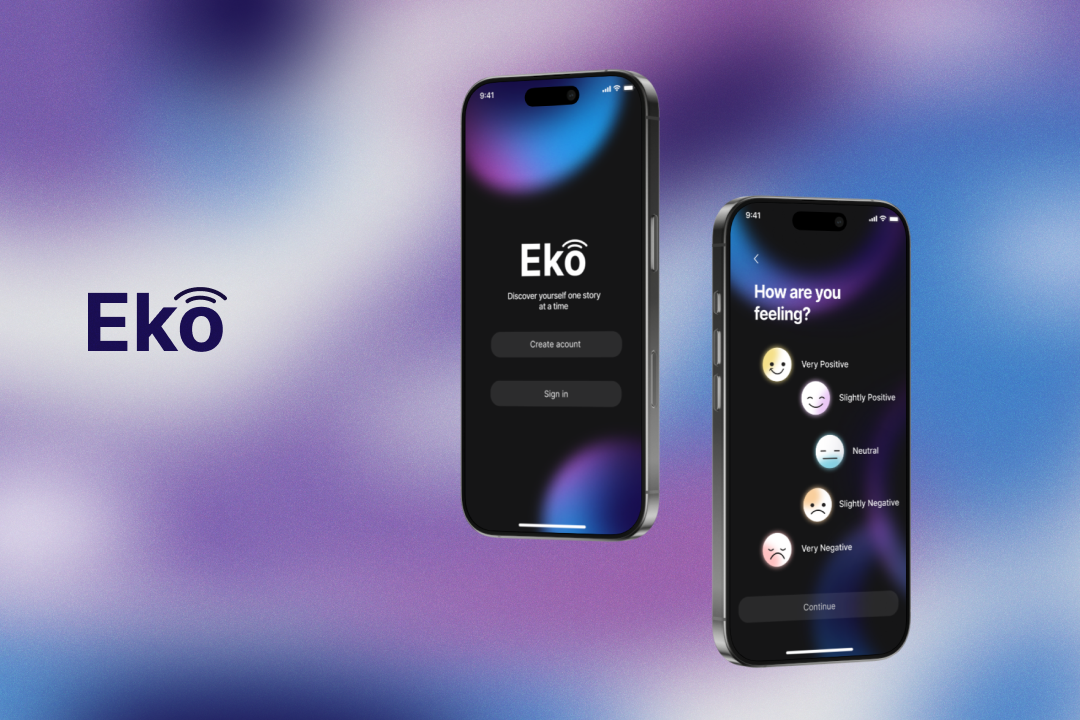
Prototype
Describe your project
Eko is an app powered by AI that aids students in journaling and is designed to make personal reflection more engaging, intuitive, and insightful. We noticed many people struggle with journaling habits due to uncertainty, time constraints, or difficulty organizing their thoughts. Eko addresses the barriers using guided prompts, emotional pattern visualization, and AI-assisted tools, all while prioritizing privacy and control.
Eko enhances the journaling experience without replacing personal reflection with features like habit tracking, customizable AI-assisted summaries, and interactive emotion trends. Users can tailor AI assistance according to their preferences, which ensures that the app is for self-expression rather than automation. Eko integrates research-backed strategies to process emotions for self-improvement, and it empowers users to develop a sustainable journaling habit that fits their specific needs.
Describe your research process and findings. If you conducted any surveys or interviews, please include the survey form and/or interview questions here. If you conducted secondary research by pulling from online sources, please include a link to your sources.
According to our research, there are many benefits to journaling, including the improvement of mental health through the management and reflection of emotions, the promotion of self-awareness, and the release of stress and anxiety. As we know, college students can undergo a lot of stress due to the difficulty of classes, balancing social and educational life, and the anxiety of unclear prospects like finding a job after graduation. Therefore, journaling is a viable medium for channeling feelings and frustrations.
However, there is a limitation to the physical journal that a digital journal like Eko can fill. For instance, Jessica Davey details in her case study that the problems of keeping a journal consist of portability, legibility, and organization/tracking issues. Eko challenges these constraints in addition to providing users with other beneficial tools that will assist in nurturing emotional intelligence and purposeful reflection.
Our team found the “Enhancing Mental Health with Artificial Intelligence: Current Trends and Prospects” paper from the Journal of Medicine, Surgery, and Public Health helpful regarding AI's role in promoting wellness and mental health. The paper shows that “AI can provide therapists with data-driven insights that inform treatment decisions and interventions by identifying patterns and trends in this data.” Due to AI’s ability to interpret trends and provide useful information from data, it is a valuable mechanism to suggest therapeutic and retrospective measures. Another interesting finding from the paper concerned Wysa, an “AI-powered mental health chatbot that offers therapeutic interventions based on cognitive-behavioral principles. It suggests coping strategies and exercises to users based on their interactions, providing immediate support and actionable recommendations”. This also shows the multifaceted nature of AI. These findings reveal space for AI in mental health and wellness.
Human beings undergo undeniable stress and emotional turbulence throughout their lives, especially in such a fast-paced and ever-changing world. So, with AI's help, humans can better understand their mental disposition and how their emotions affect their lives and healthily regulate these stresses and emotions.
Questions that we asked in our survey in the form of multiple choice, multi-select, and open-ended format: Do you currently keep a journal or write down your thoughts? What motivates you to journal? What obstacles keep you from journaling? How often have you used AI to help process emotions or reflect? How interested are you in AI summarizing past journal entries or identifying emotional trends? How comfortable would you be with AI analyzing your writing to suggest insights? What features would encourage you to journal more consistently? What would make you trust an AI-powered journaling tool? Do you have any concerns about AI shaping personal reflection? (If yes, please explain.) Any additional thoughts on the role of AI in journaling? Google Form: Link
The survey was sent predominantly to college students, and we obtained 19 responses. The survey aims to gather information about target users’ journaling habits and the comfortability of using AI in their journaling environment.
Describe your most important design decisions. What research findings and/or user testing results led you to make these decisions?
Our first significant design decision was to use AI as an assistive tool, not a replacement. Research shows that users like AI for organization and insights but don’t want to use it for personal reflections. To address this, we designed AI features that summarize past entries, highlight emotional trends, and suggest prompts without interfering with the user’s experience. This ensures that users remain in control of their stories.
Our second design decision was habit formation features. Since inconsistency was a significant issue, we implemented habit-tracking tools, guided prompts, and reminders. These were designed to be non-intrusive and adaptable, allowing users to personalize their routines.
Our third decision was emotional pattern visualization based on the survey results. It showed that respondents expressed interest in seeing their long-term trends in writing. We incorporated that feature to allow users to visualize their emotional shifts over time. This offers key insights into their personal growth and mood patterns.
Our last decision was privacy first design because user trust was a significant concern regarding AI in journaling. Because of this, we implemented transparent privacy policies, optional AI toggles, and the ability to control how many AI-generated insights they can see. Users can turn off AI entirely if they prefer a more traditional journaling experience.
Built With
- figjam
- figma
- procreate

Log in or sign up for Devpost to join the conversation.