Inspiration
Physics instructors need assessments that test physical reasoning rather than the ability to reproduce familiar text. Diagram-led questions can help, but producing a consistent figure, question, answer choices, instructor solution, and LMS-ready export is time-consuming and error-prone.
FigureFirst Physics was created to make that process faster while preserving scientific verification and final instructor control.
What it does
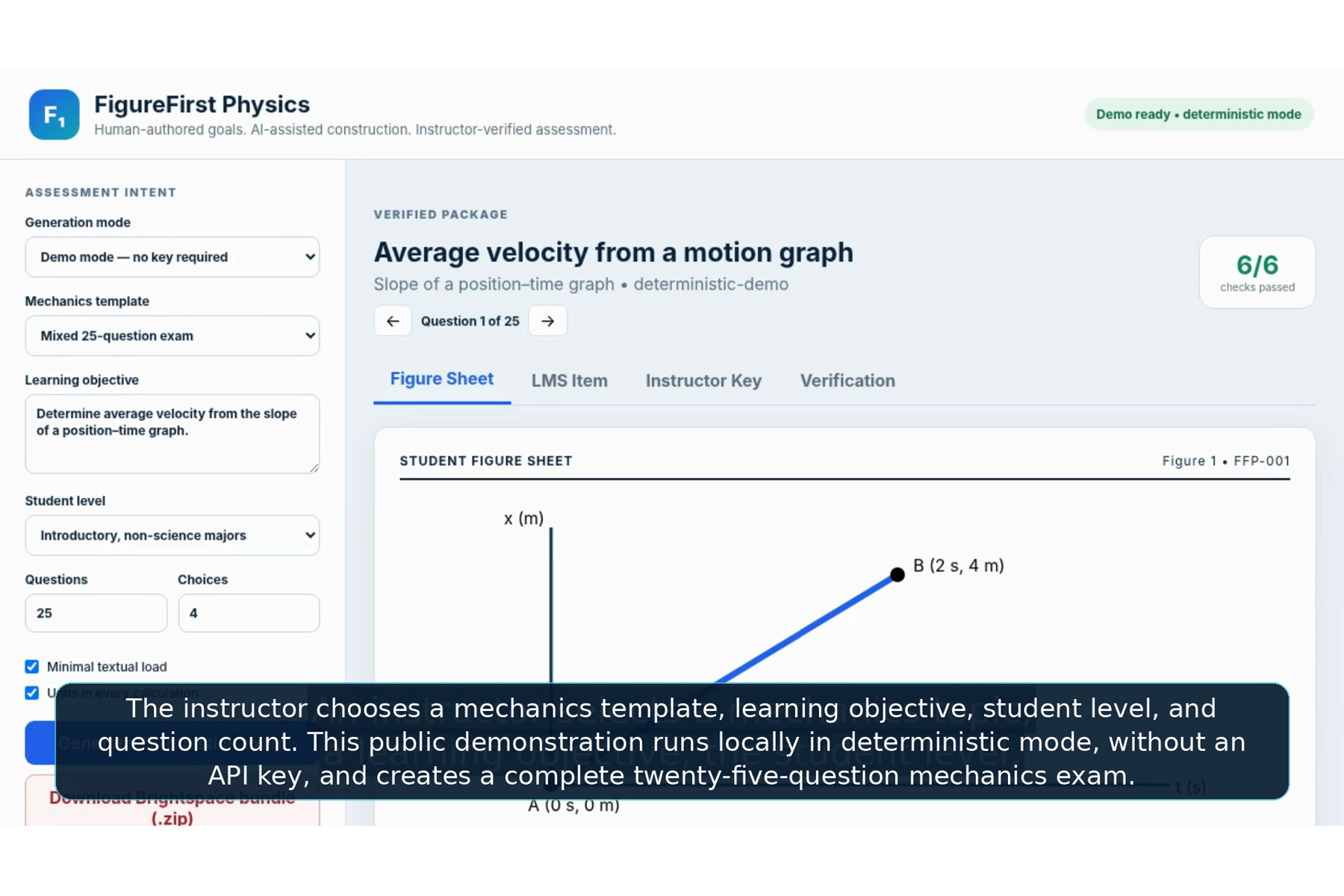
FigureFirst Physics is an instructor-facing web application for creating verified, diagram-led introductory physics assessments.
It produces synchronized outputs:
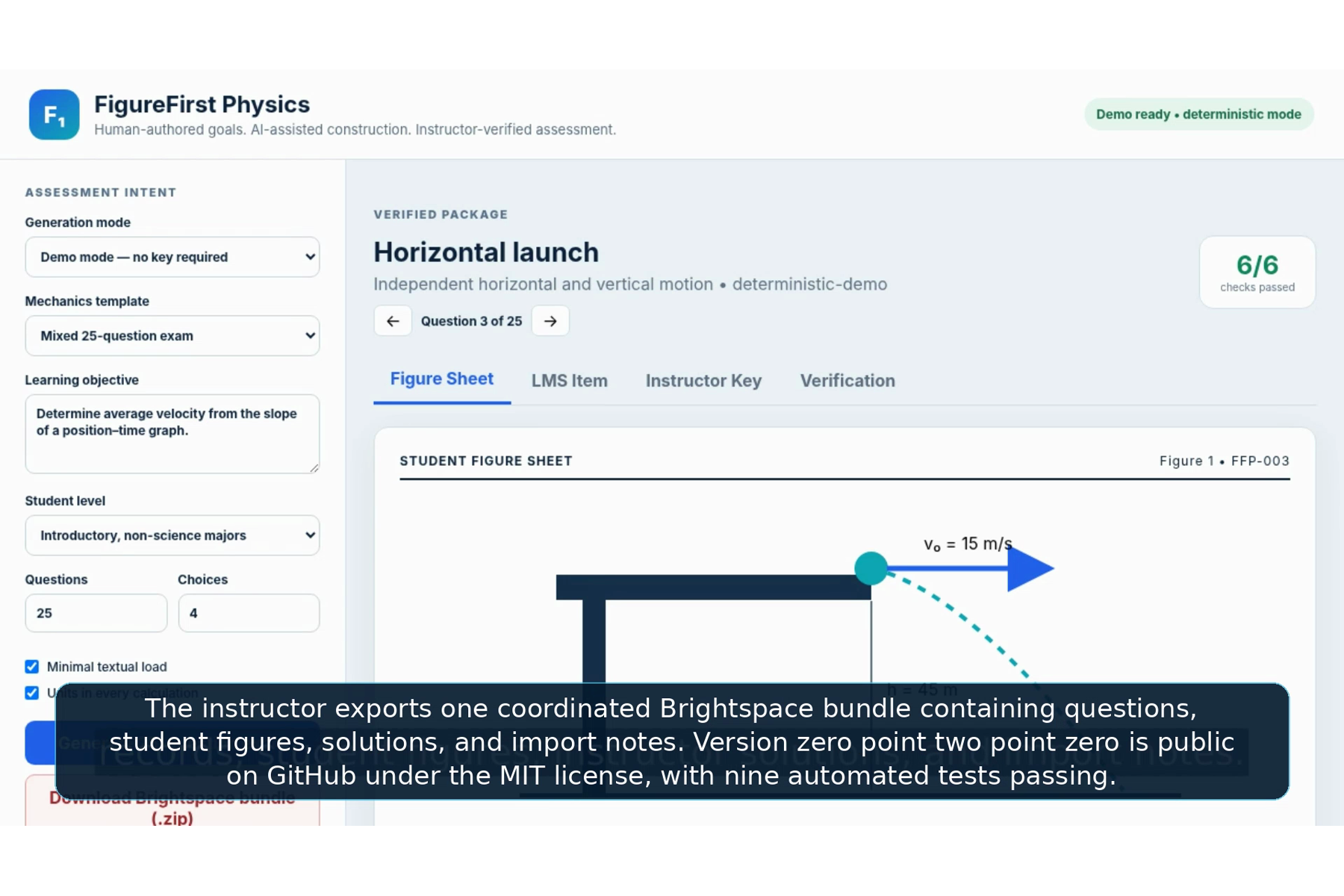
- a student-facing physics diagram;
- a multiple-choice question with plausible distractors;
- an instructor solution with units shown throughout the calculation;
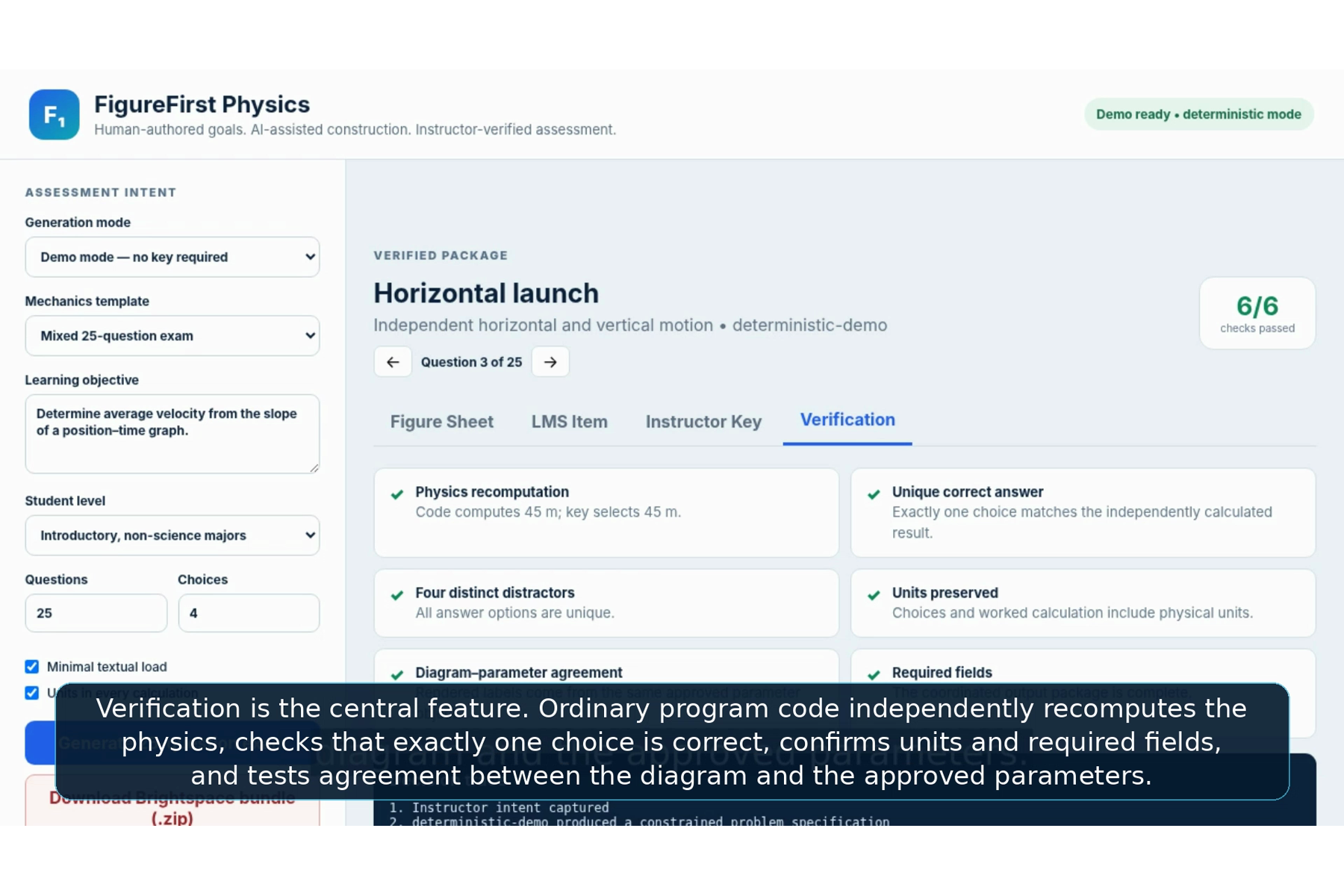
- a verification report;
- export-ready assessment content.
The application independently recomputes the physics, checks that exactly one answer is correct, validates units and required fields, and confirms agreement between the diagram and the approved numerical parameters.
A deliberately introduced mismatch demonstrates the safety layer: export is blocked until the inconsistency is corrected.
How we built it
The prototype was developed with Codex and GPT-5.6. GPT-5.6 helped translate instructional requirements into application behavior, improve the assessment workflow, and refine documentation. Codex accelerated implementation, testing, configuration hardening, and release preparation.
The application uses a lightweight Node.js server and a browser-based JavaScript interface. It includes a deterministic demonstration mode that works without an API key, as well as optional OpenAI API configuration.
Scientific verification remains ordinary deterministic program logic rather than an unsupported AI judgment.
Challenges
The main challenge was keeping the diagram, numerical parameters, answer choices, solution, and export synchronized. A visually plausible question can still contain a scientifically important mismatch.
Another challenge was making AI assistance useful without allowing generated output to bypass instructor review or deterministic physics checks.
Accomplishments
- Built a working instructor-facing prototype.
- Added deterministic operation without a paid API call.
- Implemented independent physics and unit verification.
- Blocked export when a seeded diagram mismatch is detected.
- Added automated tests for deterministic mode and OpenAI request construction.
- Completed release hardening with 13 automated tests passing.
- Published the source code under the MIT License.
What we learned
AI can substantially accelerate the construction of educational materials, but scientific correctness requires an independent verification layer. The strongest workflow combines human-authored instructional goals, AI-assisted construction, deterministic validation, and final instructor approval.
What's next
Next steps include additional physics topics, larger question banks, improved Brightspace export, configurable diagrams, accessibility improvements, and instructor testing in community-college courses.
Built With
- api
- codex
- css
- gpt-5.6
- html
- javascript
- node.js
- openai
- svg

Log in or sign up for Devpost to join the conversation.