-
-
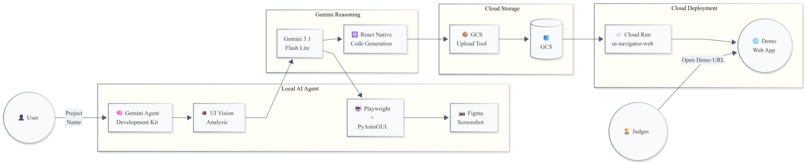
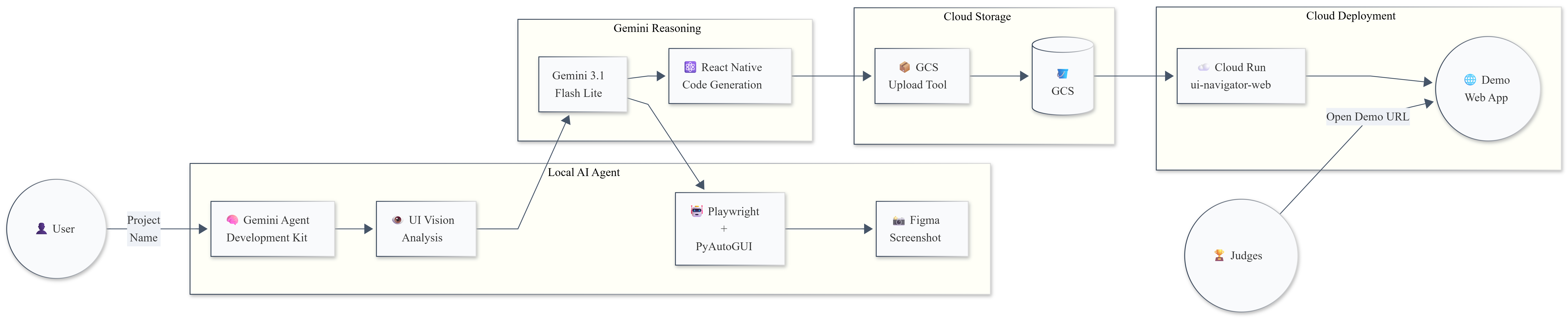
Architecture
Inspiration 💡
The "handoff" from design to development is a notorious bottleneck in software delivery. Engineers spend days manually translating pixels into boilerplate code, often losing design fidelity. I wanted to build an agent that could "see" a designer’s intent and instantly provide a production-ready codebase, allowing developers to focus on high-value logic rather than UI repetition.
What it does 🧩
Figma to Code is an autonomous AI agent that interprets Figma prototypes through computer vision and generates pixel-perfect React Native code. It doesn't just export assets; it reasons through UI hierarchies and brand systems, persisting the results in Google Cloud Storage and deploying a live preview via Google Cloud Run for instant stakeholder validation.
How I built it 🏗️
The solution uses a Hybrid Edge-Cloud Architecture:
The Brain & Hands: Built with Gemini 3.1 Flash and the Gemini Agent Development Kit (ADK). It uses Playwright and PyAutoGUI to physically navigate and capture Figma canvases.
The Persistence: Every build is automatically uploaded to Google Cloud Storage using the Python SDK.
The Presentation: A Google Cloud Run microservice (Flask/Docker) serves a live dashboard that renders the generated .tsx builds in real-time.
Challenges I ran into 🛠️
Navigating Figma’s infinite canvas required precise coordinate mapping and robust multimodal feedback loops. Additionally, configuring the IAM security layer for automated local-to-cloud deployments was a significant hurdle that required fine-tuning service account permissions to ensure a secure and seamless pipeline.
Accomplishments that I'm proud of 🏅
I successfully closed the loop between Physical Automation and Cloud Deployment. Seeing the agent "move the mouse" in Figma and then seeing the resulting code live on a Cloud Run URL seconds later is a testament to the power of autonomous agents in modern DevOps.
What I learned 🎓
This project highlighted the immense potential of the Gemini ADK to handle tasks that traditional APIs cannot. We learned how to orchestrate local hardware events with cloud-scale AI reasoning and the importance of building "Cloud-Native" from the start to ensure scalability.
What's next for Figma to Code powered by Gemini 🗺️ 🤖
The vision is to expand the agent's capabilities to include Component Library Integration. Instead of generic code, the agent will be trained to use a company's specific internal design system components, creating a truly seamless bridge between brand identity and production code.
Built With
- adk
- gemini
- google-cloud
- google-cloud-run
- python
- react


Log in or sign up for Devpost to join the conversation.