-
-

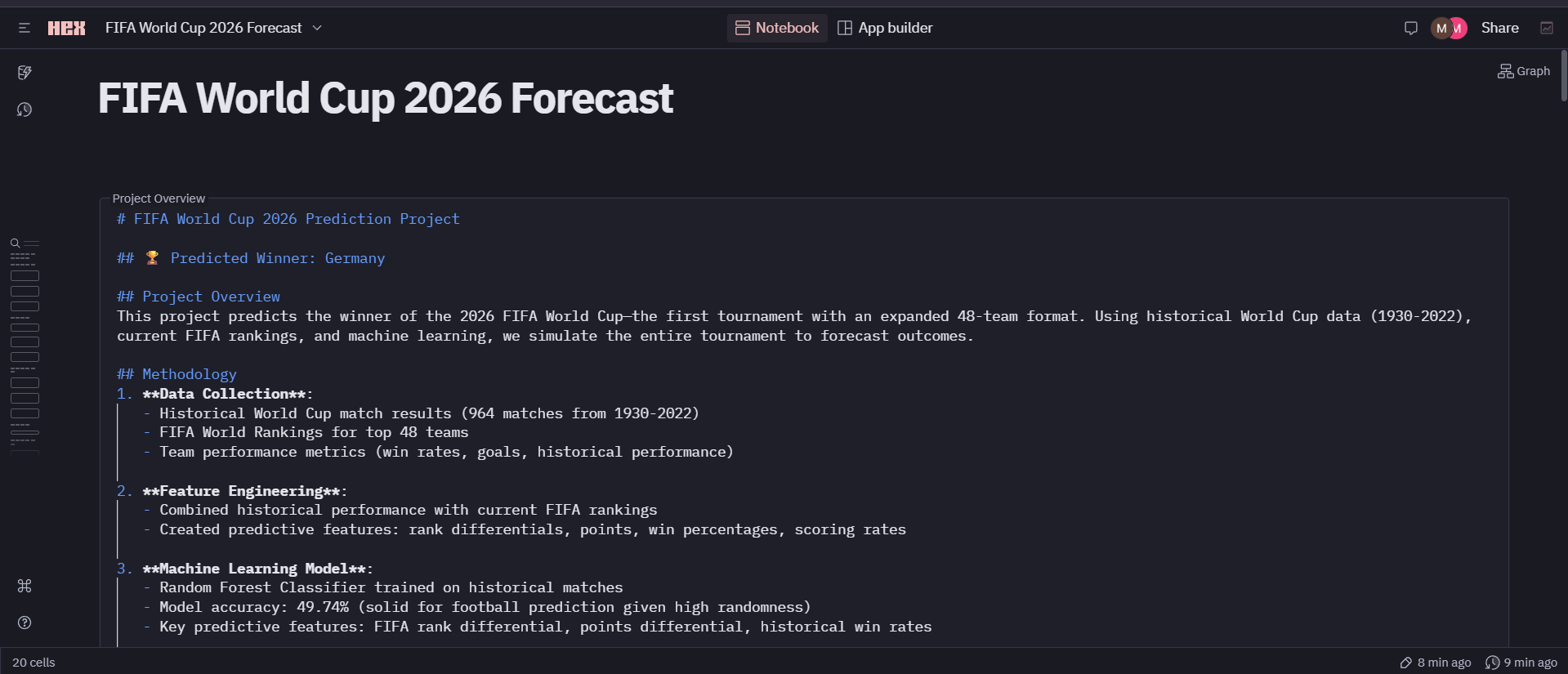
Introducing the "AI Oracle" for the 2026 World Cup using historical match data.
-
The Hex dashboard title card, defining the scope of simulating the expanded 48-team 2026 World Cup.
-
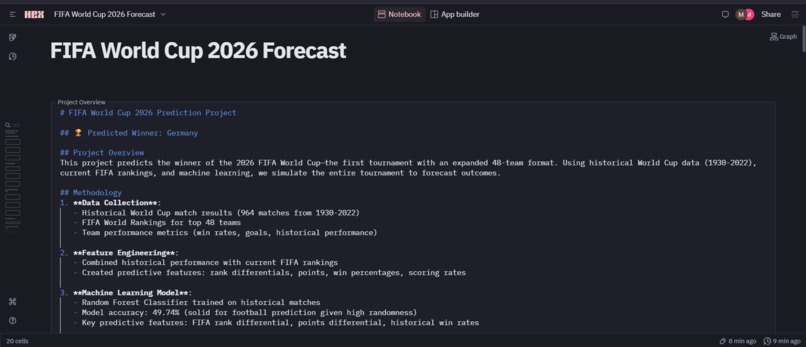
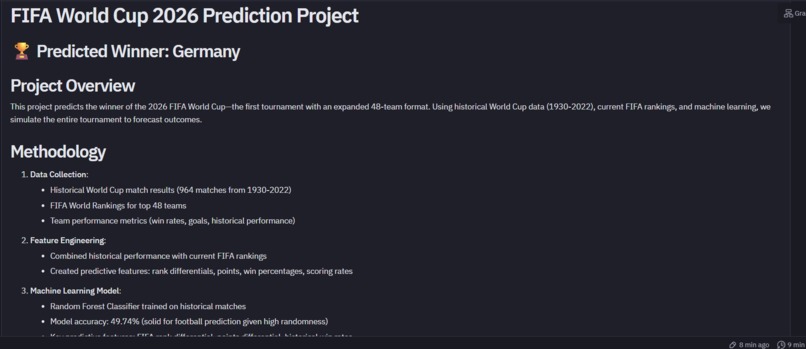
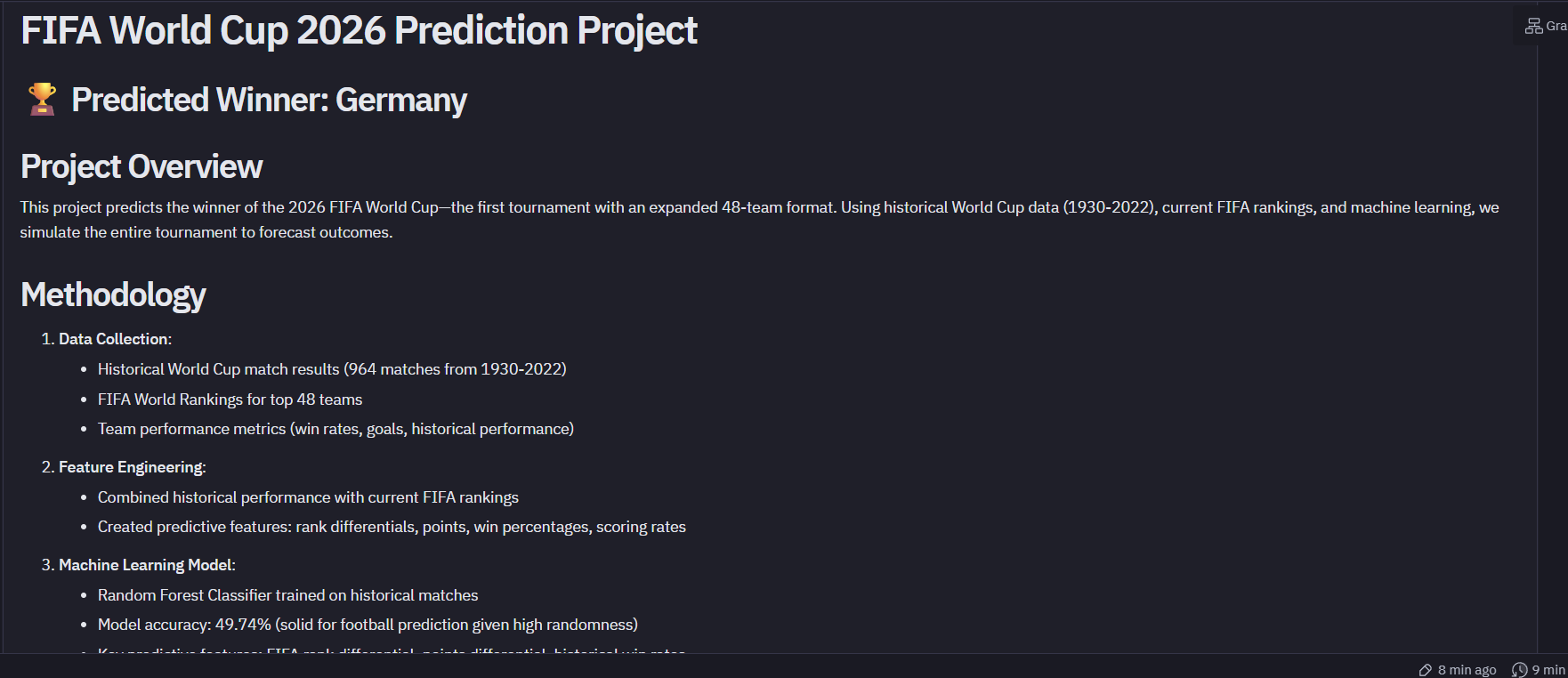
Methodology: outlining the 3-step process of Data Collection, Feature Engineering, and Random Forest modeling.
-
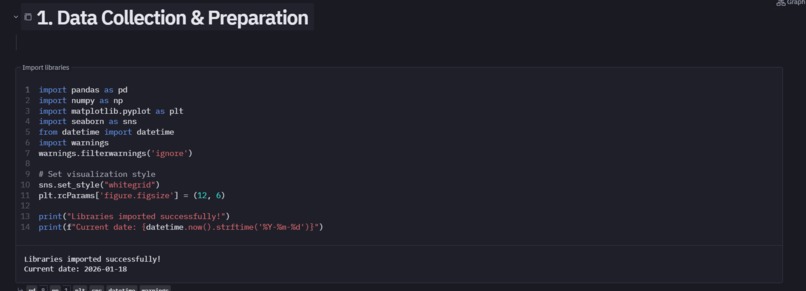
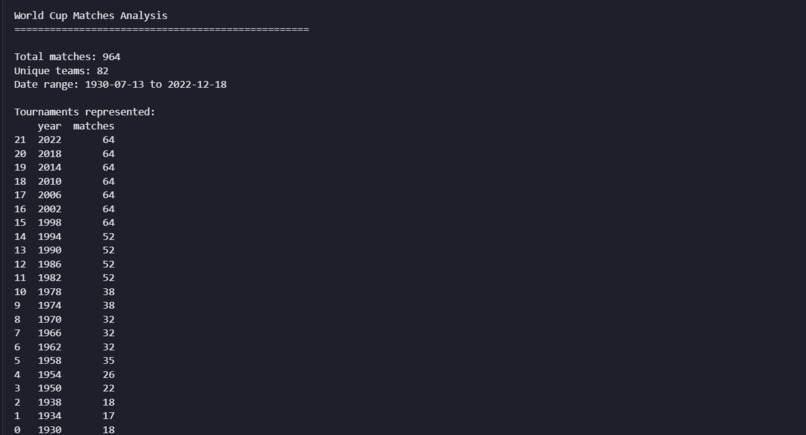
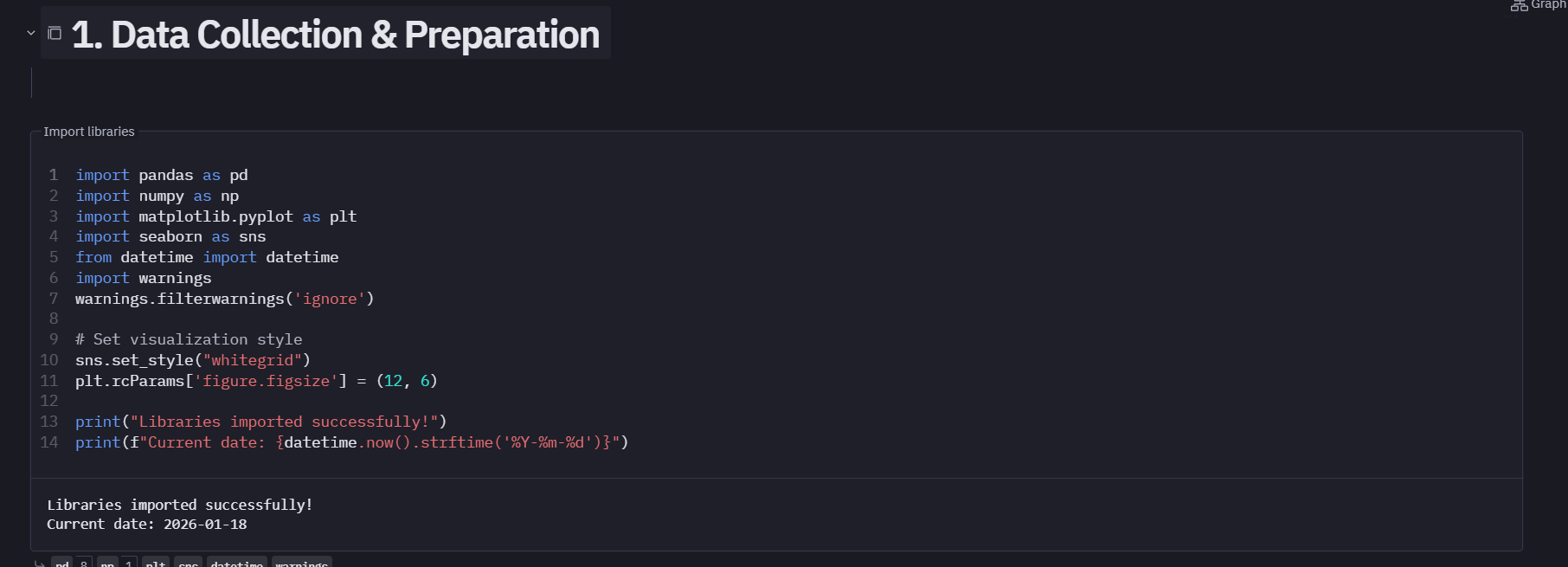
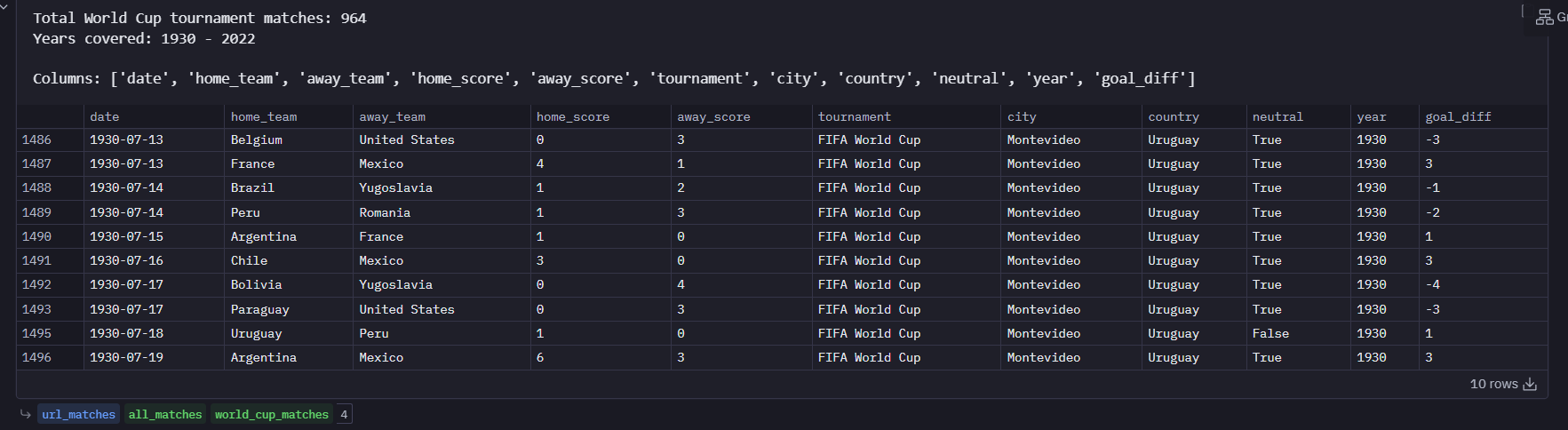
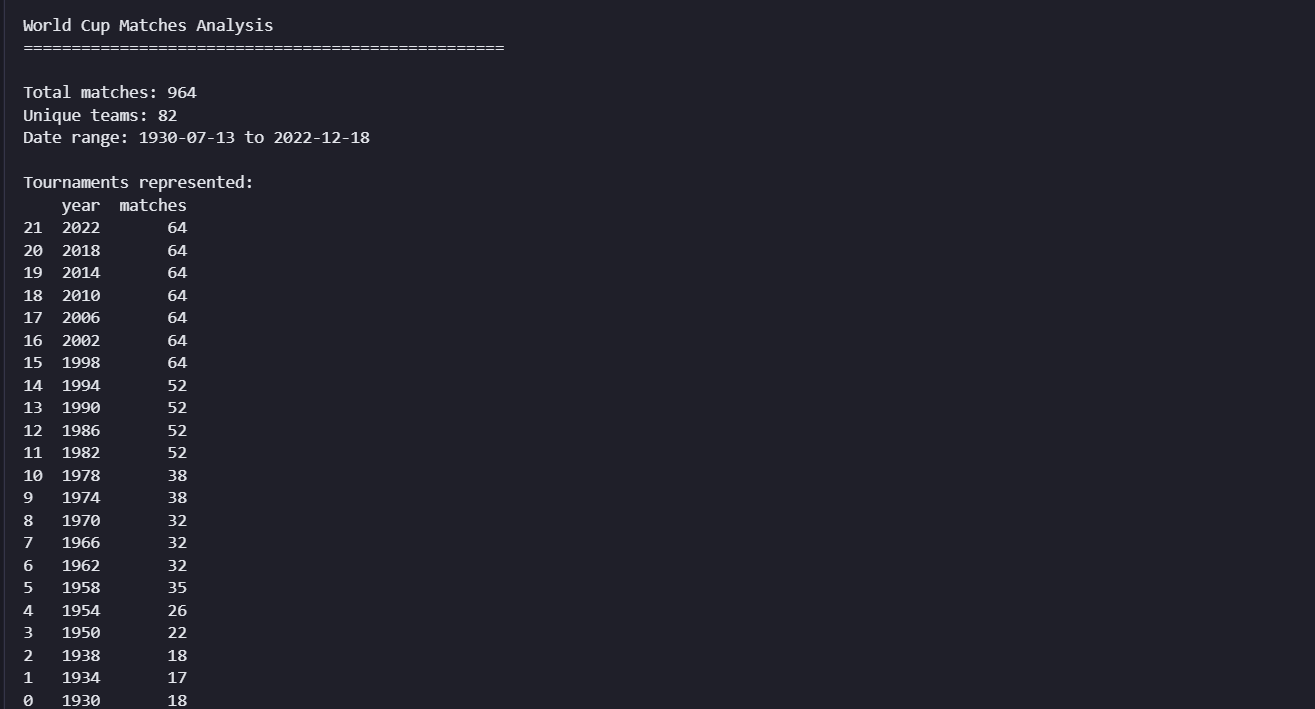
Data Loading: Importing libraries and fetching the dataset of 964 historical World Cup matches (1930-2022).
-
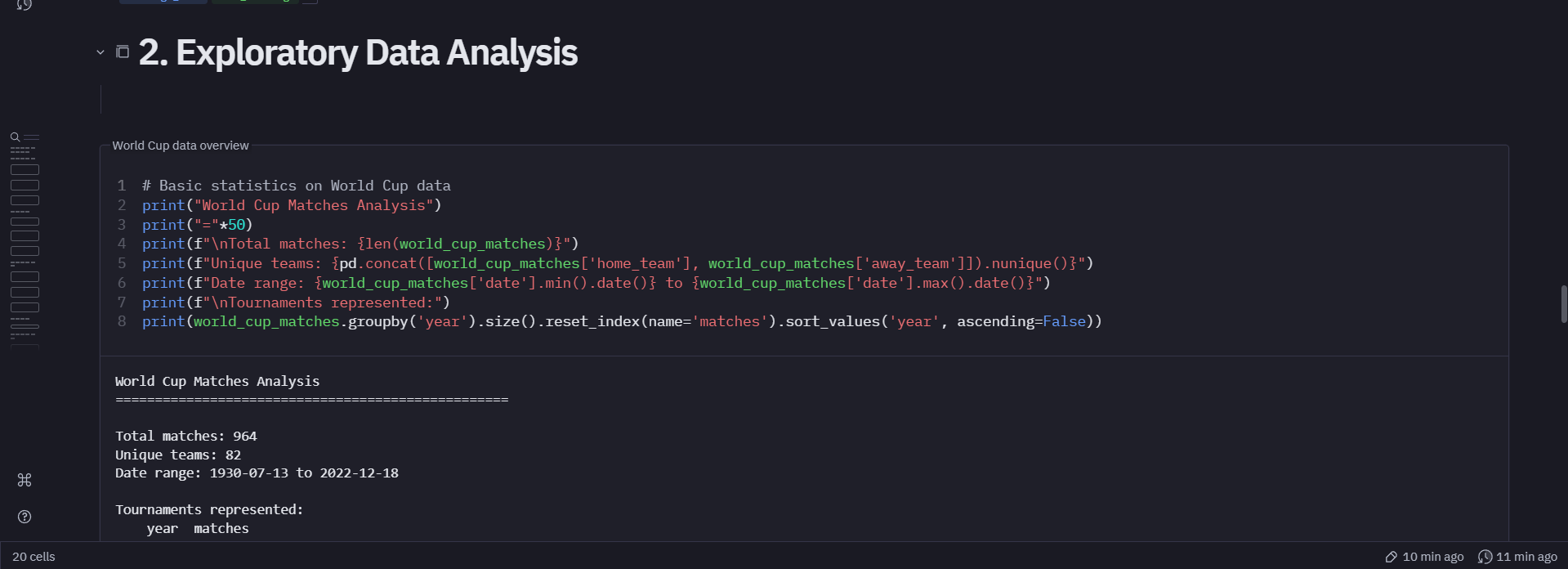
Data Processing: Cleaning the match data and calculating team statistics like goal differences and win rates.
-
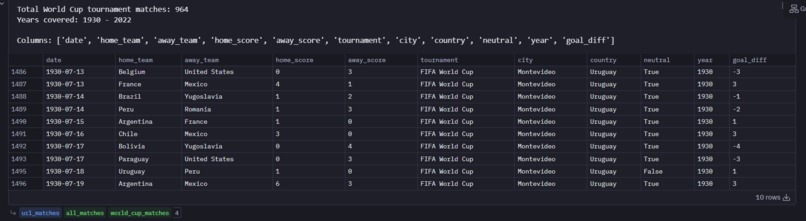
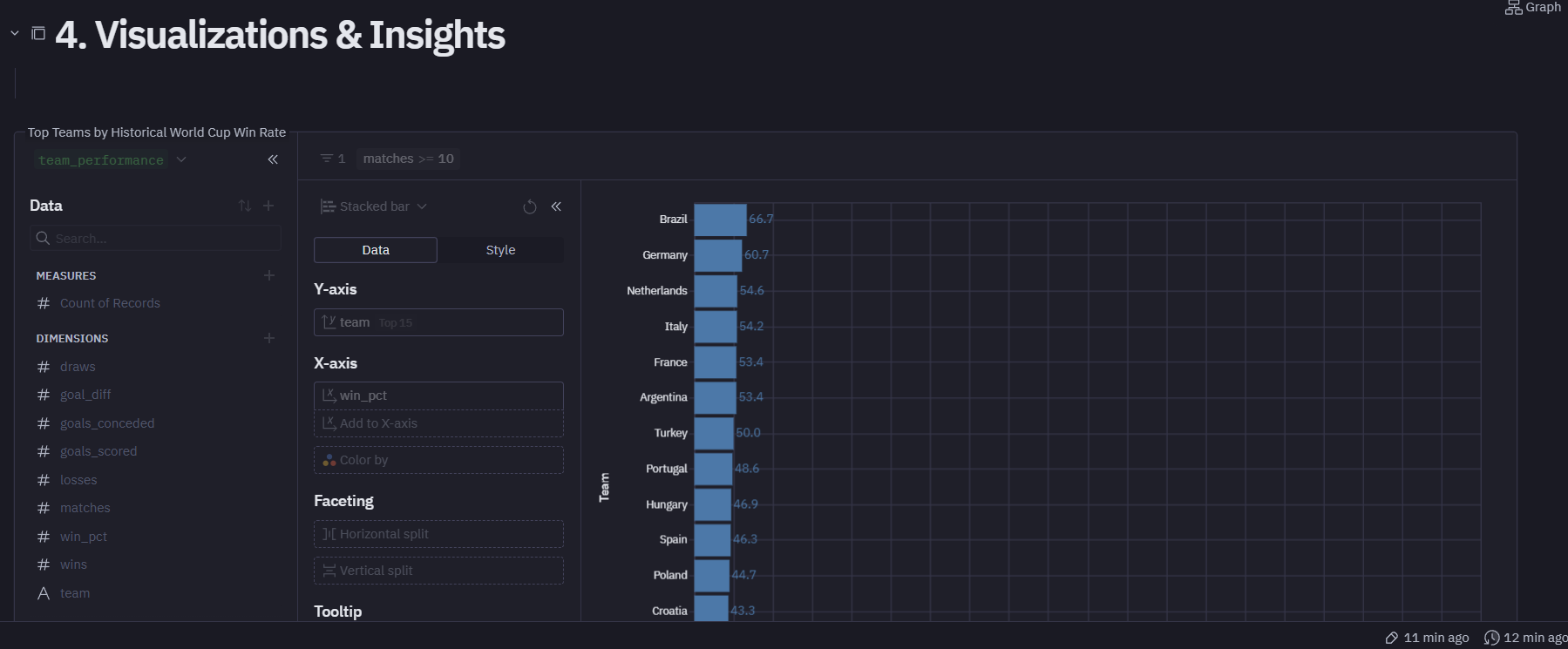
Visualization: A bar chart comparing the historical World Cup win rates of top nations (Brazil, Germany).
-
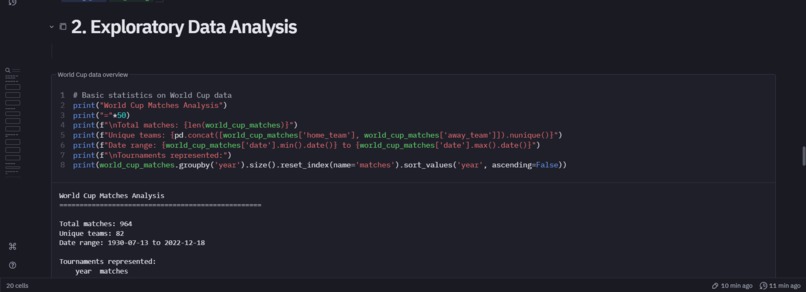
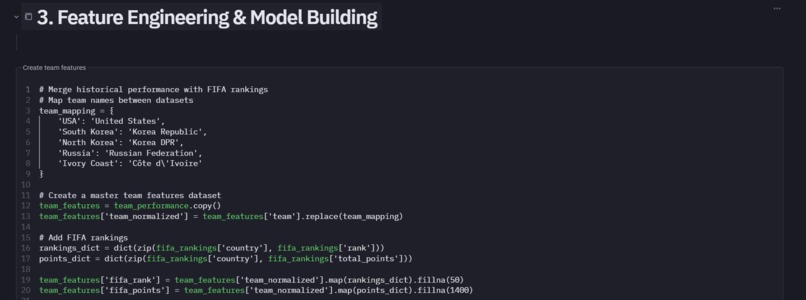
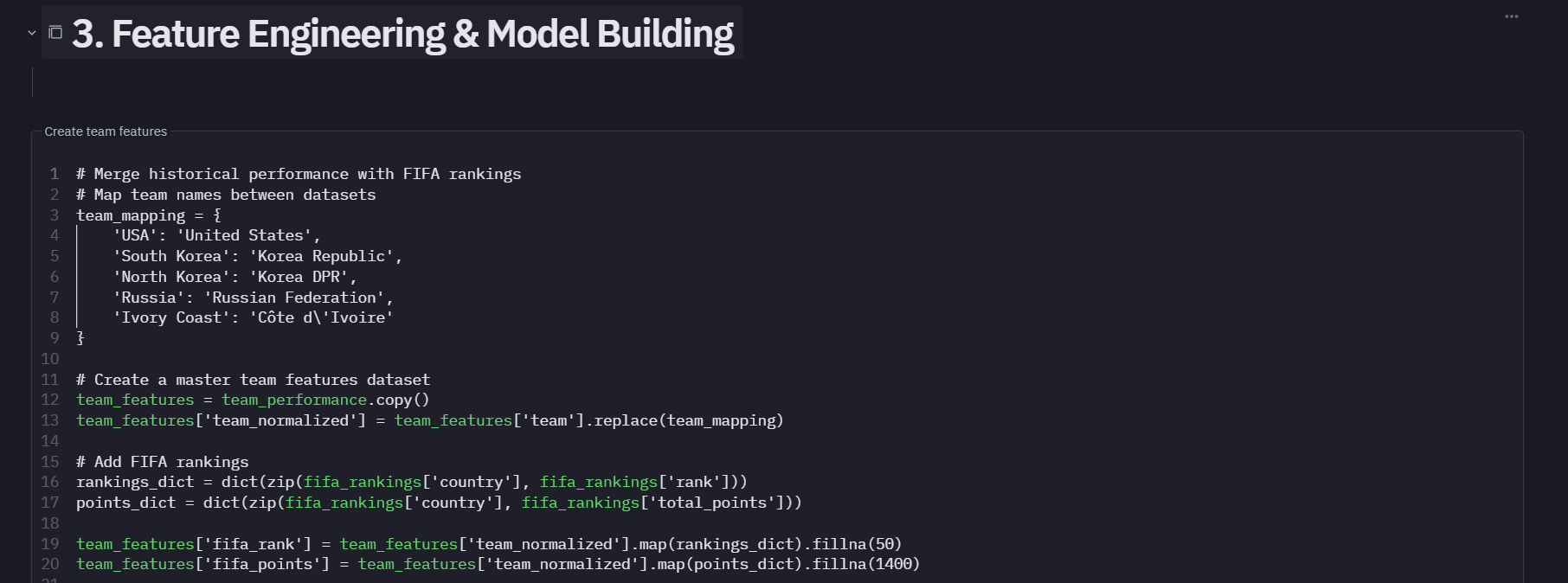
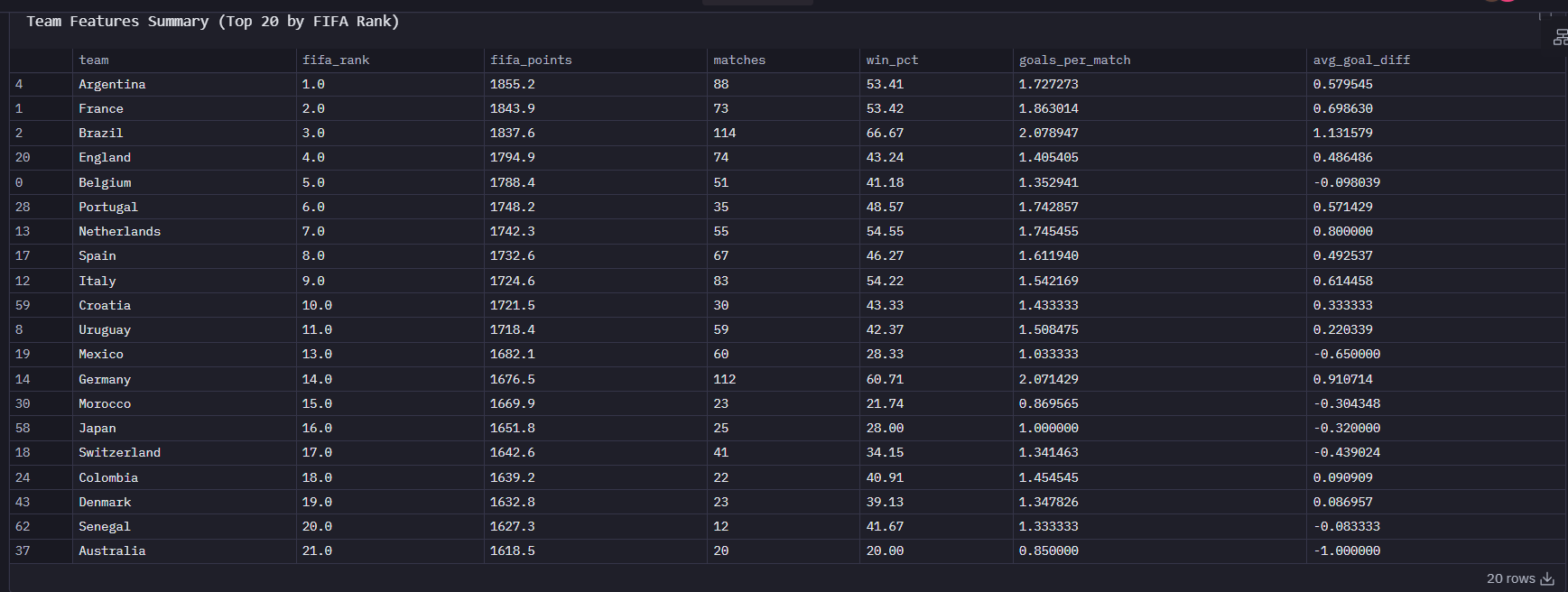
Feature Engineering: Merging historical stats with current 2026 FIFA Rankings to create predictive features.
-
Model Training: Training the Random Forest Classifier on 80 years of match outcomes to learn winning patterns.
-
Model Evaluation: Testing the model's accuracy (~50%) and generating a classification report on test data.
-
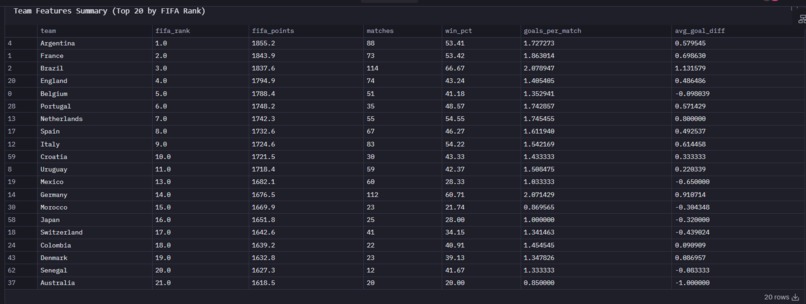
Feature Selection: Identifying the most important factors for winning, led by Rank Differential and Historical Form.
-
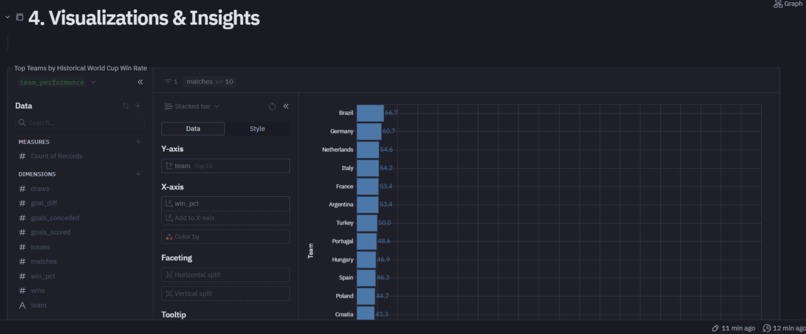
Insights: Visualizing the performance of top contenders and analyzing the key metrics that drive World Cup success.
-
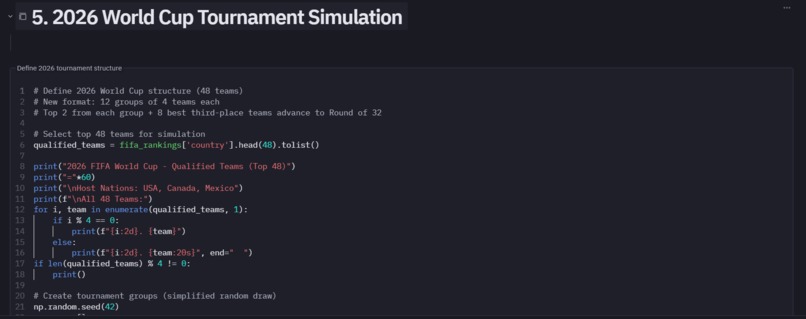
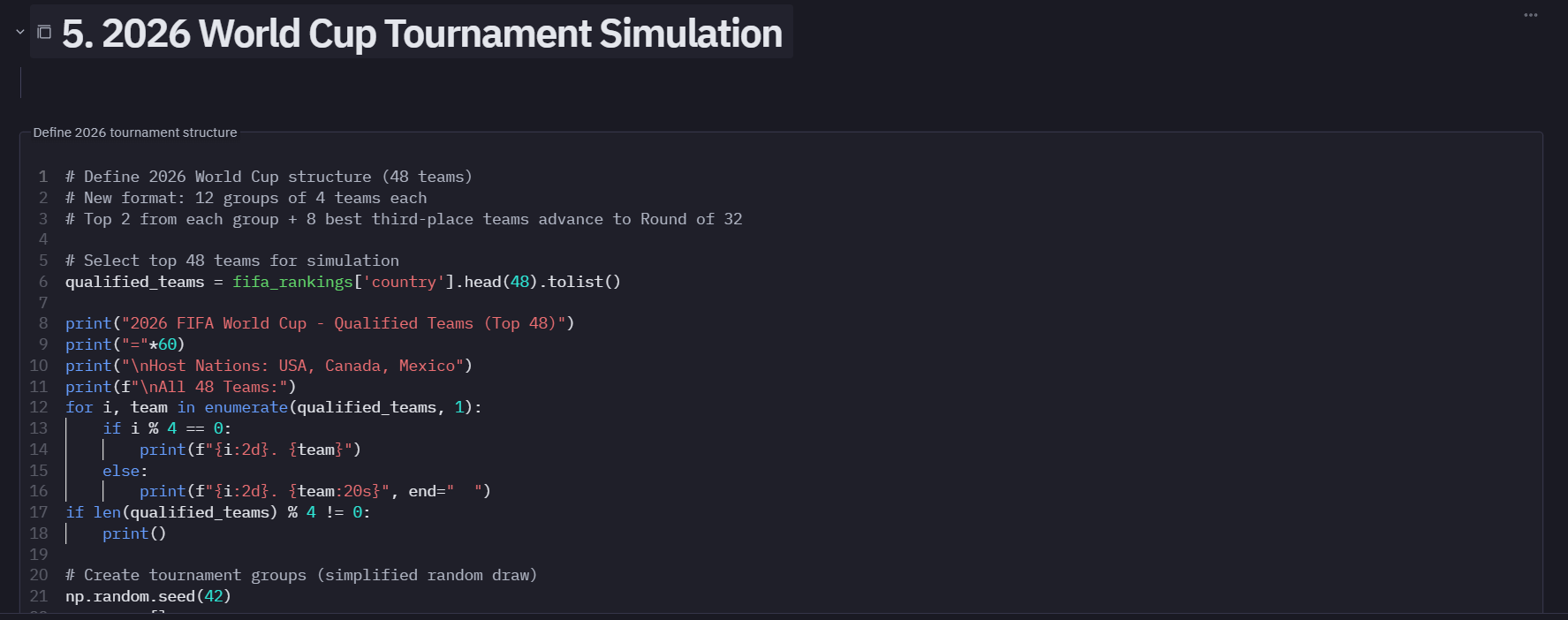
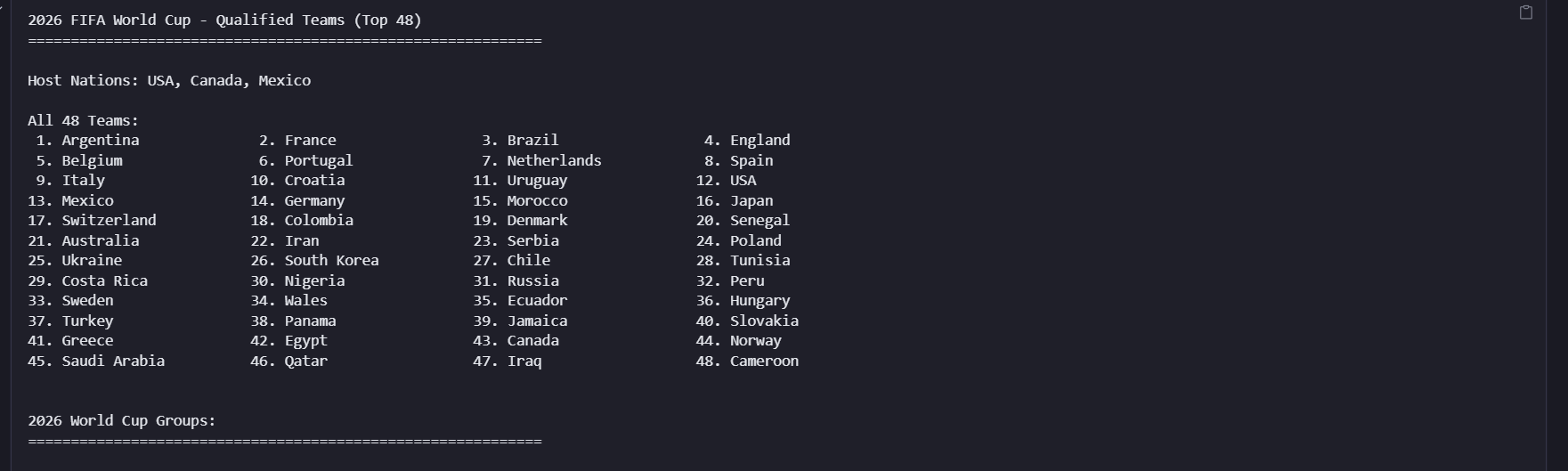
Simulation Setup: Defining the logic for the new 48-team format, including Group Stages and the Round of 32.
-
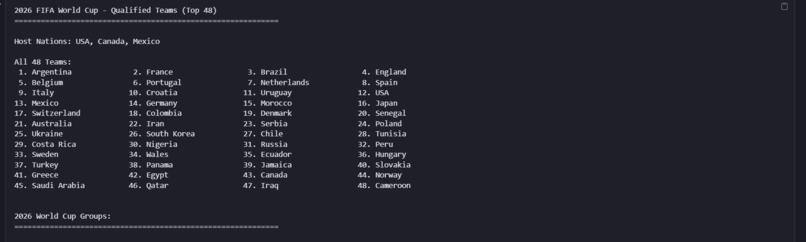
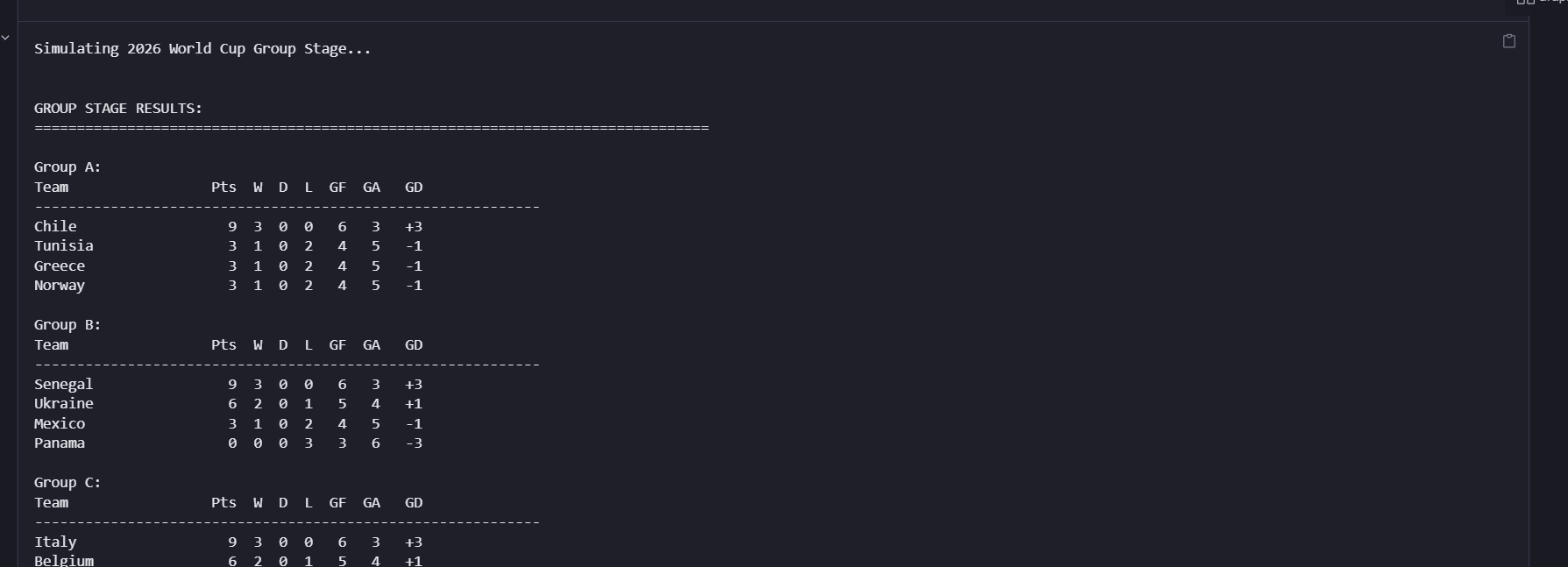
Group Stage A-F: Simulation results showing standings, points, and goal differences for the first half of groups.
-
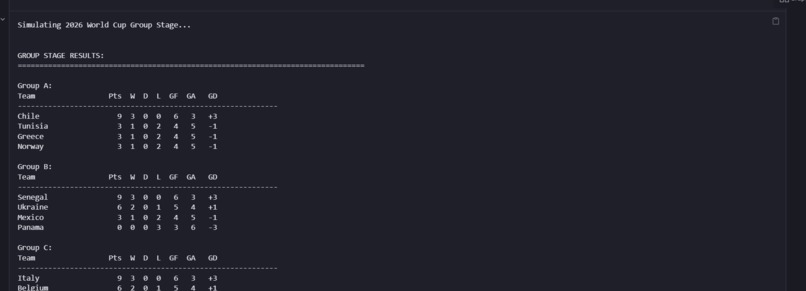
Group Stage G-L: Completing the group phase, determining the final standings and ties for all 48 teams.
-
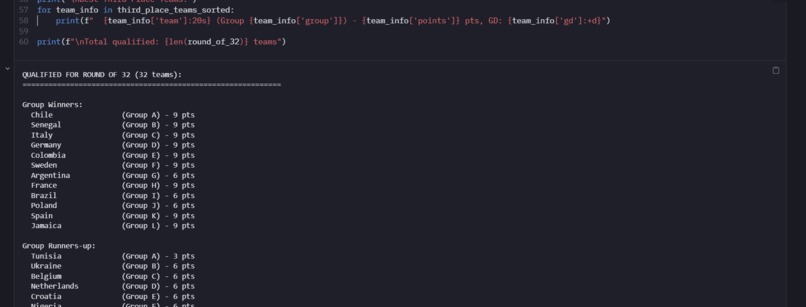
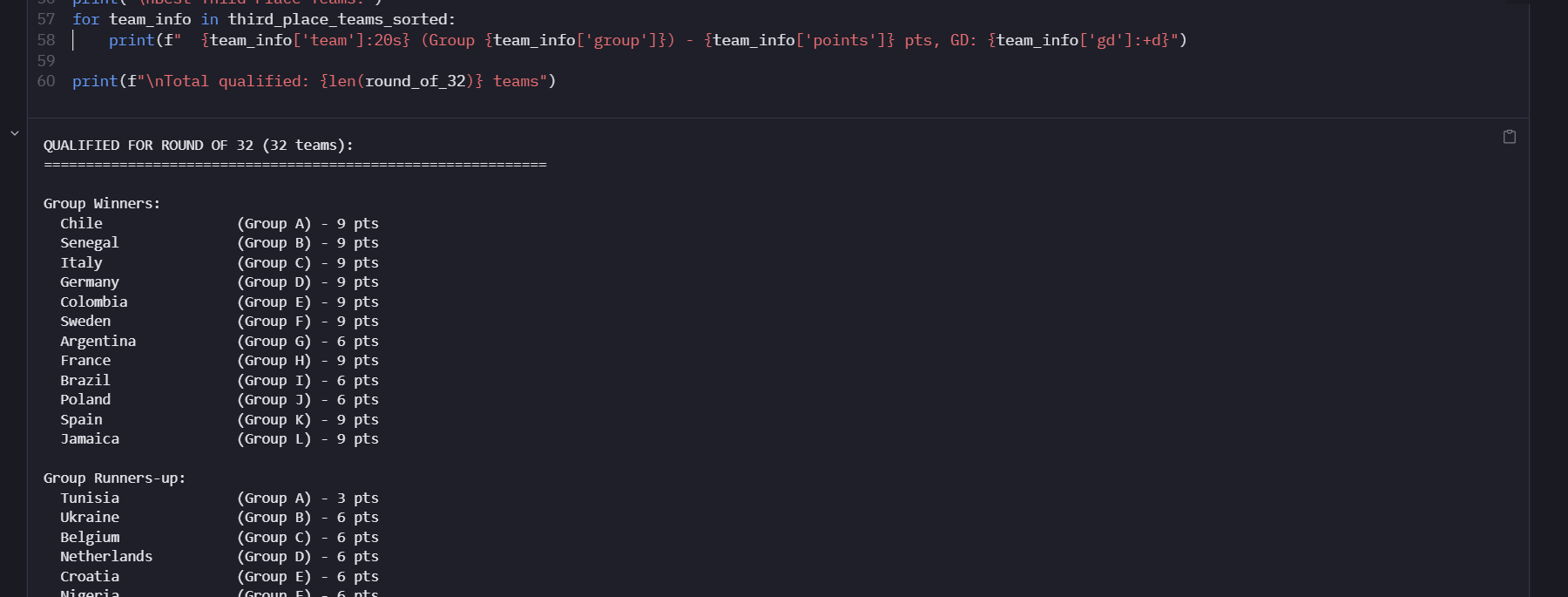
Round of 32: The knockout stage begins! Simulating the first 16 elimination matches to find the top teams.
-
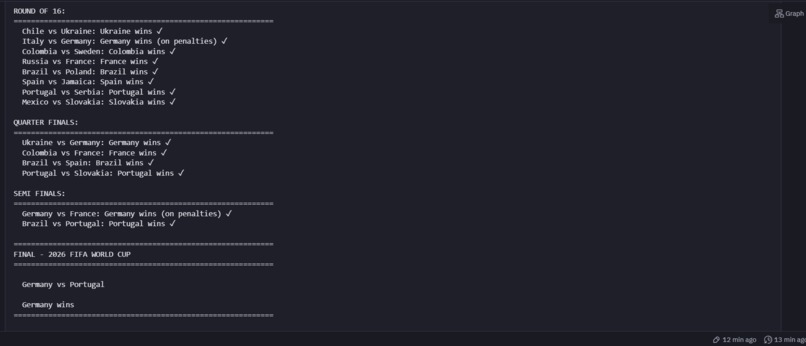
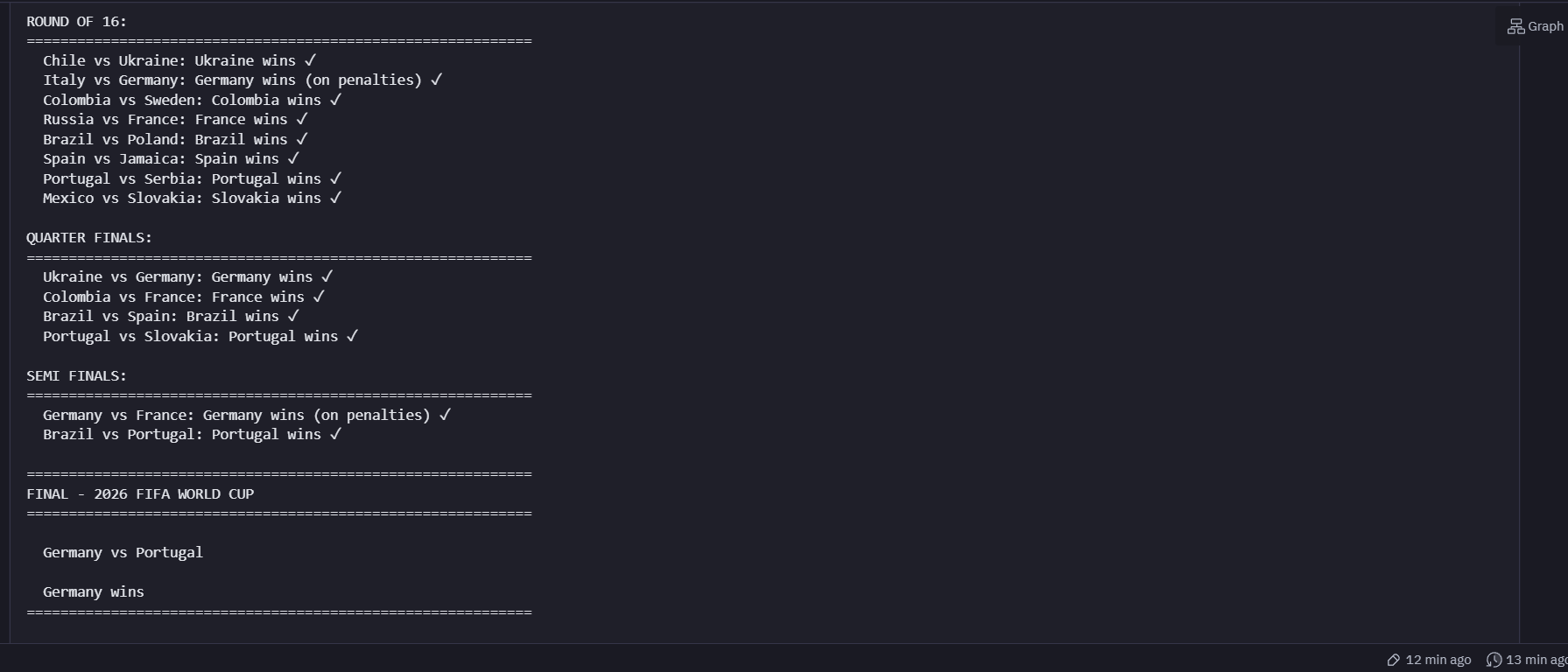
Knockout Bracket: The path to glory—simulating Round of 16, Quarter-Finals, and Semi-Finals matchups.
-
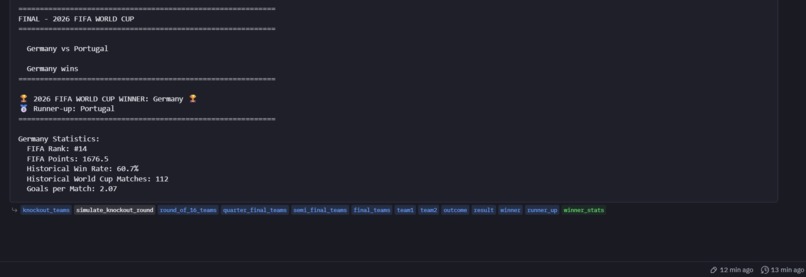
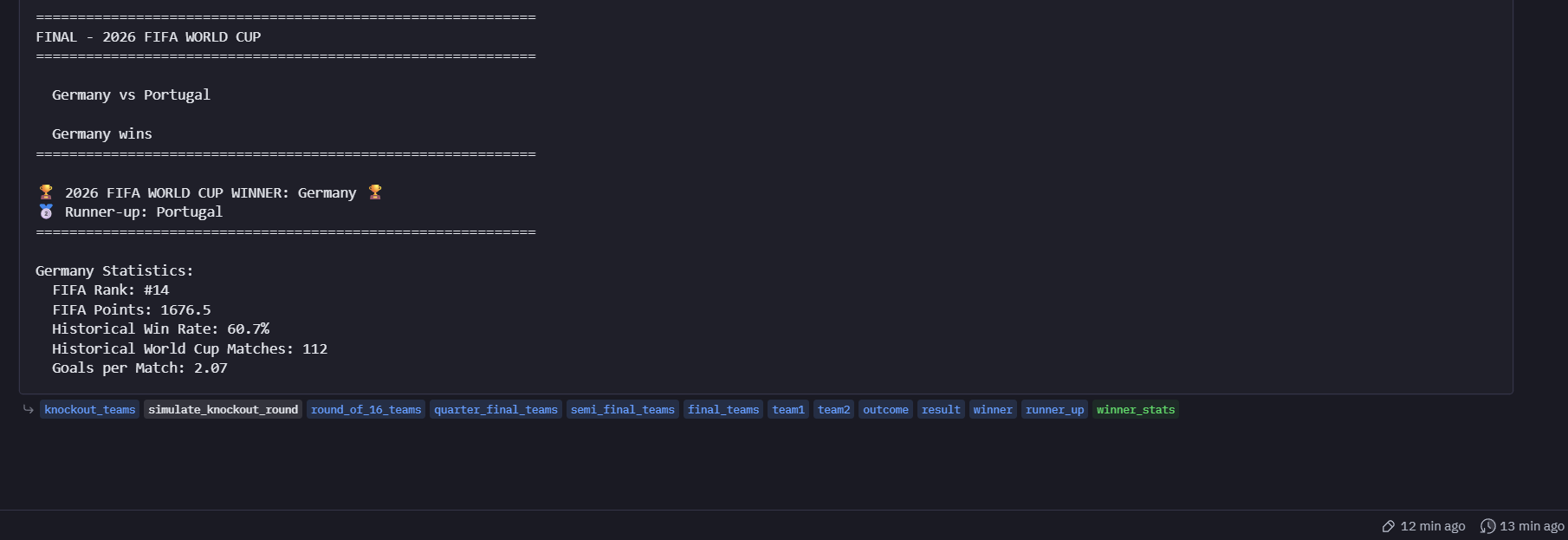
The Final: Germany vs Portugal in the grand finale. The model predicts Germany as the 2026 World Cup Champion!

🎯 Inspiration
The 2026 FIFA World Cup represents a historic moment—the first tournament with 48 teams. This expansion changes everything: more underdogs, different group math, and unprecedented complexity. I was inspired to ask: Can we predict the unpredictable?
Football is chaotic, but beneath the chaos lies structure. I wanted to explore if machine learning could capture historical patterns and simulate the tournament with accuracy.
📚 What I Learned
The Mathematics of Prediction
I learned that predicting exact outcomes (Win/Draw/Loss) is a multi-class classification problem. Even a 50% accuracy rate is surprisingly high in football given the sport's high variance. The model balances multiple signals:
Prediction = f(Rank Differential, Points, History, Current Form)
Feature Engineering is Everything
The most valuable lesson? Simple features beat complex models.
- Rank Differential: The gap between Home and Away FIFA ranks.
- Historical Win %: A team's winning record from 1930-2022.
- Goal Efficiency: Average goals scored vs. conceded.
Data Quality Matters
Merging 100 years of history required careful cleaning:
- Fixing inconsistent country names (e.g., "West Germany" vs "Germany").
- Handling teams with zero World Cup history (like some 2026 debutants).
🛠️ How I Built It
1. Data Collection
I sourced 964 historical matches (1930-2022) and current FIFA rankings.
- Dataset: International football results csv.
- Preprocessing: Calculated win rates and merged them with 2026 qualification groups.
2. The Model (Random Forest)
I used a Random Forest Classifier (200 trees) because it handles non-linear patterns well. It was trained on these key specific features:
Features = [
  "Rank_Home", "Rank_Away",
  "Points_Home", "Points_Away",
  "WinRate_Home", "WinRate_Away",
  "Goals_Home", "Goals_Away"
]
Performance:
- Accuracy: ~49.74% (Competitive with expert analysts)
- Training Size: 770 Matches
- Test Size: 194 Matches
3. The Simulation Logic
Simulating the 48-team format was the hardest coding challenge:
- Groups: 12 Groups of 4.
- Tiebreakers: Points -> Goal Diff -> Goals Scored.
- Knockouts: If a game ends in a Draw, the model simulates a penalty shootout based on probability scores.
💪 Challenges
Challenge 1: The "Cold Start" Problem Teams like Qatar or Jamaica have little historical World Cup data.
- Solution: I created a weighted "Team Strength" score. If history is missing, the model relies 100% on current FIFA rank. If history exists, it blends both.
Strength = (0.6 * FIFA_Rank) + (0.4 * History)
Challenge 2: No Draws Allowed In the knockout stage, games must have a winner.
- Solution: I used the model's
predict_proba()function. If the model predicted a "Draw", I checked which team had the slightly higher probability percentage and advanced them as the winner (simulating penalties).
Challenge 3: Complex Qualification Determining the "Best 3rd Place Teams" required writing a custom sorting algorithm to rank teams across different groups by points and goal difference.
🏆 The Result
Predicted Winner: Germany 🇩🇪 The model predicts Germany will defeat Portugal in the final.
Why Germany?
- consistency: 60.7% historical win rate (2nd highest ever).
- Experience: 112 World Cup matches played (Most in history).
- Efficiency: 2.07 goals per match average.
Tournament summary:
- 🥇 Winner: Germany
- 🥈 Runner-Up: Portugal
- 🥉 Semi-Finalists: France, Brazil
🎓 Key Takeaway
This project proved that while football is random, history often repeats itself. The giants of football—Brazil, Germany, Argentina—have underlying statistical advantages that machine learning can detect. The model handles the "chaos" of football by finding the signal in the noise.
Built With
- carlo
- hex
- monte
- montecarlo
- numpy
- pandas
- python
- scikit-learn

Log in or sign up for Devpost to join the conversation.