-
-
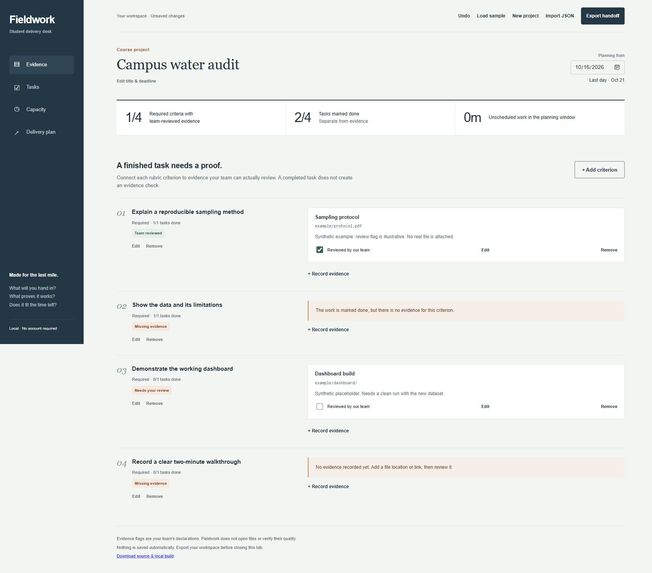
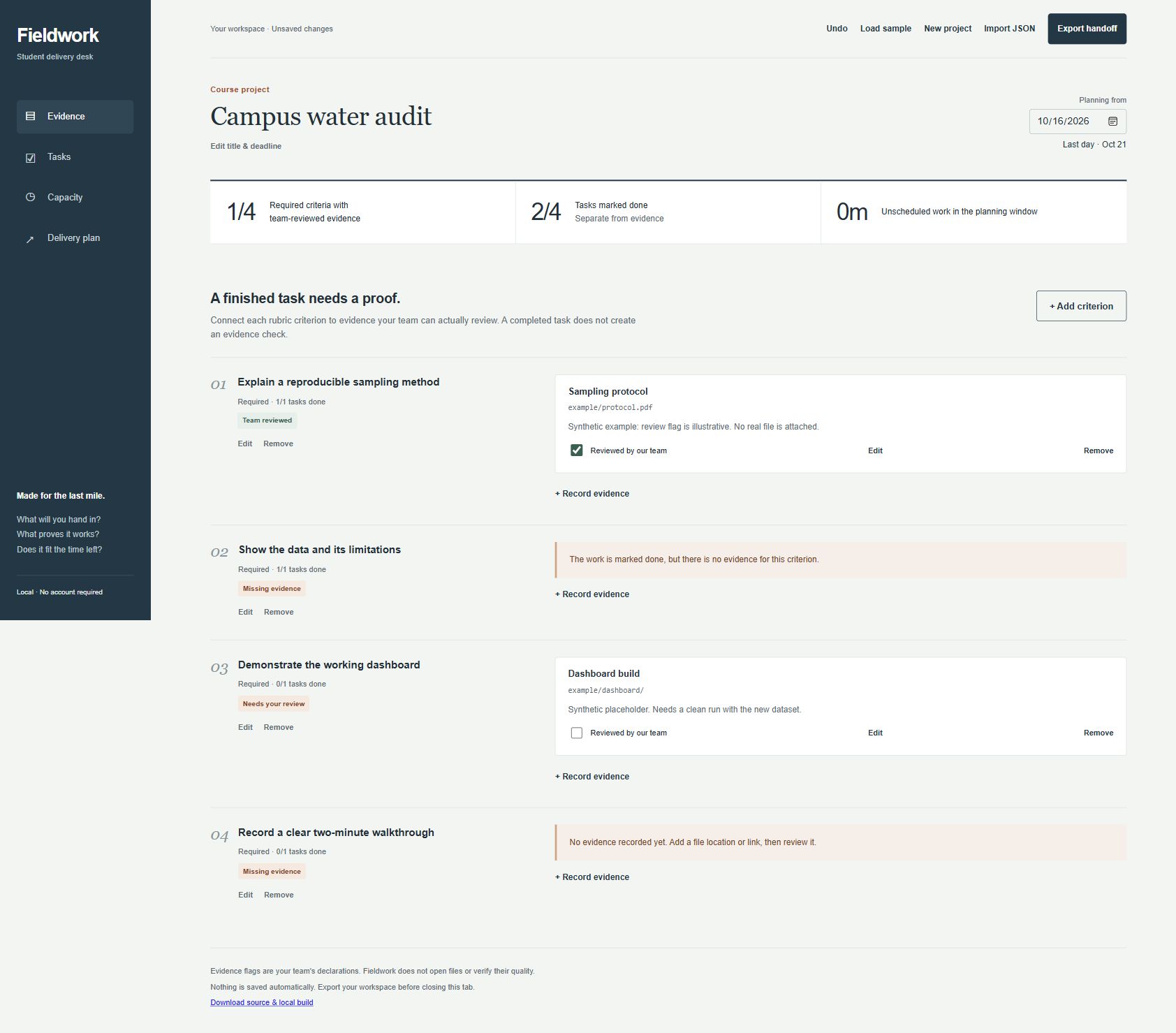
The fictional campus-water example separates completed tasks from team-reviewed evidence; no real participant data.
Inspiration
A submission checklist can look complete while its proof is missing. A finished demo task may still lack a recording, an accessible artifact or a reviewed README. Teams also need to know whether the remaining work fits the people who actually own it. Fieldwork keeps those two questions visible in one project.
What it does
Fieldwork connects rubric criteria to evidence and separately tracks the tasks needed to prepare a submission. Each evidence item has a location and an explicit team-reported verification state. Each pending task has an owner and a duration estimate. A deterministic planner distributes the work across that person's available dates and minutes through the deadline and reports any unscheduled remainder.
The project can be carried as a JSON file. A Markdown handoff gathers evidence, workload and remaining gaps. An iCalendar download creates date-only workload reminders for import into the user's calendar; it sends no invitations and invents no appointment hours.
How it was built
The implementation uses browser JavaScript modules, plain HTML and CSS, and a small Node.js static server for the downloadable local build. The public site uses a self-contained Worker to serve the application and source ZIP. The planner and exporters use no external dependencies. Both delivery paths use a fixed file allowlist, no project-data endpoints, and a browser policy that blocks data connections.
The planning contract is portable JSON. Validation rejects invalid dates, unknown references, duplicate IDs and duplicate person/date capacity. Scheduling preserves task priority, respects ownership and capacity, splits tasks across dates and exposes deficits. Calendar text is escaped and folded for iCalendar compatibility.
What makes it useful
The main decision is concrete: which criterion lacks checked proof, and which owner's remaining work does not fit? Marking a task done changes work accounting without manufacturing evidence. Conversely, an evidence item marked verified records that declaration without pretending that all related tasks are done. The synthetic example makes both situations visible.
Challenges and limits
Task completion, evidence verification and an actual contest submission are different events. Fieldwork preserves that distinction. It does not inspect files, test link access, evaluate rubric quality or determine eligibility. Durations are estimates; the planner has no task dependencies or productivity model. Deadlines are calendar dates, so users must check the contest's exact closing hour separately.
All included names, tasks, schedules and evidence artifacts are synthetic demonstration data. No participant testing, adoption figures, time savings or competition results are claimed.
Testing
The automated suites passed 25/25 tests, checking owner-specific capacity, splitting work across dates, overbooking prevention, deficits, done-versus-evidence behavior, reproducibility, leap days and malformed inputs. They also check calendar escaping and date-only events, the local server's file allowlist and browser policy, and the public Worker/source archive. The real recorded browser walkthrough is separate from these automated checks. The same 25 tests passed again during the final submission review.
AI assistance disclosure
OpenAI Codex assisted with implementation, documentation and automated testing under EazyHood's direction. AI assistance is part of the development process. This project does not claim independently conducted user research or human-only authorship.
Next steps
Evaluate the workflow with real teams, measure whether the evidence/capacity distinction helps their decisions, and use that feedback before adding task dependencies or shared editing. These are proposed next steps, not completed work.
Event work and setup
The prototype, planner, exporters, tests and public delivery were built on October 16, 2026 during LaunchPad Hacks. The submission media and verification were finalized afterward. Open the live demo and select Load sample to explore the fictional project. The source ZIP includes the README and a local build; no account or API key is required.

Log in or sign up for Devpost to join the conversation.