-
-
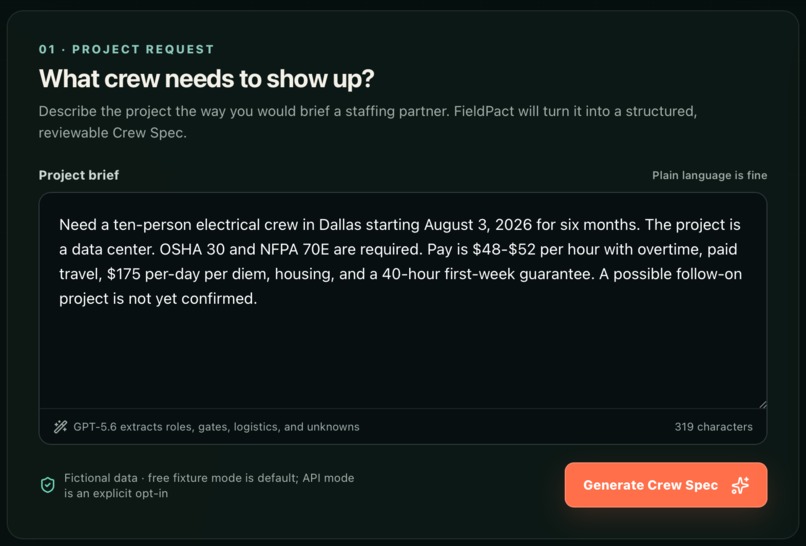
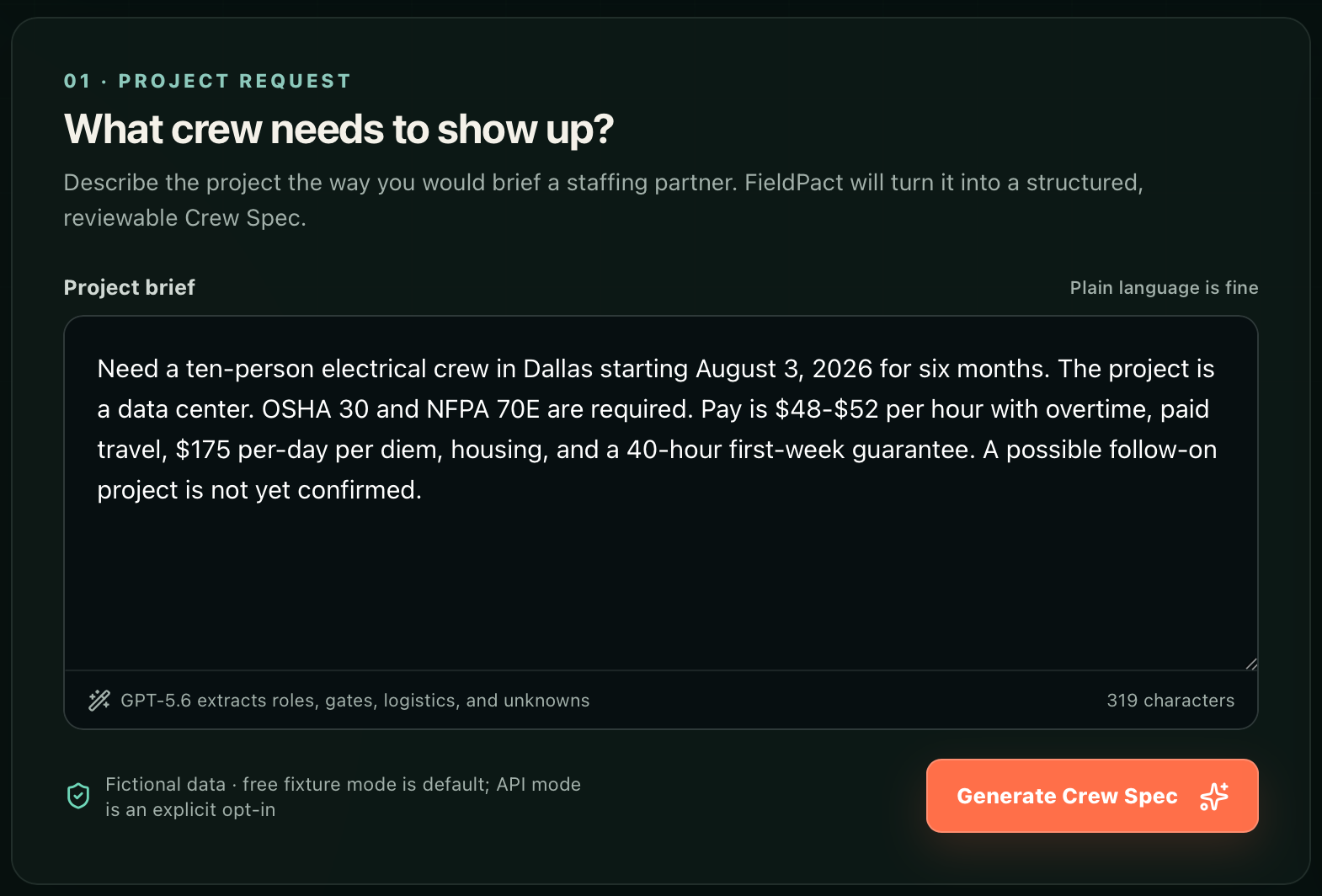
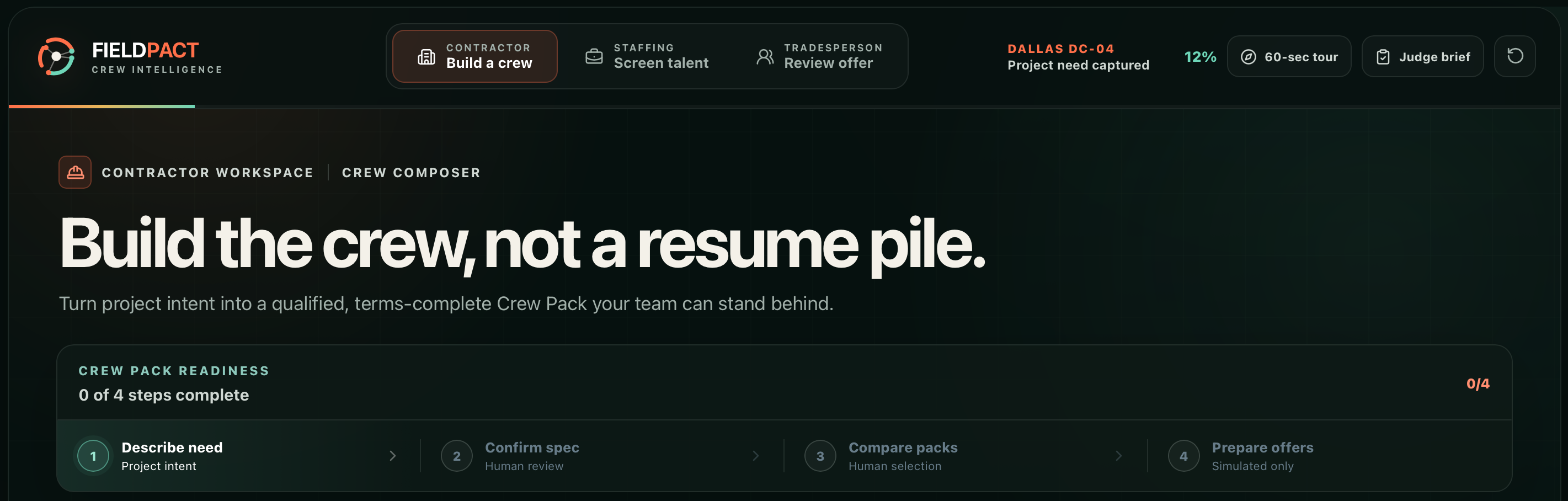
A contractor describes the job in plain language; GPT-5.6 structures roles, requirements, logistics, terms, and unknowns.
-
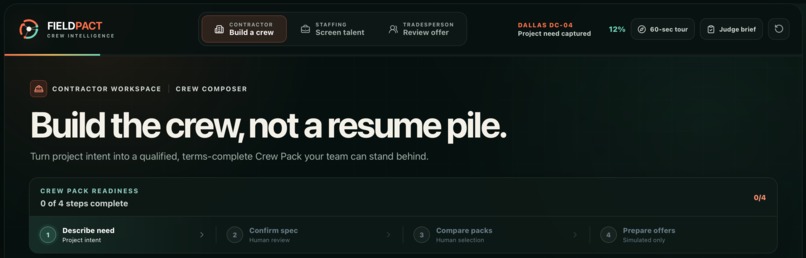
FieldPact turns project intent into a qualified, terms-complete Crew Pack through one human-controlled workflow.
-
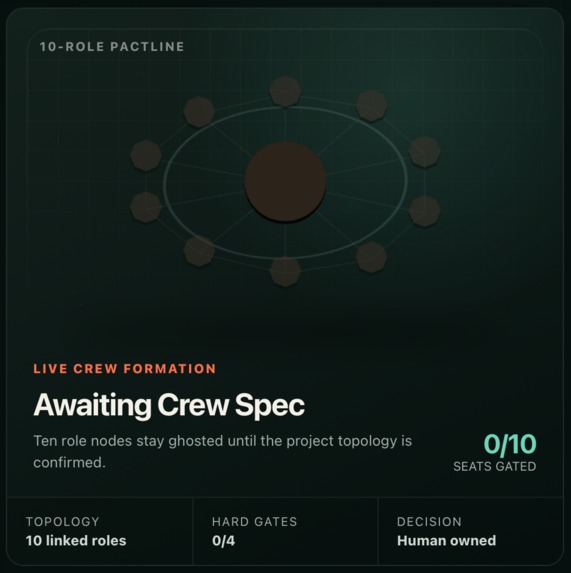
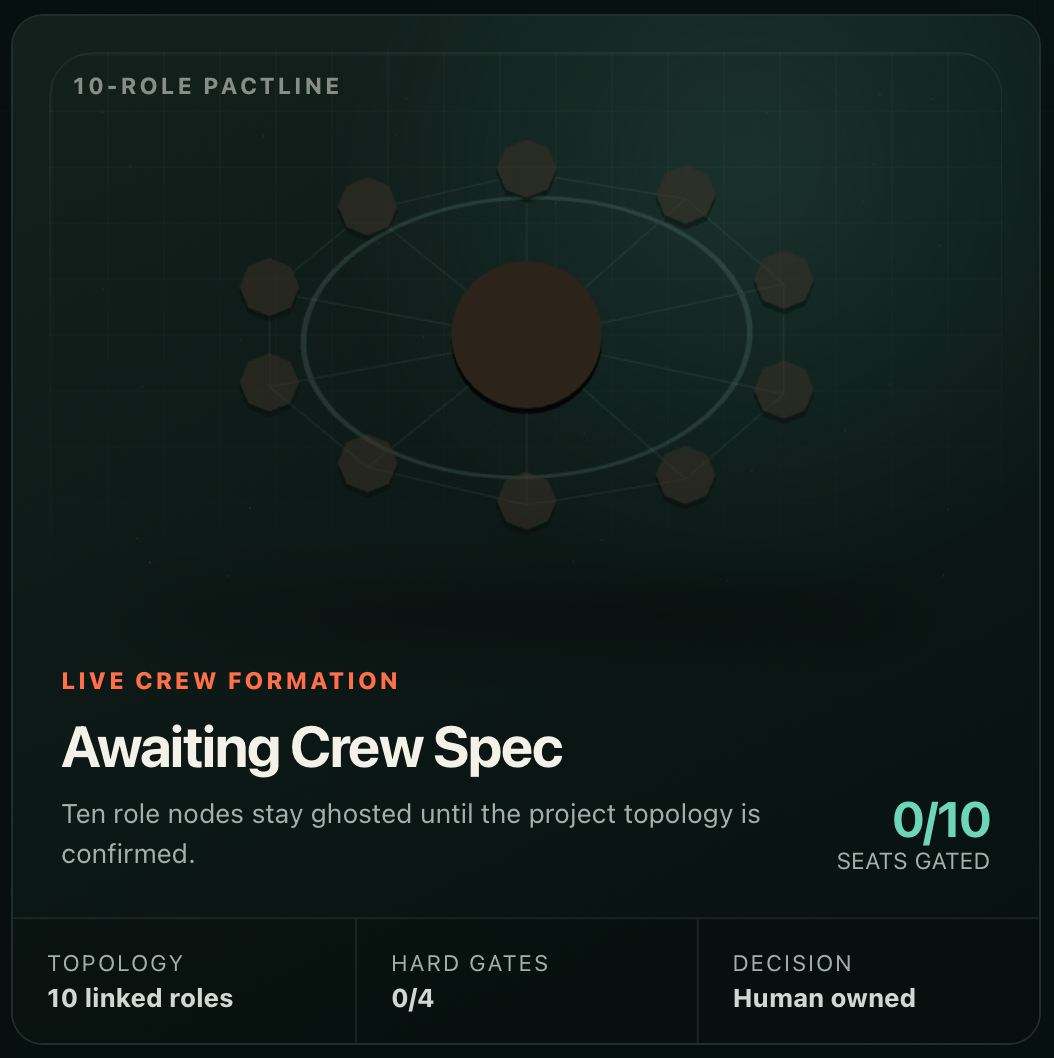
The ten-role Pactline visualizes crew readiness as the Crew Spec, hard gates, assignments, offers, and recovery progress.
Short description
Contractors do not need ten unrelated resumes. They need one qualified crew that can start together under clear terms.
FieldPact transforms a contractor’s plain-language project brief into a validated Crew Spec and three complete Crew Pack options. Deterministic code enforces credential, date, availability, skill, travel, and role-composition requirements, while GPT-5.6 supports project understanding, trade-specific screening, and grounded Career Proof.
When a worker declines, FieldPact proposes a qualified same-role replacement while preserving the other nine assignments. Recruiters receive source-linked evidence without an AI hire/reject verdict, and workers see complete offer terms before responding.
Inspiration
FieldPact started with a problem our friend, Gerald, had seen repeatedly in skilled-trades staffing. Contractors could often find individual electricians, but finding enough qualified people to form a complete crew, at the time they were needed, and at a workable cost was painful. Conventional staffing systems were organized around applicants, while field operations were organized around crews.
That realization led us to a different thesis:
Most hiring software treats the applicant as the unit of work. FieldPact treats the deployable crew as the unit of work.
We also recognized a second problem: successful work often disappears once a project ends. Workers may complete difficult assignments, lead teams, solve field problems, and earn trust, but those accomplishments rarely become portable evidence they can carry forward.
FieldPact was designed around both ideas:
- the contractor should be able to evaluate a complete crew, not a pile of disconnected applicants
- successful work should compound into worker-controlled Career Proof.
The public need is substantial. The U.S. Bureau of Labor Statistics projects about 81,000 electrician openings per year from 2024–2034, and the Associated General Contractors of America continues to report difficulty filling hourly craft roles. These sources establish the labor context, not FieldPact’s business impact. Broader structured validation with contractors, staffing recruiters, and tradespeople is still ahead.
What it does
For OpenAI Build Week, we intentionally built one polished golden path instead of trying to solve the entire workforce ecosystem at once.
The demonstration follows one fictional scenario: assembling a ten-person electrical crew for a Dallas data-center project.
- A contractor submits a plain-language project need.
- GPT-5.6 structures that request into a strict Crew Spec covering project details, required roles, qualifications, logistics, terms, assumptions, and unknowns.
- A person reviews and confirms the Crew Spec before matching begins.
- Deterministic TypeScript validates that the role equation equals ten, applies hard gates, prevents duplicate assignments, and blocks a fictional candidate whose required NFPA 70E training record is expired for the project.
- The contractor compares three complete Crew Pack options through transparent operational lenses:
- Evidence depth
- Lower mobilization exposure
- Stronger ready-alternate coverage
- No worker-quality score is shown. Every option satisfies the same hard requirements, and a person chooses the operational trade-off.
- The contractor prepares a fictional complete-terms offer batch. No external message is sent.
- A tradesperson reviews rate, overtime, schedule, travel, per diem, housing, first-week guarantee, project duration, and clearly unconfirmed follow-on work.
- If a worker declines, FieldPact proposes a qualified same-slot alternate, preserves the other nine assignments, and requires contractor confirmation.
- Recruiter Copilot provides trade-specific screening questions, follow-up prompts, strong-answer signals, supported evidence, unverified claims, and unresolved unknowns without issuing a hire/reject verdict.
- The worker receives a grounded Career Proof draft based on supplied performance facts and can approve, correct, or reject it.
A state-driven ten-role formation mirrors the workflow across request, specification, selected pack, offer, decline, and recovered states. The visualization makes crew topology legible, but it does not calculate eligibility or replace the inspectable evidence beneath it.
Why it is different Most staffing products focus on applicant matching, shift filling, or individual vetting. FieldPact is different because it treats the deployable crew as the operational unit. That shift changes the workflow: '''project brief → confirmed Crew Spec → deterministic hard gates → complete Crew Pack options → human selection → transparent offers → worker response → same-slot recovery → worker-controlled Career Proof ''' Its Build Week differentiation is the combination of:
- the crew, rather than the individual applicant, as the unit of work;
- three transparent pack-level trade-off lenses;
- deterministic same-slot recovery when a worker declines;
- one evidence vocabulary across contractor, recruiter, and worker experiences; complete terms before commitment; and
- source-grounded Career Proof controlled by the worker. The AI boundary is explicit:
- GPT-5.6 handles language reasoning and structured drafting;
- deterministic TypeScript handles eligibility, dates, role arithmetic, uniqueness, pack logic, and source checks;
- accountable people make every employment decision.
How we built it
FieldPact is a responsive Next.js, React, and TypeScript application.
Shared Zod contracts connect server routes, fictional fixtures, deterministic validators, tests, and UI state. The Pactline interface uses CSS Modules and a compact semantic palette so actions, verified evidence, attention states, and declines remain visually distinct across contractor, recruiter, and worker experiences.
Three server-only AI routes use the OpenAI Responses API with GPT-5.6 Structured Outputs:
- Crew request normalization
- Trade-specific screening and evidence organization
- Grounded Career Proof drafting
GPT-5.6 is used where language context adds visible value.
Deterministic TypeScript owns everything requiring certainty, including:
- credential expiry;
- availability and travel compatibility;
- role arithmetic;
- unique assignment;
- pack generation;
- declined-worker exclusion;
- prohibited screening topics;
- source-ID checks; and
- unsupported numeric-claim checks.
Fixture mode is the default judging path. It returns clearly labeled, schema-valid canonical responses and records 'openAIRequestAttempted: false'. Judges do not need an API key, paid plan, or billable runtime request. Live GPT-5.6 mode is available as an optional paid opt-in and is never misrepresented as the source of a fixture result.
The demo uses twenty fictional profiles and no real personal data. Vitest covers schemas, route contracts, matching, grounding, pack lenses, expired credentials, and decline recomputation. Playwright covers the connected contractor, recruiter, and worker paths at desktop and mobile widths.
The contractor experience includes one bounded Three.js formation driven by workflow state. The module loads only in the browser, pauses when offscreen, respects reduced motion, and disposes its graphics resources. An SVG topology and ordinary DOM text remain available if WebGL does not initialize.
How we used GPT-5.6 GPT-5.6 handles the language-intensive parts of FieldPact:
- transforming a messy project brief into a strict Crew Spec;
- separating supplied facts from assumptions, unknowns, and clarifying questions;
- generating trade- and project-specific screening questions;
- organizing supported evidence, unverified claims, and unresolved gaps;
- drafting Career Proof from supplied fact IDs.
Every model response must pass its Zod schema and route-specific deterministic validators before the application can use it.
GPT-5.6 does not:
- determine eligibility;
- rank workers;
- choose a Crew Pack;
- infer protected traits;
- or issue a hire/reject verdict.
How we used Codex Codex helped turn an early workforce-platform concept and dense visual mockups into a focused, deadline-sized product.
It accelerated:
- research synthesis;
- scope reduction;
- repository setup;
- architecture;
- implementation;
- test and eval generation;
- responsive visual QA;
- adversarial claim review; and
- documentation.
Human-owned decisions include the FieldPact name, the electrical/data-center wedge, the crew-as-unit thesis, the three pack lenses, the employment-safety boundary, fixture transparency, the use of fictional data, the design direction, and every final submission claim.
Primary build thread: Codex Session ID: 019f820b-4c2b-74e0-a401-5cb34577ea6f
Challenges we ran into
Building a free, reliable demo without pretending fixtures are live
Judges should not need an API key or paid balance.
We made zero-cost fixture mode the safe default, kept live and fixture responses on the same strict contracts, recorded whether an OpenAI request was attempted, and exposed provenance in every route-backed experience.
Showing crew intelligence without creating an opaque worker score
A single numerical candidate score would hide trade-offs and imply unjustified precision in an employment context.
FieldPact applies disclosed hard gates first, then presents three pack-level operational lenses with explanations. Mobilization exposure is based on supplied locality and availability facts, not predicted behavior.
Connecting three personas without building three disconnected products
We did not want separate contractor, recruiter, and worker demos that happened to share a logo.
Crew Composer is the core workflow. Recruiter evidence makes the Crew Pack reviewable. Career Proof allows completed work to compound for the worker.
One Crew Spec and one evidence model connect all three experiences.
Demonstrating recovery instead of a static happy path
A crew is not ready merely because ten cards appear.
FieldPact removes a declined worker from the current offer, proposes a qualified same-slot alternate, preserves the other nine assignments, and requires contractor confirmation.
Using 3D to clarify the product instead of decorating it
We wanted the crew-as-unit thesis to be visible immediately without turning an employment workflow into a game.
The final solution is one constrained role topology whose nodes change only when the workflow changes. Every visual state has an ordinary text equivalent and static fallback.
Accomplishments that we're proud of
We are proud that we completed one deeply connected workforce workflow rather than a collection of unrelated AI features.
FieldPact now includes:
- one exact ten-role electrical Crew Spec;
- ten unique assignments drawn from twenty fictional profiles;
- three transparent pack-level lenses with no worker-quality score;
- one expired required NFPA 70E record blocked before selection;
- deterministic same-slot reassembly after a decline;
- a state-driven Three.js crew formation with SVG fallback;
- three route-backed, provenance-labeled AI experiences;
- complete fictional offer terms before worker response;
- no-verdict recruiter evidence;
- worker-controlled Career Proof;
- a resettable, zero-cost judge path with no API request;
- and unit, route-contract, grounding, eval, desktop, and mobile end-to-end coverage.
These are implementation results, not claims of real hiring outcomes, customer adoption, credential verification, ROI, or staffing-speed improvement.
What we learned
The biggest lesson was that Structured Outputs are most useful inside a larger operational contract.
Schema validation alone is not enough.
Reliable AI workflows also need:
- explicit provenance;
- stable evidence IDs;
- deterministic validators;
- human confirmation;
- correction paths; and
- tests.
We also learned that crew readiness is more informative than a stack of individual match scores. It forces the product to surface role coverage, missing evidence, logistics, complete terms, decline recovery, and worker readiness together.
Most importantly, we learned that AI is strongest when it helps expertise scale.
Recruiters and project leaders already understand people and field operations. Their challenge is coordinating complexity across roles, credentials, availability, logistics, and project demands.
AI organizes the complexity.
Deterministic software enforces the rules.
People exercise judgment.
Potential impact and measurement Our north-star metric is:
Time from project request to a fully qualified, accepted crew. Supporting measures include:
- required-role coverage;
- credential coverage;
- time to a confirmed Crew Spec;
- open versus accepted crew slots;
- recruiter evidence completeness;
- offer acceptance and correction rates;
- assignment completion;
- and the percentage of career claims backed by verified source records.
The MVP does not claim measured improvement on these outcomes. Real validation with contractors, staffing teams, and tradespeople must come before production or ROI claims. Responsible-AI boundary FieldPact is a fictional decision-support demonstration, not a production hiring system.
- A person confirms the Crew Spec.
- A person chooses the operational lens.
- A person initiates the fictional offer batch.
- A recruiter reviews the screening evidence.
- A worker controls their Career Proof.
- The model never makes an autonomous hire, reject, compensation, promotion, or termination decision.
- Protected traits and photos are excluded from matching and assessment inputs.
- Workers can decline without fictional priority penalty.
- Follow-on work remains explicitly unconfirmed. Production use would require legal, privacy, security, accessibility, bias/outcome, and representative-user validation.
What's next for FieldPact
The next credible increment is stronger operational infrastructure:
- persistent projects;
- immutable offer snapshots;
- worker correction and appeal workflows;
- audit logs and access controls;
- verified credential and availability integrations;
- and structured field validation.
Only after those foundations would we expand into additional trades, ATS/payroll/messaging integrations, consent-based crew-cohesion history, or production matching.
Our long-term vision is an AI workforce operating system that helps contractors deploy qualified crews faster, supports recruiters with evidence-backed decisions, and gives skilled tradespeople portable Career Proof that grows throughout their careers.
Because contractors do not need another pile of resumes.
They need confidence that the right crew will be ready when the work begins.
Built With
- codex
- css-modules
- gpt-5.6
- next.js
- openai-responses-api
- playwright
- react
- structured-outputs
- three.js
- typescript
- vitest
- zod

Log in or sign up for Devpost to join the conversation.