-
-
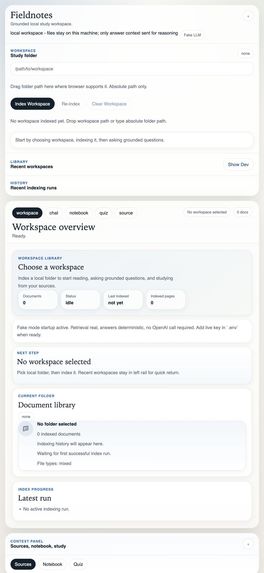
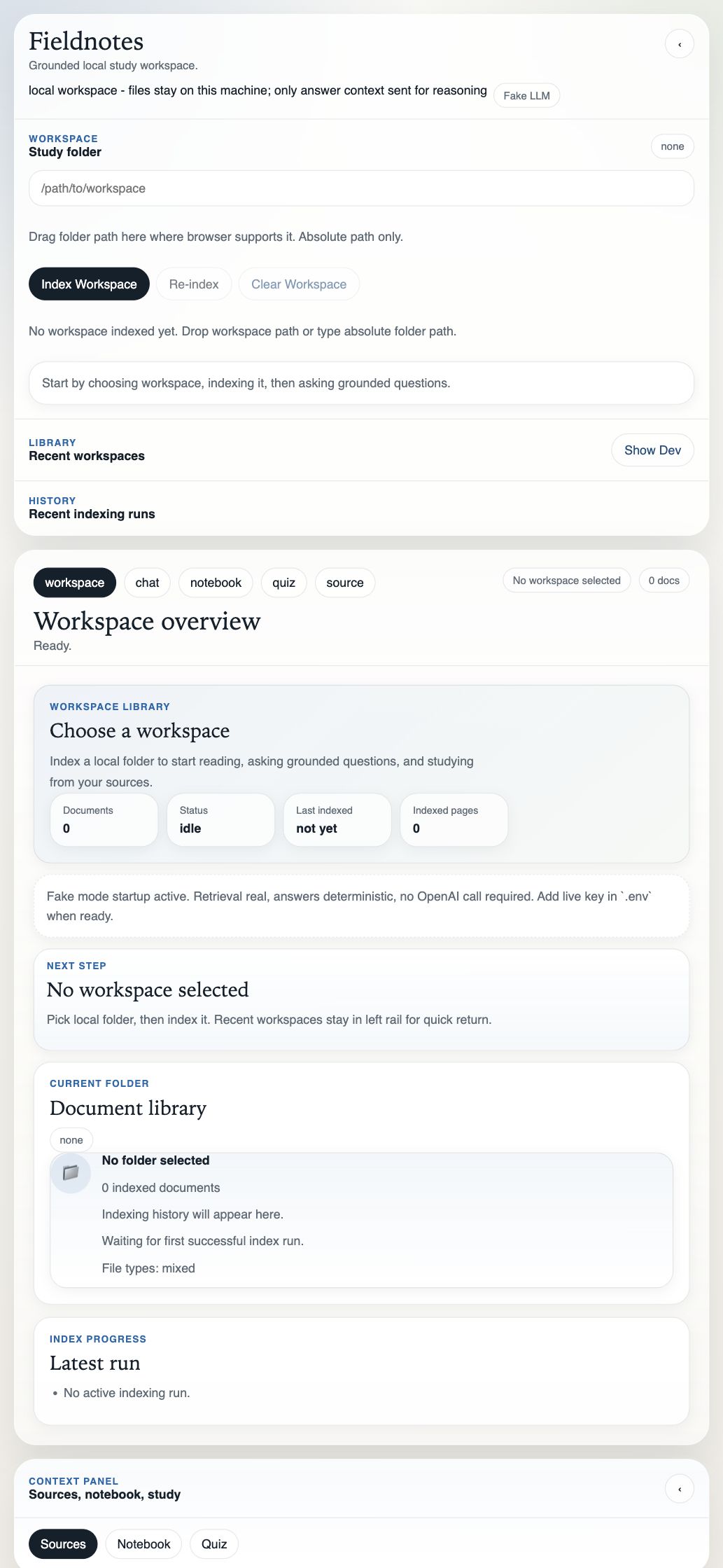
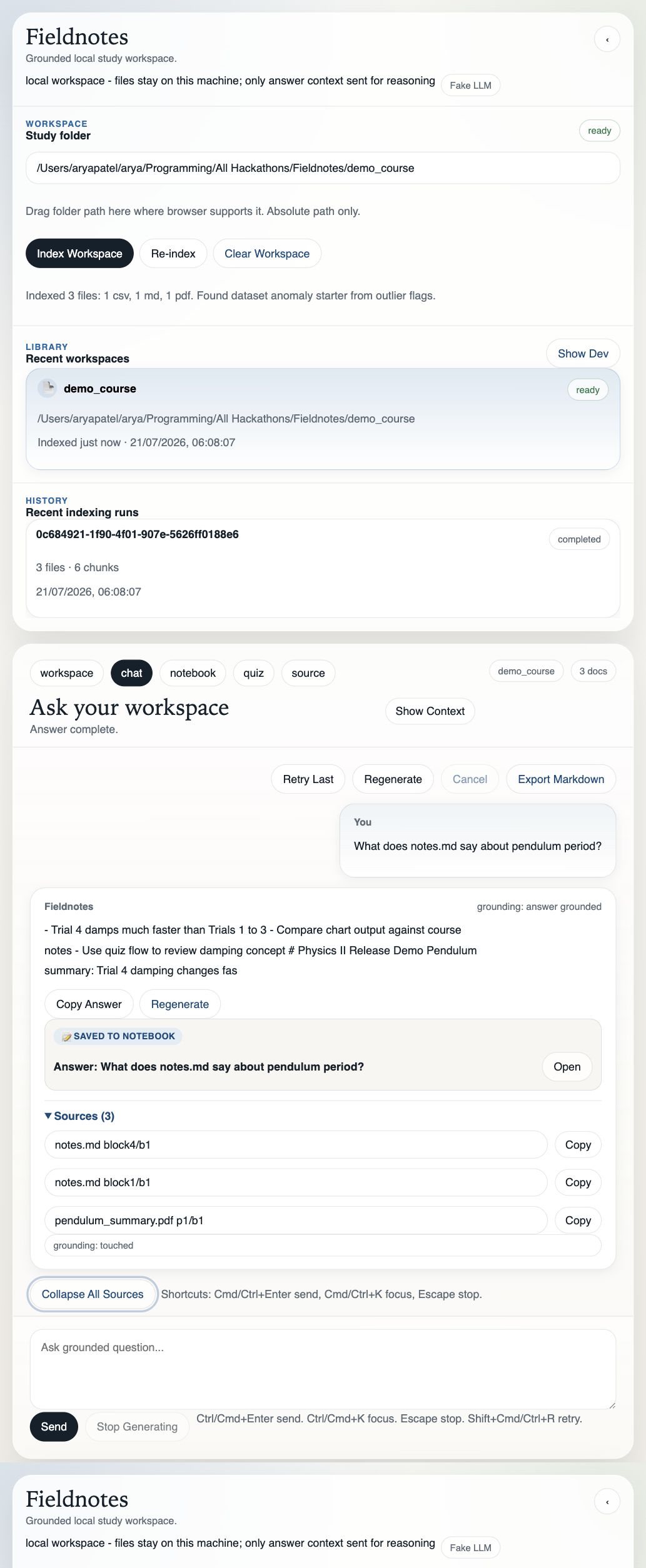
Dashboard
-
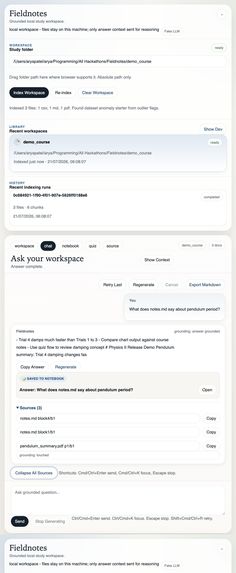
Chat
-

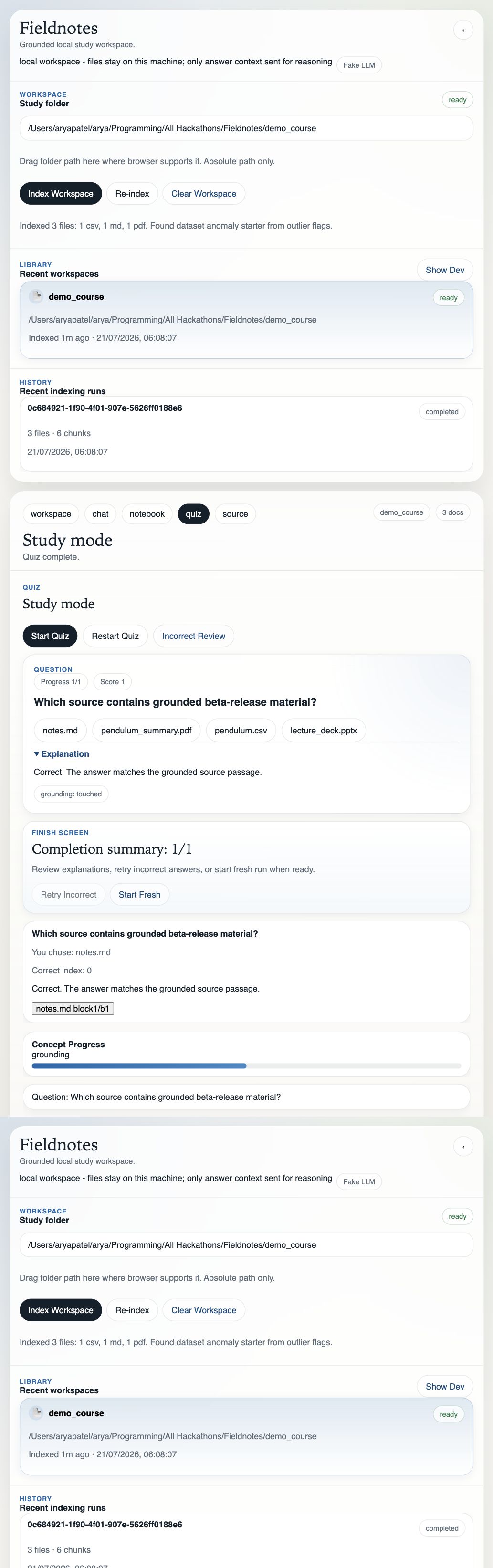
Quiz
-
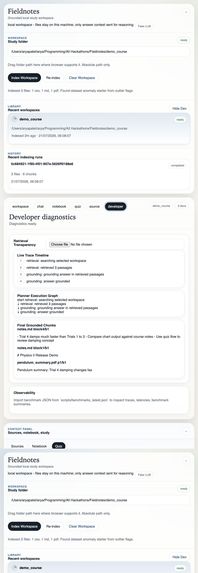
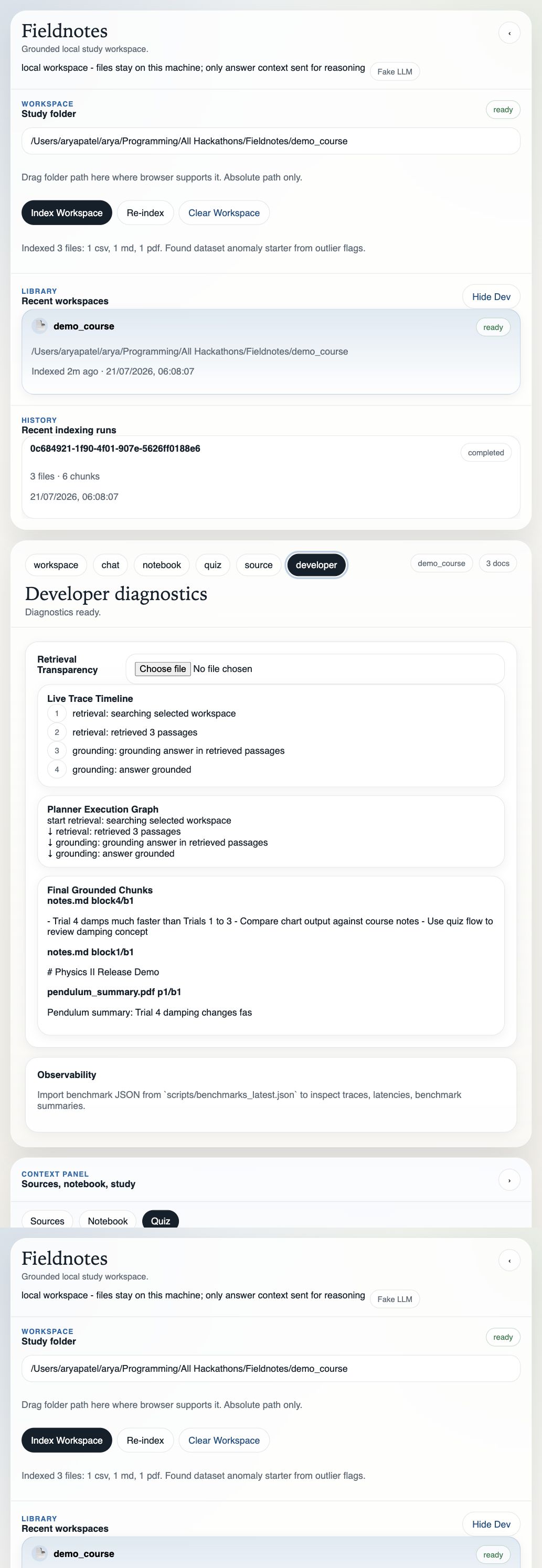
Developer Diagnostics
Inspiration
Research and studying today are fragmented. Students, researchers, and professionals constantly switch between PDFs, lecture slides, notes, datasets, and websites, wasting valuable time searching for information instead of learning from it. We wanted to build an AI-powered research companion that transforms scattered resources into a searchable, conversational knowledge base while keeping users in control of their data.
What it does
Fieldnotes is an AI-powered research workspace that enables users to upload documents, organize knowledge, and interact with their research through natural language. Instead of manually searching through folders, users can ask questions, retrieve relevant information, generate summaries, and quickly revisit previous work.
Key features include:
- Intelligent document ingestion
- Semantic search across uploaded files
- AI-powered question answering (RAG)
- Automatic summarization
- Local-first architecture for improved privacy
- Organized research workspace
How we built it
We built Fieldnotes using a modern AI stack focused on scalability and privacy.
- Frontend: React, TypeScript, Vite
- Backend: FastAPI (Python)
- AI: Retrieval-Augmented Generation (RAG), embeddings, LLMs
- Storage: PostgreSQL with Redis caching
- Authentication: JWT
- Infrastructure: Docker, GitHub Actions, Microsoft Azure
The pipeline processes uploaded documents, extracts meaningful text, generates semantic embeddings, retrieves the most relevant context, and uses an LLM to generate grounded, context-aware responses.
Challenges we ran into
Building Fieldnotes presented several technical challenges:
- Processing multiple document formats consistently.
- Creating accurate semantic search across thousands of document chunks.
- Preventing AI hallucinations by grounding responses in retrieved context.
- Designing a local-first architecture without sacrificing usability.
- Building an efficient retrieval pipeline while maintaining low response times.
Accomplishments that we're proud of
We're proud of creating a platform that goes beyond traditional note-taking.
Some highlights include:
- Building an end-to-end AI research assistant.
- Successfully implementing Retrieval-Augmented Generation.
- Creating a clean, intuitive research workspace.
- Designing a privacy-focused local-first architecture.
- Developing a scalable foundation for future AI agents and research automation.
What we learned
Throughout the project we learned:
- The importance of high-quality retrieval before generation.
- Chunking and embedding strategies significantly impact answer quality.
- Privacy and user trust are critical when building AI applications.
- AI systems perform best when grounded in reliable contextual information.
- Building AI products requires balancing accuracy, speed, and user experience.
What's next for Fieldnotes
Our vision is to evolve Fieldnotes into a complete AI research companion.
Future plans include:
- Multi-document reasoning
- Citation generation
- Research paper analysis
- Knowledge graph visualization
- AI agents for literature reviews
- Collaborative workspaces
- Offline AI capabilities
- Experiment planning and research workflow automation
Ultimately, we want Fieldnotes to help researchers spend less time searching for information and more time discovering new ideas.
Built With
- actions
- ai
- css
- embeddings
- fastapi
- github
- learning
- llm
- machine
- natural-language-processing
- openai
- postgresql
- python
- rag
- react
- search
- semantic
- tailwind
- typescript
- vector
- vite


Log in or sign up for Devpost to join the conversation.