-
-
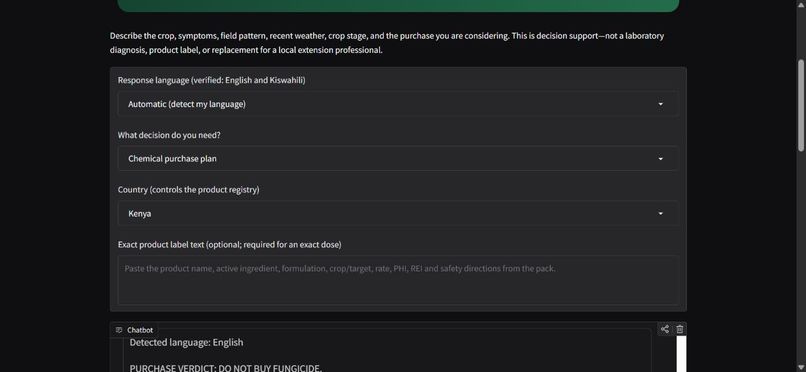
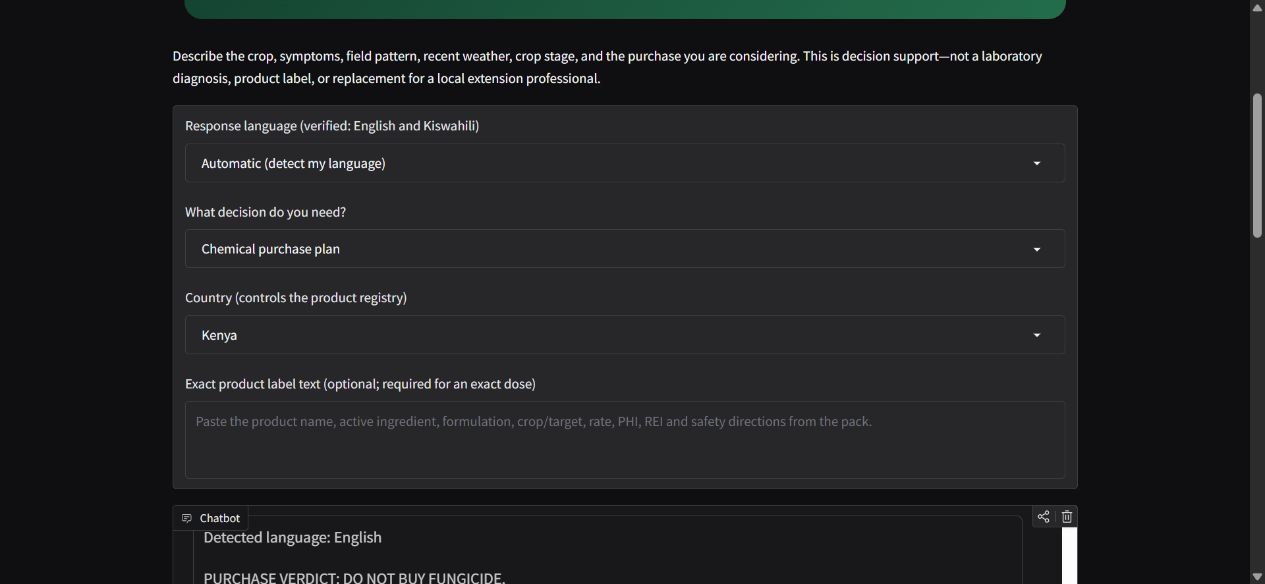
Cassava Spend Guard example: mosaic-like symptoms return DO NOT BUY FUNGICIDE with evidence and next checks.
-
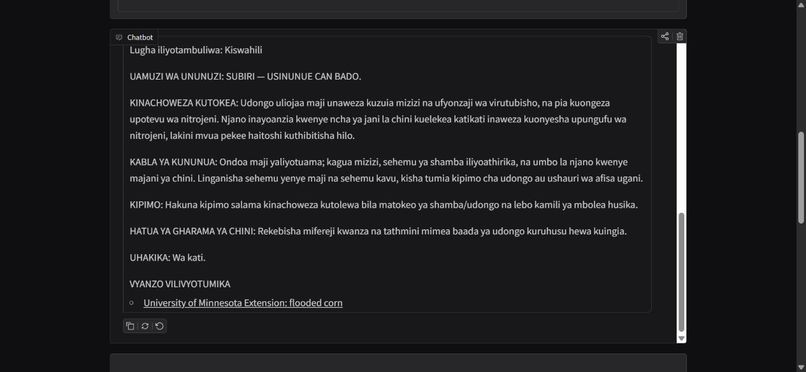
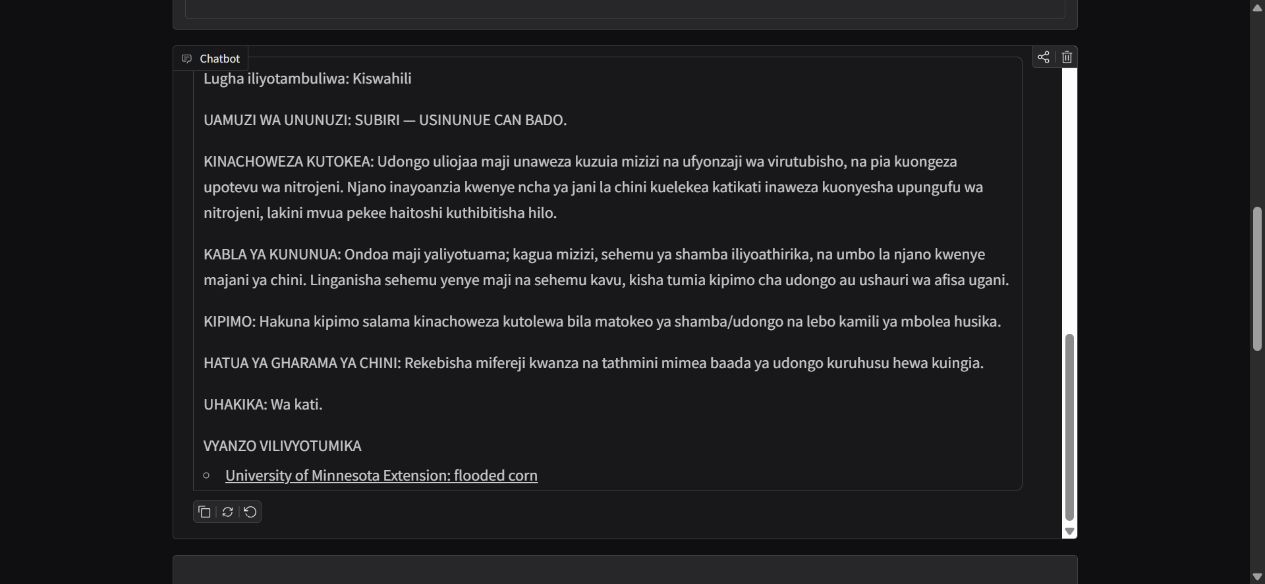
Kiswahili maize example: FieldMind detects the language and returns a clear USINUNUE CAN BADO verdict.
-
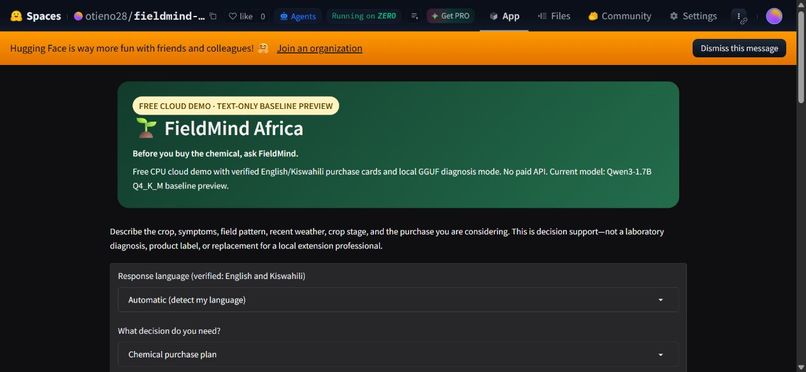
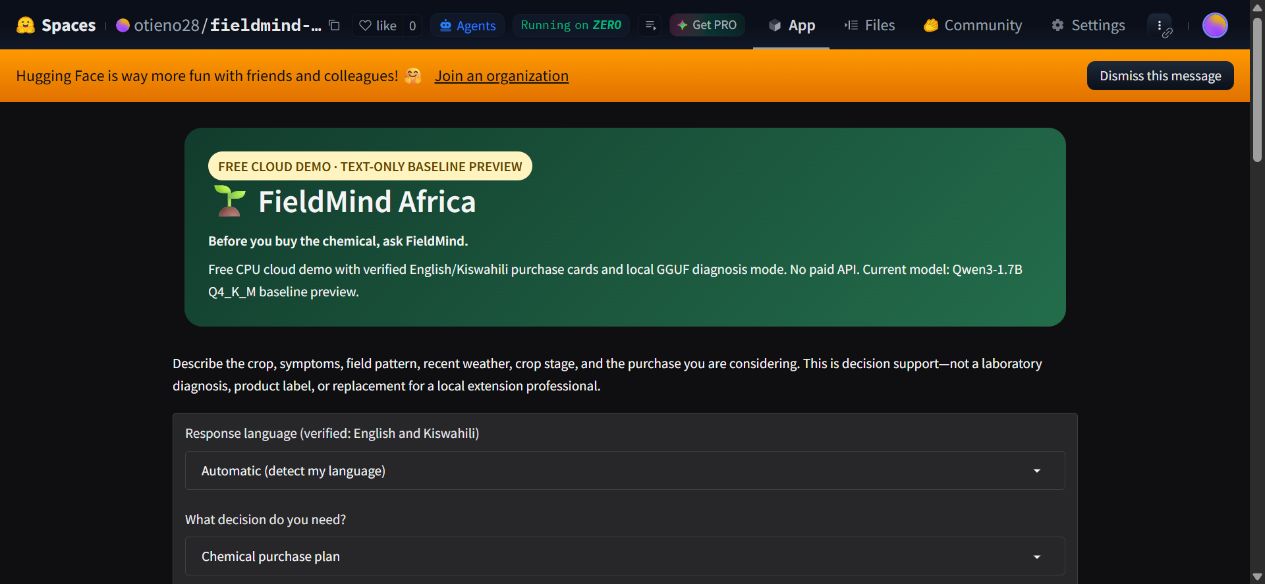
Free Hugging Face Spaces demo for English and Kiswahili crop input decisions—no paid inference API.
-

FieldMind Africa — offline agricultural purchase-decision AI: Before you buy the chemical, ask the laptop.

Inspiration
For a smallholder farmer, a wrong input purchase is not a harmless recommendation. It can consume the season's limited fertilizer or crop-protection budget while the real problem gets worse. Yellowing, curling, spotting, wilting and stunting are ambiguous, yet agricultural advice often jumps directly from one symptom to a chemical product.
FieldMind Africa was built for the decision before money changes hands.
Before you buy the chemical, ask the laptop.
The problem we solve
FieldMind Africa is not a generic farming chatbot. It is a focused agricultural purchase-decision assistant for extension offices, cooperatives, community centres and agro-input shops.
A farmer or extension worker describes the crop, symptoms, weather, field conditions and intended purchase. FieldMind's Spend Guard then:
- separates observed facts from possible causes;
- asks for the few field checks that can change the decision;
- recommends the lowest-cost reversible next step;
- explains what evidence would justify an input purchase;
- ends with a clear BUY, DO NOT BUY, or DO NOT BUY YET verdict;
- states confidence and missing information.
This protects scarce input budgets while keeping the farmer in control.
What it does
The public demo supports automatically routed English and Kiswahili responses. A farmer can write naturally in either language and receive the answer in that language.
For example:
- cassava mosaic-like symptoms return DO NOT BUY FUNGICIDE, because a fungicide will not treat a viral mosaic disease;
- flooded maize with lower-leaf yellowing returns DO NOT BUY CAN YET until drainage and root-zone conditions are checked;
- verified Kenya tomato scenarios can shortlist options backed by the Kenyan PCPB registry;
- unmatched chemical requests return DO NOT BUY YET and ask for the crop, target problem, country, product and label evidence.
FieldMind does not invent chemical doses or transfer a rate between formulations. It only transcribes an application rate from complete label text supplied by the user, and still requires verification of the crop, target, formulation, country, PPE, pre-harvest interval and re-entry interval.
The current ADTC entry is deliberately text-only. Image input is not claimed as a finished feature.
How we built it
Open model and free training
The model starts from Qwen3-1.7B, selected because its Apache-2.0 licence permits redistribution and its size is practical for free-GPU QLoRA training and CPU deployment.
We trained with Unsloth QLoRA on a freely allocated Google Colab T4—without paid APIs, GPU credits or proprietary inference services. The bounded training run completed 200 optimizer steps in 2,494 seconds and reached a training loss of 0.7590.
Reproducible African agriculture data
Our deterministic preparation pipeline processes CC-BY-4.0 Digital Green FarmerChat records for Kenya, Nigeria and Ethiopia. It:
- preserves per-record provenance;
- removes malformed, duplicate, redacted and unsafe dose-seeking records;
- creates a stable train/validation split;
- mixes project-authored Spend Guard behaviour examples;
- checks normalized-question hashes for leakage.
The executed build produced 11,280 training records, 316 validation records and a separate 24-question held-out evaluation suite covering general agriculture, African context and premature-spending safety. Validation found zero normalized-question overlap among training, validation and evaluation questions.
FarmerChat advisory answers are not treated as automatically expert-reviewed ground truth. The separate evaluation sets and deterministic purchase cards are explicit safeguards against overclaiming correctness.
Edge-ready model packaging
After training, we merged the adapter, converted the model to GGUF and generated Q3_K_M, Q4_K_M, Q5_K_M and Q6_K candidates with llama.cpp. The selected public artifact is:
FieldMind-Africa-1.7B-Q5_K_M
- Size: 1.26 GB
- SHA-256: 42e4b60d3df7f0661c65e1f85ffad11a1cf1be125105e09691712270d7c94795
- Runtime: llama.cpp on CPU
- Network dependency after download: none
- Application regression tests: 15/15 passing
Q5_K_M was selected as a quality-preserving middle point that remains comfortably below the ADTC memory ceiling.
ADTC profiler measurement
We ran the official ADTC profiler tool in participant mode on the public Q5_K_M artifact using CPU-only llama.cpp. The reproducible throughput/memory run measured:
- Generation throughput: 4.53 tokens/second
- Peak RSS: 1,412.72 MB
- Self-reported performance score (Sperf): 30.2
- Self-reported efficiency score (Seff): 80.2913
The run skipped the profiler's accuracy stage, so these are specifically the measured performance and memory-efficiency results—not a claim of an official accuracy score or final competition ranking.
Free public demonstration
The live demo runs on free Hugging Face Spaces CPU infrastructure and uses no paid inference API. Purchase mode uses deterministic, evidence-backed decision cards for responsiveness and safety. The public trained GGUF remains the competition artifact and can run locally through llama.cpp.
Why it matters for Africa
The African use case is not a decorative theme; it determines the design:
- Kenya, Nigeria and Ethiopia are represented in the data pipeline;
- crops include maize, cassava, beans, tomato, sorghum, banana and cowpea;
- prompts include heavy rain, waterlogging, rain-fed production, limited budgets and local service access;
- English and Kiswahili are verified;
- the 1.26 GB model supports offline CPU inference where connectivity and cloud cost are constraints;
- the product is designed for institutions farmers already visit rather than requiring every farmer to own a new device.
FieldMind connects scientific reasoning, constrained-device engineering and a clear product outcome: fewer unjustified input purchases.
Challenges we ran into
The hardest product problem was not generating more possible causes—it was deciding when the available evidence justified spending money. A small model could drift between languages, repeat dose phrases or sound certain on unmatched questions.
We responded by narrowing the verified language promise to English and Kiswahili, moving high-risk purchase decisions to tested evidence cards, isolating each farmer case, grounding exact-dose handling in label text and keeping the direct GGUF artifact as the competition truth.
The engineering constraint was equally important: everything had to remain free, reproducible and runnable on ordinary hardware. The pipeline therefore avoids paid APIs, proprietary datasets, GPU credits and cloud inference endpoints.
Accomplishments
- Deployed a working free-cloud demo with clear purchase verdicts.
- Published a credential-free 1.26 GB Q5_K_M GGUF with a pinned checksum.
- Built a deterministic open-data pipeline with provenance and zero train/eval question leakage.
- Implemented complete English and Kiswahili response routing.
- Added label-grounded dose handling that refuses to invent or transfer application rates.
- Passed 15/15 application regression tests.
- Measured real CPU throughput and peak memory with the official ADTC profiler tool.
- Kept the complete build on free and open resources.
What we learned
Agricultural usefulness is not the same as diagnostic confidence. A model can create real value by protecting a farmer from an unjustified purchase, identifying the next observation and admitting what it cannot know.
We also learned that demo middleware can hide weaknesses that a direct GGUF evaluator will expose. Reproducibility, transparent limitations and direct artifact measurement are therefore part of the product—not documentation added at the end.
What's next
Next we will add agronomist review, expand country-specific product registries, collect more verified African-language examples and package the GGUF in a small offline desktop/mobile interface for extension teams.
Image input will only be added after field testing proves that image quality, crop coverage and device constraints improve decisions rather than merely making the demo look multimodal.
Try it and verify it
- Live free cloud demo
- Public source and reproducible pipeline
- Public GGUF model
- Technical report
- Demo video
FieldMind Africa is advisory decision support. It is not a laboratory diagnosis, pesticide label or replacement for a local extension professional.

Log in or sign up for Devpost to join the conversation.