Inspiration
Most service businesses don't lose customers because they don't have a chatbot. They lose them because a customer enquiry arrives as messy, incomplete natural language, and someone still has to understand it, determine what the business can actually offer, calculate the right price, check availability, assess risk, and decide what should happen next.
We wanted to build something different.
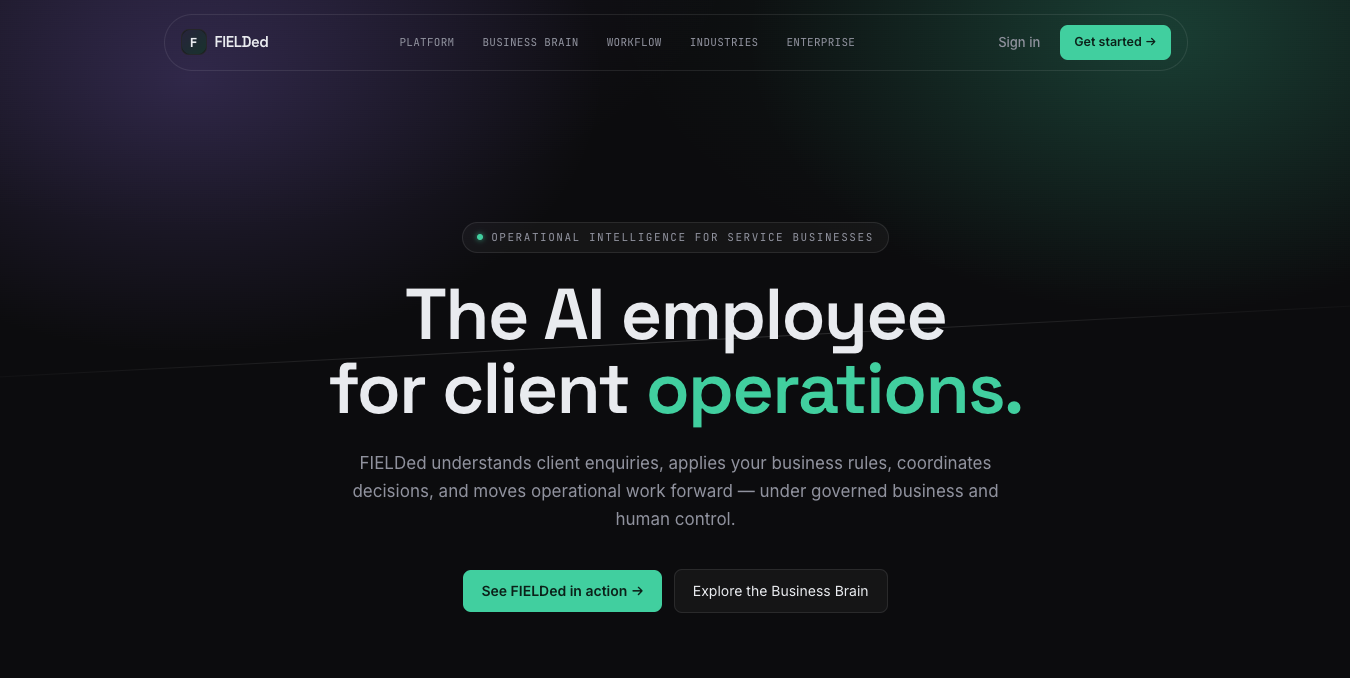
FIELDed. is an AI Client Operations Employee for service businesses.
The idea came from asking a simple question:
What if AI could do more than answer a customer — what if it could actually understand the business and help operate it?
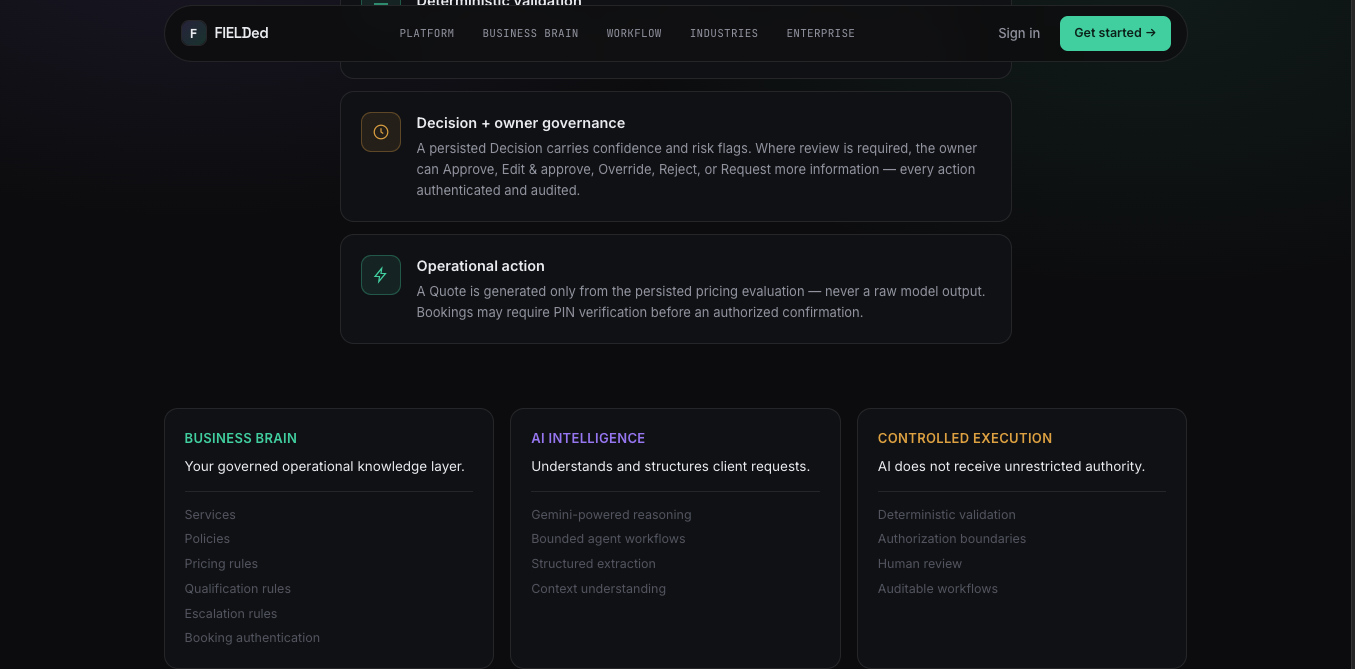
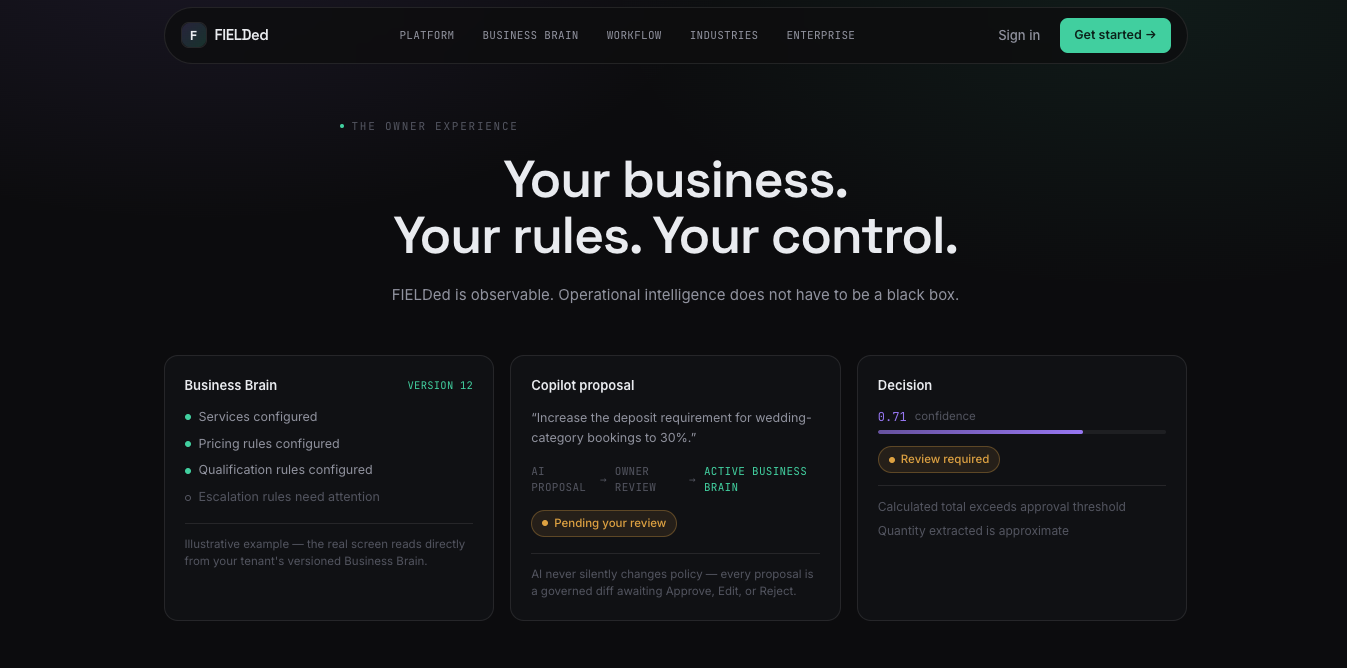
That led us to the concept of the Business Brain: a structured, versioned representation of a business's services, pricing, policies, availability, escalation rules, and customer-facing knowledge.
The Business Brain gives AI something many generic assistants lack: business-specific context and boundaries.
Our goal is to move from AI that merely generates responses to AI that can participate meaningfully in real business operations.
What it does
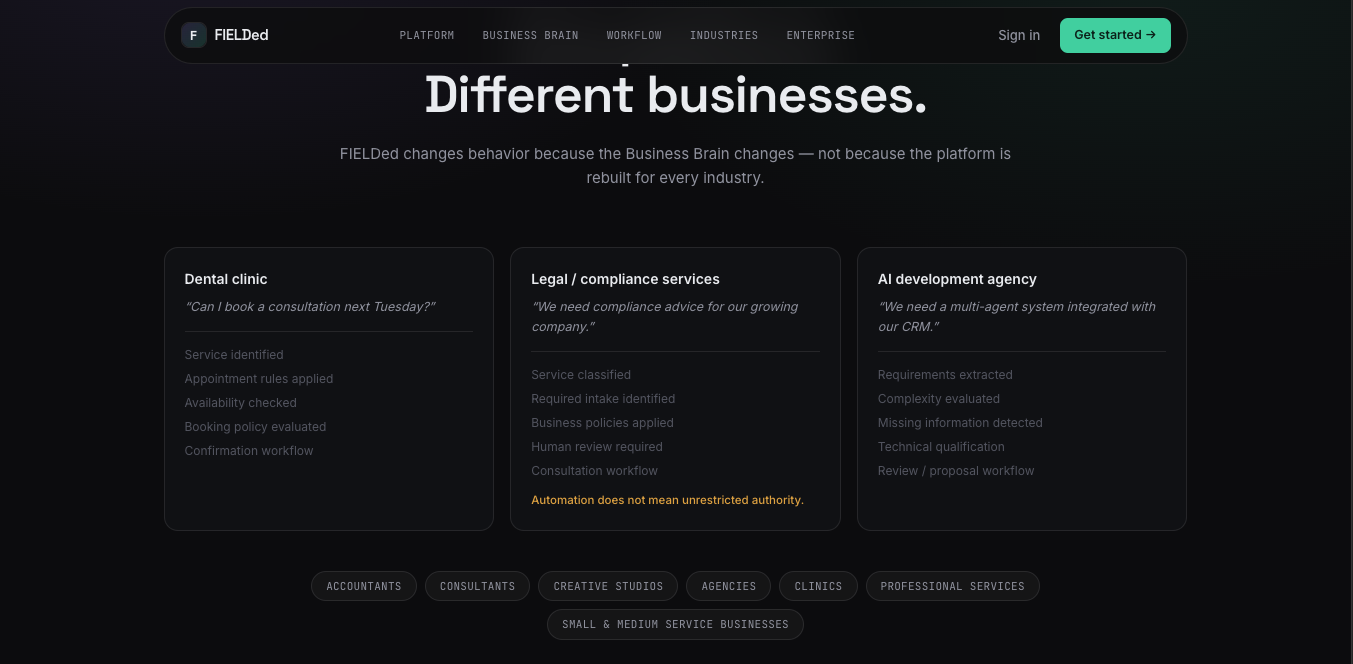
FIELDed. takes a customer enquiry and moves it through an operational decision workflow.
A typical journey looks like:
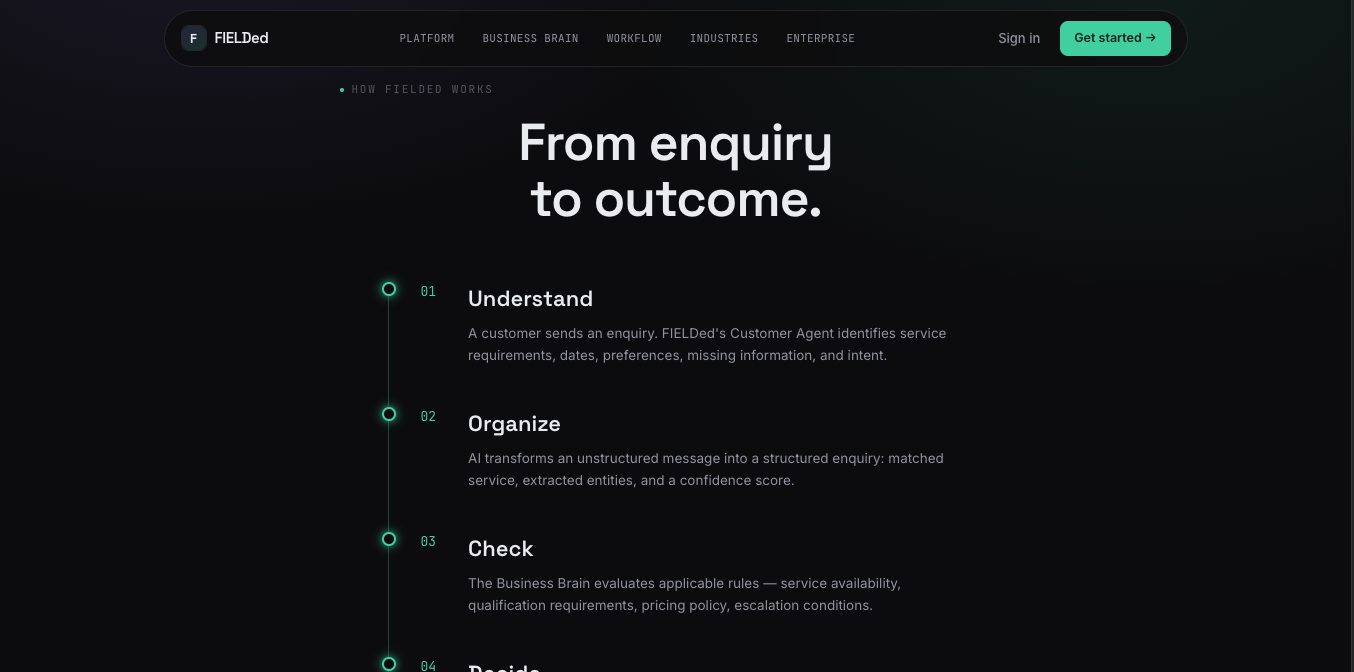
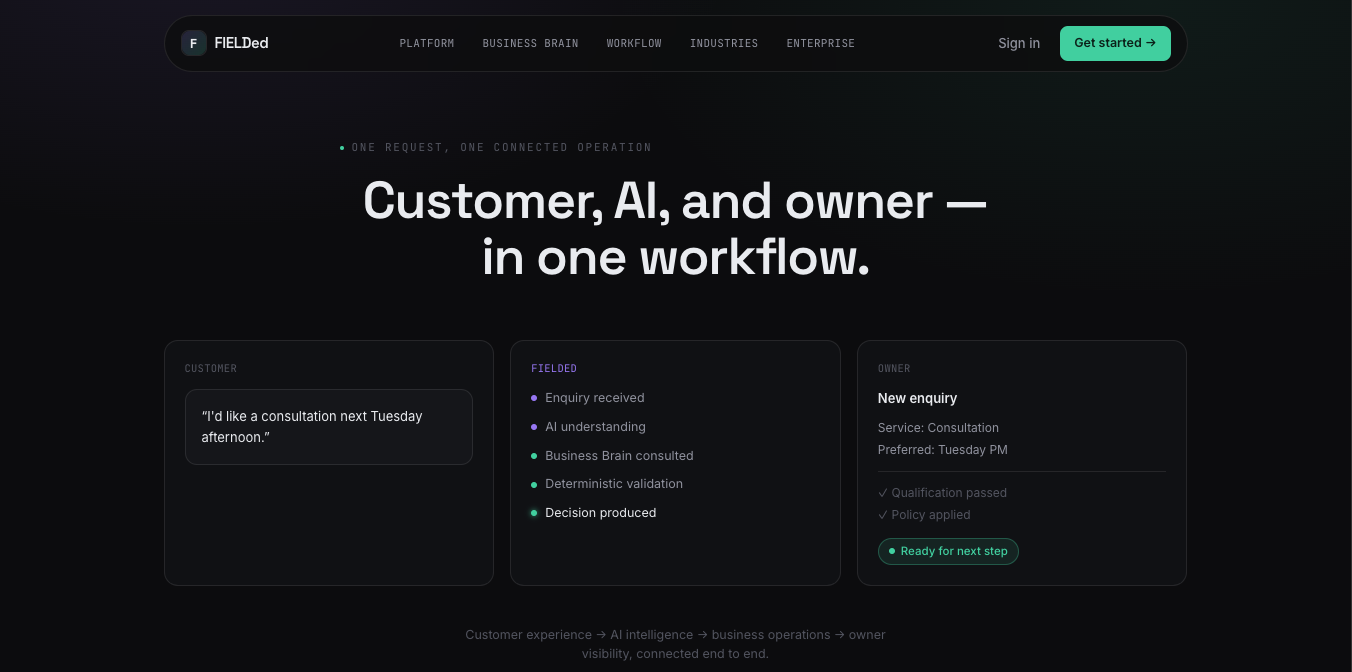
Customer Enquiry → Understanding → Business Brain → Pricing → Scheduling → Risk & Policy → Decision → Human Review / Action
For example, a customer might ask:
"I need a corporate event photographer for about 80 people next month. What would that cost?"
FIELDed. can interpret the request, identify the relevant service, apply the business's pricing rules, check scheduling constraints, evaluate uncertainty or risk, and determine what should happen next.
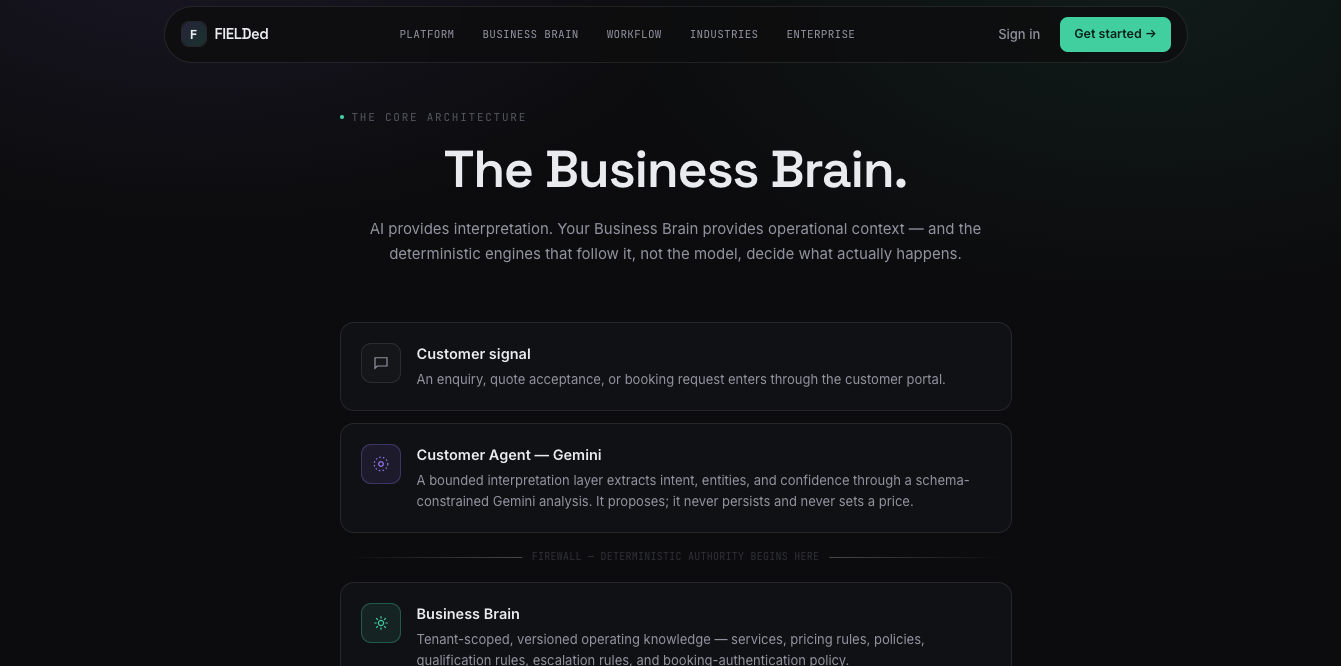
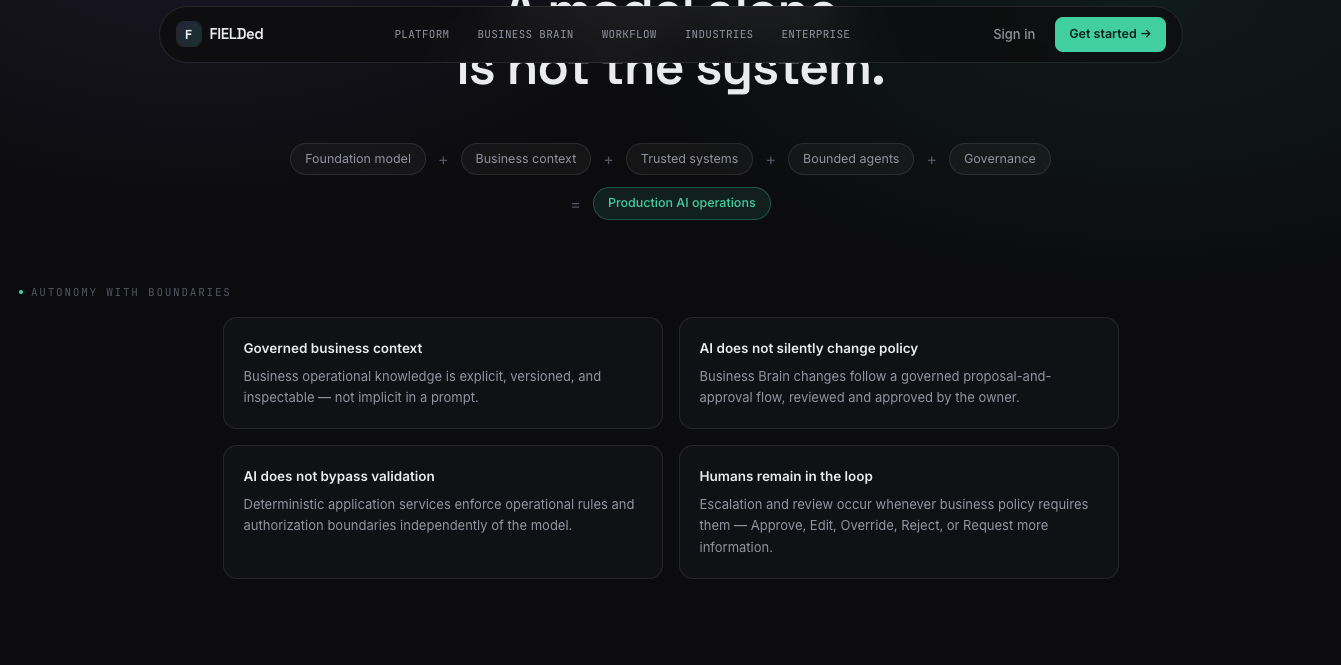
The important distinction is that FIELDed. does not allow the LLM to become the source of truth.
Gemini can interpret and propose.
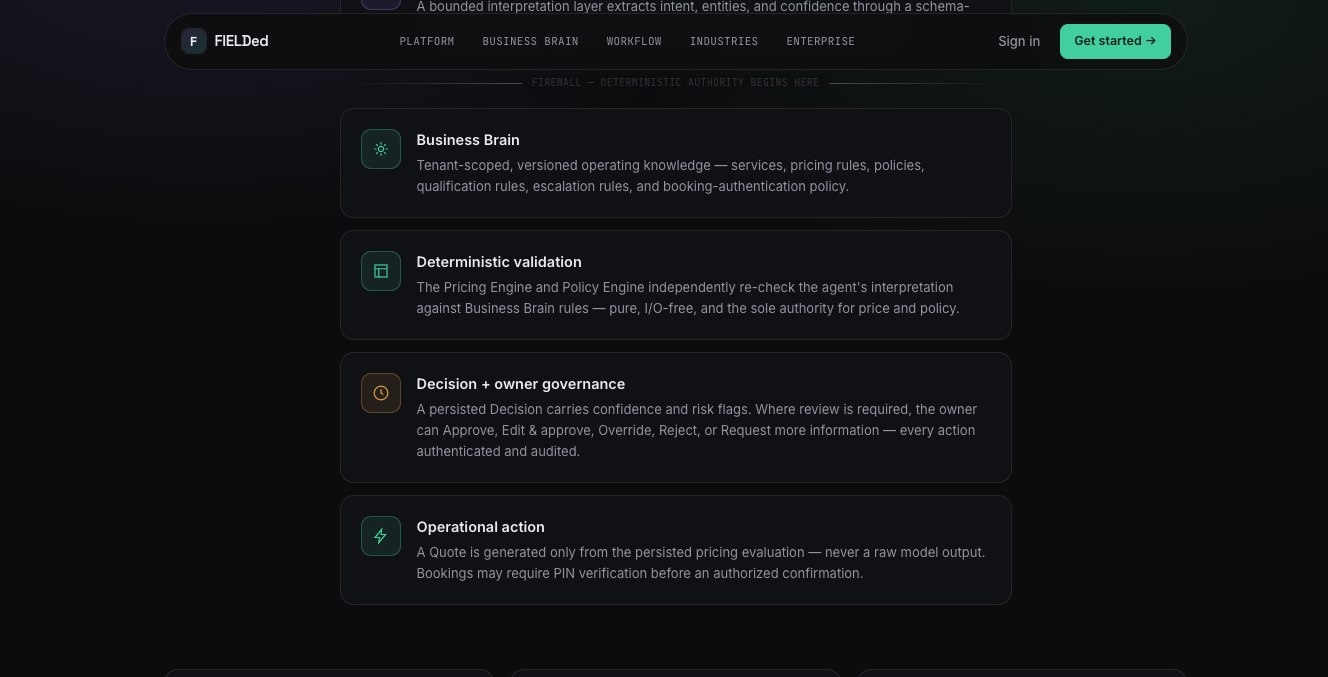
Deterministic application logic remains responsible for:
- Pricing calculations
- Scheduling and availability validation
- Policy enforcement
- Authorization
- Business Brain versioning
- Persistence
- Human approval
- Auditability
FIELDed. also includes a Business Brain proposal workflow. Owners can propose changes to their business knowledge, review the generated proposal, and approve or reject it. Approved Business Brain changes are applied atomically and preserved as versioned snapshots.
This creates a human-governed operational system rather than an uncontrolled AI chatbot.
How we built it
FIELDed. is built as a multi-tenant AI Client Operations platform with a layered architecture.
At the agentic layer, we are integrating Gemini and Google ADK for natural-language interpretation and agentic workflows.
The architecture deliberately separates AI reasoning from deterministic business execution:
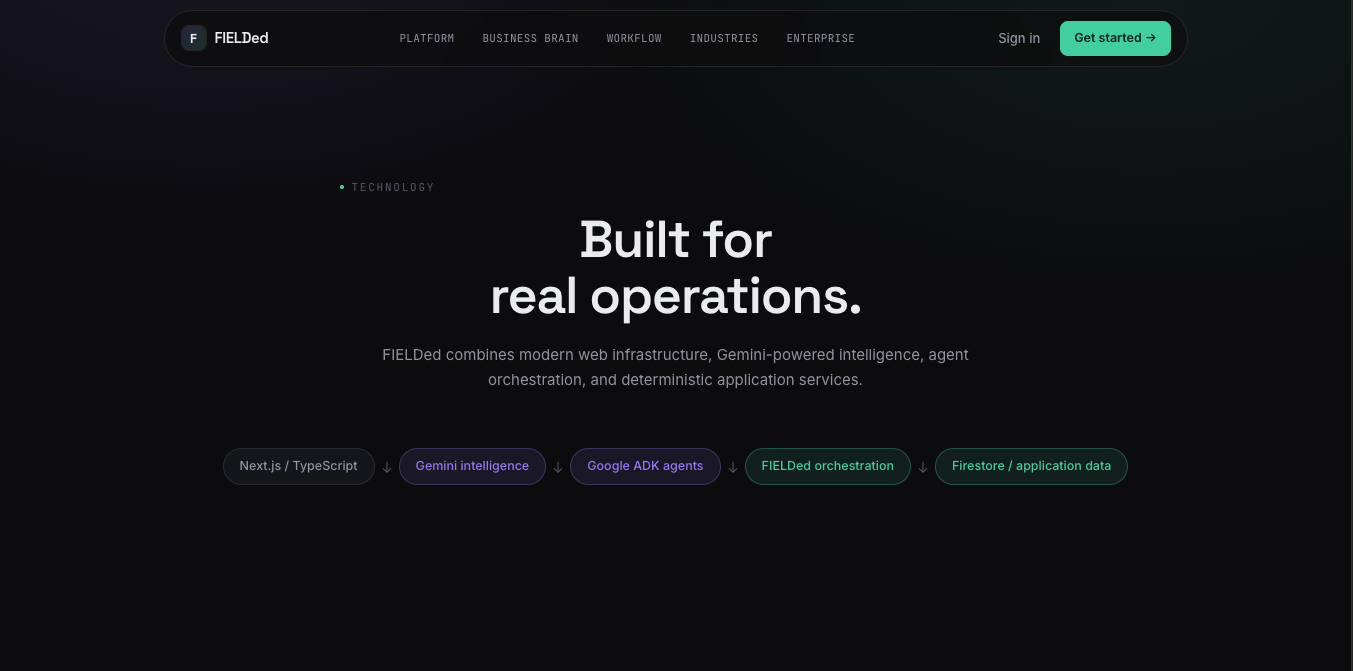
Customer / Owner ↓ Gemini + Google ADK Agents ↓ Application Orchestration ↓ Business Brain + Tool Adapters ↓ Deterministic Domain Engines ↓ Persistence + Audit
The Customer Enquiry Agent interprets customer messages and produces structured candidate information.
The Business Brain Copilot helps owners express changes to their business rules in natural language.
Neither agent receives unrestricted database access or direct persistence authority.
Instead, application services control what the agents can do, while strongly typed tool adapters expose specific deterministic capabilities.
The deterministic layer contains the actual business authority for areas such as pricing and scheduling.
The persistence layer uses Firebase/Firestore, including tenant isolation, versioned Business Brain snapshots, audit trails, and atomic proposal approval.
The system is built with TypeScript, React, Next.js, Firebase/Firestore, Gemini, and Google ADK, with Google Cloud deployment being prepared for the hackathon demonstration.
We have also designed the architecture to remain provider-agnostic. Gemini is the implementation used for the hackathon, but the application architecture is not intended to make FIELDed. permanently dependent on a single AI provider.
Challenges we ran into
The biggest challenge was not getting an LLM to produce an answer.
The difficult problem was deciding how much authority an AI agent should actually have.
Giving an agent unrestricted access to business data and persistence would make the system easier to prototype, but much harder to trust.
We therefore had to establish clear boundaries between:
- What the AI can interpret
- What the AI can propose
- What deterministic application code must decide
- What requires human approval
- What can be persisted
- What must be audited
Another major challenge was maintaining consistency when Business Brain changes happen concurrently.
We addressed this by implementing versioned Business Brain snapshots and an atomic approval mechanism that verifies the current version before applying an approved proposal.
We also had to preserve the existing deterministic system while introducing the agentic layer. Rather than replacing the existing pricing, scheduling, decision, and persistence logic with AI, we designed the agents to operate around those systems.
This has made the architecture more complex, but substantially more trustworthy.
Accomplishments that we're proud of
We are proud that FIELDed. has evolved beyond a chatbot prototype into a structured operational system.
A Business Brain for every business
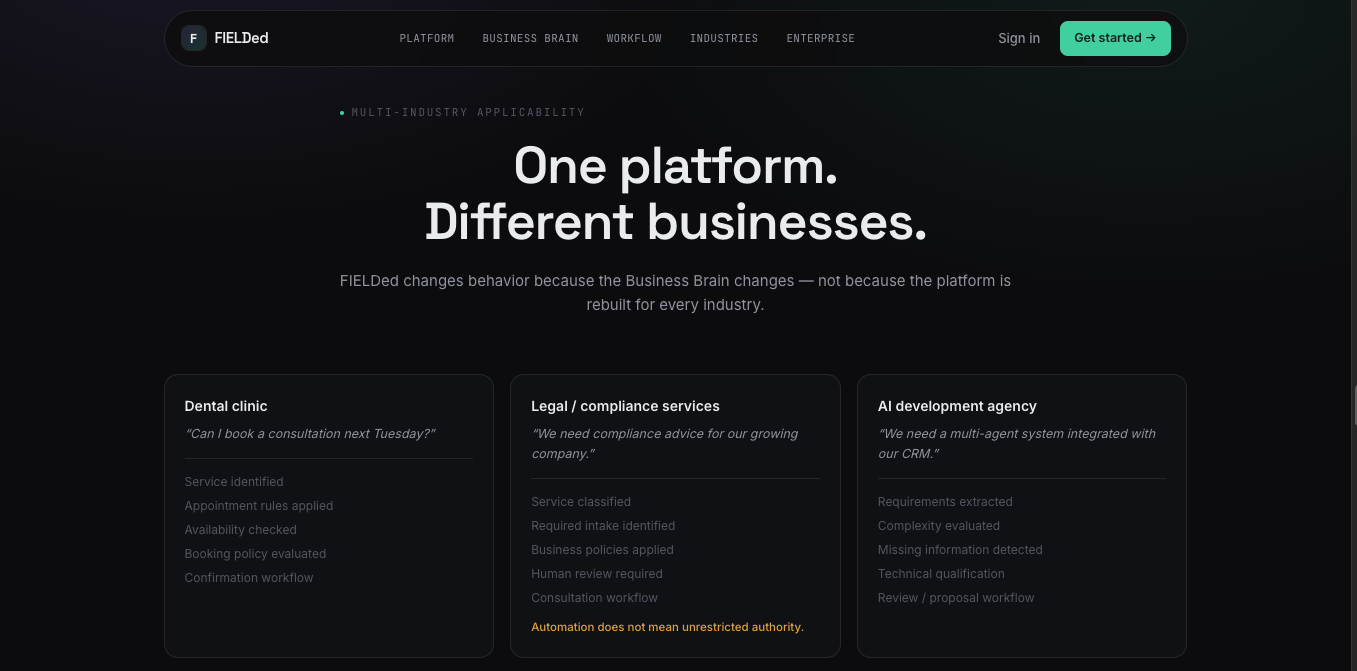
Each tenant can have its own structured business knowledge, including services, pricing, policies, availability, and escalation rules.
Deterministic business authority
AI does not determine the final price or bypass business rules. Deterministic engines remain the authority.
Human-in-the-loop governance
Uncertain or risky decisions can be routed for human review instead of forcing automation.
Atomic Business Brain updates
Approved Business Brain changes use transactional application so that the live Brain, version snapshot, and proposal state remain consistent.
Multi-tenant foundation
The system is designed around tenant isolation and server-side authentication rather than treating every business as the same configuration.
Agentic architecture
Gemini and Google ADK are being integrated into an architecture where agents can reason and use capabilities without receiving unrestricted persistence authority.
Production-oriented engineering
We have maintained automated regression testing, TypeScript validation, production builds, Firestore security review, versioning, auditability, and explicit architectural boundaries throughout development.
Our goal has never been to make the smallest possible hackathon demo.
We are trying to demonstrate a foundation that could actually become a product.
What we learned
Our biggest lesson is:
An LLM should not be the source of truth for business operations.
An agent can be excellent at understanding language, extracting intent, reasoning about possibilities, and proposing actions.
But business rules need stronger guarantees.
That led us to a fundamental FIELDed. principle:
AI interprets. Deterministic systems decide. Humans govern exceptions.
We also learned that good agent architecture is less about giving agents more authority and more about giving them the right capabilities with the right boundaries.
This separation makes the system easier to audit, safer to operate, and easier to extend.
We also learned that a Business Brain should not feel like a technical configuration file.
For FIELDed. to work for real service providers, the experience needs to be understandable to someone who knows their business but does not know databases, schemas, or AI engineering.
That is why we are designing the Business Brain around a "Show, Don't Configure" principle.
What's next for FIELDed.
Our immediate goal is to complete the Gemini/Google ADK agentic architecture and validate the complete operational flow from customer enquiry through decision and human governance.
Before final product polishing, we plan to expand FIELDed. with:
- Public provider profiles and shareable FIELDed. links
- Deeper, more experiential Business Brain configuration
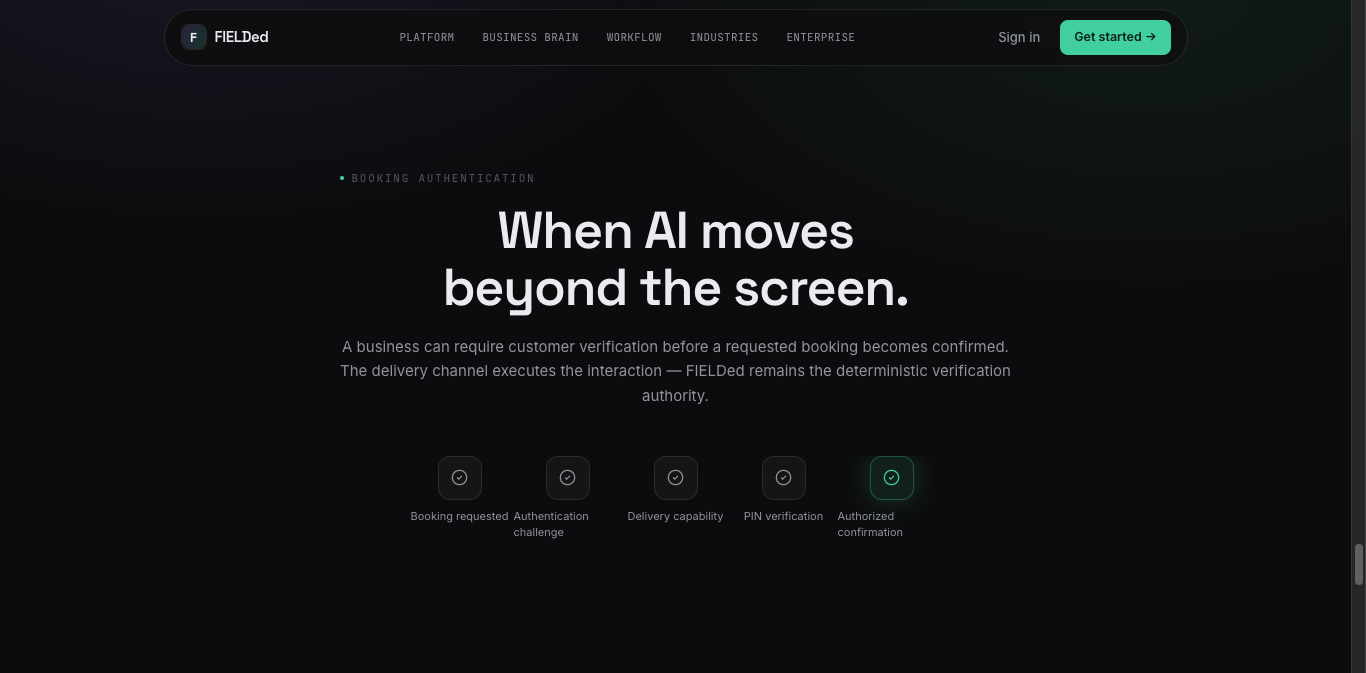
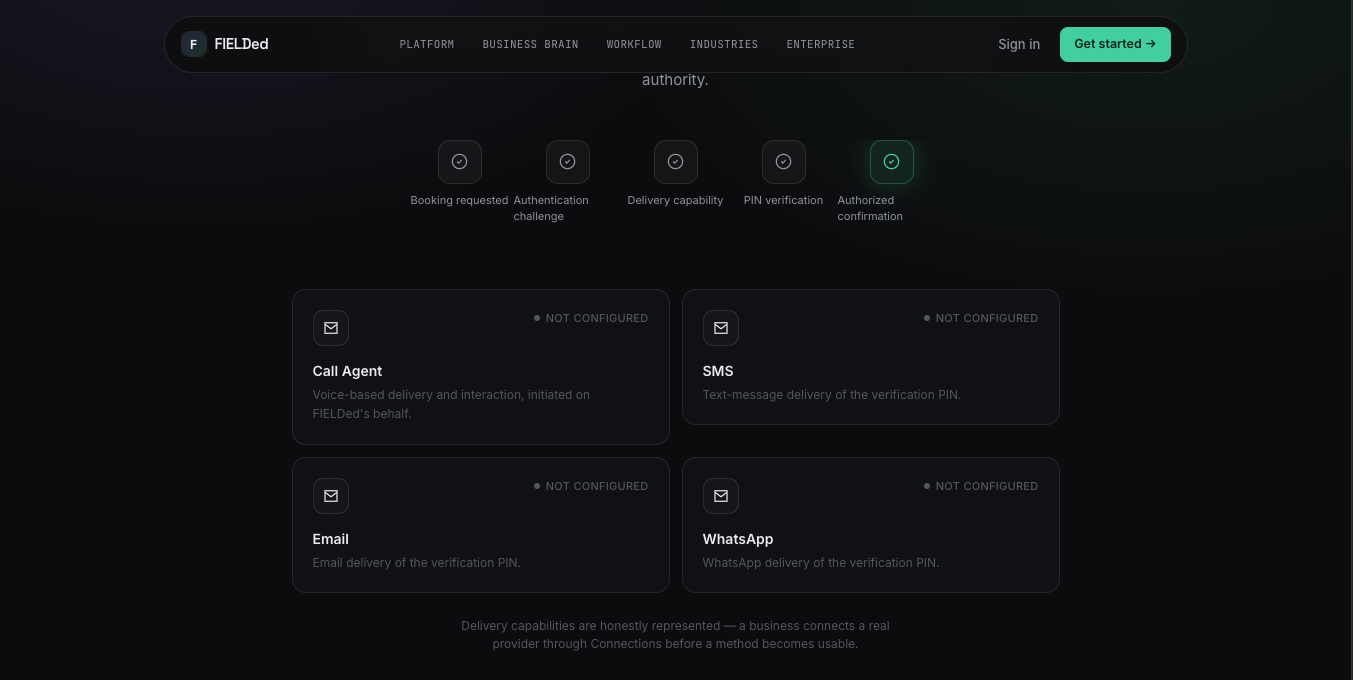
- Configurable customer confirmation mechanisms
- Optional voice/call interaction
We are also designing the platform's integration architecture so businesses can eventually connect their own AI providers, email, phone, WhatsApp, calendars, payment systems, and other services without exposing their credentials to agents.
After the hackathon, we want to explore more advanced Google and agentic integrations and eventually a FIELDed. Network that could connect customers with service providers.
The long-term vision is simple:
FIELDed. should become an AI employee that understands how a business works, helps operate it, and knows when a human should take control.
A different way of building with AI
FIELDed. is also an experiment in how a solo builder can work with AI agents to tackle complex real-world problems.
I approached the project from a business and problem-solving perspective, using AI agents not simply as code generators, but as research partners, brainstorming collaborators, architectural reviewers, implementation assistants, and testing partners.
The process became a continuous human–agent workflow:
Human defines the problem → AI researches and challenges assumptions → human makes architectural decisions → AI implements → human reviews and tests → both iterate.
I deliberately avoided treating the agents as a black box. Architectural decisions, boundaries, trade-offs, implementation steps, and failures were continuously examined and discussed between the human and the agents.
This was particularly important because the objective was not simply to generate working code. It was to understand why the system should be structured a certain way, maintain architectural boundaries, preserve deterministic business logic, and make the interaction between humans and agents as transparent as possible.
That experience strongly influenced FIELDed. itself. The product is designed around the same principle: AI should be capable and autonomous, but its capabilities, authority, context, and interaction with humans should remain understandable and controlled.
Building FIELDed. this way has become one of the most interesting parts of the journey — exploring what becomes possible when a solo builder can work with multiple AI agents as an extended engineering, research, and architectural team.
Built With
- adk
- ai
- api
- automation
- cloud
- database
- firebase
- firestore
- gemini
- generative
- google-cloud
- googleadk
- javascript
- llm
- machine-learning
- next.js
- react
- saas
- typescript

Log in or sign up for Devpost to join the conversation.