-
-

Home Page
-
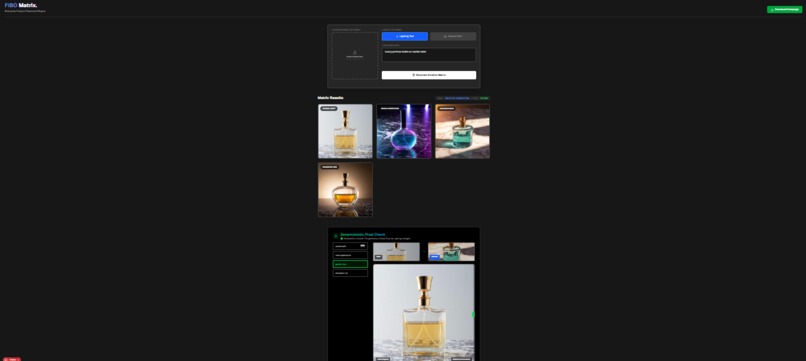
Standard Generating
-
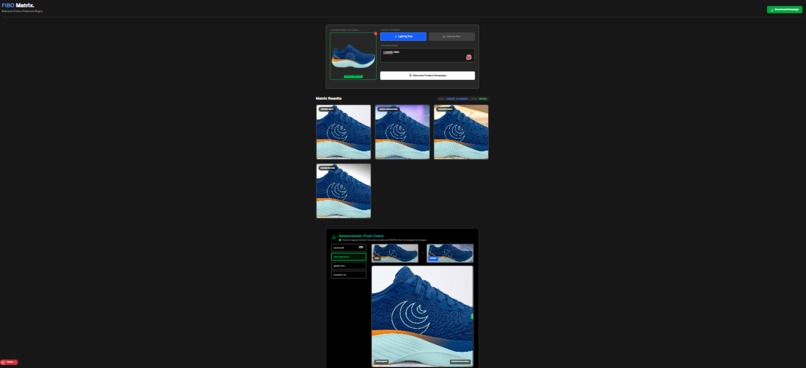
Enterprise
🌀 FIBO Matrix: Taming the Chaos of Generative AI
💡 Inspiration — The “Slot Machine” Problem
FIBO Matrix was inspired by a recurring frustration we observed among creative professionals using generative AI. A designer would get a great result, then request a small change—like different lighting or a new background—only to receive an entirely different image. The product changed, the angle shifted, and visual continuity was lost.
We realized that most generative AI tools behave like a slot machine: every prompt tweak spins randomness. That’s fine for exploration, but unacceptable for professional and enterprise workflows that demand precision, repeatability, and control. Our goal was to turn generative AI into a sniper rifle, not a slot machine—treating creativity as data science, not luck.
💻 What It Does
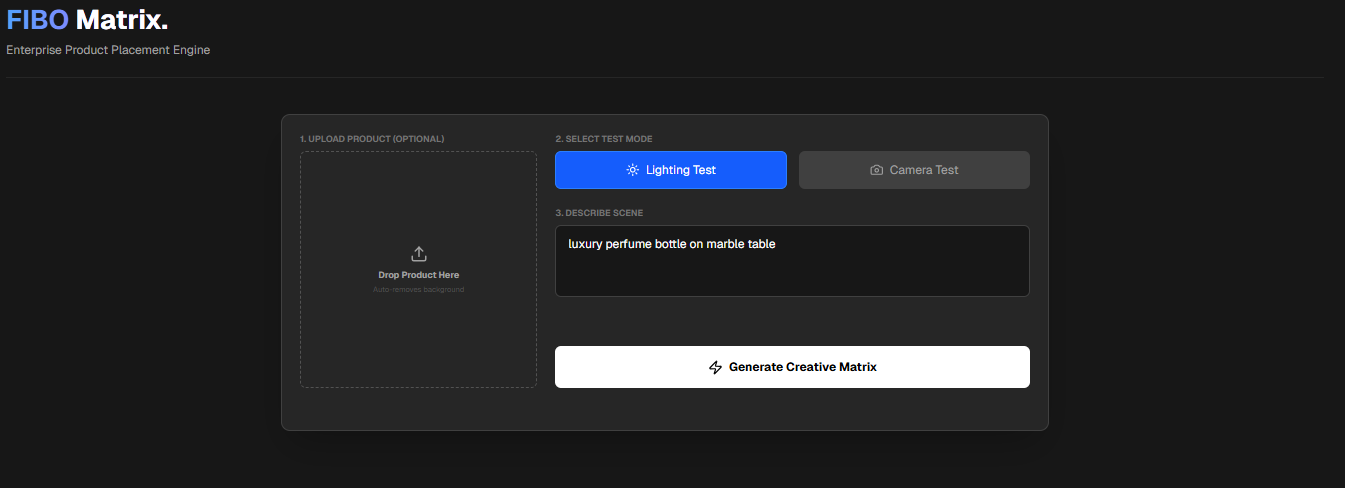
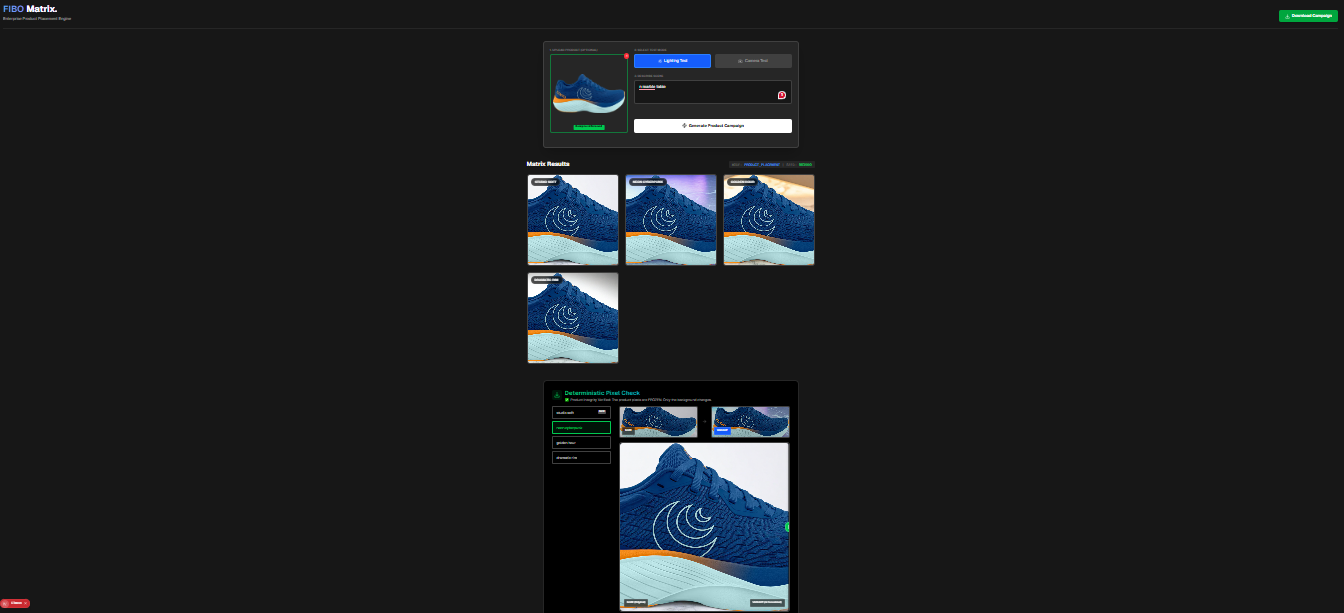
FIBO Matrix is a deterministic visual generation and A/B testing platform that decouples what is in an image from how it is styled.
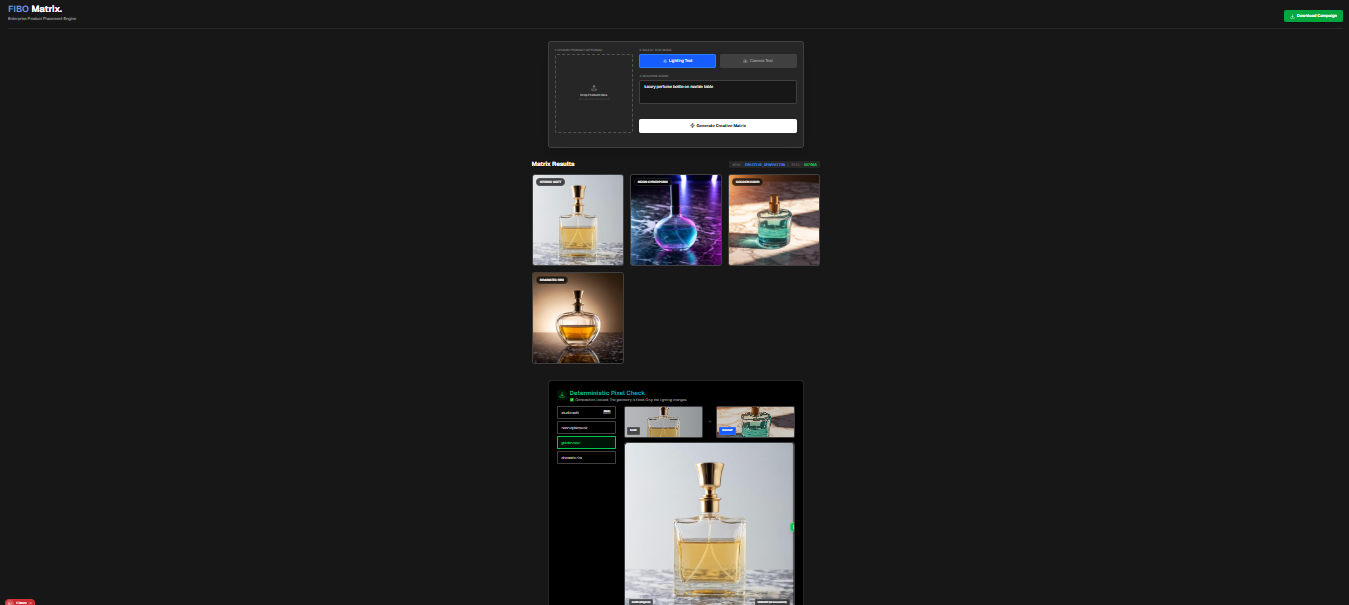
- Creative Mode: Generates a structured grid where composition remains fixed while variables like lighting or mood change systematically.
- Enterprise Product Mode (BYOP): Brands upload a real product photo; the product is preserved pixel-perfect while AI generates new environments around it—without altering the product itself.
⚙️ How We Built It
We built a high-performance, asynchronous pipeline focused on consistency and scalability.
The Math of Consistency
In standard diffusion models, an image can be described as:
[ I = f(S, P) ]
Where:
- ( S ) is a random seed
- ( P ) is the prompt
Changing ( P ) typically changes the entire image. We engineered seed locking to generate controlled variations:
[ I_{\text{matrix}} = { f(S_{\text{fixed}}, P_1), f(S_{\text{fixed}}, P_2), \dots } ]
For product preservation, we inverted the logic using a calculated entropy offset so the background evolves while the product remains fixed:
[ S_{\text{variant}} = S_{\text{base}} + \Delta_{\text{random}} ]
Tech Stack
- Backend: Python FastAPI for orchestrating parallel AI requests
- Frontend: Next.js 14 (React) with a responsive, dark-mode dashboard
- AI Engine: Bria AI v2.3, leveraging
/product/cutoutand/background/replacefor commercial-safe, high-fidelity results
🚧 Challenges We Faced
- The “Empty Grid” Bug: API calls returned success, but images didn’t render due to nested response formats. We built a robust parser to handle multiple structures dynamically.
- Ignored Parameters: Lighting metadata was silently ignored by the model. We solved this with a weighted prompt-injection system that enforces stylistic control.
- Endpoint Limitations: Some experimental endpoints were inaccessible. We pivoted quickly to a hybrid background-replacement workflow, which proved more stable and product-safe. ## 🏆 Accomplishments We’re Proud Of
- Visual Comparator Slider: An interactive overlay that lets users scrub between the base image and variants—showing pixel-perfect product preservation in real time.
- Campaign Export: High-resolution PNG exports plus a
campaign_dna.jsonfile, making results reproducible and ready for enterprise workflows. ## 🧠 What We Learned We learned that constraints unlock creativity. By limiting the AI’s freedom—locking seeds and preserving product layers—we gave users more power and predictability. We also learned the importance of commercial-safe AI; building on Bria allowed us to innovate without copyright concerns, which is critical for enterprise adoption. ## 🔮 What’s Next Next, we’re adding Computer Vision Scoring—automatically evaluating variants with metrics like logo visibility and contrast:
“Variant B increases logo visibility by 20% compared to Variant A.”
This will transform FIBO Matrix into a full-cycle platform that doesn’t just generate visuals—but measures, compares, and optimizes them.


Log in or sign up for Devpost to join the conversation.