-
-
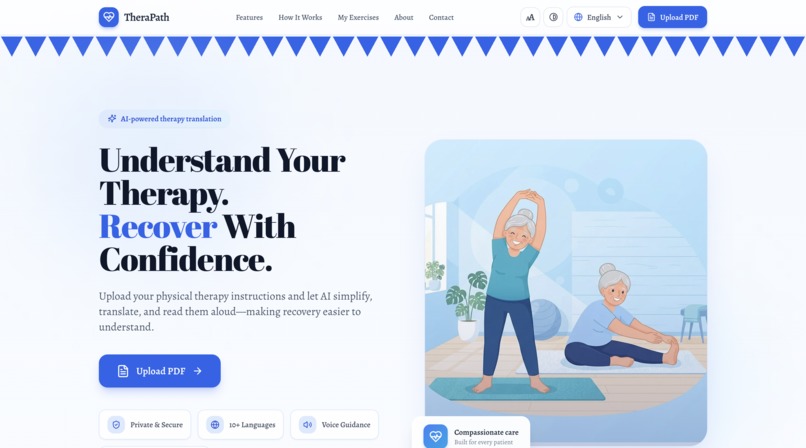
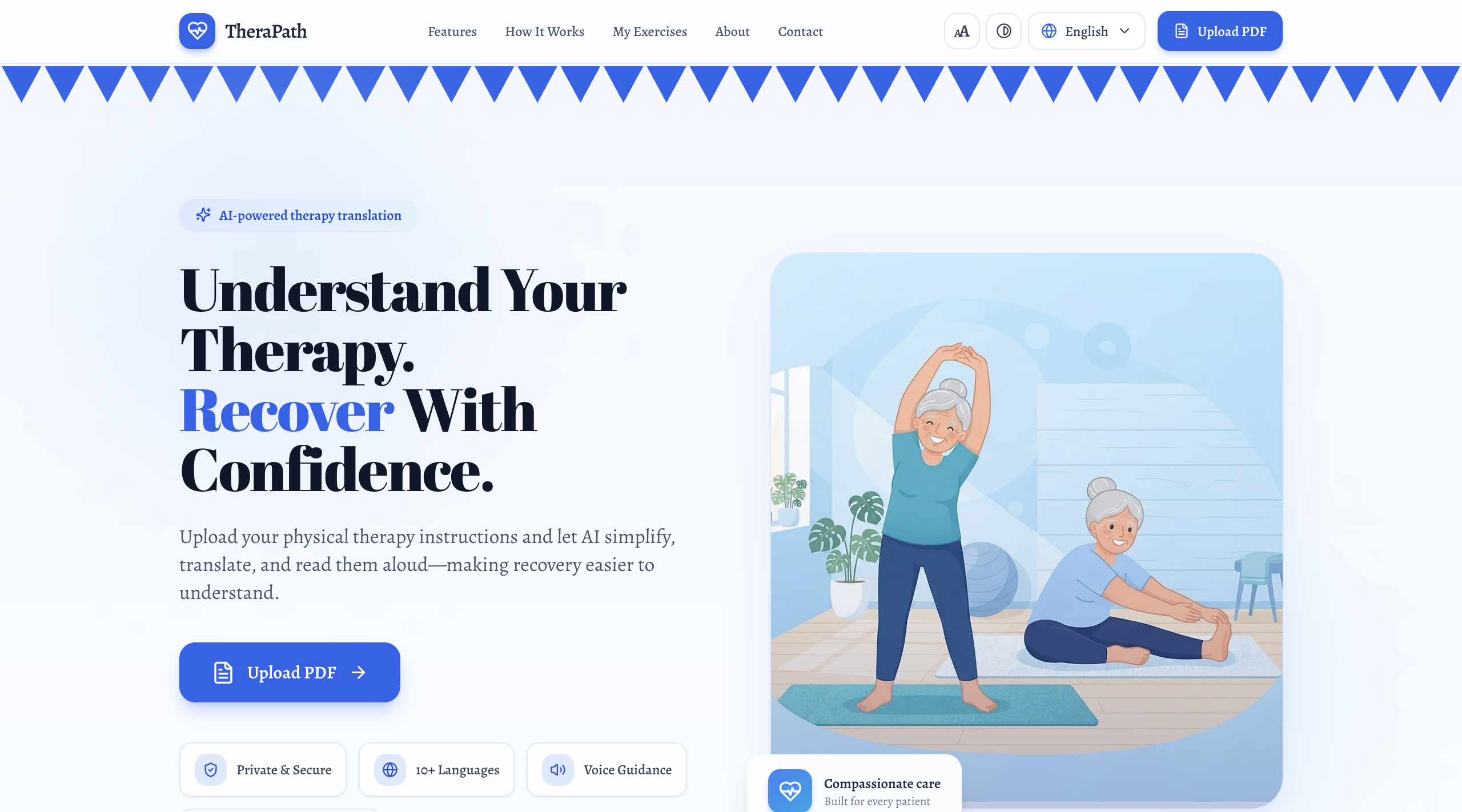
This is the homepage
-
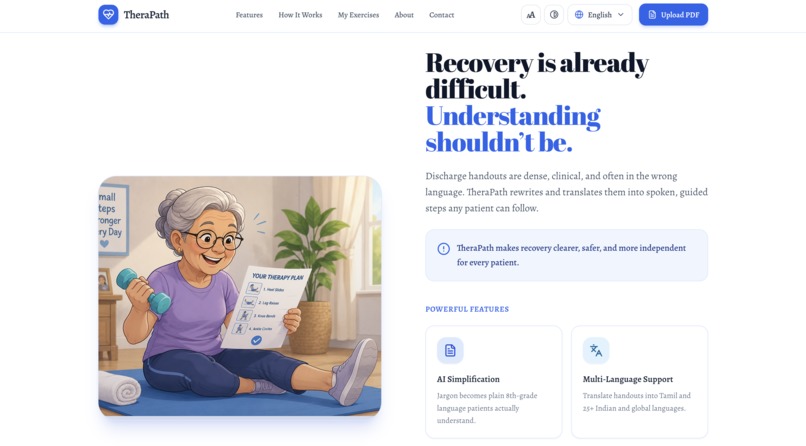
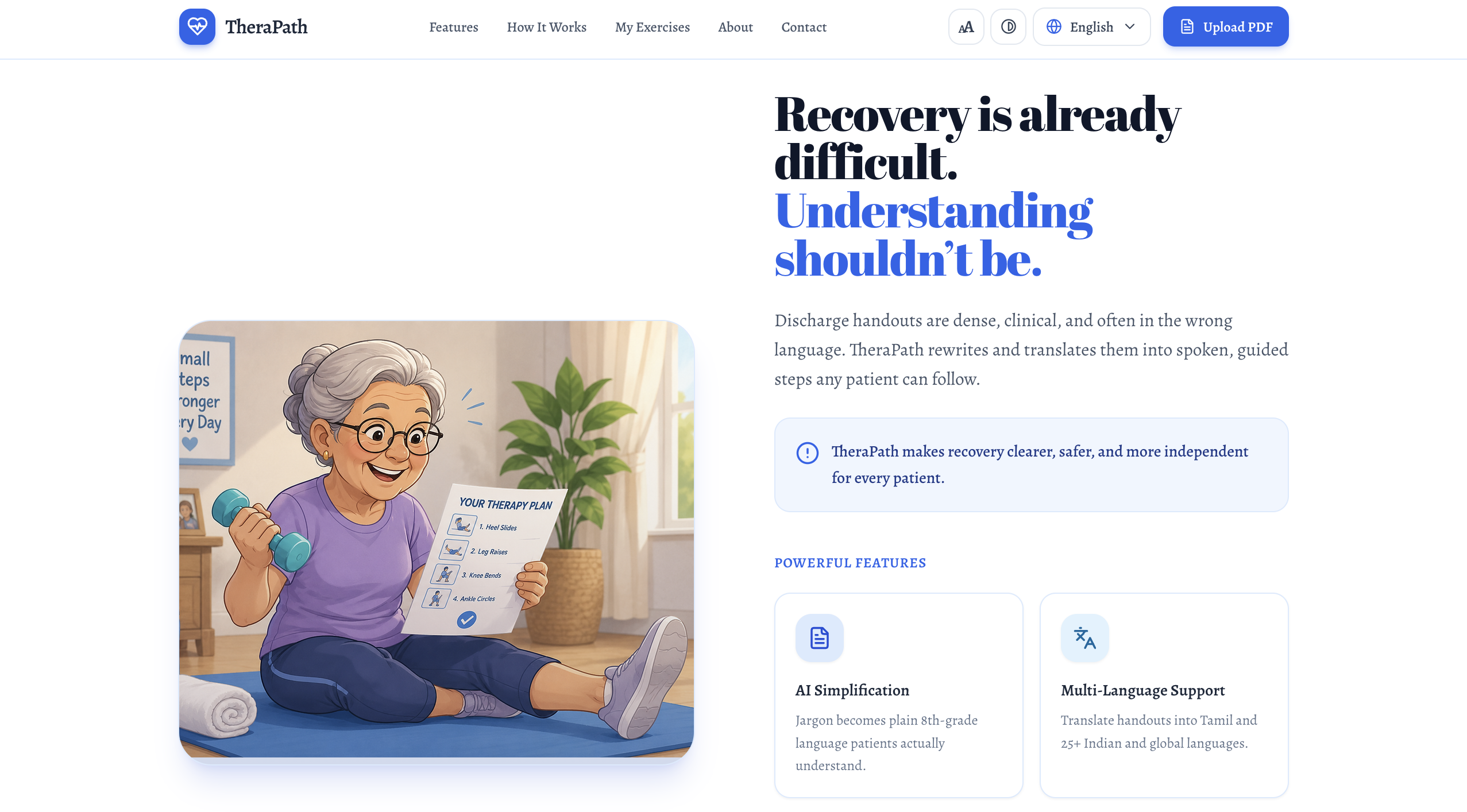
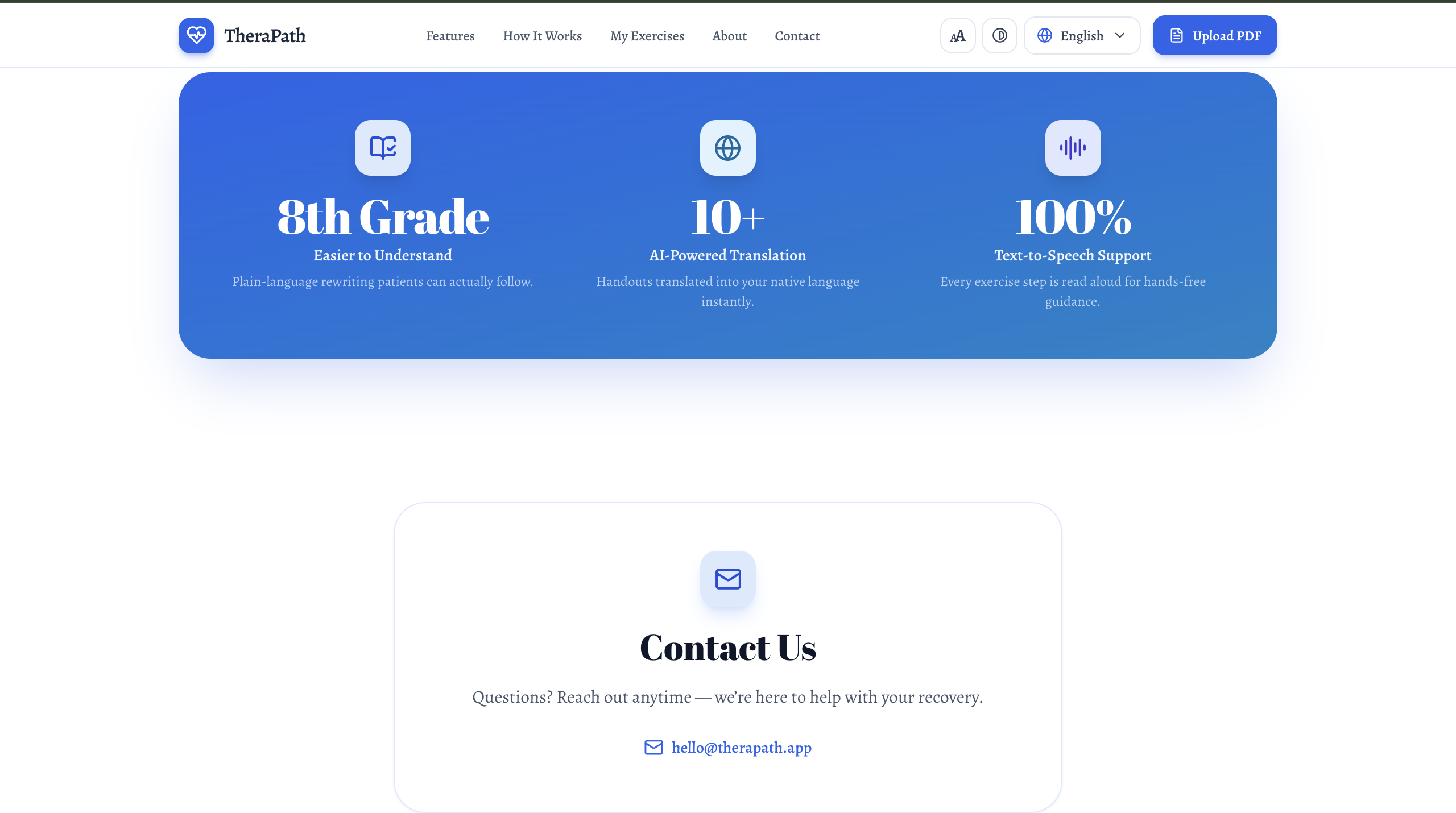
The about section
-
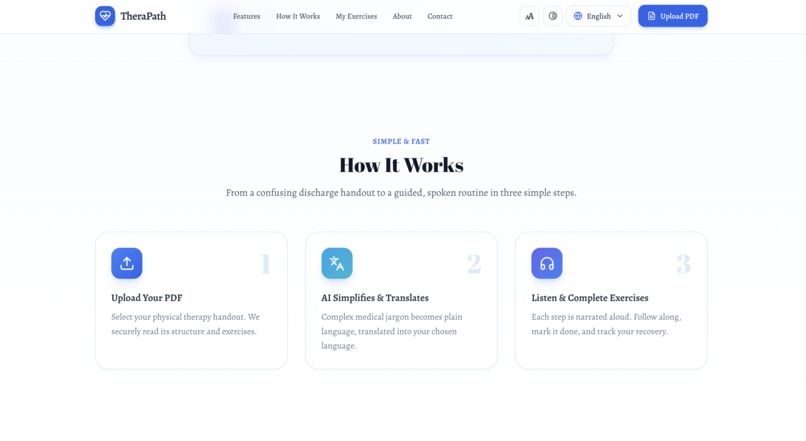
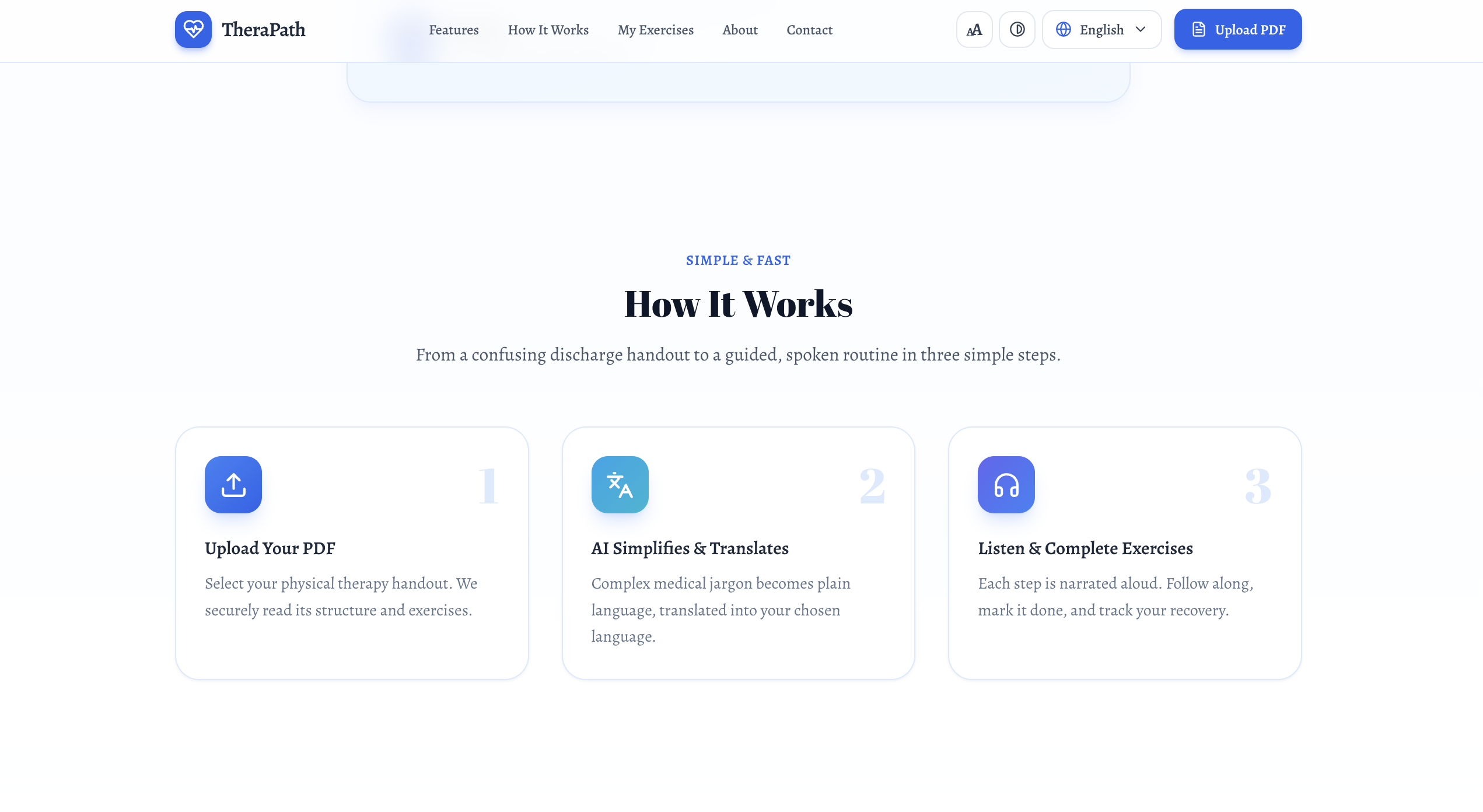
How it Works section
-
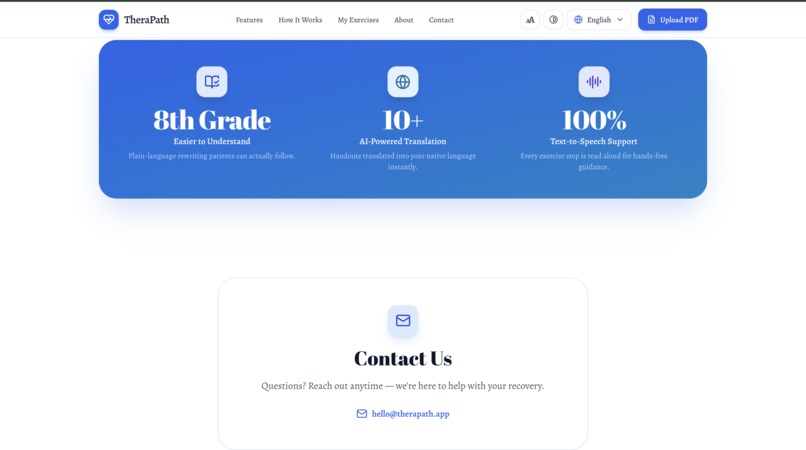
Contact section
-
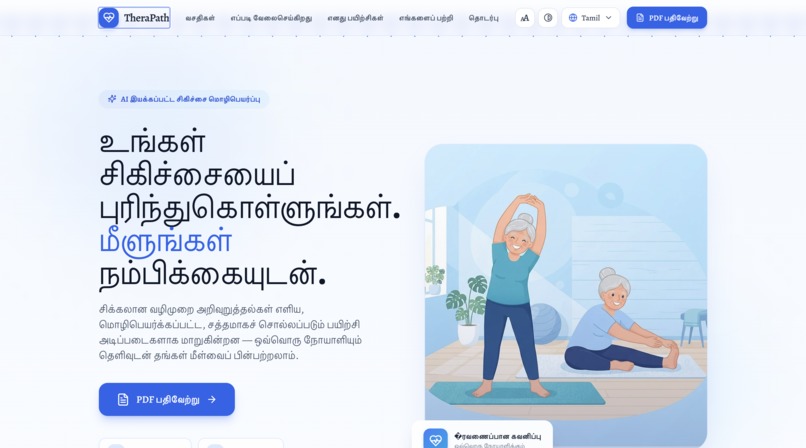
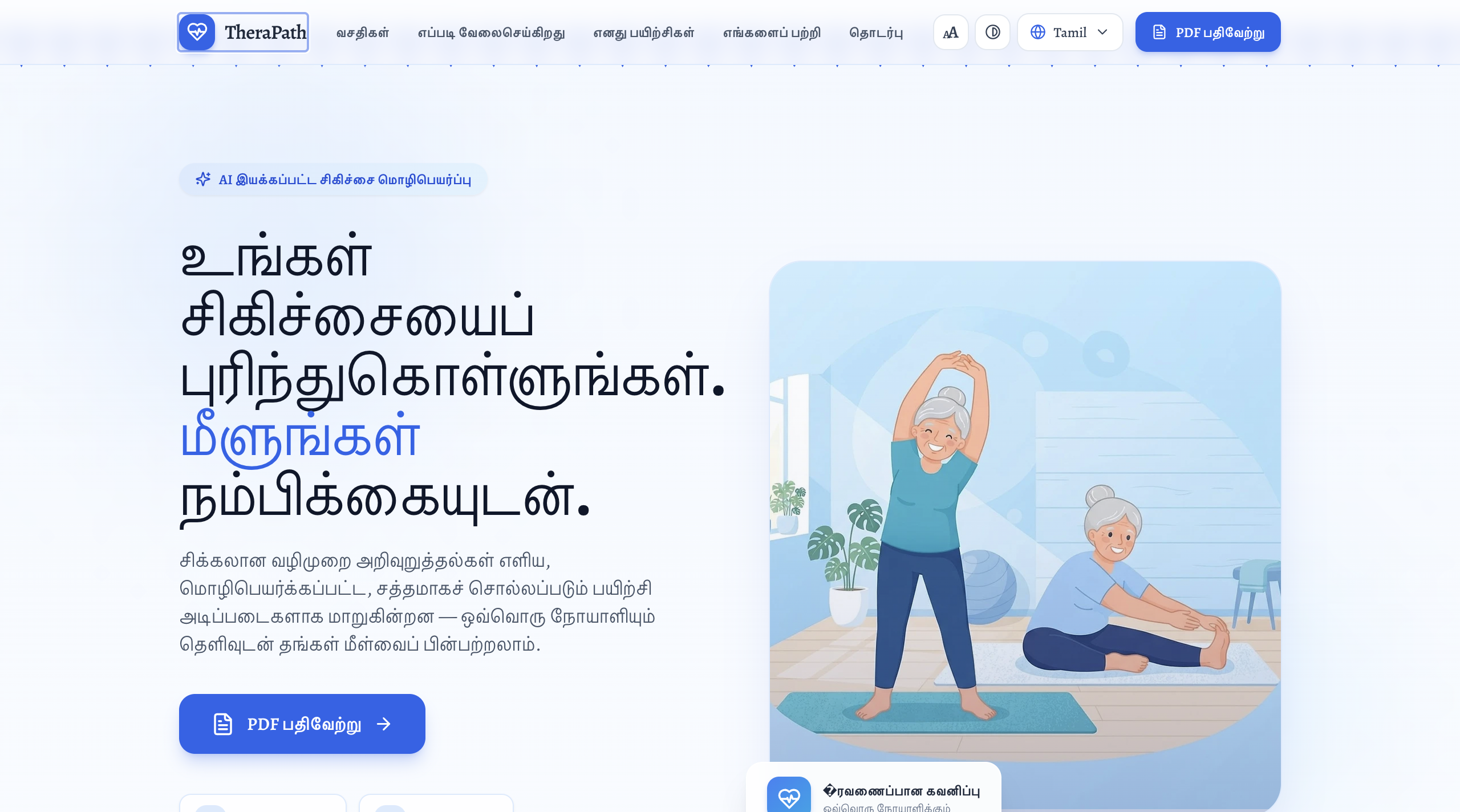
Example of app inteface in Tamil
-
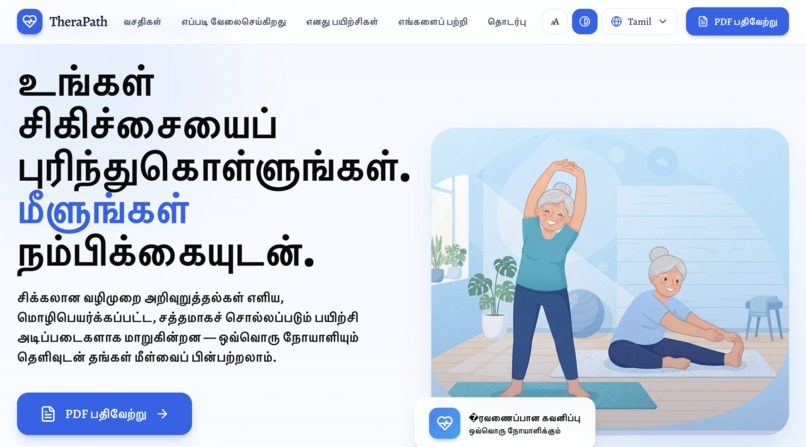
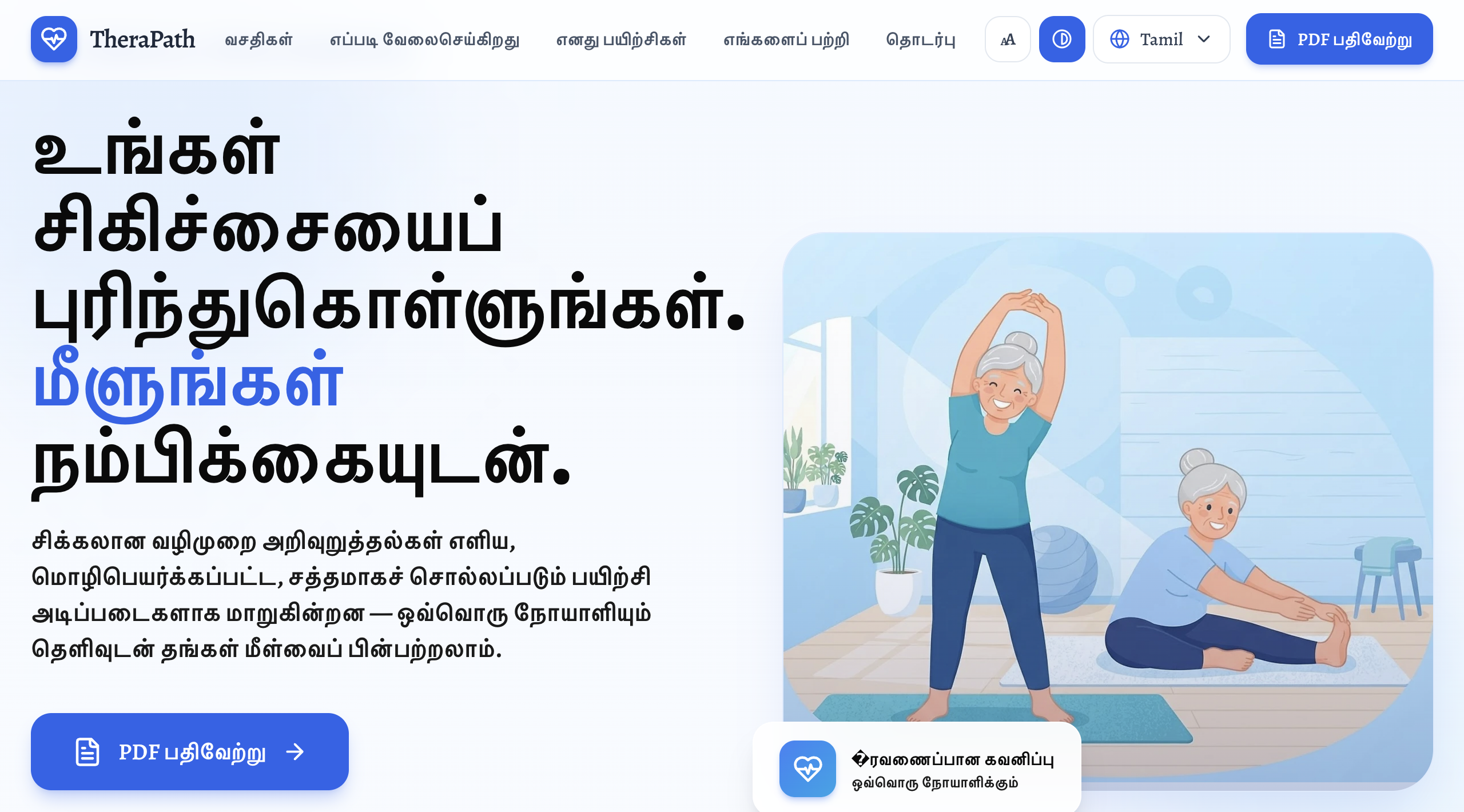
Example of app interface in Tamil, with high contrast and font size increase
-
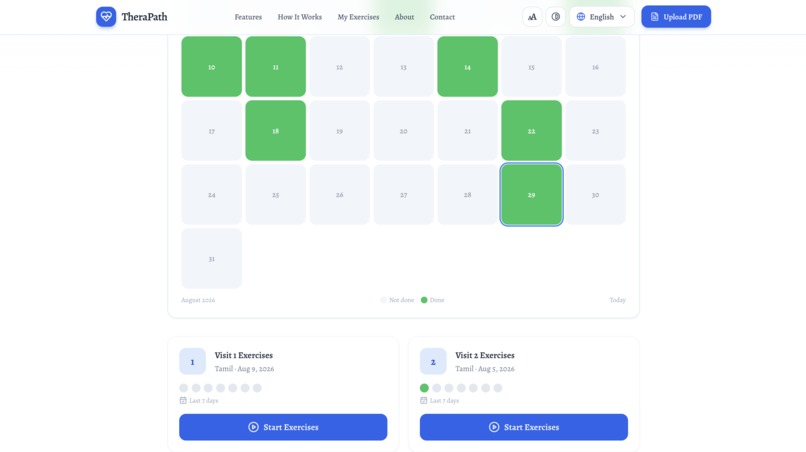
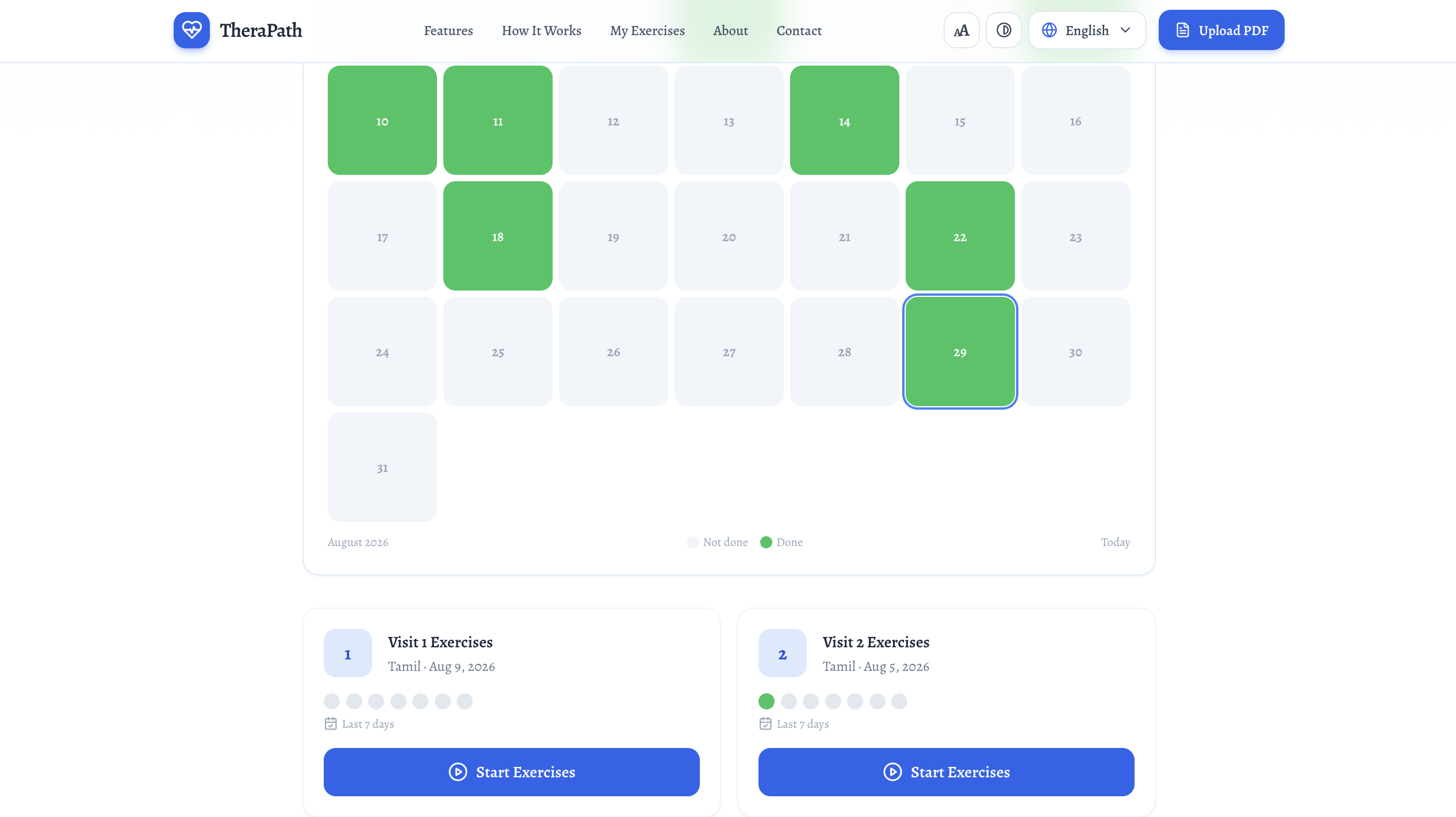
My exercise tracker homepage, with the list of old exercise pdf underneath.
-
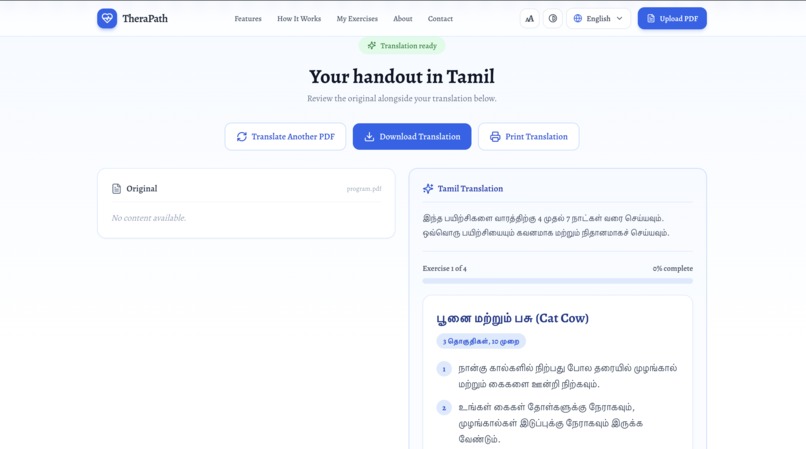
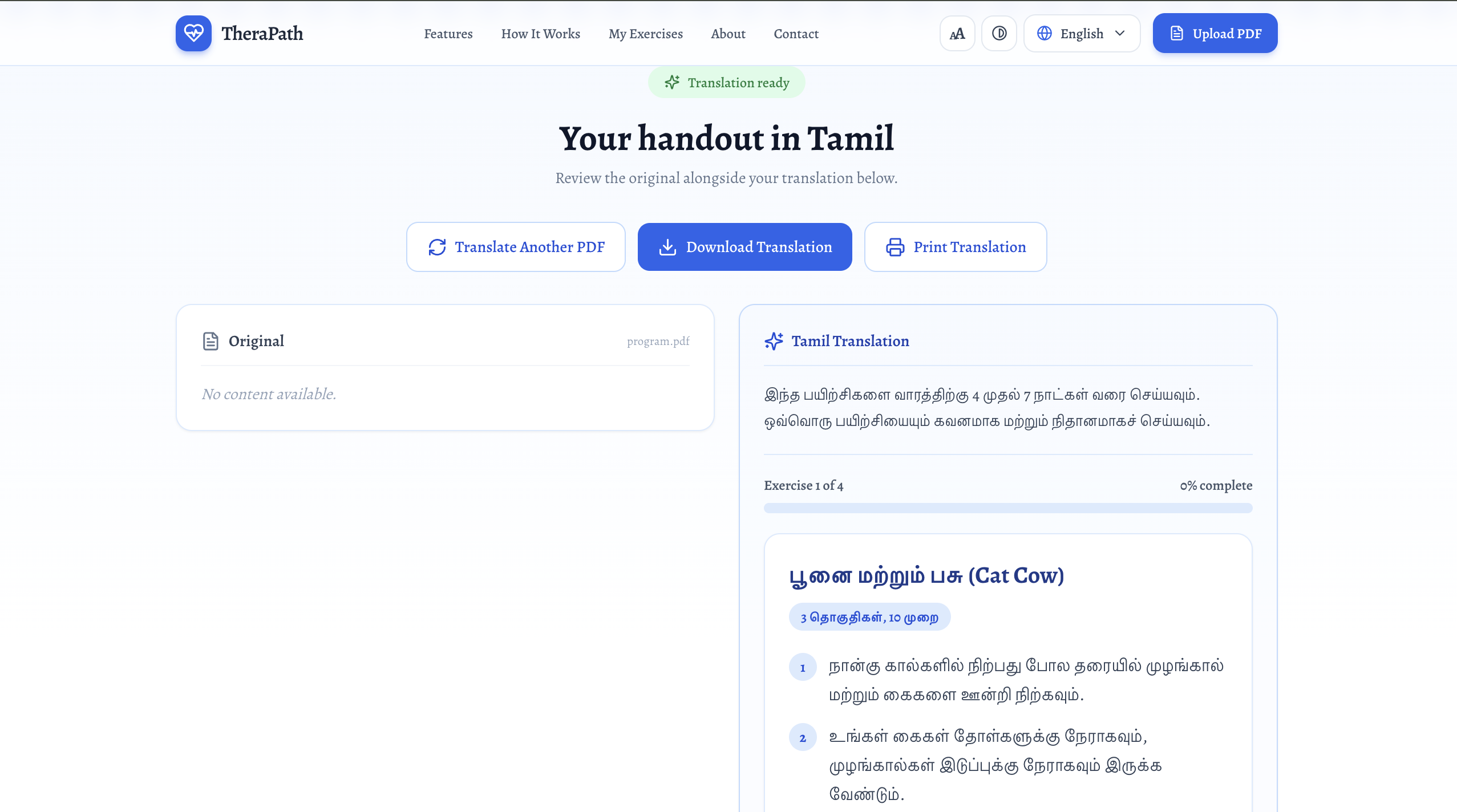
Translation of exercise instructions page
-
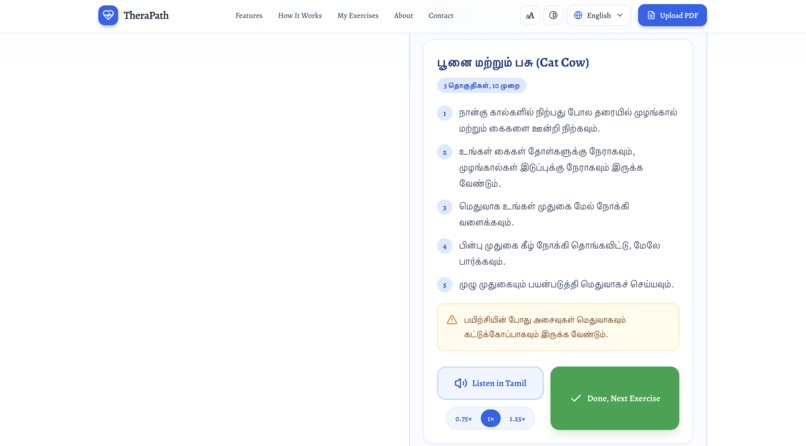
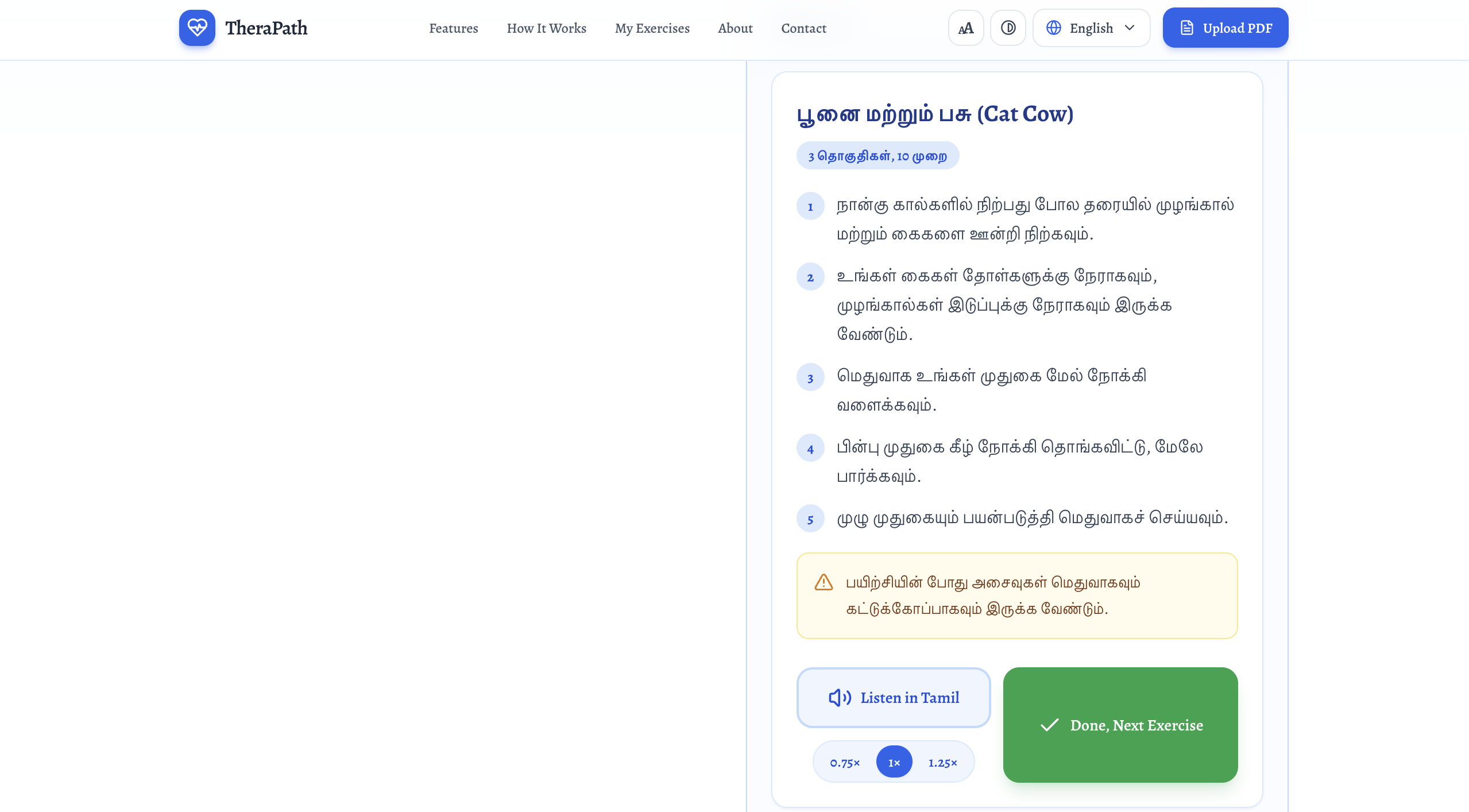
Translation of exercise instructions page continued
-
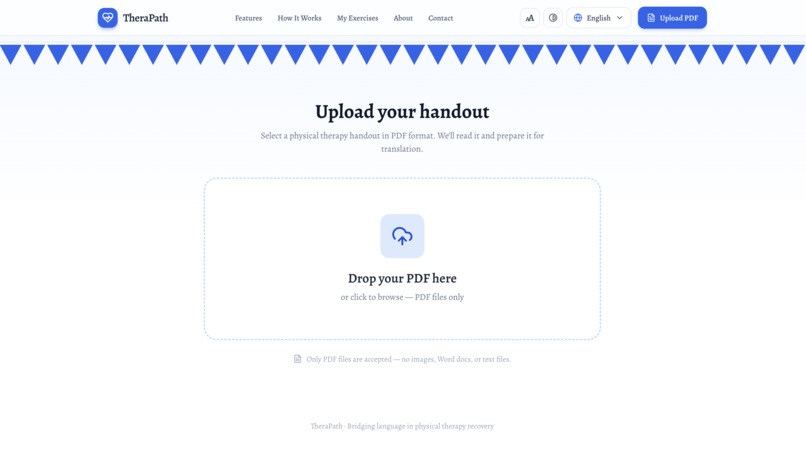
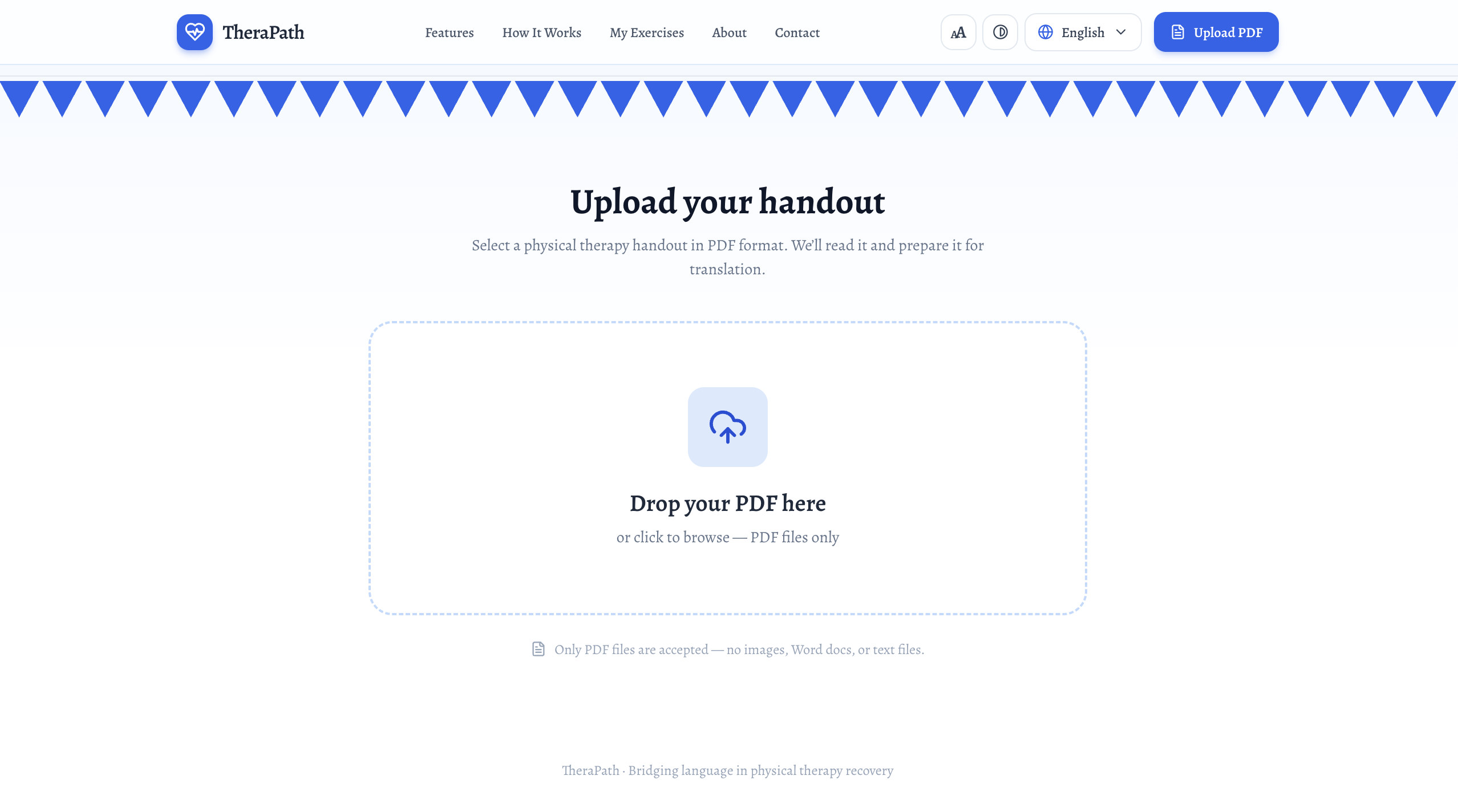
Upload Pdf page
Inspiration
Last month, my grandmother came from India after a surgery, and to help rebuild her strength, she has had to attend physical therapy appointments here in the U.S. Every time she goes, she comes home with exercise instructions written in English medical terms, but Tamil is her primary language, not English. She relies on my dad to translate every exercise for her, which makes it hard for her to stay independent in her own recovery. We wanted to build something that gave her that independence back. That experience inspired us to create TheraPath, a tool that helps patients understand their therapy instructions confidently, regardless of the language they speak. After completing the app, we tested it directly with our grandparents, who found it genuinely useful and were able to follow their exercises independently for the first time without needing a family member to translate. Their positive response confirmed that we were solving a real problem in a meaningful way.
What it Does
TheraPath is an AI-powered web app that helps patients understand their physical therapy instructions. Users upload their real PT handout as a PDF, and the app simplifies the medical language into plain, easy to follow text and translates it into the patient's preferred language; currently, Tamil is fully built and tested. Each exercise is shown as its own card with a text to speech Listen button, so patients can hear their routine read aloud instead of reading dense medical text. A step by step checklist guides them through their exercises one at a time, and completed routines are saved to My Exercises, with each upload labeled sequentially. Visit 1 Exercises, Visit 2 Exercises, and so on. Users can also track their consistency with a calendar tracker so they can track monthly progress. The app is designed to be accessible for all types of people, for example there is a button that can switch the entire app interface between languages, a high contrast feature, font size feature, and audio playback speed feature.
How We Built it
TheraPath was developed in Base44, where we described our application’s architecture and features, which helped us to automatically produce the frontend, data model, and integrations. We leveraged the Google Gemini API for PDF text extraction, medical language simplification, and translation into Tamil in a pipeline and specifically prompted Gemini to rewrite instructions at an 8th grade reading level, using short simple sentences and avoiding medical jargon, so patients can follow along without needing a medical background. We also made a caching mechanism to prevent the same documents from being processed again. As we are native speakers ourselves, we could validate the accuracy of the translation. For testing purposes, we used a real redacted Kaiser Permanente physical therapy handout, which allowed us to test the app on real medical texts rather than samples. Additionally, we developed high contrast mode, font size adjustment, and audio playback speed control to suit people with special needs. In addition, we added a complete English/tamil/spanish interface switch so that non English speaking people could freely navigate through the app, and we plan to add more languages in the future. Furthermore, completed exercises will be saved to My Exercises, and the calendar will help users track their progress every month. We chose a calming blue theme to represent trust and healthcare.
Challenges we ran into
One of our biggest challenges was managing integration credits on Base44 while testing, since our free plan had a limited budget for live AI calls. This problem only became clear after a test run that used almost half our credits. To address this, we built a caching system so every time the same PDF was uploaded again, the saved translation and audio would be reused instead of triggering new AI calls, this allowed to us to test run our program numerous times. We also solved the credit issue more fundamentally by integrating the Google Gemini API directly, which handles PDF extraction, simplification, translation, and text-to-speech outside of Base44's credit system entirely. We also ran into a version-sync issue while collaborating in Base44, where we saw different versions of the app while editing, which we resolved by consistently publishing updates of our website.
Accomplishments that we're proud of
We're proud that TheraPath is built around a real, authentic use case, tested with an actual Kaiser Permanente physical therapy handout, and that every core feature works, such as the PDF upload, AI simplification, Tamil translation, text-to-speech narration, a guided checklist, and a saved-programs calendar tracker. We're also proud of the app's accessibility design, including a fully functional interface language toggle, high contrast mode, adjustable font size, and audio playback speed control. Finally, we're proud of how we navigated Base44's credit constraints creatively, turning a technical limitation into a learning opportunity around caching and external API integration.
What we learned
We learned a lot about planning a project realistically under real constraints like time, credit usage, and technical risk. We learned to prioritize features that directly served our core mission over features that were flashy but risky or medically questionable. We also learned the value of testing with real data, which helped us catch issues we wouldn't have caught with placeholder content. Integrating the Google Gemini API taught us how external APIs can solve platform limitations creatively, turning a credit constraint into an opportunity to build a more robust, scalable pipeline. We also learned the importance of writing detailed, specific prompts when prompt engineering, since vague instructions produced inconsistent results while precise prompts gave us much more reliable and accurate outputs.
What's next for Therapath
In the near future, we'd like to build in HIPAA-conscious data handling, for example, automatically redacting personal information from uploaded PDFs. We'd also like to add real instructional photos and videos pulled directly from the original handout rather than AI-generated, to preserve accuracy and patient safety. We also plan to expand language support for both document translation and the app interface, building on the English and Tamil foundation we've already established. Finally, we hope to expand our user testing by bringing TheraPath to real patients and physical therapy settings to gather authentic feedback and continue improving the app based on real-world use.
Built With
- artificialintelligence
- base44
- googlegeminiapi
- naturallanguageprocessing
- translation


Log in or sign up for Devpost to join the conversation.