Inspiration
Real-world AI agents wait. They wait for human approvals, vendor replies, API responses, and scheduled tasks. But what happens when an agent crashes while waiting? It loses everything—the analysis it performed, the emails it drafted, the context it gathered.
We were inspired by the challenge of building agents with memories that last. In finance, invoice processing often requires back-and-forth negotiations that span hours or days. An agent that can't survive a server restart is useless in production.
MemMachine's persistent memory and Neo4j's graph reasoning gave us the perfect toolkit to solve this problem.
What it does
LedgerLoop is an AI-powered invoice anomaly detection system that:
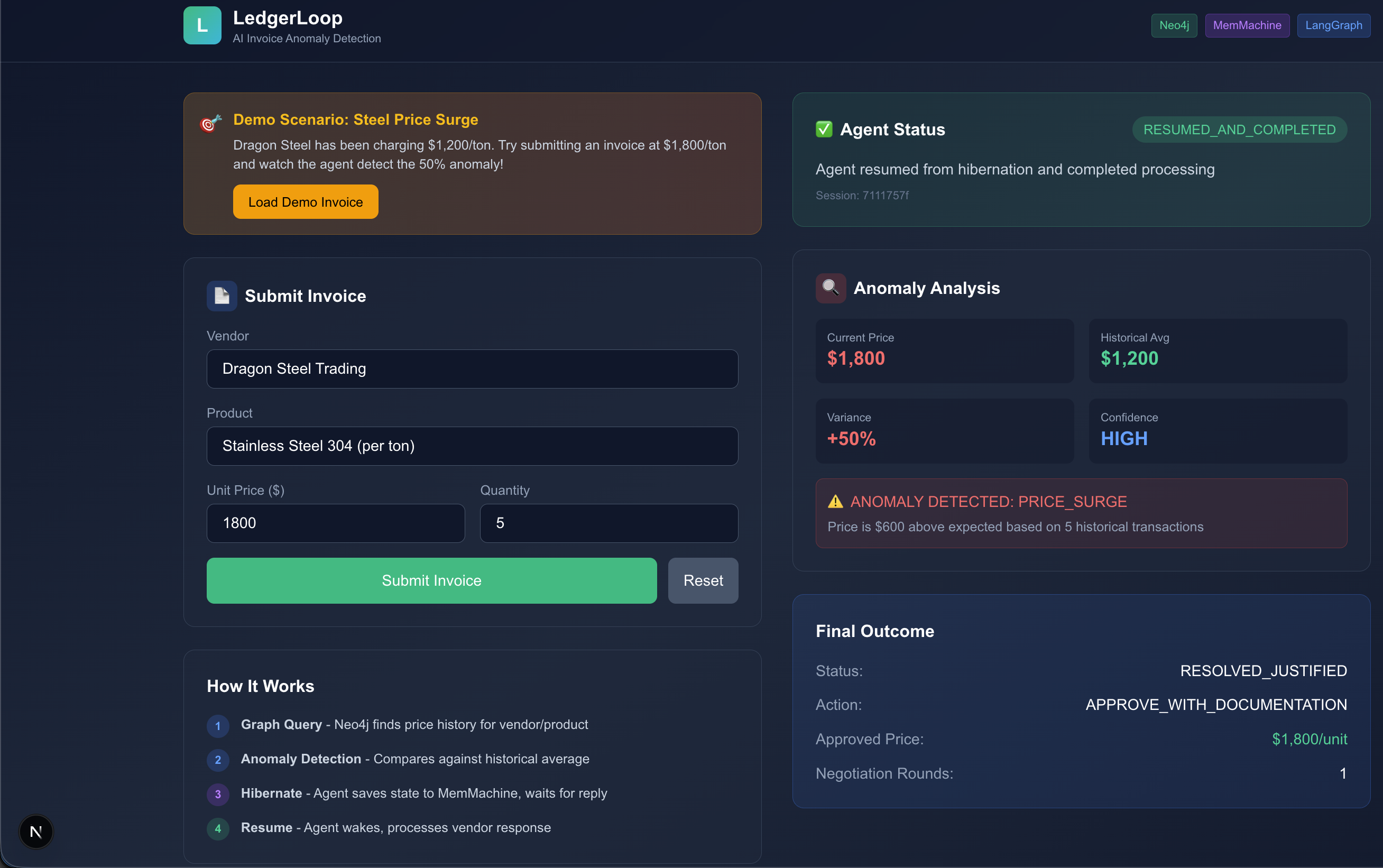
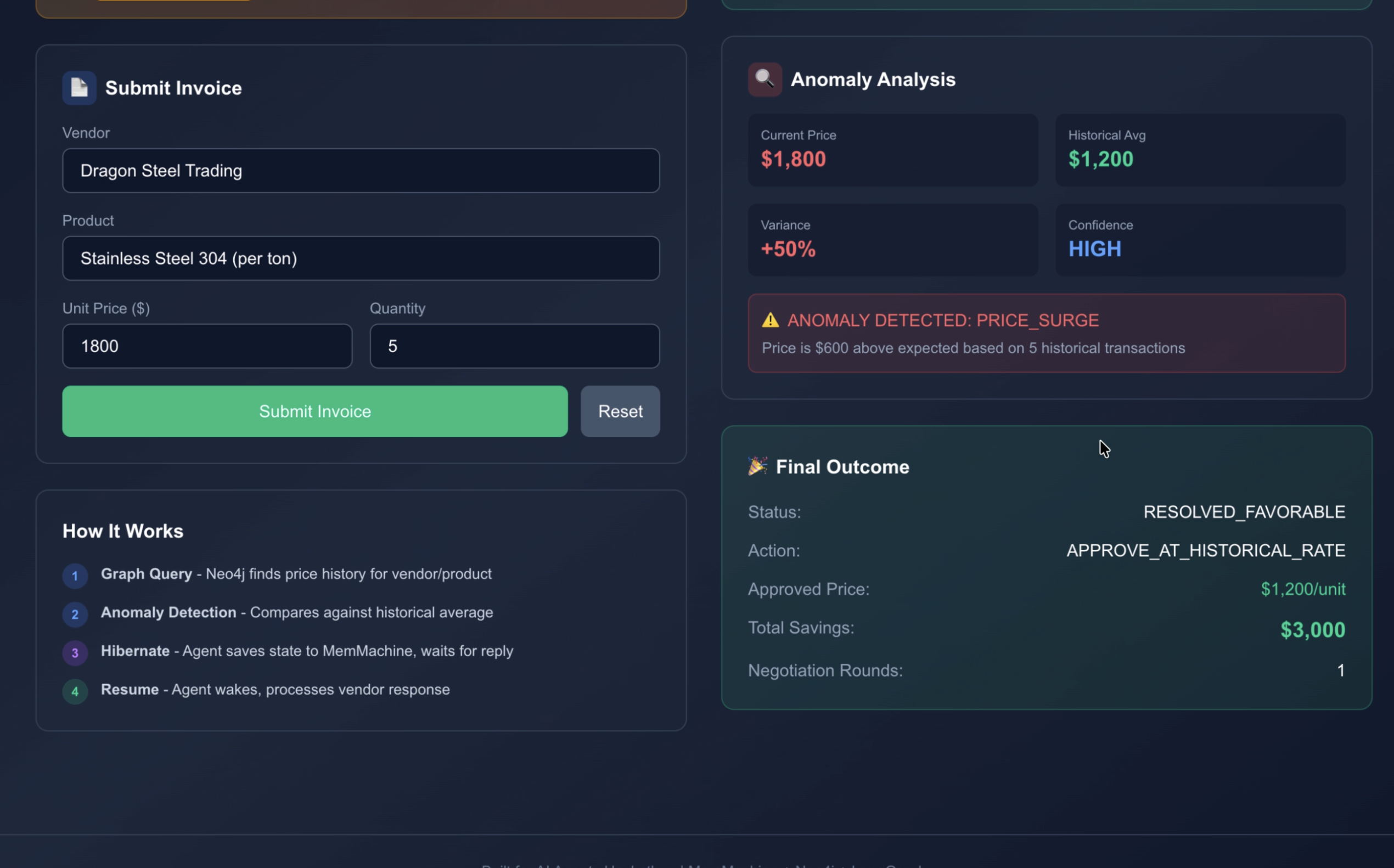
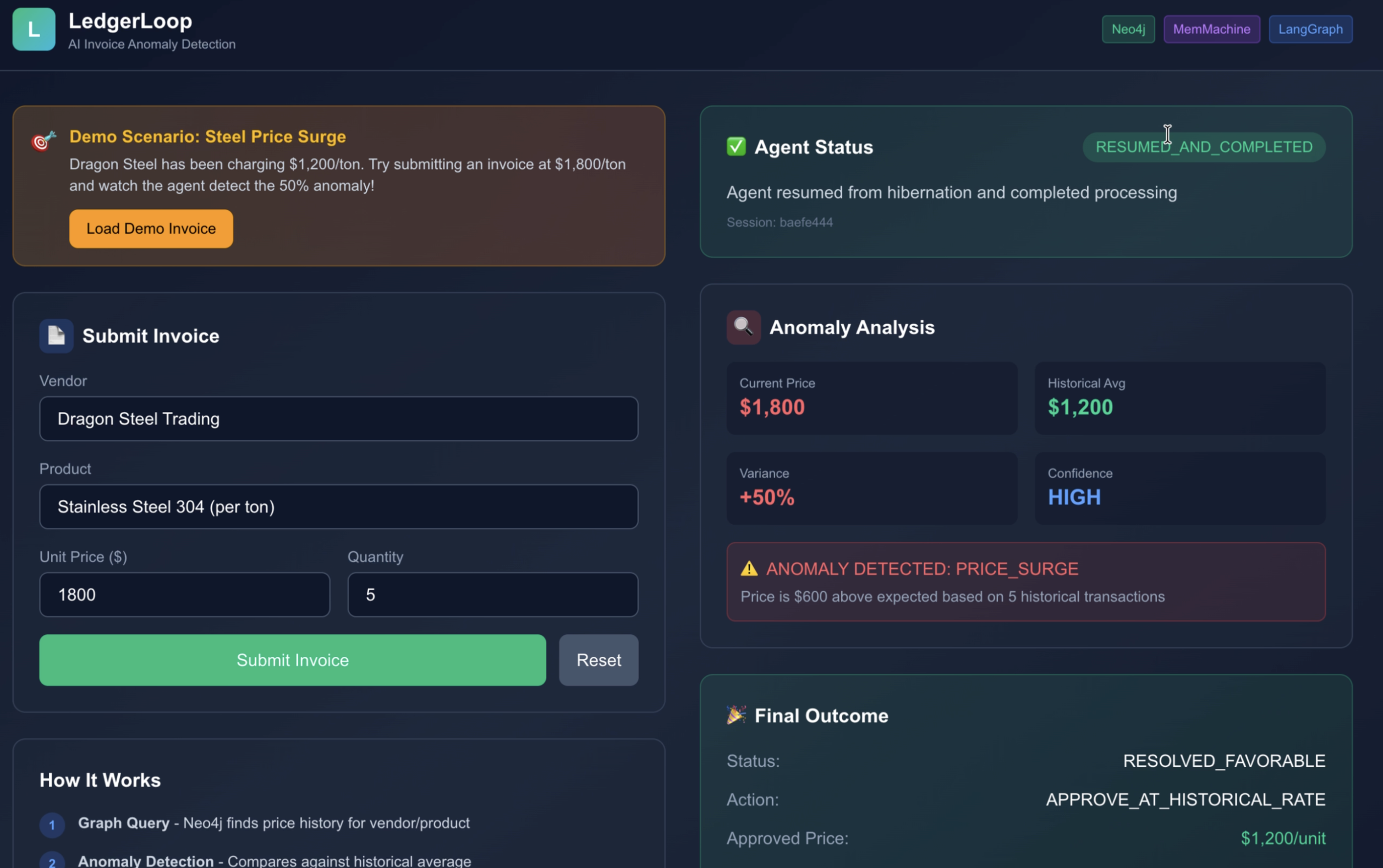
Detects Price Anomalies - Uses Neo4j to query historical invoice data and identify price surges (e.g., 50% above average)
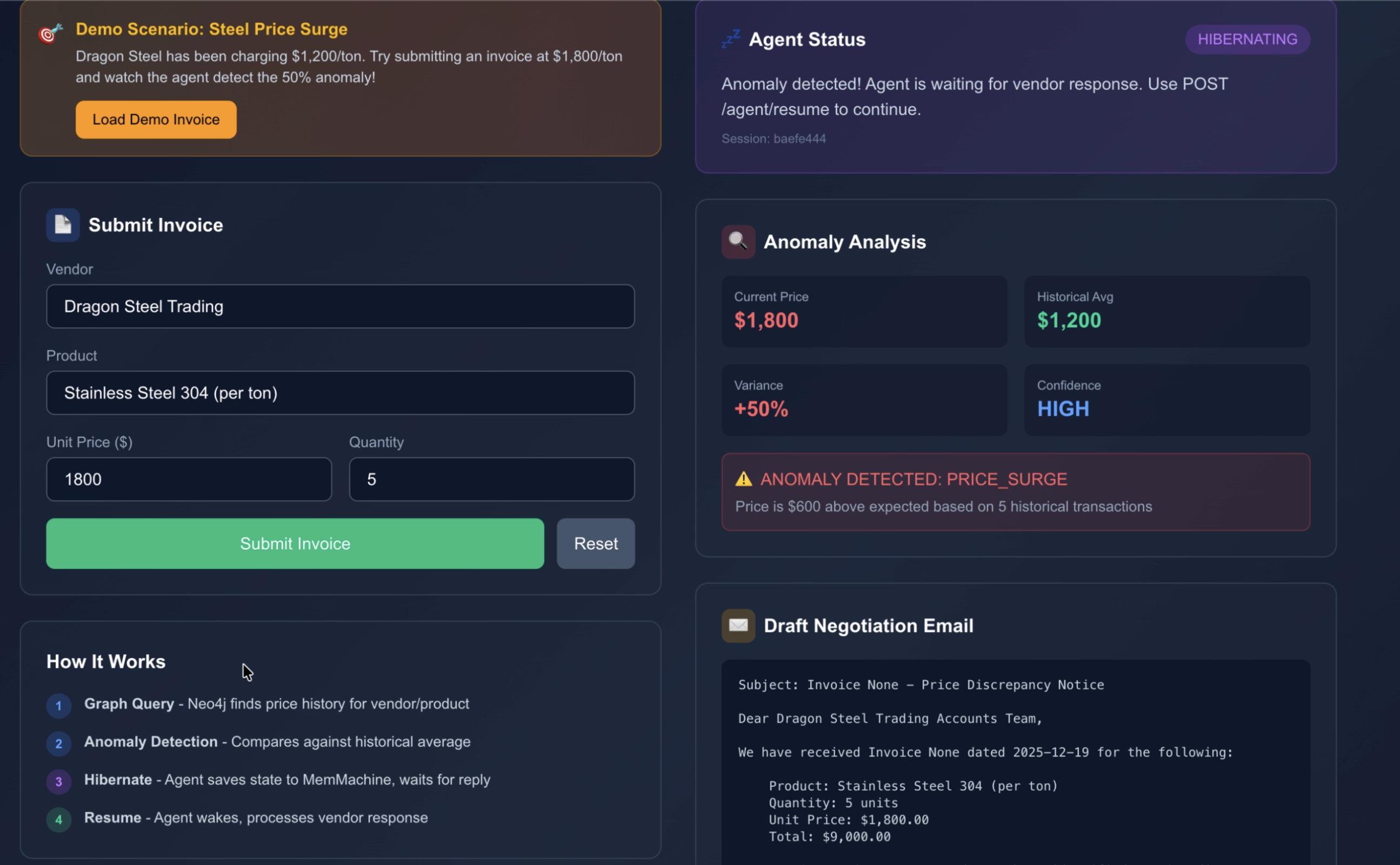
Drafts Negotiation Emails - Automatically creates professional vendor communications when anomalies are detected
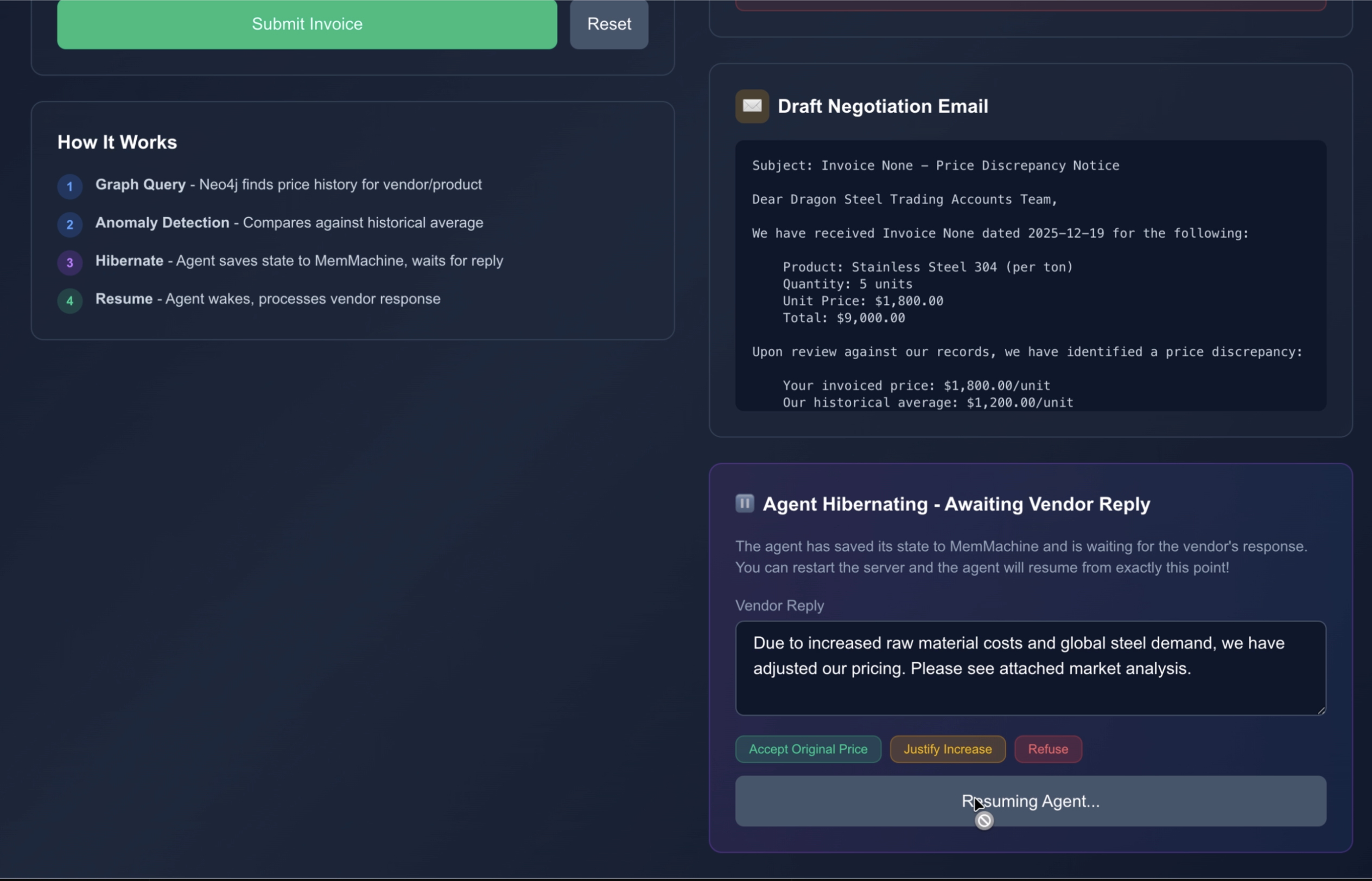
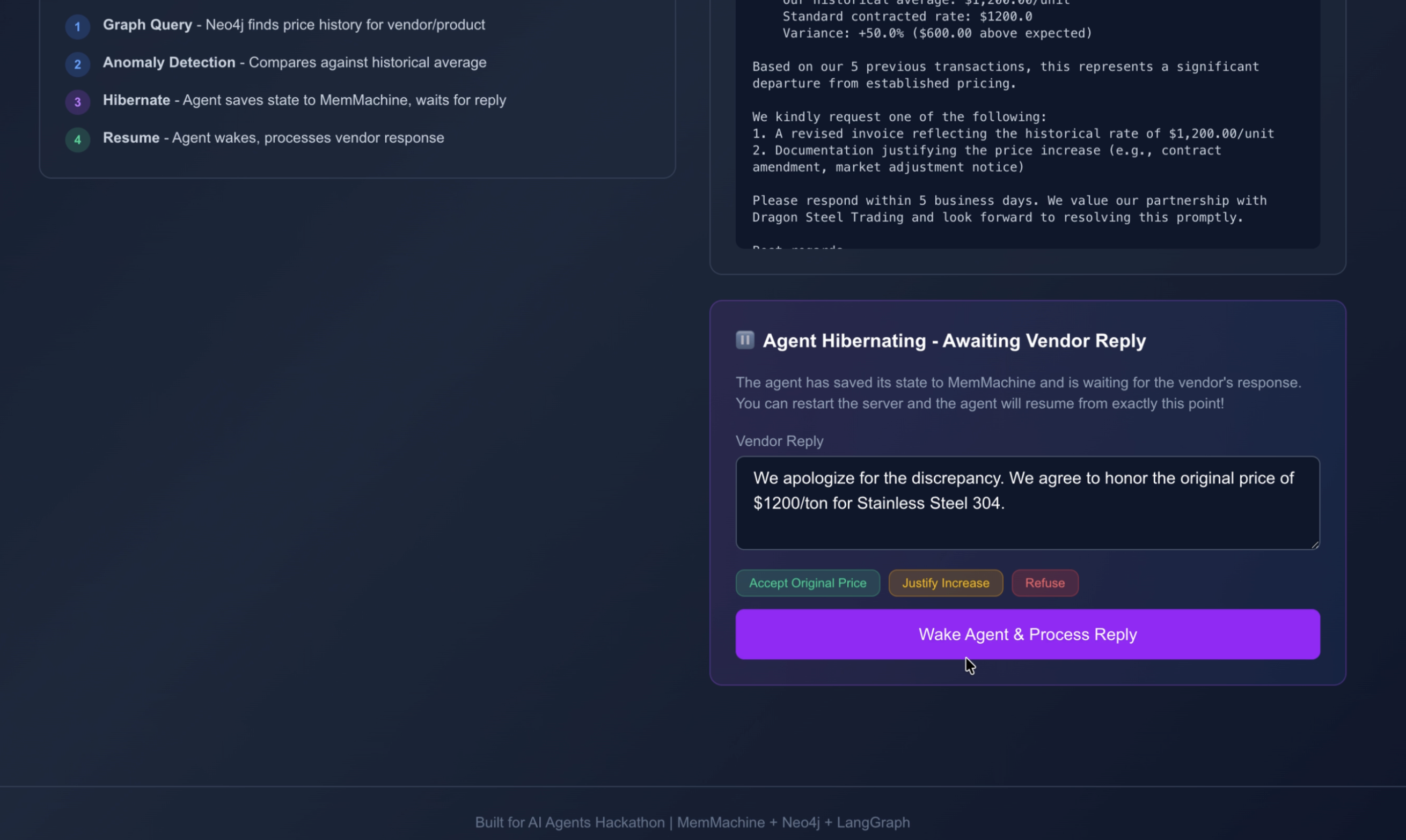
Hibernates Mid-Task - When waiting for vendor responses, the agent saves its complete state to MemMachine and stops execution
Survives Server Restarts - Kill the server, restart it—the agent's checkpoint is still there, ready to resume
Resumes with Full Context - Wake the agent with the vendor's reply, and it continues exactly where it left off
Demo Scenario: Dragon Steel Trading invoices Stainless Steel 304 at $1,800/ton. Historical data shows 5 invoices at $1,200/ton. Agent detects 50% anomaly → drafts email → hibernates → survives restart → processes vendor reply → saves $3,000.
How we built it
Architecture:
- Frontend: Next.js + TypeScript + Tailwind CSS
- Backend: FastAPI (Python)
- Agent: LangGraph with 6-node workflow (Ingest → Query → Detect → Draft → Hibernate → Resume)
- Graph Database: Neo4j for vendor/product/invoice relationships and price history queries
- Memory: MemMachine for persistent agent state and episodic memory
Key Implementation:
Neo4j Schema: Created nodes (Vendor, Product, Invoice, Department) with relationships (SUPPLIES, CONTAINS, ISSUED_BY) and seeded 25 historical invoices
LangGraph Agent: Built a 6-node stateful workflow where the
await_vendornode triggers hibernation andprocess_replyhandles resumptionMemMachine Integration: Implemented
hibernate()to serialize and persist agent state,wake()to restore it, andadd_memory()for episodic learningFrontend UI: Created an interactive demo with "Load Demo Invoice" button, real-time status updates, and pre-written vendor reply options
Challenges we ran into
LangGraph Routing Changes - Newer versions of LangGraph changed how conditional edges work with the END constant. We had to update our routing logic to use explicit path mapping instead of string returns.
State Serialization - Ensuring the complete agent state (including analysis results, drafted emails, and negotiation context) could be serialized and restored perfectly required careful design of our state schema.
Cloud Deployment - Cloud Run containers can't connect to localhost Neo4j. We had to design the system to work both locally (Docker Neo4j) and in production (Neo4j AuraDB).
Demo Flow Design - Creating a demo that clearly shows the value of persistent memory required careful UX design—the "kill server, restart, checkpoint survives" moment needed to be dramatic and clear.
Accomplishments that we're proud of
True Hibernation/Wake Cycle - The agent genuinely survives server restarts with complete context preservation
Production-Ready Architecture - Clean separation between agent logic, memory operations, and API layer
Beautiful Demo UI - The frontend clearly visualizes the hibernation concept with status badges, analysis cards, and pre-written reply buttons
Real Graph Reasoning - Neo4j queries across vendor-product-invoice relationships provide genuine historical context, not just mock data
$3,000 Savings Demo - The demo tells a compelling story with concrete business value
What we learned
Memory Persistence is Essential - Real agents need to survive interruptions. In-memory state is a liability in production.
Graph Databases Excel at Historical Analysis - Neo4j's Cypher queries made price history lookups natural and fast. SQL would have been painful.
LangGraph Simplifies Complex Workflows - The graph-based agent model is intuitive for multi-step processes with conditional branching.
Demo Design Matters - A good demo isn't just working code—it's a story that shows the problem, the solution, and the impact.
What's next for LedgerLoop
LLM-Powered Invoice Parsing - Extract data from PDF/image invoices using vision models
Multi-Vendor Negotiations - Handle parallel negotiations with multiple vendors simultaneously
Slack/Email Integration - Send negotiation emails directly and receive replies via webhooks
Predictive Analytics - Use historical negotiation outcomes to predict vendor behavior
Risk Scoring - Enhance vendor risk scores based on negotiation history and payment patterns
Production Deployment - Deploy with Neo4j AuraDB for fully cloud-native operation
Built With
- docker
- fastapi
- langchain
- langgraph
- memmachine
- memverge
- neo4j
- next.js
- python
- tailwindcss
- typescript

Log in or sign up for Devpost to join the conversation.